
They Mocked the Tunnel of Branches He Wove — Until the Blizzard Took Everything Else
The first snow came early that year in the mountains of Montana—soft at first, almost polite, drifting down across the pine ridges like ash from an unseen fire.
By the second week of October, the roads were already crusted white.
By the third, people in the little timber town of Black Hollow had begun saying the same thing they always said when winter threatened:
“This one’s going to be hard.”
But no one believed winter could surprise them.
Not anymore.
Not until Elias Boone started weaving trees together.
Elias Boone was thirty-seven years old, broad-shouldered, dark-bearded, and quieter than most men trusted. He had the kind of face carved by work instead of age—deep lines around the eyes, hands thick with scars, a permanent stiffness in his knees from years cutting timber in the high country.
He lived with his two children on the edge of town in a weather-beaten log cabin that had belonged to his father.
The cabin leaned slightly west.
Its roof leaked every spring.
And every winter, Elias patched it with whatever he could find.
His daughter, Clara, was eleven—sharp-eyed, stubborn, and smarter than most adults.
His son, Henry, was six—small for his age, always muddy, always asking questions nobody had time to answer.
Their mother had died four winters earlier from pneumonia.
Since then, the mountain had made Elias into two people:
A father…
And a survivor.
That October morning, the ground was half snow, half mud.
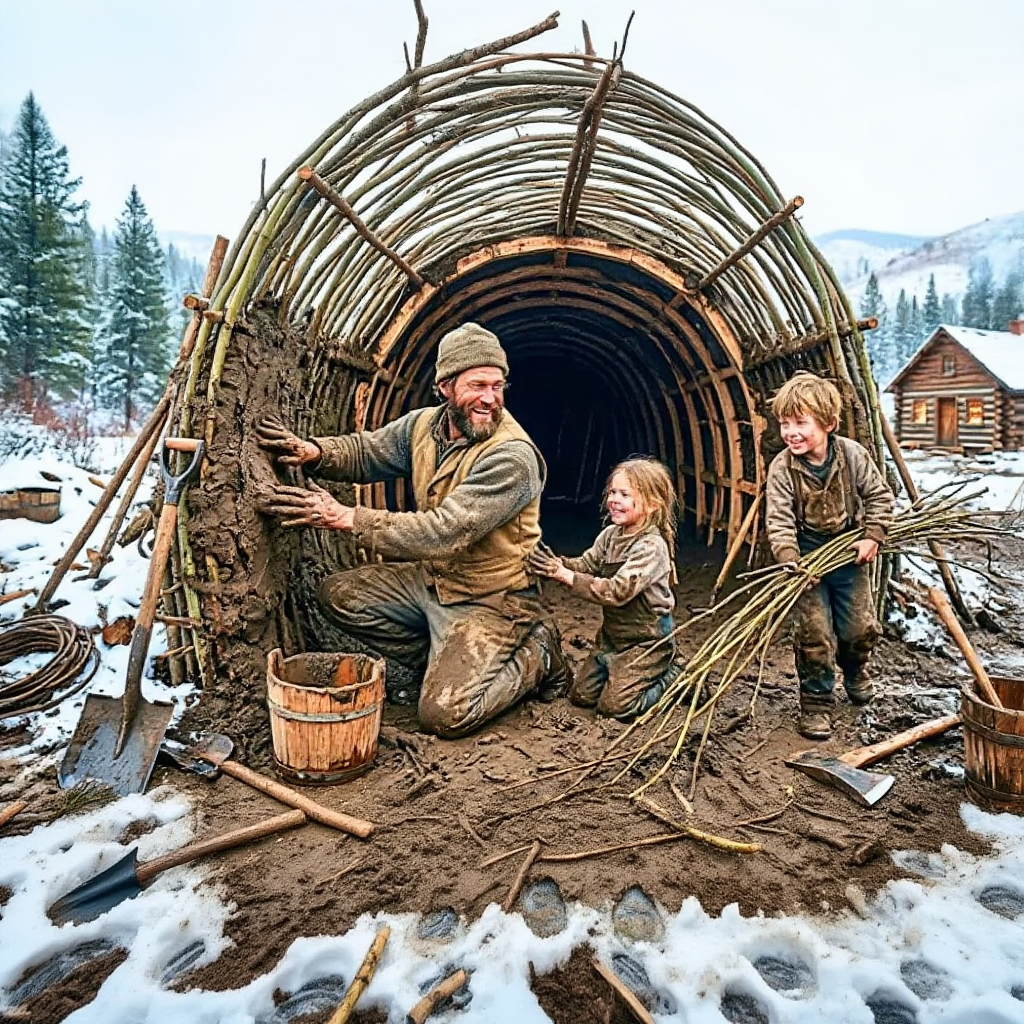
Elias knelt beside a strange arch of saplings, pressing thick clay into a lattice of bent branches.
His wool beanie was damp.
Mud covered his brown vest and his pants from knee to boot.
Beside him, Henry crouched in muddy overalls, patting handfuls of clay onto the lower wall with both hands like he was frosting a cake.
A few feet away, Clara stood holding a bundle of long willow rods against her shoulder.
“Dad,” she asked, “you sure this’ll work?”
Elias pressed another slab of mud into place.
“It worked before houses.”
Clara smirked.
“Before houses, people also died younger.”
Henry laughed.
Elias smiled without looking up.
“Then we’ll improve on history.”
Behind them, snow-covered pines rose toward the gray mountains.
Their cabin sat nearby, smoke curling from its crooked chimney.
And in front of it stood the thing half the town had started calling…
Boone’s rabbit hole.
The tunnel was twenty feet long.
Six feet high.
Woven from green willow, pine saplings, branches, rope, clay, and packed earth.
Curved like the spine of some buried animal.
Inside, Elias layered pine boughs, straw, wool blankets, and hides.
Between the woven walls he packed mud, moss, and leaves for insulation.
At both ends he built narrow entry chambers with heavy flap doors made from canvas and deer hide.
The whole thing looked ridiculous.
Primitive.
Ugly.
And impossible to explain.
Which made it perfect entertainment for the town.
The first to laugh was Earl Patterson, owner of the general store.
Earl stood in front of his porch with a mug of coffee, watching Elias haul branches.
“What’re you building there, Boone?” he called.
Elias kept walking.
“A plan.”
The men on the porch laughed.
Earl grinned.
“Looks more like a grave.”
Another man shouted:
“Or a dog kennel!”
One of them added:
“Big enough for Boone and his cubs.”
Laughter rolled across the street.
Clara’s face reddened.
Henry looked confused.
Elias didn’t slow down.
Didn’t answer.
Didn’t even look at them.
That somehow made them laugh harder.
By November, everyone in Black Hollow knew about the tunnel.
Some drove past just to see it.
Some brought their kids.
Some pointed.
Some laughed.
Some shook their heads.
And every day, Elias kept building.
He cut saplings before dawn.
Dug drainage trenches.
Packed more clay.
Sealed cracks with moss.
Built stone-lined fire pits near both entrances.
Stored split wood inside waterproof caches.
Hung lantern hooks.
Created vents through the roof.
Buried food barrels beneath packed snow.
Every evening, Clara and Henry helped.
Every evening, neighbors laughed.
One afternoon, as Clara carried branches across the yard, a group of boys from town stopped by.
One of them, fourteen-year-old Cole Patterson, Earl’s son, smirked at the tunnel.
“Your dad building you a squirrel nest?”
The boys laughed.
Clara tightened her grip on the branches.
“He’s building something your dad couldn’t.”
Cole grinned.
“Crazy?”
Henry stepped forward.
“My dad ain’t crazy.”
Cole shrugged.
“Then why’s everybody laughing?”
Henry looked down.
And for the first time, Elias spoke.
From twenty feet away.
Without raising his voice.
“Because laughter’s cheaper than preparation.”
Silence followed.
The boys left.
And Henry never forgot that sentence.
December arrived with deceptive kindness.
Clear skies.
Cold nights.
Gentle snow.
Even Earl Patterson admitted maybe winter wouldn’t be so bad.
People relaxed.
Stopped stacking wood.
Delayed repairs.
Put off food runs.
Ignored the old warnings.
Ignored the ravens flying low.
Ignored the pressure drop.
Ignored the way the mountains went quiet.
Elias ignored none of it.
On December nineteenth, he walked the ridge at dawn.
Watched clouds boil over the western peaks.
Felt the sudden wetness in the wind.
And by noon…
He moved everything into the tunnel.
Blankets.
Food.
Lanterns.
Water.
Axes.
Shovels.
Medical supplies.
The children.
Even their dog.
Clara watched him with wide eyes.
“Dad…”
He looked at the horizon.
“When I say inside…”
“Don’t ask questions?”
He nodded.
“Don’t ask questions.”
The storm hit at sunset.
And it didn’t begin like snow.
It began like sound.
A low roar across the mountains.
A distant freight train.
Then the wind came.
Hard enough to bend pines.
Hard enough to rip shutters loose.
Hard enough to make grown men suddenly remember old prayers.
Snow followed sideways.
Not falling.
Flying.
White bullets.
Ice needles.
Visibility dropped to ten feet.
Then five.
Then nothing.
Inside the tunnel, lantern light flickered against curved walls of woven wood and clay.
Henry sat wrapped in blankets beside the dog.
Clara checked the vent holes.
Elias sealed the outer flap.
The structure groaned.
Then settled.
The earth around them absorbed the wind.
The curved walls deflected pressure.
The packed clay held.
The narrow entrances trapped warmth.
Within an hour, the inside temperature stayed above freezing.
Outside…
The world disappeared.
Across Black Hollow…
Things began breaking.
First fences.
Then sheds.
Then roofs.
Then windows.
Snow piled against doors.
Chimneys collapsed.
Generators froze.
Power lines snapped.
Cars vanished beneath drifts.
Cabins built from pride and shortcuts began coming apart.
And for the first time…
No one laughed.
At midnight, Earl Patterson’s roof tore off.
At twelve-thirty, his furnace died.
At one, his back door vanished under seven feet of snow.
At one-fifteen…
He realized his wife couldn’t breathe in the cold.
At one-twenty…
He remembered Boone’s tunnel.
And for the first time in his life…
Earl Patterson was afraid.
Elias heard the pounding through three feet of snow and sixty-mile winds.
A muffled thump.
Then another.
Clara looked up.
“Dad.”
He grabbed a shovel.
Opened the inner flap.
And disappeared into white.
For ten minutes…
Nothing.
Then the outer flap burst open.
Elias stumbled in carrying Earl’s youngest daughter.
Behind him came Earl.
Then his wife.
Then his son Cole.
Then two neighbors.
Frozen.
Bleeding.
Terrified.
Elias shut the flap.
And suddenly…
The tunnel meant life.
Nobody spoke for a full minute.
Steam rose from wet clothes.
Children cried.
Adults shook.
Earl stared at the curved walls.
The clay.
The woven branches.
The warmth.
The lanterns.
The dry wood.
The food.
The impossible shelter.
And his face changed.
From disbelief…
To shame.
He looked at Elias.
“I…”
Elias handed him a blanket.
“Save it.”
By morning, eleven people occupied the tunnel.
By afternoon…
Seventeen.
Elias made room for every one.
Families.
Children.
Old men.
People who laughed.
People who mocked.
People who pointed.
Every one of them.
He made room.
Because winter didn’t care who was right.
Only who was ready.
The blizzard lasted four days.
When the sky finally cleared…
Black Hollow looked like a graveyard of timber and snow.
Roofs gone.
Barns crushed.
Power poles snapped.
Vehicles buried.
Cabins split open like rotten fruit.
Almost everything above ground…
Had lost.
Except one structure.
Half buried in snow.
Curved.
Mud-covered.
Woven from branches.
Still standing.
When rescue teams from Bozeman arrived three days later, they found seventeen survivors emerging from what one man called…
“A giant basket.”
But the townspeople called it something else.
Not Boone’s rabbit hole.
Not Boone’s grave.
Not Boone’s madness.
They called it…
Boone’s ark.
Spring came slowly.
Snow melted.
Roads opened.
Roofs were rebuilt.
Lives restarted.
And in the center of town, Earl Patterson nailed a wooden sign outside his store.
It read:
WHEN ELIAS BOONE BUILDS SOMETHING—WATCH, DON’T LAUGH.
And every child in Black Hollow learned what their parents had learned too late:
The world often mocks the man preparing for the storm…
Because comfort has never understood survival.