
They Left Him a $10 Garage in the Will — Inside Was Something Priceless
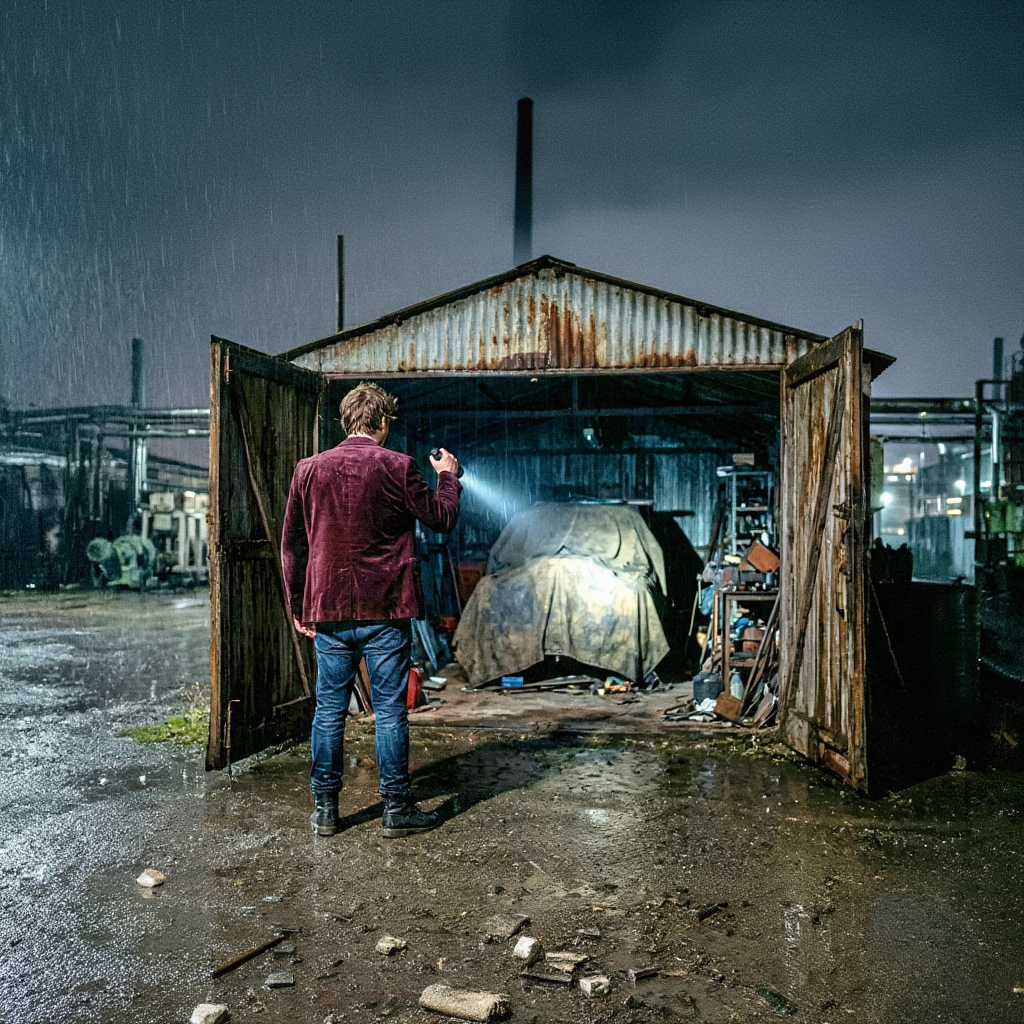
Rain fell in thin silver lines, slicing through the yellow glow of the distant streetlights. The industrial district of Millhaven looked abandoned after midnight—only the skeletons of factories remained, their smokestacks rising like silent witnesses against a low, bruised sky. Puddles spread across cracked asphalt, reflecting rusted pipes and broken fences.
Daniel Carter stood alone in the rain.
His maroon velvet blazer—an odd choice for a place like this—was already darkened with water. He didn’t move. In his hand, a flashlight trembled slightly, its beam cutting across the open mouth of a small corrugated metal garage. The doors hung crooked on their hinges. Rust streaked down like dried tears.
This was it.
Garage 117.
Worth ten dollars.
That’s what the lawyer had said.
He could still hear the quiet, apologetic voice from earlier that afternoon.
“Your uncle left you… one asset, Mr. Carter. A storage garage. Valued at ten dollars. You may decline it if you wish.”
Daniel had almost laughed.
Uncle Walter had always been strange. Not poor—just detached from everything. He lived alone, rarely called, never visited family gatherings. The last time Daniel had seen him was at his grandmother’s funeral fifteen years ago. Walter had handed him a small pocketknife and said, “You’ll need this someday,” then walked away.
That was the entire memory.
And now he’d inherited a ten-dollar garage.
The rain intensified, drumming on the metal roof above. Daniel stepped forward, boots splashing through shallow puddles. He raised the flashlight and aimed it inside.
The beam revealed a shape beneath a dirty tarp.
A car.
Dust, oil stains, scattered wrenches, old tires stacked in the corner. Nothing valuable. Nothing special. Exactly what you’d expect from a forgotten industrial storage space.
He almost turned around.
Almost.
But something stopped him.
The car wasn’t just covered — it was carefully covered. The tarp had been tucked in tightly, not tossed casually. The tools nearby were organized. A metal workbench had drawers labeled in faded handwriting: SOCKETS, SPARK, CARB.
Someone had cared about this place.
Daniel stepped inside. The smell hit him first — oil, rust, and something faintly sweet… like old leather.
He reached out and grabbed the tarp.
For a moment, he hesitated.
Then he pulled.
The fabric slid off in one heavy motion, dust bursting into the flashlight beam like smoke.
And beneath it—
A car.
Low. Long. Elegant.
Even under grime, the lines were unmistakable.
Daniel blinked.
“No way…”
He wiped the hood with his sleeve. A deep metallic silver shimmered through the dirt.
He leaned closer.
The emblem came into view.
A prancing horse.
His breath caught.
“Ferrari…?”
The flashlight shook in his hand.
The badge read: 1962 Ferrari 250 GTE.
He staggered back.
That couldn’t be right. Cars like that didn’t sit in ten-dollar garages. Cars like that didn’t get left in wills without explanation. Cars like that were worth—
He didn’t even want to guess.
Daniel circled it slowly. Tires flat but intact. Chrome slightly pitted. No visible damage. The interior, when he opened the door, smelled of aged leather and time. The dashboard was pristine. Manual stick. Original gauges.
And on the passenger seat…
A brown envelope.
His name written in careful block letters.
Daniel.
He stared at it for a long moment before picking it up. The paper felt brittle, like it had waited decades.
He opened it.
Inside was a folded letter.
He shined the flashlight and began to read.
—
Daniel,
If you’re reading this, I’m gone. And if you came here, it means you didn’t refuse the garage. That already tells me something about you.
You always looked closer than the others.
This car belonged to your grandfather.
He bought it in 1963 after returning from Italy. He told no one. Said it was “too much joy for a practical family.” Your grandmother made him sell it two years later when money got tight.
He never did.
He asked me to hide it.
I’ve kept it for forty years.
He wanted it to go to someone who wouldn’t sell it right away. Someone curious. Someone quiet.
That was you.
There’s more.
Check the trunk.
— Walter
—
Daniel lowered the letter slowly.
Rain hammered the roof harder now, echoing like applause.
He swallowed.
The trunk.
He moved to the back of the Ferrari. The latch clicked open with surprising ease. The trunk lifted.
Inside—
A wooden case.
Polished. Locked.
And beside it… an old photograph.
He picked it up first.
A younger Walter stood beside a smiling man Daniel immediately recognized — his grandfather. They leaned against the same Ferrari, sunlight bright behind them. The license plate matched.
The photo was dated 1964.
Daniel turned to the wooden case.
The lock wasn’t secure — just a simple clasp. He opened it.
Inside lay three items.
A leather-bound journal.
A folded document.
And a small velvet pouch.
He opened the pouch first.
A gold watch.
Heavy. Beautiful. The back engraved:
“To Henry Carter — Drive fast, live slow.”
His grandfather’s name.
Daniel’s throat tightened.
He opened the journal.
Pages filled with handwriting. Trips across California. Notes about engine tuning. Sketches of roads. Stories about driving through desert nights and coastal mornings.
And taped to the inside cover—
A note:
“One day, this belongs to Daniel. He listens more than he speaks.”
Daniel stopped breathing.
His grandfather had written that.
Decades ago.
Before Daniel was even born.
His hands trembled as he unfolded the document.
It was a title.
Ownership papers.
Not just for the Ferrari.
But for a second vehicle listed below.
1963 Shelby Cobra — stored offsite.
Daniel blinked.
“What…?”
He flipped the page.
An address.
Another garage.
Another inheritance.
Walter hadn’t just left him one car.
He’d left him a secret.
A legacy hidden from the entire family.
Daniel leaned against the Ferrari, overwhelmed. Rainwater dripped from his hair onto the hood. The flashlight beam flickered slightly.
He looked around the small garage.
Ten dollars.
That’s what everyone thought it was worth.
He imagined his cousins laughing when the will was read. The polite sympathy. The quiet assumption he’d gotten nothing.
But Walter hadn’t left him nothing.
He’d left him trust.
He’d left him history.
He’d left him something priceless.
Daniel slid into the driver’s seat.
The leather creaked softly. The wheel felt solid, alive.
He didn’t try to start it — not yet. That would come later. Restoration. Patience. Learning. Doing it right.
He sat in silence.
Then he noticed something else.
Taped beneath the steering wheel.
Another small note.
He peeled it carefully.
It read:
“You don’t inherit things. You inherit stories. Don’t sell this one.”
Daniel smiled for the first time that night.
Outside, rain washed the factory roofs and rusted fences. The puddles reflected the garage light like shattered mirrors. The world felt quieter.
He folded the notes carefully and placed them back in the envelope.
Then he stepped out, closed the Ferrari door, and pulled the tarp gently over it again — not hiding it, just protecting it.
He shut off the flashlight.
For a moment, darkness swallowed everything.
Then he stepped back into the rain.
Garage 117 stood behind him, small and forgotten to everyone else.
But not anymore.
He looked up at the smokestacks silhouetted against the storm.
Tomorrow, he’d return with tools. Tow equipment. Oil. A mechanic friend. He’d restore it piece by piece. He’d find the second garage. He’d uncover everything Walter had protected for decades.
But tonight—
He just stood there.
Listening to rain.
Holding the envelope.
Knowing that a ten-dollar garage had changed his life.
As he walked away, lightning flashed briefly across the industrial skyline. For a split second, the open garage illuminated behind him — the shape of the Ferrari faintly visible under the tarp.
Then darkness again.
Somewhere in the city, a train horn echoed.
Daniel smiled.
For the first time since the funeral, he didn’t feel like he’d lost family.
He felt like he’d just met them.