
STORY
By the time Clara Whitmore realized the wagon was not coming back for her, the first snow had already begun to fall.
She stood beneath the enormous sandstone overhang with one hand wrapped around the handle of her battered trunk and watched the wagon disappear between the pines.
“Wait!”
Her voice carried across the frozen slope.
The driver never turned around.
Neither did Clara’s brother-in-law.
For several seconds she simply stared after them.
Then the wind swept through the valley and erased the wagon tracks almost as quickly as they had been made.
Clara pulled her wool shawl tighter.
“So that’s how it is,” she whispered.
At thirty-eight, widowed for two years and with barely fourteen dollars left to her name, Clara had become what her late husband’s family politely called a burden.
They had sold the little house she had shared with Thomas.
They had divided his cattle.
And that morning, Silas Whitmore had driven her six miles into the mountains after telling her there was an abandoned trapping cabin where she might stay until spring.
There was no cabin.
There was only the cave.
Clara turned toward it.
The sandstone opening was enormous, perhaps forty feet across, protected by a natural shelf of rock. Farther inside, darkness swallowed everything.
Anyone else might have cried.
Clara smiled faintly.
Because she noticed something Silas had not.
There was no snow beneath the overhang.
Not even along the inner wall.
She stepped inside.
The wind immediately weakened.
Clara held out her hand.
Almost nothing.
“Well,” she murmured, “perhaps you aren’t as useless as you look.”
She spent her first night wrapped in blankets beside a tiny fire.
By morning she had made a decision.
She would not leave.
Over the next three days, Clara explored every corner of the cavern.
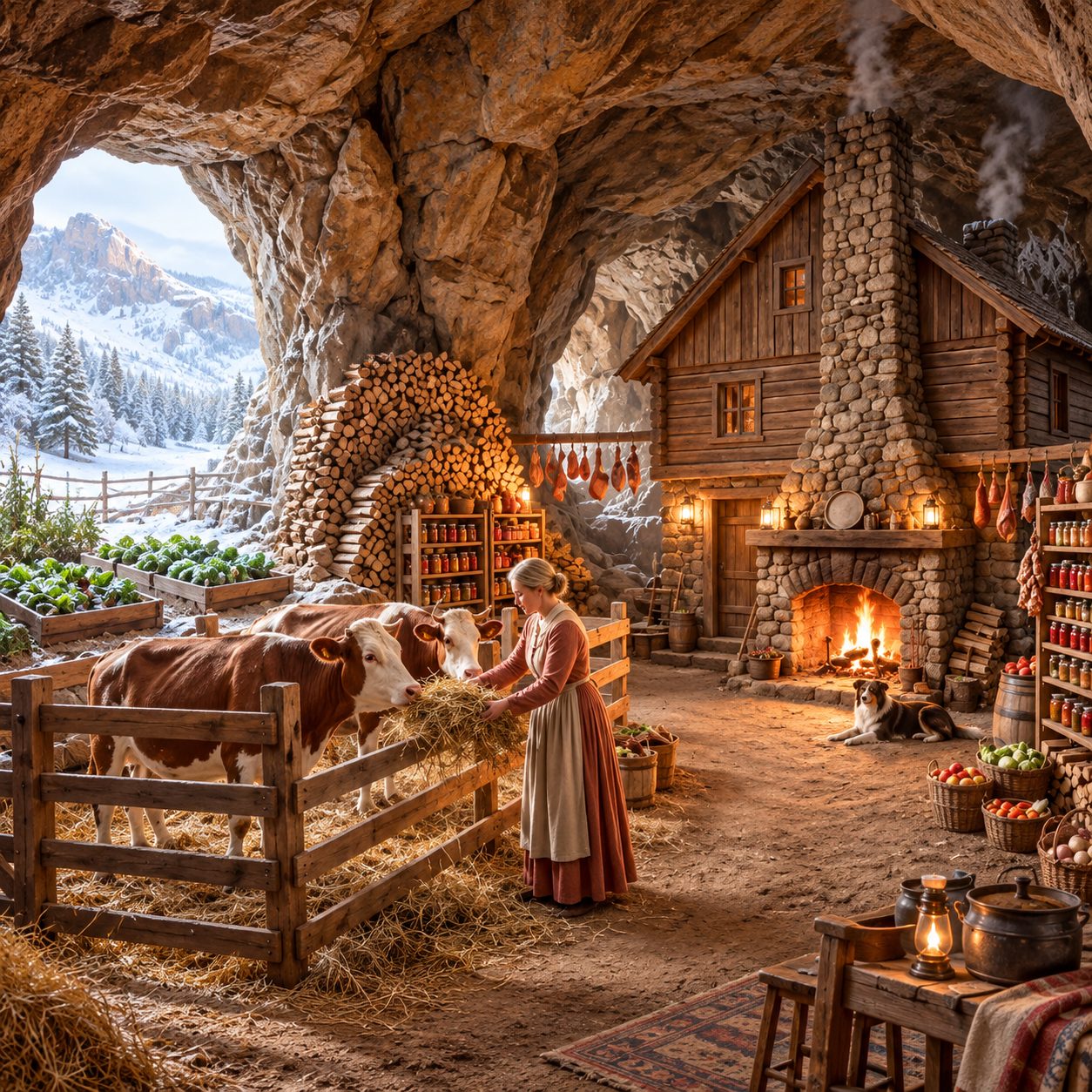
Thirty yards inside, she discovered a smaller chamber protected from nearly every direction. The sandstone ceiling rose high enough that smoke could escape through a natural crack.
There was also an old stone chimney.
Clara stared at it.
Someone had lived here before.
Behind a pile of fallen boards she found the remains of a cabin wall.
That changed everything.
She walked into town and spent nearly all her money on nails, lamp oil, salt, flour, and a used hatchet.
The storekeeper, Amos Bell, looked at her purchases.
“Where are you staying?”
“Up in the sandstone cave.”
He stopped counting coins.
“The big one above Miller Creek?”
“Yes.”
Amos frowned.
“Mrs. Whitmore, that’s no place for a woman alone.”
“It appears to be exactly the place for one.”
The men beside the stove laughed.
One called out, “Better buy yourself a coffin while you’re here!”
Clara looked at him.
“Would you deliver it?”
The laughter stopped.
Amos tried not to smile.
That afternoon, Clara dragged abandoned timber from an old sheep pen into the cavern.
She repaired the small cabin structure.
Then she rebuilt the fireplace.
She stacked stones around its base, packed the gaps with clay, and extended the chimney toward the crack in the ceiling.
Within two weeks she had something resembling a home.
Within a month, she had something better.
Clara noticed the sandstone held warmth.
When she kept the fireplace burning through the evening, the cave remained surprisingly mild long after the flames died.
So she began collecting stone.
She built a second wall behind the fireplace.
Then another beside the sleeping area.
The stones absorbed heat all day and released it slowly through the night.
“Crazy Clara,” people began calling her.
She heard it whenever she visited town.
She didn’t care.
Instead, she prepared.
She traded sewing work for potatoes.
She helped Amos inventory his store in exchange for sacks of beans and flour.
A rancher named Henry Cole offered her an old milk cow nobody wanted because she produced little.
Clara walked the animal six miles uphill.
Then Henry offered another.
By November, Clara had two cows living behind a sturdy wooden rail inside the outer chamber of the cave.
Their body heat warmed the cavern further.
She stored hay against the northern stone wall.
Firewood went beside the cabin.
Vegetables went into wooden boxes near the cave entrance, where the air remained cool.
Salted meat hung from beams.
Jars lined shelves.
People laughed harder than ever.
“Building Noah’s ark in a mountain?” Silas asked when he finally came to see what she was doing.
Clara continued stacking firewood.
“You should try preparing for winter.”
“I own a proper house.”
“So did I.”
Silas’s expression hardened.
“You’ll come crawling back by Christmas.”
Clara looked at him.
“No, Silas.”
She placed another log onto the pile.
“I don’t believe I will.”
December arrived quietly.
Then the temperature dropped.
Snow began falling on a Thursday morning.
At first nobody worried.
By afternoon, the road disappeared.
By midnight, the wind sounded like a freight train roaring through the mountains.
Clara woke to hear branches snapping outside.
She added wood to the fire.
Her dog, Jasper, raised his head.
“It’s all right,” she whispered.
The cows shifted behind their fence.
Inside the cavern, the temperature remained comfortable.
Outside, the storm grew worse.
By the second day, snow reached the lower branches of the pines.
By the third, Clara could barely see daylight beyond the cave entrance.
Then Jasper started barking.
Clara froze.
“What is it?”
The dog raced toward the entrance.
She followed with a lantern.
At first she saw nothing.
Then something moved in the snow.
A man.
Clara grabbed a rope and fought her way outside.
It was Amos Bell.
His beard was crusted with ice.
Behind him came his wife and their twelve-year-old daughter.
“Our roof collapsed,” Amos gasped.
Clara pulled them inside.
Mrs. Bell stared around the cavern.
Firelight danced across the sandstone walls.
The cows stood quietly in their pen.
Shelves were packed with food.
Firewood towered against the wall.
Steam rose from a pot hanging over the fire.
“My God,” she whispered.
Clara handed her a blanket.
“Sit down.”
That evening, four more people arrived.
The following morning brought seven.
One had frostbite.
Another carried a baby wrapped beneath his coat.
Clara moved everyone deeper into the cave.
“There isn’t enough room,” Amos warned.
“There is.”
She opened the old wooden cabin.
“Children sleep inside. Adults near the fireplace. Keep the outer chamber for animals.”
The storm continued.
On the fifth night, nearly twenty people were sheltering inside Clara’s cave.
Nobody laughed anymore.
They watched the sandstone walls hold back the wind.
They watched the fireplace warm the enormous mass of stone.
They watched Clara ration beans, potatoes, dried meat, and milk.
Then someone appeared at the entrance.
Silas.
His face was nearly blue.
His coat was torn.
Clara stared at him.
For a moment neither spoke.
“Our chimney came down,” he finally said.
Clara waited.
“The house filled with smoke. Then part of the roof collapsed.”
Behind him stood his wife and two boys.
Silas lowered his eyes.
“I didn’t know where else to go.”
The cave became silent.
Everyone remembered how he had abandoned Clara there.
Clara remembered too.
She could have closed the gate.
She could have reminded him of every cruel word.
Instead she stepped aside.
“Bring the children to the fire.”
Silas looked at her.
“Clara—”
“Now.”
His wife began crying.
Clara took the younger boy by the hand.
That night, forty-one people slept inside the sandstone refuge.
Outside, the temperature plunged below zero.
The wind buried fences.
Barn roofs collapsed.
Livestock froze.
But inside Clara’s cavern, the great fireplace burned steadily.
The sandstone radiated warmth.
The cows provided milk.
Her shelves provided food.
And the firewood she had spent months stacking lasted.
On the seventh morning, Amos stood beside Clara near the entrance.
Snow completely covered the road.
“How long can we stay?”
Clara looked at her supplies.
“Three weeks.”
Amos stared at her.
“You planned for three weeks?”
“Four, actually.”
He laughed softly.
“All those months we thought you were losing your mind.”
Clara looked toward the sleeping families.
“I know.”
Amos became serious.
“We would’ve died.”
Before Clara could answer, a strange sound came from outside.
A deep crack.
Then another.
Everyone turned.
“Clara,” Silas whispered.
The mountainside moved.
An enormous sheet of snow broke loose above the valley.
“Avalanche!”
People screamed.
Clara shouted, “Back! Everybody back!”
They rushed deeper into the cavern.
Seconds later the avalanche thundered past the entrance.
The earth shook.
Lanterns swung violently.
Children cried.
Then everything stopped.
Silence.
Clara waited.
Ten seconds.
Twenty.
A minute.
The fireplace was still burning.
The sandstone walls had not moved.
Amos slowly stood.
“Is everyone all right?”
Voices answered from the darkness.
Yes.
Yes.
Yes.
Clara walked toward the entrance.
Snow had partially blocked it, but the great rock overhang had diverted most of the avalanche around them.
Silas came beside her.
He stared outside.
Then he said something Clara never expected.
“You knew.”
She shook her head.
“No.”
“You knew this place was safer.”
“I suspected.”
Silas looked around.
At the stone walls.
At the enormous stack of firewood.
At the livestock.
At the shelves.
At forty frightened people who were still alive.
His voice broke.
“I left you here to die.”
Clara said nothing.
“I thought you’d last two nights.”
Still she said nothing.
Finally Silas whispered, “Why did you let me in?”
Clara looked at his two sons sleeping beside the fireplace.
“Because they didn’t leave me here.”
Silas lowered his head.
For the first time since Clara had known him, he had no answer.
The storm lasted eleven days.
When the sky finally cleared, the valley looked unfamiliar.
Roofs had vanished beneath snow.
Barns had collapsed.
Roads were buried.
But smoke still curled from Clara’s chimney.
Rescue crews reached them two days later.
They expected casualties.
Instead, forty-one people walked out.
A newspaper reporter arrived the following week.
He asked Clara how she had transformed an abandoned cave into a refuge capable of surviving the worst storm the region had seen in decades.
She shrugged.
“I paid attention to what the mountain was telling me.”
The reporter smiled.
“And what was that?”
“That stone remembers heat better than people remember kindness.”
The quote appeared in newspapers across the state.
By spring, nobody called her Crazy Clara anymore.
Neighbors helped build stronger livestock pens inside the outer cavern.
Amos donated lumber.
Henry brought another cow.
Even Silas returned.
He carried tools instead of insults.
“I’d like to repair your roof,” he said.
Clara studied him.
“My roof is several million tons of sandstone.”
“The cabin roof.”
“Oh.”
A tiny smile appeared.
“That could use some work.”
Silas nodded.
Then he hesitated.
“Clara?”
“Yes?”
“I am sorry.”
She looked at him for a long moment.
“I know.”
She did not say she had forgotten.
She had not.
Forgiveness, Clara had learned, did not require pretending something never happened.
Sometimes it simply meant refusing to become as cold as the people who had hurt you.
Years later, travelers still stopped to see the unusual homestead beneath the sandstone cliff.
They saw the wooden cabin tucked beneath the enormous ceiling.
They saw shelves of preserves.
Stacks of firewood.
Cattle resting behind wooden rails.
And the great stone fireplace glowing orange against walls older than memory.
Above its mantel hung a small wooden sign Amos had carved for Clara.
It contained only four words:
THERE IS ROOM HERE.
And whenever winter winds began roaring down from the mountains, Clara added another log to the fire.
Not because she feared the storm anymore.
But because somewhere beyond that cave, someone might still be searching for a warm place to survive.