
They Banished a 15-Year-Old Girl for Warning About Winter — But Her Cabin Was the Only One Still Standing
The first time Eliza Carter spoke, no one listened.
She stood at the edge of the town square, her boots dusted with early frost, her hands clenched tight at her sides as the wind cut through her thin coat. The adults gathered near the general store barely spared her a glance.
Why would they?
She was fifteen.
Orphaned.
Quiet most days—until she wasn’t.
“The winter’s coming early,” she said, her voice sharper than usual, carrying farther than she expected. “And it’s going to be worse than anything we’ve seen.”
A few heads turned.
Not with concern.
With amusement.
Old Mr. Hargrove chuckled, leaning back in his chair. “And how would you know that, girl? You talk to the wind now?”
A ripple of laughter spread through the small crowd.
Eliza didn’t flinch.
“Yes,” she said simply.
That made them laugh harder.
But she wasn’t joking.
She had grown up watching the land the way other children watched people. She noticed the way birds flew lower this year. How the deer moved earlier, restless, heading south sooner than they should. The air itself felt different—thinner, colder even when the sun was high.
And the sky…
The sky had been wrong for weeks.
“You need to start reinforcing your homes,” she continued, louder now. “Stock more wood. Seal your roofs. If you don’t—”
“That’s enough.”
The voice cut through the air like a blade.
Sheriff Dalton stepped forward, his expression hard.
“You’ve been stirring up fear all week,” he said. “People don’t need that.”
“I’m not stirring fear,” Eliza shot back. “I’m telling the truth.”
“And you expect us to take advice from a child?”
Eliza met his gaze.
“I expect you to survive,” she said.
That did it.
The laughter died, replaced by something colder.
Not fear.
Offense.
Because she wasn’t asking anymore.
She was warning them.
And people didn’t like being told they were wrong—especially not by someone like her.
—
They voted that evening.
Not formally.
But enough voices spoke, enough heads nodded, and by nightfall, the decision was made.
Eliza Carter was to leave town.
“She’s causing panic,” someone said.
“She’s disrespectful,” said another.
“She’s cursed,” whispered a third.
Eliza stood there, listening to it all, her chest tight but her face steady.
No one asked her where she would go.
No one offered help.
Not even Mrs. Greene, who had once given her bread when she was younger.
The sheriff approached her last.
“You’ve got until sunrise,” he said.
Eliza swallowed hard.
“Fine,” she replied.
She didn’t beg.
Didn’t argue.
Because deep down…
She already knew this would happen.
—
She left before dawn.
The world was quiet, frost clinging to every surface, the sky pale and distant.
Eliza carried what little she had—a small pack, a worn blanket, a hatchet, and the knowledge she had spent years gathering.
She didn’t look back.
Not once.
—
The place she chose wasn’t random.
It sat deeper into the hills, where the land curved slightly, protected from the worst of the wind. There were trees nearby—strong, dense ones—and a narrow stream that hadn’t frozen over yet.
Most people would’ve called it inconvenient.
Too far.
Too isolated.
But Eliza saw something else.
Shelter.
She worked without stopping.
Day after day.
Her hands blistered, then hardened. Her body ached, but she ignored it.
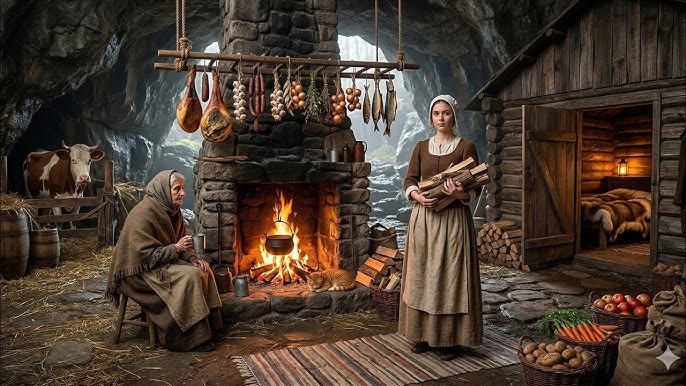
She built her cabin low—lower than most would think to. Not tall and proud like the ones in town, but compact, reinforced.
She packed mud between the logs. Layered the roof thick with branches and earth. Dug a shallow trench around the base to guide melting snow away.
She didn’t build for comfort.
She built to survive.
And when the first real snow fell…
She was ready.
—
Back in town, they weren’t.
At first, everything seemed fine.
The snowfall was heavier than usual, but nothing they hadn’t seen before. People went about their routines, laughing off the early warnings.
“Just a cold season,” they said.
“Nothing more.”
But the cold didn’t stop.
It deepened.
Day by day.
Week by week.
The wind grew vicious, tearing at roofs, forcing its way through cracks no one thought to seal. Snow piled higher than anyone could remember, burying paths, isolating homes.
Supplies ran low faster than expected.
Wood burned quicker.
Food dwindled.
And then the real storms came.
Not one.
Not two.
But a relentless series of blizzards that battered the town without mercy.
Roofs collapsed.
Walls cracked.
Entire homes gave in to the weight of snow and wind.
Fear spread like wildfire.
Because now…
It wasn’t just winter.
It was survival.
—
It was during the third storm that someone said her name again.
“Eliza.”
The room fell silent.
“She warned us,” Mrs. Greene whispered, her face pale.
No one laughed this time.
Sheriff Dalton stared into the fire, his jaw tight.
“…We should’ve listened.”
But regret didn’t fix broken homes.
It didn’t bring back lost supplies.
And it didn’t stop the storm outside.
—
Out in the hills, Eliza Carter sat by her fire, wrapped in a thick blanket, listening to the wind slam against her cabin.
The walls held.
The roof didn’t budge.
Every crack she had sealed, every layer she had reinforced—it all worked exactly as she had planned.
She wasn’t comfortable.
But she was safe.
And that was enough.
Still…
She thought about the town.
About the people who had cast her out.
She wondered if they were alright.
Then she shook her head, pushing the thought away.
“They made their choice,” she murmured.
But the words didn’t sit right.
—
The knock came late at night.
Soft.
Barely there.
Eliza froze.
For a moment, she thought she imagined it.
Then it came again.
She grabbed her hatchet, moving carefully toward the door.
“Who’s there?” she called.
A weak voice answered.
“…Please.”
Eliza opened the door.
The wind howled in instantly—but through it, she saw them.
Three figures.
Half-buried in snow.
Barely standing.
From the town.
Her heart twisted.
For a split second, she hesitated.
They had sent her away.
Left her alone.
Treated her like she didn’t matter.
But now…
They were here.
Desperate.
Freezing.
And without help…
They wouldn’t make it through the night.
Eliza stepped aside.
“Get in,” she said.
—
Word spread quickly.
Not by voice—but by survival.
Those who could still travel began making their way toward the hills.
Toward the only place that still stood.
Eliza’s cabin.
At first, it was just a few.
Then more.
Each arrival weaker than the last.
Each one carrying the same look—fear, regret, and something else.
Humility.
They didn’t question her anymore.
Didn’t mock her.
They followed her instructions without hesitation.
Reinforce the walls.
Pack the gaps.
Conserve the fire.
Share the food.
And slowly…
The small cabin became something more.
Not just shelter.
A refuge.
—
Sheriff Dalton arrived last.
Alone.
Exhausted.
He stood at the doorway, unable to meet her eyes.
For a long moment, neither of them spoke.
Then, quietly, he said:
“I was wrong.”
Eliza studied him.
The man who had sent her away.
Who had dismissed her.
Who had chosen the town over truth.
Now standing there, humbled by the very storm she had warned about.
She could’ve turned him away.
Part of her wanted to.
But instead…
She stepped back.
“There’s space,” she said.
It wasn’t forgiveness.
Not yet.
But it was something.
—
The winter didn’t break easily.
It dragged on, testing them all.
But the cabin held.
Because it had been built with care.
With knowledge.
With respect for the land—not arrogance against it.
And in time…
The storms passed.
The snow melted.
The sky cleared.
Spring returned.
—
When they finally stepped outside, the world looked different.
Quieter.
Humbled.
The town…
What was left of it…
Told the story clearly.
Collapsed roofs.
Broken walls.
Empty homes.
But the cabin in the hills still stood.
Solid.
Unshaken.
—
They didn’t call her a foolish girl anymore.
They didn’t laugh when she spoke.
They listened.
Because they had seen what happened when they didn’t.
Eliza Carter, once cast out for telling the truth, became the one they turned to.
Not because she demanded it.
But because she had earned it.
Through hardship.
Through survival.
Through standing alone when no one else would.
—
One evening, as the sun dipped low over the recovering land, Eliza stood outside her cabin, watching the wind move gently through the trees.
Behind her, voices carried softly—people rebuilding, working together.
Something new.
Something better.
The sheriff approached, slower this time.
Respectfully.
“You could’ve left us,” he said.
Eliza didn’t turn.
“Maybe,” she replied.
“But you didn’t.”
She looked out at the horizon.
“No,” she said quietly. “I didn’t.”
Because in the end…
Survival wasn’t just about enduring the storm.
It was about choosing who you became after it passed.
And Eliza Carter chose to be the one who stayed—
Even when they didn’t deserve it.
They Banished a 15-Year-Old Girl for Warning About Winter — But Her Cabin Was the Only One Still Standing
Part 2
Spring didn’t fix everything.
It revealed it.
As the snow melted away, it uncovered the truth the storm had buried—splintered beams, collapsed roofs, frozen livestock, and empty homes that would never be filled again.
The town wasn’t just damaged.
It was broken.
And for the first time, no one pretended otherwise.
—
Eliza Carter stood at the edge of what used to be Main Street, her boots sinking slightly into the thawing mud. The wind had softened, carrying the scent of wet earth instead of ice, but the quiet that followed the winter felt heavier than any storm.
People moved slower now.
Spoke softer.
Laughed less.
They had survived—but survival had changed them.
Behind her, footsteps approached carefully.
“Eliza.”
She turned.
Mrs. Greene stood there, wringing her hands, her face thinner than before, her eyes tired but steady.
“I… I wanted to thank you,” the older woman said. “For taking us in. For… not turning us away.”
Eliza studied her for a moment.
This was the same woman who had once looked away when the town cast her out.
The same one who said nothing.
Now her voice trembled.
“I didn’t do it for thanks,” Eliza replied.
Mrs. Greene nodded quickly.
“I know. That’s what makes it matter more.”
Eliza didn’t answer.
Because she didn’t know what to do with gratitude that came too late.
—
They began rebuilding a week later.
Not the way they had before.
Not carelessly.
Not quickly.
This time, they asked Eliza first.
“Where should we build?”
“How should we reinforce the roofs?”
“What do we need to prepare for next winter?”
At first, it felt strange.
Hearing grown men and women—people who once dismissed her—wait for her answer before making a move.
She almost said nothing.
Almost walked away.
But then she looked at the ruins around her.
And remembered the storm.
“We build lower,” she said finally. “Closer to the ground.”
They listened.
“We double the wood on the north walls. That’s where the wind hits hardest.”
They nodded.
“We stock twice as much as we think we need. And then a little more.”
No one argued.
Because they had learned what it cost not to.
—
The cabin in the hills remained the center.
Not just physically.
But in spirit.
People gathered there to plan, to share, to rest.
It wasn’t just Eliza’s home anymore.
It was a reminder.
Of what had saved them.
Of who had saved them.
—
But not everyone changed.
One afternoon, as the rebuilding continued, Eliza overheard voices near the edge of town.
“She got lucky,” a man muttered. “That’s all it was.”
Eliza didn’t stop walking.
But she listened.
“A lucky guess,” another added. “Doesn’t make her some kind of leader.”
Something in her chest tightened.
Not anger.
Not exactly.
Just… something old.
Familiar.
The feeling of being unseen.
Misunderstood.
She kept walking.
But that night, sitting alone outside her cabin, she stared into the fading light longer than usual.
Maybe they were right.
Maybe it had just been luck.
Maybe next time, she’d be wrong.
And if she was…
People would pay for it again.
The thought sat heavy on her shoulders.
—
“You are thinking too much.”
The voice came from behind her.
Eliza didn’t turn.
“I do that sometimes.”
Sheriff Dalton stepped closer, stopping a few feet away.
He didn’t stand like he used to—rigid, authoritative.
Now, there was something quieter about him.
Measured.
Careful.
“They’re talking again,” Eliza said.
He didn’t pretend not to understand.
“Some of them, yes.”
“They think I just got lucky.”
Dalton was silent for a moment.
Then he said, “They’re afraid.”
Eliza finally looked at him.
“Of me?”
“Of being wrong again.”
That made her pause.
“They trusted what they knew before,” he continued. “And it nearly killed them. Now… they don’t know what to trust.”
Eliza frowned slightly.
“That’s not my fault.”
“No,” Dalton agreed. “But it is your burden now.”
She let out a quiet breath.
“I didn’t ask for that.”
“I know.”
A long silence stretched between them.
Then Dalton added, softer:
“But you’re carrying it anyway.”
—
Days turned into weeks.
The town slowly began to take shape again.
Stronger this time.
Smarter.
More careful.
And Eliza…
Eliza found herself in a place she had never expected.
Not outside.
Not alone.
But at the center.
People came to her with questions.
With concerns.
Even with disagreements—but now, they listened when she answered.
Still…
Something felt unfinished.
—
It came to a head the day the argument broke out.
Two men stood in the middle of town, voices raised, tempers flaring.
“We should expand further south,” one insisted. “More space, better land.”
“And leave ourselves exposed again?” the other snapped. “Did you learn nothing from the last storm?”
Eliza watched from a distance.
The crowd grew.
Voices layered over voices.
Tension rising.
The same kind of tension that had once turned against her.
Only now…
They turned toward her for the answer.
“Eliza,” someone called. “What do you think?”
The noise quieted.
All eyes on her.
Waiting.
She stepped forward slowly, her heart beating harder than she expected.
This was different.
Before, she had nothing to lose.
Now…
If she was wrong, it wouldn’t just be her.
It would be all of them.
She looked at the land.
The wind.
The sky.
The same way she always had.
Then she spoke.
“We expand,” she said.
A murmur rippled through the crowd.
“But not south,” she added. “West. The hills break the wind there. It’s safer.”
The two men exchanged glances.
“And if you’re wrong?” one of them asked.
The question hung in the air.
Heavy.
Real.
Eliza met his gaze.
“Then we adjust,” she said calmly. “We don’t ignore it. We don’t pretend it’s fine. We fix it.”
Silence.
Then…
A nod.
Not just from him.
From others too.
Because that was the difference now.
It wasn’t about being perfect.
It was about being willing to learn.
—
That night, Eliza stood outside her cabin again.
But this time, she wasn’t alone.
Footsteps approached—lighter this time.
Mrs. Greene.
Then Dalton.
Then others.
They didn’t speak right away.
They just stood beside her, looking out at the land they were rebuilding together.
Finally, Mrs. Greene said softly:
“You didn’t just save us from the storm.”
Eliza glanced at her.
“You changed us.”
Eliza shook her head slightly.
“No,” she said. “The storm did that.”
Dalton gave a small smile.
“Maybe,” he said. “But you made sure we survived it.”
—
Summer came.
Warm.
Steady.
Alive.
The new town stood stronger than the last.
Not bigger.
Not grander.
But wiser.
And at its heart was a girl who had once been cast out for speaking the truth.
Now, when Eliza Carter spoke…
People didn’t laugh.
They listened.
Not because she demanded it.
But because she had proven something far more powerful than words.
She had proven she would stand firm—
Even when everyone else turned away.
—
One evening, as the sun dipped low once more, Eliza sat on the steps of her cabin, watching the golden light stretch across the land.
She thought about the girl she had been.
Standing alone in the square.
Unheard.
Unwanted.
And she realized something.
That girl hadn’t disappeared.
She had just grown stronger.
Because sometimes…
The ones who are pushed out first—
Are the ones who learn how to stand when everything else falls.