
“Take My Children!” She Sobbed — Until The Cowboy Said, “You’re All Coming With Me.”
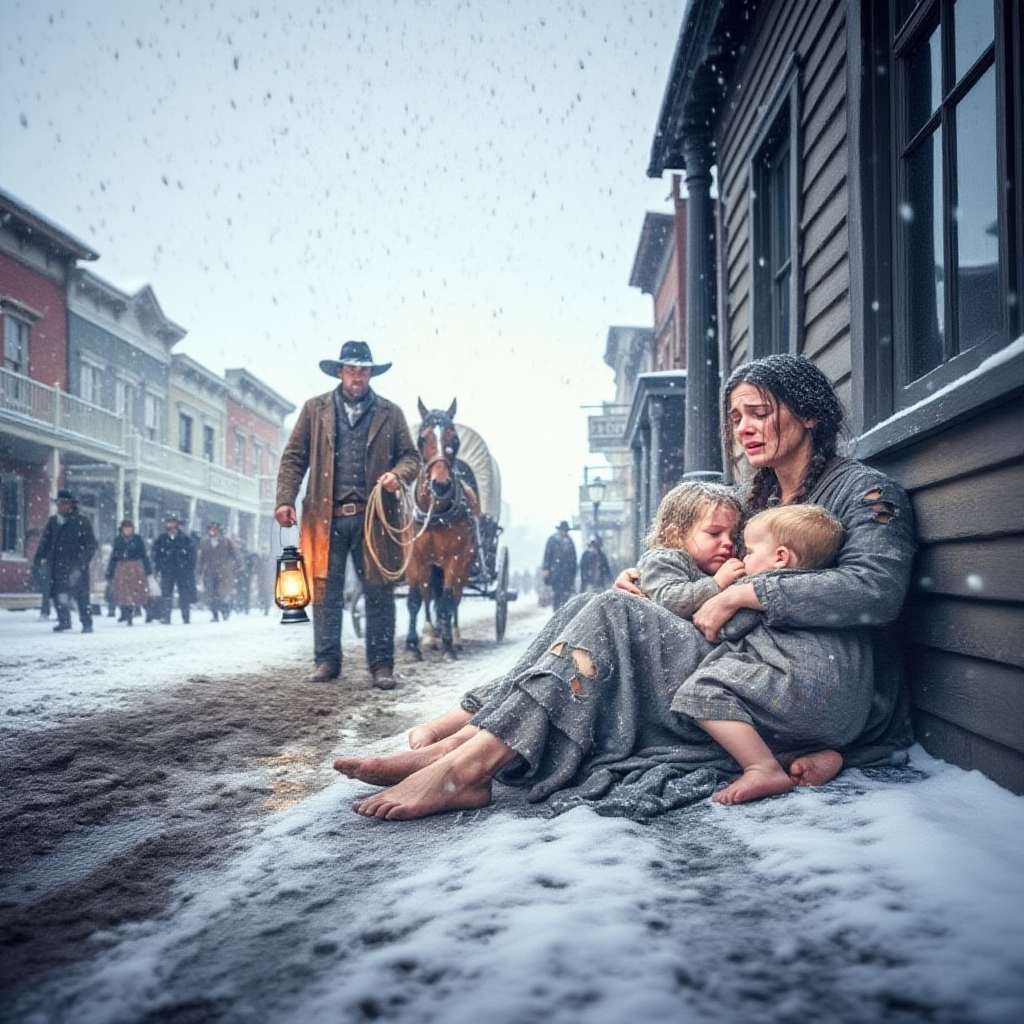
In the high plains of eastern Montana, where the wind never stopped whispering through the sagebrush, Ellie Whitaker stood on the cracked porch of her rented trailer, watching snow fall like ash from a dying fire. It was late November, the kind of cold that seeped into bones and stayed. Her three children—Lila (9), Mason (6), and baby Grace (18 months)—huddled behind her in threadbare coats too thin for the weather. The eviction notice was taped to the door like a death warrant. The landlord had given them until dawn.
Ellie’s husband, Jake, had died two years earlier in a rig accident on the interstate. The life insurance barely covered the funeral. Medical bills from Grace’s premature birth had eaten the rest. Ellie worked double shifts at the diner in town, but tips dried up when winter tourists stopped coming. The bank took the truck last month. Now the trailer was gone too.
She had called every shelter within a hundred miles. Full. Waiting lists. No room for families with young kids. The state offered foster care—temporary placement—but they might split the children. Lila had already lost her father; Ellie couldn’t let her lose her siblings too.
That night, after the kids fell asleep on the thin mattress, Ellie sat at the kitchen table with a pen and paper. She wrote letters. One for each child. Simple things: how much she loved them, how sorry she was. Then she wrote one more—to whoever would take them. “Please keep them together. They’re good kids. They deserve better than this.”
Dawn came gray and merciless. Ellie bundled the children into the last of their blankets and walked them to the county office building downtown. The social worker, a kind but tired woman named Ms. Rivera, met them at the door.
“I can’t keep them anymore,” Ellie said, voice breaking. “I’ve tried everything. Just… take my children. Please. But don’t separate them.”
Lila clung to her mother’s leg. “Mommy, no.”
Mason started to cry. Grace whimpered in Ellie’s arms.
Ms. Rivera’s eyes filled. “Ellie, we’ll do our best, but—”
A deep voice cut through the hallway. “Hold on.”
Ellie turned.
He stood in the doorway like he’d ridden in from another time: tall, broad-shouldered, wearing a weathered Carhartt coat dusted with snow, a black Stetson low over hazel eyes. Boots scarred from years of hard work. A faint scar ran along his jaw. Caleb Harlan. Everyone in Dawson County knew the name. He ran the Double H Ranch—thirty thousand acres of grassland, cattle, and solitude. Widowed five years. No kids. Kept to himself.
Caleb stepped inside, snow melting off his hat brim. “I heard what you said.”
Ellie wiped her face. “This isn’t your business.”
“Maybe it is.” He looked at the children, then back at her. “You’re giving them up because you think it’s the only way to keep them safe.”
“I don’t have a choice.”
“You do now.” Caleb’s voice was steady, low like distant thunder. “You’re all coming with me.”
Ellie stared. “What?”
“I’ve got a big house, empty rooms, heat that works. Food in the pantry. School bus stops at the gate. No strings. No papers today. Just a place to breathe until you figure things out.”
Ms. Rivera raised an eyebrow. “Mr. Harlan, you can’t just—”
“I can offer temporary guardianship if the mother consents. I’ve got the space, the means, and no criminal record. Check it.” He handed over a folded paper—references, bank statements, a letter from the county sheriff calling him “one of the good ones.”
Ellie’s knees buckled. Lila caught her hand. “Mommy?”
Caleb crouched to the children’s level. “Hey there. I’ve got horses. Real ones. And a dog named Rusty who thinks he’s people. You like dogs?”
Mason nodded slowly.
Caleb looked up at Ellie. “I’m not trying to fix your life. I’m just saying you don’t have to do this alone today.”
Tears streamed down Ellie’s face. She had been strong for so long. The weight of it cracked her open. “Why would you do this?”
“Because I know what it’s like to lose everything and have nowhere to go.” His voice softened. “My wife died in a house fire. I couldn’t save her. Couldn’t save the baby she was carrying. I’ve spent five years rattling around that ranch like a ghost. Maybe helping you keeps me from turning into one.”
Ellie searched his face. No pity. Just quiet resolve.
She nodded once.
They left the county office together. Caleb loaded them into his crew-cab Ford—blankets, a thermos of hot chocolate, seat warmers on. The drive to the Double H took forty minutes of silent, snow-covered highway. The kids stared out the windows at endless white fields.
The ranch house was old but solid: two stories, wraparound porch, lights glowing in every window. Smoke curled from the chimney. Inside smelled of pine and coffee. A golden retriever thumped his tail from a rug by the fireplace.
Caleb showed them rooms. Lila and Mason got bunk beds with cowboy quilts. Grace got a crib already set up in the corner of Ellie’s room—fresh sheets, a mobile of little horses. “Belonged to my niece when she visited last summer,” he explained.
Ellie stood in the doorway, arms wrapped around herself. “I don’t know how to repay this.”
“Don’t need repaying. Just need you to eat something and sleep. Tomorrow we’ll talk about jobs if you want. I could use help in the office—bookkeeping, scheduling hands. Or you can just rest. Your call.”
That first week was strange and gentle. Caleb cooked breakfast—eggs, bacon, pancakes shaped like stars for the kids. He drove them to school in town, waited until they were inside. Ellie started helping in the ranch office, learning the software, answering calls. The work gave her purpose. The paycheck—small but steady—gave her hope.
The children bloomed. Lila learned to ride a gentle mare named Daisy. Mason followed Caleb everywhere, asking a thousand questions about cattle and fences. Grace toddled after Rusty, giggling when he licked her face.
Nights were harder. Ellie woke from nightmares—Jake’s accident, the eviction, the moment she almost gave her kids away. One night she found Caleb on the porch, staring at the stars.
“Can’t sleep?” he asked.
She sat beside him on the swing. “I keep thinking you’ll wake up and regret this.”
“I won’t.” He paused. “But if you want to leave, door’s open. No hard feelings.”
“I don’t want to leave,” she whispered. “I want to stay. But I’m scared.”
“Of what?”
“Of needing someone again. Of losing again.”
Caleb looked at her then—really looked. “I’m scared too. Been alone so long I forgot how to let people in. But watching your kids laugh… watching you smile when you think no one’s looking… it’s waking something up I thought was dead.”
Winter passed. Spring came with mud and new calves. Ellie’s old life felt farther away. One evening, after the kids were in bed, Caleb found her in the kitchen washing dishes.
He dried his hands on a towel. “Ellie, I’ve been thinking.”
She turned off the faucet. “Yeah?”
“I don’t want this to be temporary anymore. Not the house. Not the help. Not us.” He took a breath. “Marry me. Not because you need saving. Because I need you—all of you—in my life. I love your kids like they’re mine. And I love you. Have for months.”
Ellie’s heart hammered. “Caleb…”
“Say yes or no. No pressure.”
She stepped closer, touched his scarred jaw. “Yes.”
They married in June on the ranch lawn. Lila carried wildflowers. Mason held the rings. Grace rode on Caleb’s hip in a tiny white dress. Neighbors came—ranchers, hands, the diner staff. Ms. Rivera smiled from the back row.
After the vows, Caleb lifted Ellie onto his horse—side-saddle style—and they rode out to the ridge overlooking the valley. The kids ran ahead with Rusty, laughing.
“You kept your promise,” Ellie said, leaning against him.
“What promise?”
“You said we were all coming with you.”
He kissed her temple. “And I meant all of you. Forever.”
Below them, the ranch lights glowed like stars brought to earth. The wind carried the sound of children’s voices—happy, safe, home.
Sometimes the greatest rescues aren’t from danger, but from despair. And sometimes a cowboy’s quiet “come with me” is the start of everything beginning again.