
“She’s Bigger Than a Bull” — They Laughed Until the Mountain Man Spoke
The first laugh came from the far end of the auction yard, sharp as a whip crack.
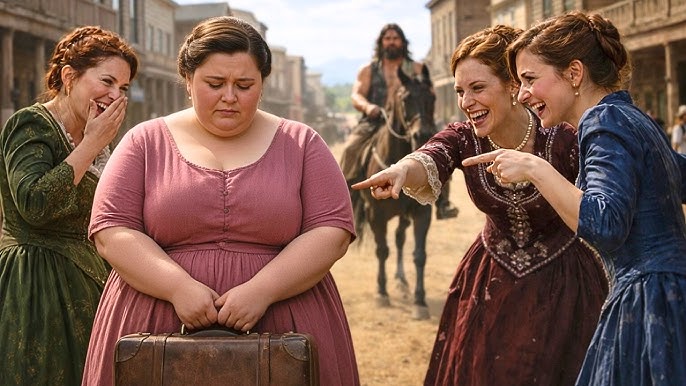
“She’s bigger than a bull,” someone shouted.
The others joined in, the sound rolling across the dusty lot like loose gravel. Men leaned against fence posts, hats tipped back, chewing tobacco and grinning. A few women stood near the supply wagon, whispering behind their hands. Even the horses seemed restless, stamping as the laughter swelled.
On the platform, Mary Ellen Carter kept her chin lifted.
She had learned long ago that if she looked down, they’d think they’d won.
The auctioneer cleared his throat, shuffling his papers, clearly uncomfortable. “Lot twelve,” he announced. “Strong worker. Farm labor. Cooking. Laundry. General help. Starting bid—”
“She’ll eat more than she works!” someone yelled.
More laughter.
Mary Ellen felt the familiar heat creep into her cheeks. Her hands tightened around the small cloth bag she carried — everything she owned now: a change of clothes, a worn Bible, and her mother’s silver thimble.
She had arrived in Dry Creek three days earlier after the wagon train she’d traveled with moved on without her. They had needed to lighten the load. She took up space, they said. The oxen were already strained. Food was running low.
They hadn’t said it cruelly. Not all of them.
But they still left her behind.
Now she stood on a wooden platform, being judged like a mule.
“She’ll break a saddle just looking at it,” another man called.
Mary Ellen stared past them, beyond the crowd, toward the mountains. Blue-gray ridges cut into the horizon, sharp and silent. She had always liked mountains. They didn’t laugh. They didn’t whisper.
They simply stood.
“Do I hear five dollars?” the auctioneer tried.
Silence.
A fly buzzed lazily near the rail. Someone spat.
“Three dollars?”
Nothing.
Mary Ellen swallowed. She had expected this. Still, the quiet hurt worse than the laughter.
“Two?”
A man near the front shook his head. “Not if you pay me.”
The crowd chuckled again.
Mary Ellen shifted her weight, the boards creaking beneath her. She imagined stepping down, walking away, disappearing into the mountains. But she had no horse, no supplies, no plan. The plains beyond Dry Creek stretched for miles — harsh, empty, unforgiving.
She would not survive alone.
The auctioneer sighed. “One dollar. Anyone?”
For a moment, it seemed even the wind had stopped.
Then a voice came from behind the crowd.
“I’ll give one.”
It wasn’t loud. But it cut through everything.
The men turned.
He stood near the edge of the yard, half in shadow. Tall. Broad-shouldered. A long, weathered coat hung from his frame. Dark hair brushed his collar, streaked with early gray. A beard covered most of his face, but his eyes were clear and steady.
People shifted uneasily.
“Mountain man,” someone muttered.
Mary Ellen had heard of him. Everyone in Dry Creek had. He lived alone somewhere up in the ridges. Came down twice a year for supplies. Trapped in winter. Hunted elk. Kept to himself.
Some said he fought a grizzly and lived.
Some said he’d buried three men.
No one seemed sure which stories were true.
The auctioneer blinked. “You… you’re bidding?”
The mountain man stepped forward. His boots thudded against the packed earth. “One dollar.”
A few men snorted.
“You buying her for bait?” one joked.
“She’ll scare off wolves just standing there,” another added.
The mountain man didn’t look at them. His gaze stayed fixed on Mary Ellen.
Something about it made her straighten.
The auctioneer cleared his throat again. “One dollar… going once…”
A pause.
“Going twice…”
No one spoke.
“Sold.”
The gavel tapped.
The sound felt strangely loud.
Mary Ellen stepped down from the platform slowly. The mountain man reached into his coat, pulled out a worn coin, and handed it over. Then he turned toward her.
Up close, he seemed even larger — not just tall, but solid, like he had been carved from the same rock as the mountains behind him.
“You ready?” he asked.
His voice was calm, almost gentle.
Mary Ellen nodded. “Yes, sir.”
He picked up her bag before she could stop him. “Name’s Daniel Boone Carter,” he said. “Folks call me Boone.”
“Mary Ellen.”
He gave a small nod. “We’ll head out before sundown.”
They started toward the hitching rail where a sturdy mule waited. The crowd parted, still murmuring.
“She’ll slow him down.”
“He won’t make it to the foothills.”
“Bet he turns back by morning.”
Mary Ellen kept walking.
They reached the mule. Boone tied her bag behind the saddle, then looked at her.
“You ride,” he said.
She blinked. “There’s only one saddle.”
“I’ll walk.”
“That’s— I can walk.”
He shook his head once. “You ride.”
She hesitated, then climbed awkwardly onto the mule. The leather creaked, but held. Boone took the reins and started toward the road leading out of town.
They walked in silence at first. Dry Creek faded behind them, replaced by open plains dotted with sagebrush. The mountains loomed closer with every step.
After a while, Mary Ellen spoke. “Why did you buy me?”
Boone didn’t answer right away. “You needed someone,” he said finally.
“So did you?”
He glanced up at her. “Maybe.”
The wind picked up, carrying the smell of dust and distant pine.
They traveled until the sun dipped low. Boone led them to a small stream and made camp. He moved with quiet efficiency — gathering wood, building a fire, setting a pot to boil.
Mary Ellen slid off the mule. Her legs felt stiff. She brushed her skirt, unsure what to do.
“Can cook?” he asked.
“Yes.”
He handed her a small pouch. “Beans. Salt. Dried venison.”
She smiled faintly. “I’ll make something.”
They worked together without speaking much. Soon the smell of stew filled the air. Boone sat across from her, watching the fire.
When she handed him a tin bowl, he nodded in thanks.
He tasted the stew, then took another spoonful.
“Good,” he said simply.
They ate in quiet comfort. The stars emerged, bright and sharp.
After a while, Mary Ellen said softly, “They always laugh.”
Boone looked at her.
“I know I’m big,” she continued. “I’ve heard it all my life. Bull. Wagon. Barrel. You name it.”
He stirred the fire with a stick.
“They think it doesn’t hurt,” she said. “But it does.”
Boone set the stick aside. “They’re small men,” he said.
She blinked. “What?”
“Small men laugh loudest. Makes ‘em feel bigger.”
Mary Ellen stared at the fire. No one had ever said it like that.
“You don’t think I’m… too big?” she asked.
Boone shook his head. “I think you’re strong.”
The word settled between them.
Strong.
Not big. Not heavy.
Strong.
She felt something loosen in her chest.
The next morning, they climbed into the foothills. The path narrowed, winding through pines. Boone walked steadily, never seeming to tire. Mary Ellen watched the way he moved — careful, sure-footed, quiet.
By midday, they reached a clearing.
A cabin stood near the edge — rough-hewn logs, smoke curling from a stone chimney. A small garden patch lay nearby, fenced against deer.
Mary Ellen stared. “You built this?”
Boone nodded.
“It’s… beautiful.”
He shrugged slightly. “It’s home.”
He helped her down from the mule. “We’ll need wood before dark.”
She rolled up her sleeves. “Tell me where.”
They worked side by side, hauling logs, stacking kindling. Mary Ellen found she could carry more than she expected. Boone noticed, but said nothing — just handed her another piece.
By evening, her arms ached, but she felt… useful.
Inside the cabin, Boone showed her the shelves, the small bed in the corner, the loft above.
“You take the bed,” he said.
“And you?”
“Loft.”
She opened her mouth to argue, but he had already turned away.
That night, as wind whispered through the trees, Mary Ellen lay awake. For the first time in weeks, she didn’t feel afraid.
Days turned into weeks.
Mary Ellen cooked, cleaned, and helped in the garden. Boone trapped and hunted. They spoke little, but the silence grew comfortable.
One afternoon, while lifting a water bucket, Mary Ellen slipped. The bucket tipped, water splashing.
Before she could steady herself, Boone caught her arm.
His grip was firm, warm.
“You alright?” he asked.
“Yes,” she said, breathless.
For a moment, neither moved.
Then he released her gently.
“Careful,” he said.
But his voice was softer than before.
Word spread, eventually, that Boone had taken in the “big woman” from Dry Creek. Some men rode up weeks later, curious.
They expected to laugh.
Instead, they saw Mary Ellen hauling firewood with ease. They saw her splitting kindling. They saw the garden thriving, the cabin neat, the smoke steady.
One man whispered, “She works harder than any of us.”
Another nodded.
Boone stood nearby, silent.
Mary Ellen wiped her hands and faced them calmly.
No one laughed.
As the men rode away, Boone glanced at her.
“Told you,” he said quietly.
She smiled.
Far below, Dry Creek sat small against the plains.
And in the mountains, where no laughter echoed cruelly, Mary Ellen Carter stood tall — strong as the ridges themselves — beside the man who had spoken when everyone else laughed.