
Starving Widow Said, “Take My Children,” Poor Rancher Answered, “I’ll Take You Too”
The snow had already begun to fall when she made the decision.
It came quietly, without ceremony—like most of the hardest choices in her life.
Mary Collins stood at the edge of the ranch fence, her thin shawl pulled tight around her shoulders, her breath visible in the cold air. Behind her, five small figures huddled together, their eyes fixed on the man across the yard.
They hadn’t eaten properly in two days.
Maybe three.
She had stopped counting.
“Please,” Mary said, her voice barely steady.
The man didn’t answer right away.
He stood with one hand resting on the wooden post, his gaze moving from her… to the children… and back again.
His name was Jacob Hale.
A rancher by necessity, not by fortune.
His land was modest.
His house small.
His supplies… limited.
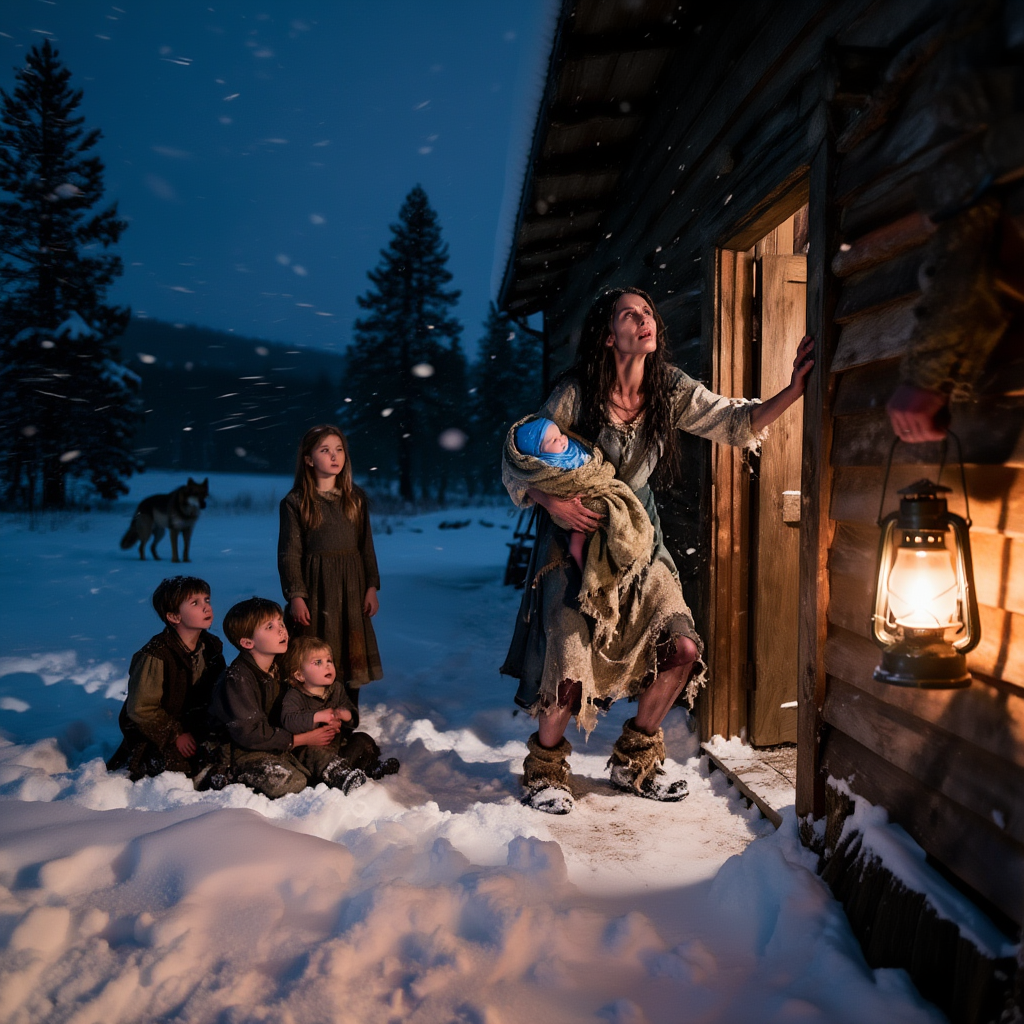
“You’re asking me to take in five children,” Jacob said finally.
Mary nodded.
“I wouldn’t ask if there was another way.”
Her voice broke on the last word, but she forced herself to continue.
“They’re good children. They work hard. They won’t cause trouble.”
Behind her, the oldest boy straightened slightly, as if trying to prove it without speaking.
“They just need a chance,” Mary added softly.
Jacob exhaled slowly.
He had seen this before.
Not exactly like this—but close enough.
Winter had a way of bringing desperation to people’s doors.
“And you?” he asked.
Mary hesitated.
Then shook her head.
“I’ll go,” she said. “I just need to know they’ll be safe.”
The words landed heavier than the snow.
Jacob’s brow furrowed.
“You’ll go where?”
“Anywhere,” she replied.
“It doesn’t matter.”
The children shifted behind her.
One of the smaller ones reached for her hand.
Mary squeezed it gently.
But didn’t look back.
If she did—
She might not be able to let go.
Jacob watched her carefully.
There was no pride left in her posture.
No bargaining.
No expectation.
Just… surrender.
He had seen that before too.
And it never sat right with him.
“You’d leave them?” he asked.
Mary closed her eyes briefly.
“They deserve more than I can give them.”
The truth of it hung in the air.
Cold.
Unforgiving.
Jacob looked at the children again.
Five of them.
Too thin.
Too quiet.
Too used to being hungry.
Then he looked back at her.
“No,” he said.
Mary blinked.
“I… I understand,” she began quickly. “It’s too much, I shouldn’t have—”
“That’s not what I meant,” Jacob interrupted.
She stopped.
“I’ll take them,” he said.
Relief flooded her face—so sudden, so overwhelming it almost broke her.
“Thank you,” she whispered. “Thank you, I—”
“I’ll take you too.”
The words stopped everything.
Mary stared at him.
“What?”
Jacob didn’t look away.
“You heard me.”
“I can’t,” she said immediately.
“Yes, you can.”
“I don’t have anything to offer,” she insisted.
Jacob shrugged slightly.
“Neither do I.”
“That’s not the same.”
“It is to me.”
Mary shook her head, stepping back slightly.
“No. You don’t understand. I’m not asking for myself. I’m asking for them.”
“And I’m answering for all of you,” Jacob replied calmly.
Silence fell.
The children looked between them, unsure, hopeful, afraid to believe.
“I won’t be a burden,” Mary said quietly.
“You already said that,” Jacob replied.
“And I meant it.”
“So did I.”
She hesitated.
Struggled.
The instinct to refuse—deep and ingrained—fighting against something she hadn’t allowed herself to feel in a long time.
Hope.
“Why?” she asked finally.
Jacob considered the question.
“Because splitting you apart isn’t right,” he said.
A pause.
“And because I don’t think you’d survive long without them.”
Mary let out a small, broken laugh.
“You’re not wrong.”
“And they wouldn’t do much better without you,” he added.
The truth of that settled heavily.
Mary looked back at her children.
At their thin faces.
Their tired eyes.
Their quiet strength.
Then back at Jacob.
“You’re sure?” she asked.
“No,” he said honestly.
That made her blink.
“But I’m willing,” he added.
Something in that answer…
Felt more real than certainty ever could.
Mary nodded slowly.
“Alright,” she said.
And just like that—
Everything changed.
The house was small.
Smaller than Mary had expected.
But it was warm.
The fire crackled steadily in the hearth, casting soft light across wooden walls worn smooth by years of use.
The children hesitated in the doorway.
“Go on,” Jacob said, stepping aside.
They moved carefully, as if afraid the warmth might disappear if they weren’t careful.
Mary followed last.
Closing the door behind her.
For the first time in weeks—
The wind was on the outside.
Days passed.
Then weeks.
It wasn’t easy.
Food had to be stretched.
Work had to be shared.
Every hand mattered.
The children adapted quickly.
They always did.
The boys helped in the fields, learning to tend what little livestock Jacob had.
The girls cleaned, mended, organized.
Mary did everything she could—
Cooking, repairing, keeping the house running.
Jacob watched it all quietly.
“You don’t stop moving,” he said one evening.
Mary didn’t look up from the pot she was stirring.
“I’m used to it.”
“You don’t have to prove anything.”
She paused.
Just for a second.
Then continued.
“I’m not proving anything.”
A lie.
But one she had told herself so many times it almost sounded true.
Jacob didn’t argue.
Instead, he reached for a bowl.
Sat down.
And waited.
It took time.
For the house to feel less like a shelter…
And more like a home.
For the children to laugh without looking over their shoulders.
For Mary to sit without immediately searching for the next task.
For Jacob to realize…
He didn’t mind the noise.
One night, as snow fell heavily outside, Mary sat by the fire, her hands resting in her lap.
“You could have said no,” she said quietly.
Jacob looked up from where he sat.
“Yeah,” he said.
“But you didn’t.”
“No.”
She hesitated.
“Do you regret it?”
Jacob considered the question.
He looked around the room.
At the children, half-asleep near the fire.
At the warmth that hadn’t been there before.
Then back at her.
“No,” he said.
Mary exhaled slowly.
“Neither do I.”
The words surprised her.
But they were true.
Winter stretched on.
Cold.
Relentless.
But inside the small house…
There was something stronger than the storm.
Not just survival.
Something else.
Something built quietly, day by day.
Trust.
And something that followed close behind it.
Belonging.
One evening, the oldest boy approached Jacob.
“Sir,” he said.
Jacob raised an eyebrow.
“You don’t have to call me that.”
The boy nodded.
“Jacob,” he corrected.
“What is it?”
The boy hesitated.
Then:
“Thank you.”
Simple words.
But they carried weight.
Jacob nodded once.
“Earn it,” he said.
The boy smiled slightly.
“I will.”
And he did.
They all did.
Because this wasn’t just a place they had been given.
It was a place they were building.
Together.
And Mary…
Mary no longer stood at the edge of anything.
She stood inside.
Where she belonged.
Because sometimes…
The hardest thing to accept…
Is not help.
But the idea that you don’t have to face everything alone.
And sometimes…
All it takes is one person willing to say—
“I’ll take you too.”
Part 2: The Place They Chose
Spring did not come gently that year.
It arrived in broken pieces—thin sunlight over frozen ground, slush where snow once held firm, wind that no longer cut like a blade but still carried the memory of winter.
Inside Jacob Hale’s small ranch house, life had already begun to change.
Not suddenly.
But steadily.
Mary Collins noticed it first in the children.
They no longer woke with that quiet, guarded tension in their bodies.
They stretched when they rose.
Spoke without hesitation.
Laughed without checking who might hear.
The youngest one—Clara—had started humming again.
Soft at first.
Then louder.
Until one morning, she spun in a slow circle near the hearth, giggling for no reason at all.
Mary watched her, something tight in her chest loosening.
“They’re settling,” Jacob said from the doorway.
Mary nodded.
“Yes.”
A pause.
“They forgot how.”
Jacob leaned against the frame, arms crossed.
“They remember fast.”
Mary glanced at him.
“That’s because they feel safe.”
The word hung there.
Safe.
It wasn’t something Mary had used lightly.
Not before.
Jacob nodded once.
“That’s the point.”
But safety brought something else with it.
Something neither of them had fully prepared for.
People.
As the snow melted and the roads opened again, word spread.
It always did.
“Five children.”
“And the widow.”
“All taken in by that rancher out on the ridge.”
Some came out of curiosity.
Others… less kindly.
The first group arrived one afternoon.
Three townsmen, boots muddy from the thaw, eyes sharp with interest that wasn’t entirely friendly.
“You’ve made quite a name for yourself,” one of them said, glancing around the yard.
Jacob didn’t smile.
“Not trying to.”
They looked past him, toward the house.
Mary stood in the doorway, one hand resting lightly on Clara’s shoulder.
The other children hovered just behind her.
“You planning to keep them?” another man asked.
Jacob’s jaw tightened slightly.
“Yes.”
“All of them?”
“Yes.”
The men exchanged looks.
“That’s a lot of responsibility,” the first one said.
Jacob didn’t answer.
“You sure they belong here?” the third added.
The question landed heavier than the others.
Mary felt it immediately.
That old, familiar weight.
The one that whispered:
You don’t belong anywhere.
Before she could speak, Jacob did.
“They do,” he said simply.
Silence followed.
The men didn’t push further.
Not that day.
But they didn’t leave convinced either.
Inside, the children had heard enough.
“Are we going to have to leave?” Ruth asked that night, her voice small despite her age.
Mary opened her mouth to answer—
But stopped.
Because for the first time…
She didn’t know.
Jacob stepped in.
“No.”
The certainty in his voice was immediate.
Unshaken.
“But they said—” Eli began.
“I don’t care what they said,” Jacob interrupted.
The room went quiet.
“You’re here because I chose it,” he continued.
“And I don’t change my mind because someone else thinks they know better.”
The children looked at him.
Something in their expressions shifting.
Mary watched too.
And for the first time…
She believed him completely.
The days that followed were not easy.
The town didn’t push directly.
But it lingered.
In looks.
In quiet comments.
In the way people paused just a little too long when the children came into sight.
Mary felt it more than the others.
She always had.
“You don’t have to go into town,” Jacob said one morning when he noticed her hesitation.
Mary shook her head.
“I won’t hide.”
He studied her for a moment.
Then nodded.
“Alright.”
So she went.
The first time back felt like stepping into a memory she hadn’t asked to revisit.
The same streets.
The same buildings.
The same people.
But she was not the same woman.
She walked differently now.
Not faster.
Not slower.
Just… steadier.
The children stayed close.
But not out of fear.
Out of habit.
Whispers followed them.
Of course they did.
“That’s her.”
“The one who gave her kids away.”
“No,” another corrected quietly.
“The one who found a place for them.”
Mary heard that.
And for a moment…
She stopped.
Not out of shame.
But out of something unfamiliar.
Relief.
When she returned to the ranch, Jacob was repairing a section of fence.
“How was it?” he asked without looking up.
Mary set down the small bundle of supplies she had brought back.
“Different,” she said.
He glanced at her.
“Better or worse?”
Mary considered the question.
“Not worse,” she answered.
Jacob nodded.
“That’s a start.”
Spring deepened.
The land softened.
The work increased.
There was more to do now.
More mouths to feed.
More hands to help.
And slowly…
The ranch began to grow.
Not just in size.
But in life.
Jacob expanded the fields.
The boys learned faster than he expected.
Strong.
Determined.
Eager to prove they were worth the space they took up.
The girls transformed the house.
It became brighter.
Warmer.
Lived in.
And Mary…
Mary found herself standing still sometimes.
Just for a moment.
Watching.
Taking it in.
“You’re allowed to rest,” Jacob said one evening when he caught her doing exactly that.
She smiled faintly.
“I’m learning.”
He nodded.
“That’s all any of us are doing.”
That night, after the children had gone to sleep, Mary sat by the fire.
“You changed everything,” she said quietly.
Jacob shook his head.
“No.”
She looked at him.
“You did,” she insisted.
He met her gaze.
“I opened a door,” he said.
“You walked through it.”
Mary held his eyes for a long moment.
Then:
“We walked through it.”
The correction settled between them.
Right where it belonged.
Summer arrived.
The land flourished.
The house stood stronger.
The laughter came easier.
And the question that had once hung over everything…
Faded.
Not because it was answered.
But because it no longer mattered.
They weren’t waiting to see if they could stay.
They already had.
One evening, as the sun dipped low over the fields, casting gold across the land, the children ran through the tall grass, their voices carrying freely on the wind.
Mary stood beside Jacob, watching them.
“I almost left them,” she said quietly.
Jacob didn’t respond right away.
“But you didn’t,” he said finally.
She nodded.
“Because you said something no one ever had before.”
He glanced at her.
“What’s that?”
Mary smiled.
Soft.
Certain.
“That I could stay too.”
Jacob looked out at the land.
At the life they had built.
“Seemed like the right thing,” he said.
Mary shook her head slightly.
“No,” she said.
“It was more than that.”
A pause.
“It was the reason everything else became possible.”
The wind moved gently through the fields.
The children laughed.
And for the first time in a long time—
Mary didn’t feel like she was standing on the edge of losing something.
She felt like she was exactly where she was meant to be.
Because sometimes…
The greatest act of kindness…
Is not just giving someone a place to stay.
It’s giving them a reason to belong.
And sometimes…
All it takes…
Is four simple words.
“I’ll take you too.”