
She Was Thrown Out at 18 and Forced to Live in a Cave — Then the Great Freeze Turned Her Home Into a Deadly Trap
The winter of 1888 arrived early in the mountains of Wyoming.
Snow began falling before the last autumn leaves had finished dropping. Ranchers muttered that it felt wrong. Hunters returned from the forests sooner than usual. Even the animals seemed uneasy.
But eighteen-year-old Abigail Carter had bigger problems than the weather.
Standing outside her father’s farmhouse with a single canvas bag in her hands, she watched the front door slam shut.
The sound echoed through the cold evening.
“Don’t come back,” her stepmother shouted from inside.
Abigail waited.
Part of her hoped the door would open again.
That her father would appear.
That he would tell her it was all a terrible mistake.
Instead, the curtains closed.
The lights inside glowed warmly.
And nobody came.
Slowly, Abigail turned and walked away.
She had no money.
No husband.
No relatives willing to take her in.
By sunset, she was completely alone.
For three days she wandered.
She slept beneath trees.
She ate berries and stale bread.
On the fourth day she reached a rocky ridge overlooking a narrow valley.
There she discovered a small cave hidden behind a curtain of evergreen branches.
It wasn’t much.
The entrance was narrow.
The floor was uneven.
Cold air drifted through cracks in the stone.
But it was dry.
And for someone with nowhere else to go, it felt like a palace.
That night she built her first fire.
The flames danced against the cave walls.
For the first time since being thrown out, she felt safe.
“Home,” she whispered.
The word sounded strange.
Yet somehow true.
The years passed.
Abigail learned things most people never had to learn.
How to trap rabbits.
How to identify edible roots.
How to preserve meat.
How to survive snowstorms.
She gathered firewood through every season.
Collected rainwater.
Mended her own clothing.
Sometimes loneliness felt unbearable.
Weeks could pass without seeing another person.
But she survived.
And eventually, she stopped thinking of herself as abandoned.
The mountains became her family.
The forests became her neighbors.
The cave became her home.
One spring morning she discovered an injured sheep caught in a thorn bush.
The animal belonged to a ranch several miles away.
Its leg was badly cut.
Abigail freed it and carried it home.
For weeks she cared for it.
Fed it.
Cleaned its wound.
Protected it from coyotes.
By summer the sheep had healed completely.
Instead of leaving, it stayed.
A few months later another sheep appeared.
Then another.
Soon Abigail had a tiny flock.
The animals followed her everywhere.
They provided wool.
Companionship.
Purpose.
The cave no longer felt empty.
Several years later, while exploring an abandoned property near the valley, Abigail discovered an old wooden barn.
Its owners had left long ago.
The structure leaned slightly to one side.
Parts of the roof needed repair.
But the foundation remained solid.
Most people saw a ruin.
Abigail saw opportunity.
She spent nearly two years restoring it.
Board by board.
Beam by beam.
Stone by stone.
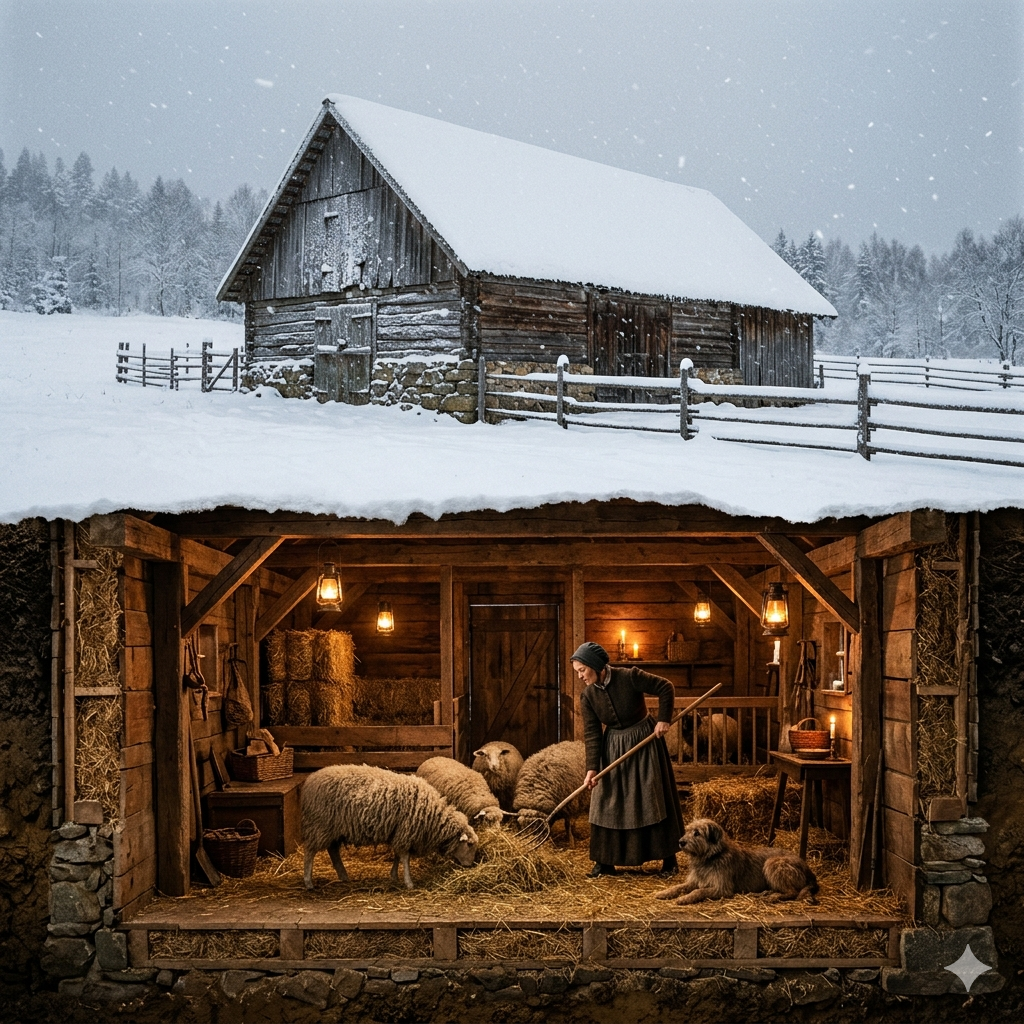
What nobody realized was that the barn sat directly above a network of natural caverns—including the one Abigail had lived in for years.
Using her knowledge of the caves, she created something extraordinary.
She connected the underground chambers beneath the barn.
Insulated the walls.
Stored food below ground.
Built hidden passages that trapped warmth during winter.
Above ground stood an ordinary barn.
Below ground existed a carefully engineered shelter.
It became her life’s work.
By the winter of 1888, Abigail was twenty-six years old.
The sheep flock had grown.
A loyal brown dog named Rusty slept beside her every night.
Lanterns illuminated the lower chambers with golden light.
Visitors occasionally stopped by.
Many thought she was eccentric.
Others admired her independence.
Nobody understood how important her underground shelter would soon become.

The Great Freeze arrived without warning.
One evening temperatures dropped sharply.
By dawn, the valley had transformed into a frozen nightmare.
Snow fell sideways.
Wind screamed across the plains.
Entire fences disappeared beneath drifts.
The storm intensified day after day.
Livestock froze where they stood.
Roads vanished.
Trees cracked under the weight of ice.
People began calling it the worst freeze anyone could remember.
Inside the barn, Abigail worked steadily.
Above her, snow buried the roof.
The wooden structure groaned beneath the pressure.
But underground, warmth remained trapped.
Lanterns glowed softly.
Sheep huddled together eating hay.
Rusty slept comfortably on the straw-covered floor.
Abigail pitched fresh hay with a wooden fork while humming an old song her mother once sang.
The contrast was astonishing.
Above ground, death.
Below ground, life.
On the seventh day of the storm, disaster struck.
A thunderous crack echoed overhead.
Abigail froze.
Another crack followed.
Then another.
The roof.
The weight of snow was becoming too much.
She rushed upstairs.
The sight made her stomach drop.
Massive drifts covered nearly every inch of the structure.
Support beams were bending.
Sections of the roof sagged dangerously.
If the barn collapsed, the main entrance to her underground shelter could become sealed forever.
She might survive for a while.
But eventually food, air circulation, and escape routes would become serious problems.
For the first time in years, Abigail felt fear.
Real fear.
The storm continued.
Snow piled higher.
Visibility dropped to almost nothing.
Trying to clear the roof alone would be nearly impossible.
Yet doing nothing could prove fatal.
Abigail made a decision.
She tied a rope around her waist.
Anchored it to a support post.
Then climbed onto the roof.
The wind hit her like a hammer.
Snow blasted her face.
She could barely see.
Using a shovel, she began pushing snow over the edge.
One load.
Then another.
Then another.
Hours passed.
Her hands went numb.
Ice formed on her eyelashes.
Still she continued.
Suddenly the rope jerked tight.
The surface beneath her feet gave way.
A section of roof collapsed.
Abigail plunged downward.
For a terrifying moment she thought she was dead.
But the rope caught.
She swung violently against the side of the structure.
Pain shot through her shoulder.
Below her yawned a deep gap where the roof had broken.
Snow poured inside.
The barn groaned like a wounded animal.
Abigail struggled back to safety.
By the time she climbed down, she was shaking uncontrollably.
The Great Freeze had nearly claimed her life.
That night she sat beside a lantern.
Rusty rested his head on her knee.
The sheep slept quietly nearby.
Abigail stared into the flame.
If the storm lasted much longer, she wasn’t sure the barn would survive.
Neither would she.
Then something unexpected happened.
A faint sound echoed from outside.
At first she thought it was the wind.
Then she heard it again.
A voice.
Someone shouting.
Abigail grabbed a lantern and hurried toward the entrance.
Through the blowing snow she saw three figures.
A rancher.
His wife.
Their young son.
Their wagon had become trapped miles from home.
The storm had nearly killed them.
They were desperate.
Without hesitation Abigail brought them inside.
The family stared in amazement.
Warm air.
Dry shelter.
Food.
Animals.
Light.
It felt impossible.
Like discovering an oasis in a frozen desert.
For days they remained there.
Then more travelers arrived.
A trapper.
Two ranch hands.
An elderly widow.
Word spread quickly through the valley.
Somehow people found their way to Abigail’s barn.
And every person she welcomed.
Within two weeks, nearly twenty people sheltered beneath the structure.
The underground chambers became a village.
Children played among stacks of hay.
Women cooked stews over iron stoves.
Men reinforced support beams.
Everyone worked together.
Everyone survived together.
The barn had become something far greater than a home.
It had become a refuge.
The storm finally ended after nearly three brutal weeks.
Sunlight returned.
Blue sky appeared overhead.
People cautiously emerged.
What they saw left them speechless.
Entire ranches had been destroyed.
Buildings collapsed.
Livestock losses were staggering.
Several homes stood buried beneath mountains of snow.
Yet Abigail’s shelter remained standing.
Damaged.
Scarred.
But standing.
And every person inside was alive.
News traveled rapidly.
The young woman once thrown away by her family had saved dozens of lives.
People came from neighboring towns to hear the story.
Reporters arrived.
Ranchers offered payment.
Local leaders praised her ingenuity.
But Abigail accepted little attention.
She simply returned to caring for her animals.
Repairing fences.
Gathering hay.
Living quietly.
Months later, one visitor arrived unexpectedly.
Her father.
Time had aged him.
His shoulders seemed smaller.
His hair had turned gray.
He stood silently outside the barn.
Finally he spoke.
“I heard what you did.”
Abigail nodded.
Neither knew what to say.
After a long pause, tears filled his eyes.
“I should never have let you leave.”
The words hung in the air.
Years too late.
Yet sincere.
Abigail looked toward the valley.
The mountains.
The life she had built with her own hands.
Then she smiled gently.
“Maybe if you hadn’t,” she said, “none of this would exist.”
Her father lowered his head.
Unable to argue.
That evening Abigail stood outside as the sun set behind the snowy peaks.
The barn glowed warmly.
Smoke drifted from the chimney.
Sheep grazed peacefully nearby.
Rusty lay at her feet.
Once, she had believed being cast out was the end of her story.
Instead, it had been the beginning.
The cave that became her home had taught her survival.
The barn she built above it had taught her purpose.
And when the Great Freeze transformed her world into a deadly trap, those hard-earned lessons had saved not only her own life—but the lives of countless others.
As darkness settled across the valley, Abigail looked at the home she had created from nothing.
Not a palace.
Not a mansion.
Just a barn above a cave.
Yet when the coldest winter came, it proved stronger than anything the world had tried to take from her.
And that made it the richest home of all.