
She Thought Everyone Mocking Her Was Right—Until the Wool, the Firewood… and the Blizzard Turned Her Cabin Into the Only Place No One Died
The first time they laughed at Emily Carter, she was dragging a sled full of firewood through town in the middle of July.
The second time, she was buying every old wool blanket the church ladies were trying to throw away.
By autumn, nobody in Silver Creek bothered hiding their smiles anymore.
They laughed openly.
They laughed from the porch of the general store.
They laughed from horseback.
They laughed while Emily loaded split pine into her wagon until the springs groaned beneath the weight.
And every time she heard them, Emily smiled back… though deep inside, she wondered if they were right.
Maybe she was foolish.
Maybe she was becoming her mother.
Maybe fear really did make people strange.
At twenty-eight years old, with no husband, no children, and a cabin sitting alone three miles above town near the foothills of the Rocky Mountains, Emily Carter had become exactly the sort of woman frontier towns liked to whisper about.
Independent.
Quiet.
Useful when someone needed stitching or herbs.
Ridiculous the rest of the time.
And as winter approached, Emily kept stacking wood.
Kept buying wool.
Kept preparing for something she couldn’t explain.
Not even to herself.
The cabin had belonged to her father.
A broad-shouldered trapper who could read weather from the movement of ravens.
A man who had once stood on the porch in October, stared at a cloudless sky, and said:
“Some storms don’t announce themselves.”
Emily had been eleven.
Two weeks later, a whiteout had buried half the valley.
Three families froze before spring.
Her father never forgot.
Neither did Emily.
He had spent the next ten years preparing for winters nobody else believed in.
Wool in cedar trunks.
Wood stacked higher than windows.
Salted meat.
Dried beans.
Rendered fat.
Extra lamp oil.
And every year the townspeople laughed.
Until the winter he died.
Then they laughed at Emily instead.
“Another load?”
Old Thomas Reed leaned against the porch of the general store, chewing tobacco.
Emily tightened the reins of her mare.
“Yes.”
Thomas squinted at her wagon.
“Girl, you got enough wood to heat the governor’s mansion.”
A few men nearby chuckled.
Emily stepped down, boots crunching over dust.
“Then I suppose the governor’s welcome.”
More laughter.
Thomas spat.
“You preparing for war?”
Emily glanced toward the mountains.
“No.”
She paused.
“Just winter.”
One of the ranch hands barked out a laugh.
“Winter?” he said.
“Sky’s clear as glass.”
Emily didn’t answer.
She simply paid for another bolt of wool.
Loaded it.
And drove home.
But this time…
Even she wasn’t sure why.
By November, her cabin looked absurd.
The logs walls were lined with split pine stacked shoulder-high.
Bundles of wool blankets sat in the loft.
Barrels of dried beans lined the pantry.
Extra water had been hauled from the spring and stored inside.
And every night, Emily climbed onto the roof.
She checked the snow braces.
Checked the chimney cap.
Checked the shutters.
And every night she asked herself the same question:
What if they’re right?
What if I’m becoming afraid of ghosts?
What if my father’s fear became mine?
The valley below glittered peacefully.
No wind.
No warning.
No sign.
And still…
She kept preparing.
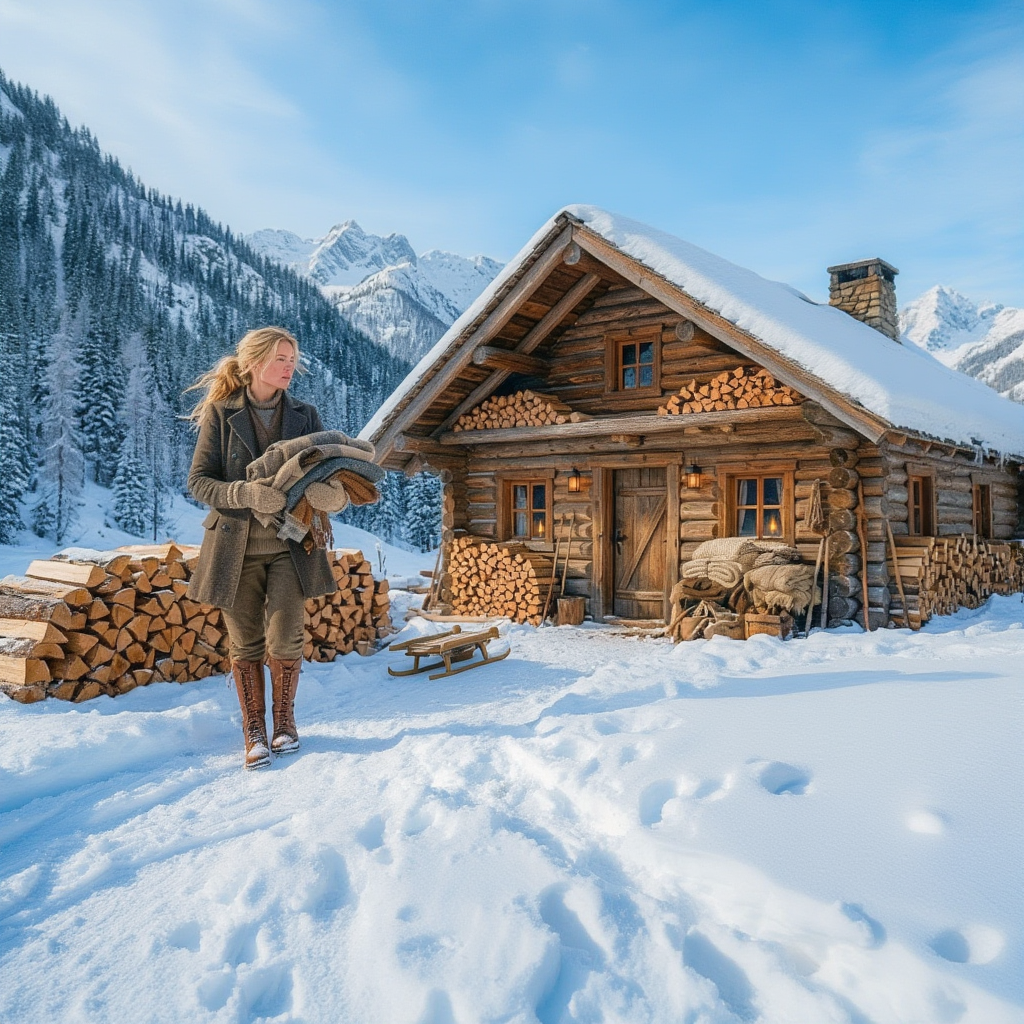
On the first day of December, Sarah Whitmore rode up to the cabin.
Emily opened the door with flour on her hands.
Sarah smiled.
“I came to see the fortress.”
Emily laughed softly.
“Come in.”
Sarah stepped inside and froze.
Blankets.
Wood.
Lanterns.
Food.
Shelves of preserves.
Stacks upon stacks.
“My Lord…”
Emily looked embarrassed.
“It’s too much, isn’t it?”
Sarah ran her fingers across folded wool.
“Honestly?”
Emily nodded.
Sarah smiled.
“I think it’s beautiful.”
Emily blinked.
Nobody had said that before.
Sarah sat by the fire.
“Why do you do it?”
Emily stirred the soup.
“My father used to say winter remembers who mocks it.”
Sarah chuckled.
“That sounds dramatic.”
“It does.”
Emily smiled faintly.
“Still… I remember.”
Sarah looked toward the mountains.
Snow glittered on the peaks.
Peaceful.
Silent.
Perfect.
She stood.
“Well.”
She pulled on her gloves.
“If the world ends, I’m coming here.”
Emily laughed.
“You’ll always be welcome.”
Neither woman knew how soon that promise would matter.
Three days later…
The temperature dropped thirty degrees overnight.
Birds disappeared.
The horses in town became restless.
Dogs refused to leave their barns.
And at sunrise…
Emily stepped onto her porch.
The mountains had vanished.
Not behind fog.
Not behind clouds.
Gone.
Swallowed by a wall of white.
Her heart stopped.
She whispered:
“Oh God…”
Then she heard it.
The wind.
Still miles away.
But coming.
Like a freight train across heaven.
Emily ran.
She secured shutters.
Reinforced doors.
Pulled blankets from storage.
Lit every lantern.
Fed her mare.
Filled every kettle.
By noon…
The sky turned black.
By one…
The world disappeared.
And by two…
The blizzard hit.
The first gust slammed her cabin so hard the windows rattled.
Snow exploded against the walls.
Wind screamed through the pines.
Emily stood by the door, trembling.
And for the first time…
She realized something terrifying.
She wasn’t afraid for herself.
She was afraid for the town.
At dusk—
BANG.
Emily spun.
Another bang.
Then shouting.
She threw open the door.
Snow blasted into her face.
Shapes stumbled through white chaos.
Three men.
A woman.
Two children.
Nearly frozen.
Emily dragged them inside.
Wrapped them in wool.
Fed them broth.
Placed them near the fire.
One of the men looked at her through blue lips.
It was Thomas Reed.
He stared at the stacked wood.
The blankets.
The barrels.
And for once…
He didn’t laugh.
“Dear God…”
He whispered.
“You knew.”
Emily shook her head.
“No.”
She handed him soup.
“I just remembered.”
Then came more knocking.
Again.
And again.
And again.
Families.
Ranch hands.
Children.
Widows.
Teachers.
Hunters.
By midnight…
Thirty-two people filled her cabin.
Blankets covered the floor.
Children slept in the loft.
Men sat shoulder to shoulder near the stove.
Women stirred soup.
Snow hammered the walls.
And outside…
The world died.
Barns collapsed.
Sheds disappeared.
Roofs tore loose.
Animals froze standing up.
Entire cabins vanished under drifts.
But Emily’s father had built differently.
Low roof pitch.
Double timber.
Stone foundation.
Wind-facing braces.
And Emily…
Emily had kept preparing.
Day two.
The fire never went out.
Emily split wood until her hands bled.
People passed logs hand to hand.
Soup pots never emptied.
Babies cried.
Mothers prayed.
Men listened to the wind and said nothing.
And every time someone reached for another blanket…
Emily felt a strange ache in her chest.
Because all summer…
She had almost stopped.
Almost listened.
Almost let them laugh her into becoming ordinary.
Night three…
A child began coughing.
Emily wrapped him in lamb wool.
Held him near the fire.
Sang songs her mother once sang.
And across the room, Thomas Reed watched quietly.
When the child finally slept…
Thomas stood.
The room went silent.
He removed his hat.
Looked at Emily.
And with tears freezing in his beard, he said:
“I mocked you.”
No one moved.
Thomas swallowed hard.
“I told everyone you’d gone crazy.”
He looked around the packed cabin.
“At this point…”
His voice broke.
“I reckon crazy saved every soul in this room.”
Emily felt tears burn her eyes.
She looked at the fire.
At the blankets.
At the wood.
At the people breathing because she had doubted herself…
…and prepared anyway.
Then she smiled.
And whispered:
“My father saved us.”
The storm lasted six days.
When the sky finally cleared…
They opened the door.
And nobody spoke.
The valley was gone.
Cabins buried.
Trees snapped.
Fences erased.
Livestock frozen beneath drifts.
But one structure stood untouched.
Emily Carter’s cabin.
Smoke rising.
Wood stacked high.
Windows glowing.
Like a lantern against death.
Rescuers from the lower valley arrived three days later.
And when they counted survivors…
They found something nobody expected.
Every person inside Emily’s cabin lived.
Every single one.
Thirty-two souls.
Not one lost.
By spring…
No one laughed anymore.
Children waved when Emily rode into town.
Men tipped their hats.
Women brought her pies.
And outside the general store…
Thomas Reed hung a hand-carved sign.
It read:
WHEN WINTER COMES—LISTEN TO EMILY CARTER.
People from neighboring valleys came just to see the cabin.
To ask how she knew.
Emily always smiled.
Always gave the same answer.
She’d look toward the peaks of the Rocky Mountains…
And say:
“I didn’t.”
Then she’d run her fingers over old wool.
Glance at stacked pine.
And finish quietly:
“I just kept doing the thing everyone told me was foolish…”
Her smile deepened.
“…until it became the reason nobody died.”