
She Inherited Nothing but a Dry Well… Then Built a Home Inside That Survived The Great Blizzard
In the winter of 1887, when the wind howled across the plains of Wyoming like a wounded beast, twenty-eight-year-old Eleanor Hayes stood alone in a cemetery outside the little town of Red Creek, staring at a fresh mound of frozen earth.
Her grandfather, Amos Hayes, had died with little ceremony and even less money.
No cattle.
No gold.
No savings.
No land worth farming.
And certainly no grand inheritance.
When the lawyer from town unfolded the yellowed deed and cleared his throat, the gathered neighbors tried not to laugh.
“By the final wishes of Amos Hayes,” he announced, “all remaining property shall pass to his granddaughter, Eleanor Margaret Hayes… including one parcel of land on the north ridge… and one dry stone well.”
A few chuckles escaped the crowd.
Someone muttered, “A well with no water. That old man always did have a sense of humor.”
Another whispered, “Poor girl inherited a hole in the ground.”
Eleanor said nothing.
She simply folded the deed, tucked it into her coat pocket, and looked toward the distant ridge where her grandfather’s forgotten property sat beneath a blanket of snow.
She had nothing else.
And sometimes, nothing was enough to begin.
Three days later, Eleanor climbed the ridge with a mule, a shovel, two blankets, and the last twelve dollars she possessed.
The property looked even worse than people described.
The land was rocky and barren.
A crooked wooden fence leaned at odd angles, half buried in snow.
An old corrugated metal barn groaned whenever the wind hit it.
And in the center of it all stood the well.
It was made of ancient stone, waist-high, with a weathered wooden crank hanging above it.
Eleanor brushed snow from the edge and peered down.
Darkness.
Deep.
Silent.
She dropped a pebble.
One second.
Two.
Three.
Then—
clack.
Stone.
No water.
Just as everyone said.
A dry well.
Worthless.
She stared into that darkness longer than most people would.
Then she smiled.
Because unlike the others…
She wasn’t seeing what the well lacked.
She was seeing what it offered.
Shelter.
That night, while the temperature dropped below zero, Eleanor slept in the barn with her mule and an oil lantern.
But she barely slept.
Her mind raced.
She remembered stories Amos used to tell her as a child.
“Underground,” he’d say, “the earth keeps its own secrets. Summer, winter—it doesn’t matter. Dig deep enough, and the ground protects you.”
At the time, she thought he was telling stories.
Now she wondered if he had been giving her instructions.
By sunrise, she had made her decision.
She wasn’t going to live beside the well.
She was going to live inside it.
The work began immediately.
The well was nearly twenty feet deep, lined with old stone all the way down.
The ladder rungs were rotten, so Eleanor replaced them with fresh pine from the barn.
She climbed down carefully, lantern in hand.
At the bottom, she found packed earth and scattered stones.
Nothing more.
Perfect.
She began digging.
At first, it seemed impossible.
One woman.
One shovel.
Frozen dirt.
Bleeding hands.
But Eleanor had learned long ago that survival cared nothing for comfort.
Each day she dug.
Each day she hauled buckets of dirt back to the surface using the old wooden crank.
Each night she collapsed beside the mule, too tired to dream.
The townsfolk came occasionally, pretending to “check on her.”
Mostly they came to laugh.
One man leaned over the well and shouted down.
“You planning to bury yourself, Ellie?”
Another called:
“Maybe she’s digging for the inheritance!”
Their laughter echoed off the stone.
Eleanor kept digging.
By Christmas, the vertical shaft opened into a narrow tunnel.
Then a chamber.
Then another.
The earth beneath the ridge turned out to be dense clay—stable and easy to shape.
Exactly as Amos must have known.
She supported the ceilings with timber beams from the barn.
She lined the walls with packed mud and stone.
She dug ventilation shafts.
She built drainage channels.
And little by little…
The well became a home.
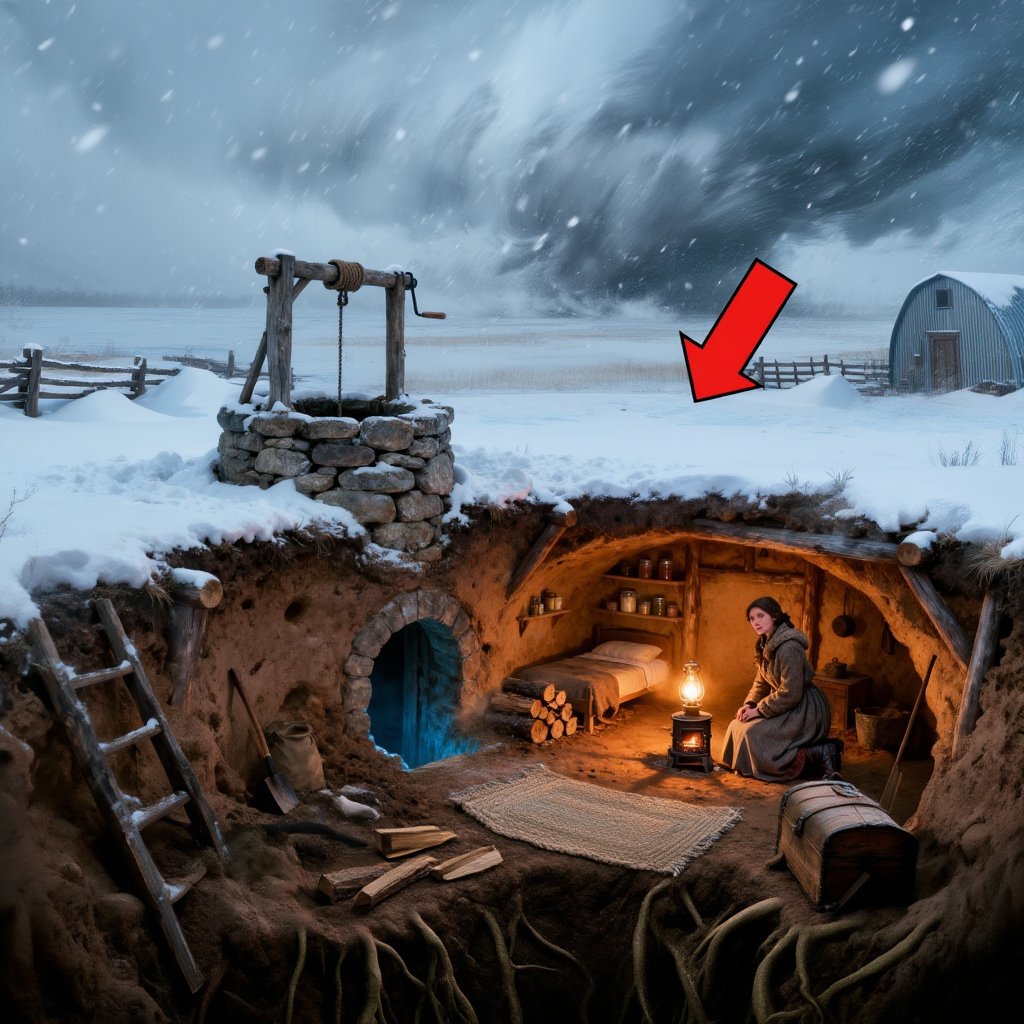
The main chamber was round, warm, and surprisingly spacious.
She built a simple wooden bed against one wall.
Shelves from salvaged planks.
Storage jars.
A woven rug.
A cedar chest.
And at the center…
A small black cast-iron stove.
When she lit it for the first time, orange firelight danced across the earthen walls.
Roots protruding from the ceiling looked almost alive.
And for the first time in years…
Eleanor felt safe.
Then January came.
And with it…
The Great Blizzard.
The storm arrived without warning.
One afternoon the sky turned black.
By evening the wind screamed.
By nightfall snow was falling sideways.
Farmers ran for shelter.
Livestock froze where they stood.
Roads disappeared.
Entire houses vanished behind walls of white.
The newspapers would later call it one of the worst storms in Wyoming history.
But Eleanor didn’t need newspapers.
She could hear it.
From deep underground.
The wind above sounded like thunder.
Snow hammered the earth.
The wooden crank groaned.
The barn screamed.
Then…
Silence.
Buried.
Completely buried.
Inside the earth, Eleanor sat beside her stove in a thick grey coat, lantern glowing softly atop the iron surface.
The chamber was warm.
Comfortable.
Almost peaceful.
A pot of rabbit stew simmered gently.
Shelves lined with jars of beans, dried meat, and preserves glowed in firelight.
Her bed was covered in clean white linen.
Firewood stacked neatly by the wall.
She listened to the storm with calm eyes.
Because she had prepared.
For weeks.
Maybe without even realizing why.
Her grandfather had known.
And now…
So did she.
The first three days passed easily.
She read Amos’s old Bible.
Cooked.
Slept.
Fed her mule in the storage chamber.
Added wood to the stove.
But on day four…
The ventilation shaft froze.
Smoke began filling the room.
Eleanor woke coughing.
Eyes burning.
Panic surged through her.
If the shaft stayed blocked…
The shelter would become her grave.
She grabbed her shovel.
Lantern.
Rope.
And climbed toward the upper tunnel.
Ice covered the shaft opening.
Snow had packed solid.
She hacked.
Dug.
Scraped.
Coughed.
Fell.
Climbed again.
For six hours she fought the frozen earth.
Until finally—
A burst of icy air exploded downward.
Fresh oxygen.
She collapsed laughing.
Alive.
The storm continued.
Day seven.
Day nine.
Day twelve.
No sunlight.
No visitors.
No world.
Only the warm orange glow of her stove.
And the blue shimmer of ice in the side tunnel she had discovered weeks earlier—a natural stone passage leading deeper into the hill.
Sometimes she explored it by lantern light.
The walls sparkled like frozen stars.
She wondered what else the earth still hid.
On day fourteen…
She heard knocking.
Faint.
Then louder.
Thunk.
Thunk.
Thunk.
She froze.
No one should have been alive out there.
She grabbed her lantern and climbed the ladder.
At the top of the shaft came muffled voices.
“Eleanor!”
“Eleanor Hayes!”
She shouted back.
And began digging upward.
An hour later sunlight pierced through.
Blinding.
And the faces of half the town looked down at her in disbelief.
Sheriff Coleman removed his hat.
“Sweet Lord…”
Another man whispered:
“She actually did it.”
The townspeople stared past Eleanor into the warm chamber below.
At the bed.
The shelves.
The stove.
The fire.
The life.
One woman covered her mouth.
“You’ve been living down there?”
Eleanor smiled.
“Comfortably.”
When the storm finally ended, Red Creek counted its losses.
Six barns collapsed.
Hundreds of cattle dead.
Three homes destroyed.
Food nearly gone.
And many families freezing.
Eleanor didn’t close her well.
She opened it.
She welcomed neighbors underground.
Children.
Widows.
Farmers.
Anyone who needed warmth.
Her dry well became the safest place for miles.
By the end of winter, people no longer called it Amos’s worthless hole.
They called it…
Hayes Hollow.
Years later, engineers came from Cheyenne to study it.
Newspapers wrote articles.
Architects sketched cross-sections.
Miners asked her advice.
Homesteaders copied her design.
And Eleanor Hayes—
the girl who inherited nothing—
became a legend across the frontier.
Not because she found treasure.
Not because she married rich.
Not because luck saved her.
But because when the world handed her a hole in the ground…
She looked into the darkness…
And built a home where everyone else saw emptiness.