
She Found Two Sioux Boys Lost in a Blizzard—Their Warrior Brother Rode Days Just to Thank Her
The wind began as a whisper against the cabin walls, a thin, restless sound that slipped through cracks and curled beneath the door like a warning. By nightfall, it had grown into something alive—howling, clawing, shaking the entire valley as if winter itself had decided to lay claim to the land.
Clara Whitmore had seen storms before. Living alone on the edge of the Dakota Territory demanded a kind of stubborn resilience most people back East would never understand. But this storm… this one felt different.
It wasn’t just the cold.
It was the silence beneath the wind.
She set another log on the fire, the flames snapping sharply, throwing shadows across the small one-room cabin. Her breath fogged faintly despite the heat. Outside, snow struck the windows like thrown sand.
“Just another night,” she murmured to herself, though her voice didn’t quite believe it.
Clara pulled her shawl tighter and turned toward the table, where a half-mended coat lay waiting. Keeping busy helped keep the fear at bay. Out here, fear had a way of growing teeth if you let it linger too long.
Then she heard it.
A sound—faint, buried beneath the storm.
She froze.
There it was again.
Not the wind.
Not the creak of wood.
A cry.
Clara moved slowly at first, her heart beginning to pound. She stepped toward the door, pausing with her hand on the latch.
“You’re imagining things,” she whispered.
But the cry came again—sharper this time.
A child.
Without another thought, she yanked the door open.
The storm hit her like a wall. Snow and wind swallowed her instantly, stealing her breath, blinding her eyes. She braced herself against the doorframe and squinted into the white chaos.
“Hello?!” she shouted.
The wind swallowed her voice whole.
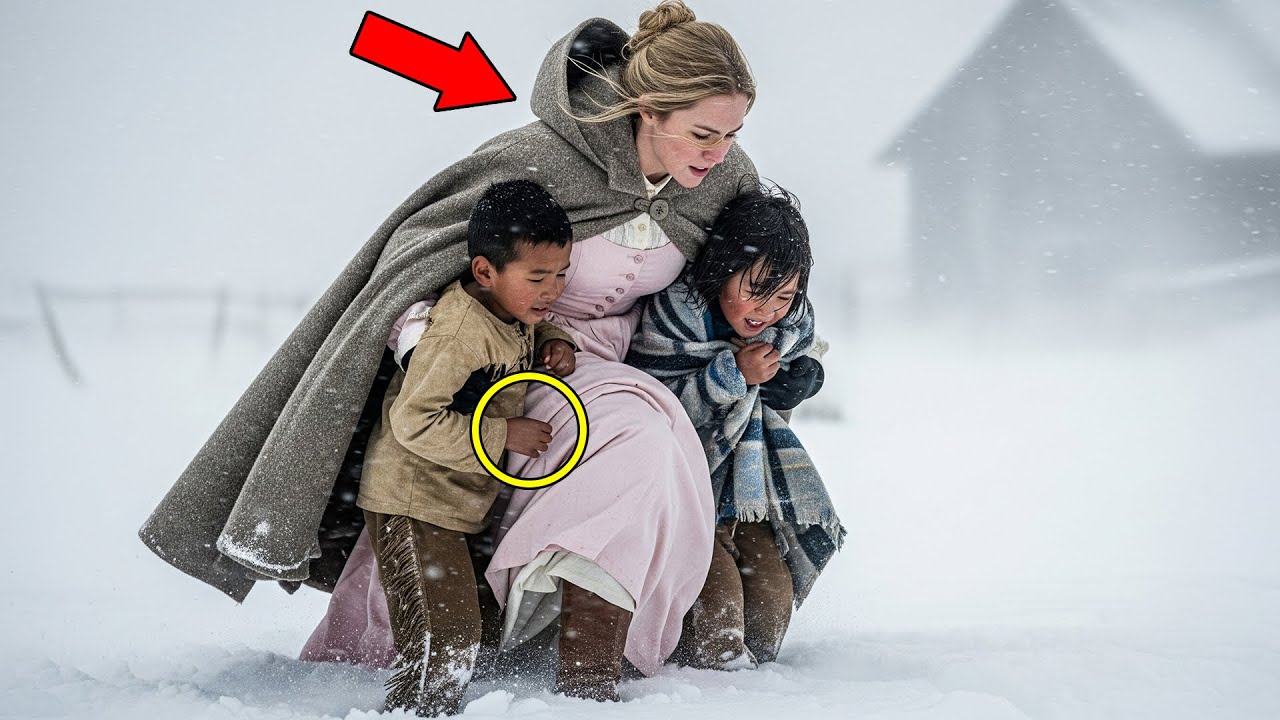
She stepped out anyway.
Each step sank deep into the snow, the cold biting through her boots. She could barely see beyond a few feet, but she moved forward, turning her head, listening.
Then—movement.
A small shape stumbled in the distance.
Clara lunged toward it, nearly slipping. As she drew closer, the shape split into two.
Two boys.
They were wrapped in thin, snow-caked hides, their dark hair plastered to their faces, their skin pale beneath the frost. One was older—perhaps ten—struggling to hold up the younger, who could barely stand.
“Oh God…” Clara gasped.
She rushed to them, dropping to her knees.
“It’s alright—come here, come here!” she said, though she knew they might not understand.
The older boy flinched, his eyes wide with fear and defiance. He tried to pull away, placing himself between her and the younger one.
“It’s okay,” Clara said gently, raising her hands. “I won’t hurt you.”
The younger boy collapsed.
That was all it took.
Clara gathered him in her arms. He was frighteningly light, his body limp with cold. The older boy hesitated only a moment before following, stumbling beside her as she fought her way back toward the cabin.
Each step felt like a battle. The wind pushed, the snow dragged, and the weight in her arms grew heavier with every breath.
“Stay with me,” she muttered to the unconscious boy. “Stay with me…”
At last, the cabin door loomed out of the storm.
She burst inside and slammed it shut behind them.
Warmth—blessed, fragile warmth—wrapped around them.
Clara wasted no time.
She laid the younger boy near the fire, stripping away his frozen coverings. His skin was ice-cold, his lips tinged blue.
“Please… please…” she whispered, rubbing his arms, trying to bring life back into them.
The older boy hovered nearby, trembling, his eyes never leaving her hands.
“It’s alright,” Clara said softly, glancing up at him. “I’m helping him.”
He didn’t respond, but he didn’t run either.
Clara worked quickly—wrapping the younger boy in blankets, warming water, pressing heated cloths against his skin. She coaxed a few drops of broth between his lips.
Minutes passed.
Then an hour.
Finally, the boy coughed.
Clara nearly sobbed with relief.
“There you go,” she breathed. “That’s it…”
The older boy let out a sound—a sharp, broken exhale—and sank to his knees beside his brother.
Only then did Clara notice how badly he was shaking.
“Come here,” she said, reaching for him.
He hesitated again, then slowly allowed her to guide him closer to the fire.
That night, the storm raged on, but inside the cabin, something else took hold.
Survival.
—
The boys spoke little English.
Over the next two days, as the storm trapped them all inside, Clara pieced together what she could.
They were Sioux.
Brothers.
Lost.
The older one—who she came to understand was called Mato—had tried to lead his younger brother, Chaska, back to their camp when the storm struck. But the land had vanished beneath the snow, and direction had become meaningless.
They had wandered for hours.
Then for longer than hours.
Until there was nowhere left to go.
Clara didn’t ask how far they had come.
She wasn’t sure she wanted to know.
Instead, she fed them, warmed them, and gave them a place to rest.
At first, Mato watched her constantly, suspicion etched into every line of his young face. But Chaska, once recovered, began to smile.
It started small.
A glance.
A quiet laugh when Clara slipped on a wet patch of floor.
By the third day, he was talking—broken words mixed with gestures, telling stories Clara only half understood but fully felt.
Mato softened, too.
Slowly.
Cautiously.
Like a frozen river beginning to thaw.
—
When the storm finally passed, the world outside had been transformed.
Snow stretched endlessly in every direction, smooth and blinding under the pale winter sun.
Clara stood at the doorway, the boys beside her.
“We’ll have to find your people,” she said gently.
Mato nodded.
He understood that much.
The journey wasn’t easy. The snow was deep, the cold still bitter, but the sky was clear, and the land—though changed—was visible again.
Clara bundled them carefully and set out, following Mato’s lead as best she could.
Hours passed.
Then more.
Just as doubt began to creep in, Mato stopped.
He raised a hand.
In the distance—faint but unmistakable—thin trails of smoke curled into the sky.
Clara let out a breath she hadn’t realized she’d been holding.
“Home,” she said softly.
Mato turned to her, his expression unreadable for a moment.
Then he nodded.
—
The Sioux camp was alive with movement when they approached.
Figures emerged from the lodges, their silhouettes sharp against the snow. Voices rose—shouts, cries—some filled with relief, others with alarm.
Clara stopped a short distance away.
“This is as far as I go,” she said quietly.
Mato looked at her.
For a moment, neither of them moved.
Then Chaska broke free and ran forward.
“Chaska!” a woman cried, rushing toward him, falling to her knees as she gathered him into her arms.
The camp erupted.
Mato followed, slower, but no less certain.
Before he reached them, he paused.
He turned back.
Clara stood alone in the snow, her breath visible in the cold air.
Mato walked back to her.
He placed a hand over his heart, then extended it toward her.
Clara felt her throat tighten.
She mirrored the gesture.
“Take care of him,” she said softly, though she knew he might not understand the words.
But he understood the meaning.
Then he turned and went home.
—
Clara returned to her cabin that evening, the silence heavier than before.
The storm was gone, but something lingered—an emptiness where two small voices had been.
She told herself it was for the best.
They were safe.
That was enough.
Days passed.
Then weeks.
Winter began to loosen its grip, though the cold still clung stubbornly to the land.
Clara fell back into her routines.
But sometimes, at night, she found herself listening for footsteps that never came.
—
It was nearly a month later when she heard the sound.
Not the wind.
Not a cry.
But the steady rhythm of hooves.
Clara stepped outside.
A rider approached through the fading light.
Tall.
Broad-shouldered.
Wrapped in furs, his posture straight and commanding.
He reined in his horse a short distance from the cabin and dismounted in one smooth motion.
For a moment, they simply looked at each other.
Then he stepped forward.
Up close, Clara could see the resemblance—the same dark eyes as the boys.
He spoke, his voice low and measured.
“I am Takoda,” he said. “Brother.”
Clara blinked in surprise.
“You… speak English.”
“A little.”
He paused, searching for the words.
“You saved them.”
It wasn’t a question.
Clara nodded.
“They found me,” she said quietly.
Takoda studied her for a long moment.
Then, without another word, he reached into a pouch at his side and withdrew something small.
He stepped closer and placed it in her hand.
It was a carved piece of bone—intricate, delicate, shaped into the form of a bird.
Clara looked up.
“I can’t—”
“You can,” he said firmly.
“It is… thanks.”
She hesitated, then closed her fingers around it.
“Thank you,” she said softly.
Takoda inclined his head.
“I rode many days,” he added.
Clara’s eyes widened slightly.
“For this?”
“For you,” he corrected.
The wind stirred gently around them, no longer cruel, no longer angry.
Just a reminder of what had been.
Takoda stepped back.
“My brothers live because of you,” he said. “That is not forgotten.”
Clara felt something shift inside her—a quiet warmth that had nothing to do with the fire waiting inside.
“They’re good boys,” she said.
He allowed the faintest hint of a smile.
“Yes.”
He mounted his horse, pausing only once more.
“If you ever need…” he began, then stopped, as if the words were unnecessary.
Clara nodded anyway.
“I understand.”
And she did.
With that, he turned and rode into the fading light, his figure slowly swallowed by the vast, open land.
Clara stood there long after he was gone.
The bird carving rested warm in her palm.
And for the first time since the storm, the silence didn’t feel quite so empty.
She Found Two Sioux Boys Lost in a Blizzard—Their Warrior Brother Rode Days Just to Thank Her (Part 2)
The carving never left Clara’s side.
She kept it on the small wooden shelf above her bed at first, turning it in her fingers each night before sleep. The tiny bird—its wings curved as if caught mid-flight—felt smooth from careful shaping, yet strong, unbreakable. Like something meant to endure.
Like the memory of that storm.
Spring came slowly to the Dakota plains, melting the snow in reluctant patches. The world revealed itself again—brown earth, stubborn grass, the first trickle of thawing streams. Clara worked from sunrise to dusk, repairing fences, tending to her small garden, and patching the roof where winter had tested its strength.
Life returned to its rhythm.
But something had changed.
She noticed it in the way she paused when she heard distant movement—not with fear anymore, but with curiosity. In the way she found herself scanning the horizon at dusk, as if expecting a rider to appear again.
Takoda never came back.
And yet, his presence lingered.
—
It was early one morning, just as the sky turned pale gold, when Clara heard it again.
Hoofbeats.
She stepped outside, her heart quickening.
But this time, it wasn’t Takoda.
Two figures approached—smaller, familiar.
“Mato?” she called.
The older boy grinned, raising a hand.
“Clara!” Chaska shouted, his voice bright with excitement.
Before she could react, he leapt from the horse—too fast, too eager—and nearly stumbled in the grass before running straight toward her.
Clara laughed, catching him in a tight embrace.
“You’re supposed to dismount properly,” she said, pulling back to look at him.
He beamed, clearly understanding only half the words but all of the warmth.
Mato approached more calmly, though his eyes carried the same light.
“You come,” he said carefully.
Clara blinked.
“Come?”
He nodded, pointing back toward the distant hills.
“Family. Want… see you.”
Clara hesitated.
The land between her cabin and their camp stretched wide—not dangerous, not anymore, but still uncertain. She had always lived at the edge of things, not within them.
“I don’t know if I should,” she admitted softly.
Mato stepped closer.
“Takoda say… you come. Good.”
That settled something in her.
Clara looked back at her cabin—the worn wood, the quiet porch, the life she had built alone.
Then she looked at the boys.
“Alright,” she said. “Let me get my things.”
—
The journey felt different this time.
Warmer.
The snow had retreated, replaced by soft earth and the scent of growing things. Birds called from distant trees, and the sky stretched wide and blue above them.
Chaska talked nearly the entire way—pointing out landmarks, mimicking animals, laughing at things Clara couldn’t quite understand but joined anyway.
Mato rode ahead at times, watchful but no longer distant.
They reached the camp by late afternoon.
Clara slowed her steps as they approached, her heart steady but uncertain.
This was not her world.
Not truly.
But it wasn’t unfamiliar anymore either.
This time, there was no alarm when she entered.
Only recognition.
The same woman who had embraced Chaska before—his mother, Clara assumed—approached first. Her expression was softer now, her eyes warm with something Clara didn’t need words to understand.
Gratitude.
She reached out, taking Clara’s hands gently.
A quiet exchange passed between them—no shared language, but no misunderstanding either.
Clara smiled.
“It’s good to see you again,” she said softly.
Behind her, voices stirred, and more people gathered—not crowding, not overwhelming, just… present.
Welcoming.
And then Takoda appeared.
He stepped from between the lodges, his gaze steady as it found hers.
For a moment, the world seemed to still.
“You came,” he said.
Clara gave a small smile.
“Your brothers insisted.”
Chaska puffed up proudly at that.
Takoda’s eyes softened, just slightly.
“Good,” he replied.
—
Clara stayed longer than she had intended.
One day turned into two.
Then three.
She was given a place by the fire, meals shared without question, quiet company in the evenings as stories passed between voices she could not fully understand but somehow still felt a part of.
She watched the way the camp moved—together, connected, each person a thread in something larger.
It stirred something deep within her.
A memory of belonging she hadn’t realized she had lost.
Takoda spoke with her when he could, his English limited but improving with each careful word.
“You live alone,” he said one evening, sitting across from her as the fire crackled between them.
“Yes.”
He studied her for a moment.
“Why?”
Clara considered the question.
“I suppose… it’s what I learned to do,” she said. “Survive on my own.”
Takoda nodded slowly.
“Strong,” he said.
She let out a small laugh.
“Or stubborn.”
He almost smiled.
—
On the fourth morning, Clara knew it was time to leave.
Her cabin, her land—they still needed her.
And as much as this place had begun to feel… warm, it was not hers to claim.
Mato and Chaska walked with her to the edge of the camp.
“You come again?” Chaska asked, his voice hopeful.
Clara crouched slightly to meet his eyes.
“I’d like that,” she said.
Mato nodded, satisfied.
But Takoda did not walk beside them.
He waited near his horse, already prepared.
“I will ride with you,” he said as she approached.
“You don’t have to,” Clara replied.
“I know.”
There was no argument after that.
—
They rode in quiet for a long while.
The land stretched open around them, the wind gentle, carrying the scent of spring.
“You are different,” Takoda said finally.
Clara glanced at him.
“How so?”
“You do not fear us.”
She thought about that.
“At first, I didn’t know what to feel,” she admitted. “But your brothers… they needed help. That was all that mattered.”
Takoda nodded.
“Many would not choose that.”
Clara shrugged lightly.
“Then many would be wrong.”
That earned a faint smile.
They reached her cabin by midday.
It stood just as she had left it—small, sturdy, alone.
Clara dismounted, brushing her hands against her skirt.
“Well,” she said softly, “this is me.”
Takoda looked at the cabin, then back at her.
“You are alone here,” he said again.
There was something different in his tone this time.
Not just observation.
Concern.
Clara met his gaze.
“I was,” she said.
A quiet understanding passed between them.
Takoda stepped closer.
“If danger comes,” he said, “you ride south. You will find us.”
Clara nodded.
“And if you need help,” she added, “you know where I am.”
He studied her for a moment, then inclined his head.
“Good.”
He turned to leave, placing a hand on his horse—
Then paused.
He looked back.
“Clara.”
“Yes?”
“You are not alone.”
The words settled deep.
Not loud.
Not dramatic.
Just true.
Clara felt her chest tighten slightly, though she smiled.
“Neither are you,” she replied.
Takoda held her gaze for a moment longer.
Then he mounted his horse and rode away.
—
Summer came.
And with it, change.
Not sudden.
Not overwhelming.
But steady.
Clara found herself riding south more often—sometimes with purpose, sometimes simply because she wanted to.
And each time, she was welcomed.
Not as a stranger.
Not as an outsider.
But as something in between.
Something becoming.
Mato and Chaska grew bolder, their English improving, their laughter louder. Takoda remained steady as ever—but there was an ease to him now when she was near.
A trust.
One evening, as the sun dipped low and painted the sky in gold and fire, Clara stood at the edge of the camp beside him.
“You never told me why you rode all that way,” she said quietly.
Takoda glanced at her.
“I did.”
She shook her head.
“You said it was to thank me.”
“Yes.”
“That’s not all of it.”
He was silent for a long moment.
Then:
“In our way,” he said slowly, “a life saved… is not forgotten. It becomes part of your story.”
Clara listened.
“You saved my brothers,” he continued. “So now… you are part of ours.”
The words settled over her like the first snowfall of winter.
Soft.
Certain.
Unavoidable.
Clara looked out at the land—the endless horizon, the place that had once felt so empty.
It didn’t anymore.
Not even close.
And for the first time, she realized something simple.
She hadn’t just found two lost boys in a storm.
She had found something she didn’t know she was searching for.
A place.
A connection.
A beginning.
The wind stirred gently through the grass.
And this time—
It carried warmth.