
She Cried Amid the Dead —A Cowboy’s Courage Changed Her Life Forever
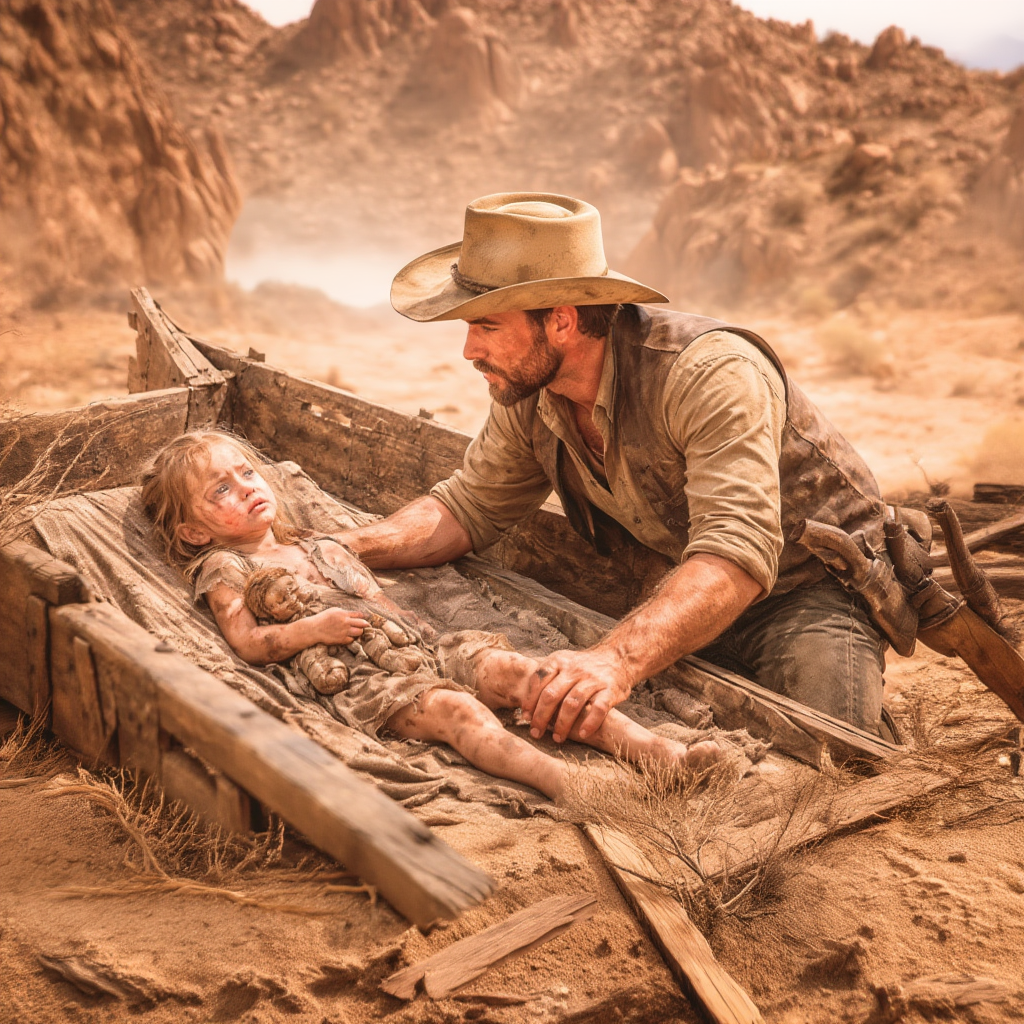
The wind had a way of erasing things in the Arizona badlands—tracks, voices, even memory. By afternoon, the dust rolled in sheets across the dry earth, swallowing the horizon until the world looked like a faded photograph. That was how Caleb Mercer found her: half-hidden by sand, lying in the broken bed of a splintered wagon, crying so quietly it nearly vanished into the wind.
Caleb had been riding since dawn. His horse, Dusty, moved slow and careful over the rocky ground, nostrils flaring at the smell of smoke that still lingered in the air. Something bad had happened out here—he could feel it long before he saw it. Burned canvas. Broken crates. A wheel snapped clean off a wagon. And then… stillness.
Too still.
He slid from the saddle and walked forward, boots crunching over scattered belongings: a tin cup, a torn blanket, a child’s shoe. He’d seen scenes like this before—raiders, sometimes bandits, sometimes just men desperate enough to become monsters. He scanned the ground, jaw tightening. Bodies lay half-covered in dust, three of them near the wagon, another farther out where he must have tried to run.
Caleb removed his hat.
“Lord…” he murmured.
Then he heard it.
A faint sound. Not wind. Not wood creaking. A small, broken whimper.
He froze.
The sound came again.
Caleb moved carefully toward the overturned wagon. One of the sideboards had collapsed inward, creating a shallow cradle of splintered wood. Inside it, barely visible beneath dirt and cloth, lay a little girl.
Her blonde hair was tangled with dust. Her cheeks were streaked with mud and tears. She clutched a rag doll so tightly her knuckles were white. Her eyes—wide, terrified, and glassy—looked straight at him.
She didn’t scream. She didn’t move.
She just cried.
Caleb crouched slowly, hands open.
“Hey there,” he said softly. “You’re alright. I ain’t gonna hurt you.”
Her lower lip trembled. She glanced past him toward the bodies scattered across the ground. Her tiny shoulders shook.
“They… they won’t wake up,” she whispered.
The words hit harder than any bullet.
Caleb swallowed, forcing calm into his voice. “What’s your name, sweetheart?”
“…Emily.”
“That’s a good name. I’m Caleb.”
She blinked, as if trying to decide whether he was real. Her fingers tightened around the doll.
“They shot Papa,” she said, voice cracking. “Mama tried to run. I hid. Mama told me… don’t come out. Don’t make a sound.”
Her breath hitched.
“I waited… but they didn’t come back.”
Caleb felt something twist deep in his chest. He had seen war, drought, and men buried too young. But nothing hardened a man enough for a child sitting alone among the dead.
“You did real good, Emily,” he said gently. “You were brave. Braver than most grown folks.”
She stared at him, eyes wet. “Are they… sleeping?”
Caleb hesitated. He couldn’t lie—not fully. But he also couldn’t break her.
“They’re… at rest,” he said softly. “They ain’t hurting anymore.”
Emily looked down at her doll. “Mama said cowboys help people.”
Caleb gave a faint, sad smile. “Your mama was right.”
He reached out slowly. “Can I pick you up?”
She nodded, just barely.
When he lifted her, she was lighter than he expected—too light. She smelled of dust and fear. The moment she was in his arms, she clung to him, pressing her face into his shirt. Her crying finally broke loose, loud and raw.
Caleb held her tight.
“It’s alright,” he murmured. “You’re safe now. I got you.”
The wind swept over the badlands, but this time, the sound of her sobbing didn’t disappear.
It carried.
—
Caleb buried them before sunset.
He found what he could—blankets, pieces of wood, stones to mark the graves. Emily sat nearby on a folded saddle blanket, silent now, watching him with hollow eyes. Every so often she whispered something to her doll.
Caleb worked until his hands blistered.
When it was done, he stood beside the small row of mounds. Emily walked slowly over, her tiny boots dragging.
“Can Mama see me?” she asked.
Caleb knelt beside her. “I reckon she can.”
Emily placed the doll on the nearest grave.
“She gets cold,” she said.
Caleb looked away, blinking hard.
They left at dusk.
Emily rode in front of him, wrapped in his coat. She didn’t speak much. Once, she asked if he had a house. He told her yes—a small ranch two days west.
“Can I stay?” she whispered.
Caleb didn’t answer right away.
He had lived alone since his wife died five years earlier. No children. No laughter. Just cattle, wind, and long nights.
But as Emily leaned against him, fragile as a sparrow, the answer came without thinking.
“You can stay as long as you want,” he said quietly.
She fell asleep before the stars came out.
—
The ranch looked different with a child in it.
Emily walked slowly through the doorway the next morning, her eyes scanning everything—the iron stove, the wooden table, the faded quilt on the bed.
“It’s quiet,” she said.
Caleb poured water into a tin cup. “That alright?”
She nodded.
For the first few days, she barely spoke. She followed him like a shadow—into the barn, out to the fence, even while he chopped wood. She watched everything he did, as if memorizing it.
One evening, Caleb burned stew.
Emily wrinkled her nose. “Mama didn’t burn stew.”
Caleb chuckled. “I reckon your mama was a better cook.”
She paused, then tugged his sleeve. “I can help.”
From that day forward, she did.
She stirred pots. Carried eggs. Fed chickens. Slowly, the silence in the ranch filled with small sounds—her footsteps, her humming, her quiet questions.
One night, a storm rolled in. Thunder cracked across the sky. Emily ran to him, eyes wide.
“Will they come back?” she asked.
“Who?”
“The men.”
Caleb crouched and placed a hand on her shoulder. “No. Ain’t nobody gonna hurt you here.”
She studied his face, searching for doubt.
Then she wrapped her arms around his neck.
“I believe you,” she whispered.
—
Winter came early that year.
Snow blanketed the plains, turning the ranch into a quiet white world. Emily pressed her nose to the window every morning, amazed.
“It looks like sugar,” she said.
Caleb laughed. “Don’t eat it.”
She grinned—the first real smile he’d seen.
Weeks passed. The grief never vanished, but it softened. Emily started laughing more. She named the chickens. She followed Caleb on short rides. She even began sleeping through the night.
One afternoon, Caleb returned from checking fences and found Emily outside, kneeling in the snow.
“What you doing?” he called.
She pointed.
Two small stones stood in the yard, side by side.
“I made Mama and Papa,” she said. “So they’re not far.”
Caleb’s throat tightened.
He walked over and placed his hat over his heart.
“They’d be proud of you,” he said.
Emily looked up. “Would they be proud of you too?”
He blinked. “Why me?”
“Because you saved me.”
Caleb shook his head slowly. “No, Emily. You saved me.”
She frowned. “How?”
He looked at the ranch—the smoke from the chimney, the footprints in the snow, the life that had returned.
“This place was empty before you came,” he said softly.
Emily thought about that, then slipped her small hand into his.
“It’s not empty anymore.”
—
Spring thawed the land, and with it came change.
One morning, a rider approached the ranch. A woman from town. She carried papers, spoke gently, asked questions. Word had spread about the orphan girl.
“There’s a family willing to take her,” the woman said. “Good people. Stable home.”
Caleb nodded slowly.
Emily clutched his hand.
“Do I have to go?” she whispered.
Caleb knelt beside her. His heart felt like it was splitting open.
“You deserve a choice,” he said.
Emily looked between them.
Then she hugged him tight.
“I choose you.”
The woman smiled softly. “Then we’ll make it official.”
Caleb blinked. “Official?”
“Adoption,” she said.
He stared at Emily—dust-streaked memory now replaced by a child with bright eyes and hope.
“You sure?” he asked.
She nodded firmly. “You’re my cowboy.”
Caleb laughed, voice breaking. “Then I reckon you’re my daughter.”
—
Years later, people in town still told the story.
About the day a cowboy found a girl crying among the dead.
About how he carried her home.
About how she filled the silence with life.
Emily grew strong. Brave. Kind. She helped neighbors, cared for animals, and never passed a lonely soul without offering warmth.
And every evening, she sat beside Caleb on the porch, watching the sun sink beyond the plains.
“You saved me,” she’d say.
Caleb would shake his head.
“No,” he’d reply. “You cried… and I listened. That’s all.”
But they both knew the truth.
In a world where the wind erased everything, one moment of courage had changed two lives forever.