
She Built a Hidden Shed Under Her Cabin — Then It Saved Her During a Snowstorm
The first winter Emily Carter spent alone in the mountains, she learned two things: silence could feel louder than a crowded city, and snow had a way of swallowing the world whole.
Her cabin stood at the edge of a pine forest in northern Montana, miles away from the nearest town. It wasn’t much—just rough timber walls, a stone chimney, and a slanted roof that creaked whenever the wind pushed too hard. But it was hers.
She had bought it with the last of her savings after leaving behind a life that had slowly unraveled—an office job that drained her spirit, a relationship that ended with more silence than closure, and a city that never noticed when she disappeared.
Up here, at least, the quiet felt honest.
Still, she wasn’t naïve. Emily had spent months preparing before moving in. She read survival guides, watched tutorials, and learned from old-timers at a hardware store in town. Most people had smiled politely at her plans. Some had warned her outright.
“Winters up here don’t forgive mistakes,” one man had said, leaning over the counter as he rang up her supplies.
Emily didn’t argue. She just nodded—and bought more than she thought she’d need.
That was how the idea of the hidden shed began.
It wasn’t something she’d seen in a book. It came from a mix of fear and stubbornness. What if the cabin roof collapsed under heavy snow? What if the door got blocked? What if she couldn’t get out—or worse, couldn’t stay warm enough to survive?
So she started digging.
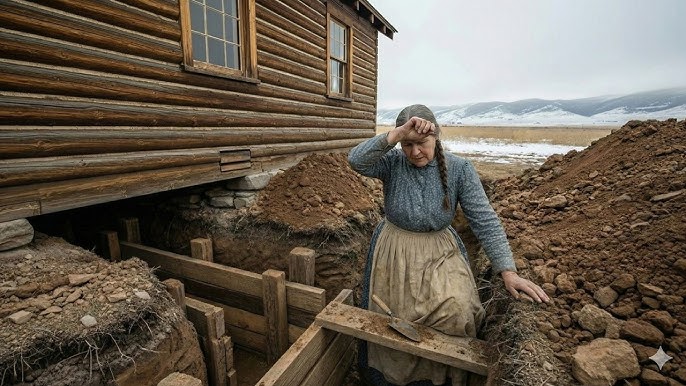
Behind the cabin, beneath a section of ground that sloped gently downward, Emily carved out a small, hidden space. It took her weeks. Her hands blistered, her back ached, and more than once she questioned her own sanity.
But slowly, a structure took shape.
She reinforced the walls with wood beams, insulated it with whatever materials she could find, and installed a narrow, concealed entrance from inside the cabin—hidden beneath a rug and a trapdoor she built herself. From the outside, there was a second exit, disguised under a pile of logs and snow.
Inside the shed, she stored essentials: blankets, canned food, a small propane heater, extra firewood, a flashlight, and a battery-powered radio.
It wasn’t comfortable. It wasn’t meant to be.
It was her last line of defense.
By the time the first snow fell, Emily had almost forgotten how much work she had put into it.
Winter arrived quietly at first. Light flakes drifted down, covering the trees in a soft white dusting. The world looked peaceful—almost magical. Emily spent her mornings chopping wood, her afternoons reading by the fire, and her evenings listening to the wind whisper through the forest.
For a while, she felt like she had found something rare: a life that belonged entirely to her.
Then January came.
The storm hit without warning.
One evening, the sky darkened earlier than usual. The wind picked up, rattling the windows and howling through the cracks in the walls. Emily stepped outside just before sunset, her boots crunching against the frozen ground.
The air felt wrong—too still beneath the rising wind, too heavy.
She looked at the horizon and saw it: a wall of white moving fast.
By the time she got back inside, the first wave had already arrived.
Snow slammed against the cabin, driven by fierce gusts that sounded like something alive trying to break in. Within minutes, visibility dropped to almost nothing. The world outside disappeared behind a swirling chaos of white and gray.
Emily moved quickly. She secured the shutters, checked the fire, and gathered extra blankets. She had prepared for storms before—but this felt different.
Stronger.
Relentless.
The radio crackled to life as she turned it on.
“…severe blizzard warning… winds exceeding sixty miles per hour… residents advised to shelter in place…”
The signal faded in and out, but the message was clear.
This wasn’t just a storm.
It was the kind that buried roads, knocked out power, and left people stranded for days.
Emily swallowed hard, her eyes drifting to the rug on the floor—the one covering the trapdoor.
Not yet, she told herself.
The cabin should hold.
Hours passed.
The storm didn’t let up.
Snow piled against the walls, pressing inward. The wind screamed like a living thing, rattling every inch of the structure. The fire flickered as cold air seeped through unseen gaps.
Then came the sound that made her heart stop.
A deep, cracking groan from above.
Emily froze.
Another crack followed—louder this time.
The roof.
Snow had been building up faster than she expected. Too fast.
She grabbed her coat and flashlight, her hands shaking despite her efforts to stay calm. For a moment, she stood in the center of the cabin, listening.
The storm roared.
The roof creaked.
And something inside her—something instinctive and urgent—made the decision for her.
Now.
She pulled the rug aside, revealing the trapdoor. It stuck for a second before giving way with a sharp tug. Cold air rushed up from below as she climbed down the narrow ladder into the hidden shed.
Once inside, she pulled the door shut above her.
The difference was immediate.
The noise softened. The wind became distant, muted by layers of earth and wood. It wasn’t silent—but it was bearable.
Emily exhaled slowly, her breath visible in the dim light of her flashlight.
She lit a small lantern and took in her surroundings.
The shed was cramped, but everything was where she had left it. Supplies lined the walls. Blankets were stacked in the corner. The small heater sat ready, waiting.
For the first time since the storm began, she felt a flicker of control.
Minutes later, a thunderous crash shook the ground above her.
Emily flinched, her heart pounding.
Dust drifted down from the ceiling. The sound echoed through the small space, followed by a heavy, suffocating silence.
She didn’t need to see it to know what had happened.
The cabin roof had given in.
If she had stayed upstairs…
Emily closed her eyes, the thought unfinished but painfully clear.
Hours turned into a long, uncertain stretch of time. She lost track of it—measuring only by the dimming of the lantern and the steady rhythm of her breathing.
The storm continued, relentless.
But the shed held.
Wrapped in blankets, Emily sat with her back against the wall, listening to the muffled chaos above. Fear came in waves—sharp and sudden—but each time, she forced herself to focus on what she could control.
Her breathing.
The warmth of the heater.
The knowledge that she had prepared for this.
At some point, exhaustion pulled her into a restless sleep.
When she woke, the world was quiet.
Not silent—never truly silent—but different.
The wind had died down.
Cautiously, Emily climbed the ladder and pushed against the trapdoor.
It didn’t budge.
Snow.
Of course.
She tried again, harder this time. The door shifted slightly, but the weight above was too much.
Her chest tightened.
Think.
She climbed back down and moved to the secondary exit—the one leading outside. It was narrower, more concealed, but it was there for exactly this reason.
She cleared the latch and pushed.
For a moment, nothing happened.
Then, with a heavy resistance, the door gave way.
A flood of light spilled in, blinding after the dim interior.
Emily stepped out into a world transformed.
Snow covered everything—deep, endless, and untouched. The forest stood frozen in place, branches heavy under the weight. The sky was pale, the storm reduced to a distant memory.
She turned toward where her cabin had been.
Or where it should have been.
Part of the roof had collapsed entirely, the structure half-buried under layers of snow. The front door was completely blocked, invisible beneath the drift.
A chill ran through her—not from the cold, but from the realization of how close she had come.
One wrong decision.
One moment of hesitation.
She might have been trapped inside.
Or worse.
Emily stood there for a long time, the wind gently brushing against her face, the silence stretching out around her.
Then, slowly, she smiled.
Not out of relief alone—but out of something deeper.
She had trusted herself.
When she first started digging that hidden shed, people had doubted her. Even she had doubted herself at times. It had seemed excessive, unnecessary—maybe even a little paranoid.
But she had listened to that quiet voice inside her, the one that said: prepare anyway.
And that voice had saved her life.
Over the next few days, Emily worked to clear the snow and repair what she could. It wasn’t easy. The damage to the cabin was significant, and the cold made every task harder.
But she wasn’t alone—not really.
Every swing of the shovel, every piece of wood she lifted, carried a sense of purpose she hadn’t felt in years.
She wasn’t just surviving.
She was building something stronger.
At night, she slept in the shed—not out of fear, but out of respect for what it had given her. It wasn’t just a backup plan anymore.
It was proof.
Proof that resilience wasn’t about being fearless.
It was about being ready.
Weeks later, when the roads finally cleared and a neighbor from miles away stopped by to check on her, he stared at the damaged cabin and then at the small, hidden entrance half-covered in snow.
“You built that?” he asked, disbelief in his voice.
Emily nodded.
He shook his head slowly. “That storm… it took down stronger places than this.”
She glanced at the shed, a quiet pride settling in her chest.
“Yeah,” she said softly. “But not this one.”
And as the wind moved gently through the trees, carrying the last whispers of winter away, Emily Carter knew she had found more than just a place to live.
She had found her strength—buried beneath fear, carved out with her own hands, and waiting patiently for the moment it would be needed most.
She Built a Hidden Shed Under Her Cabin — Then It Saved Her During a Snowstorm (Part 2)
Spring didn’t arrive all at once.
It crept in slowly, like a shy guest unsure of its welcome. The snow softened first—edges rounding, surfaces sinking. Then came the dripping. Long, steady drops falling from the broken edges of Emily Carter’s cabin roof, tapping against the ground like a quiet clock counting down the end of winter.
Emily stood outside one morning, her breath no longer visible, and tilted her face toward the pale sun.
She had made it.
But surviving the storm was only the beginning.
The cabin, once her sanctuary, now looked like a wounded animal struggling to stand. Half the roof had collapsed inward, crushing part of the living space. Snow had melted into everything—soaking wood, warping beams, leaving behind a cold, damp smell that clung to the air.
Most people would have left.
Emily didn’t.
Instead, she adapted.
The hidden shed—the place she had built out of fear—became her temporary home. She expanded it in the following weeks, digging a little farther into the earth, reinforcing the walls, adding more insulation. What had once been a cramped emergency shelter slowly transformed into something more permanent.
More intentional.
She built a proper sleeping platform, added hooks for her tools, and even carved out a small nook where she could sit and write. The space was still simple, but it held warmth in a way the damaged cabin no longer could.
Above ground, she worked every day to repair what she could.
Some beams were salvageable. Others had to be replaced entirely. Emily made trips into town whenever the roads allowed it, trading labor for supplies, learning from people who had spent their entire lives in the mountains.
They didn’t laugh at her anymore.
Word had spread about how she survived the storm.
“The woman with the underground shelter,” they called her.
She didn’t correct them.
Because the truth was, that shelter had become more than just a structure.
It was a second chance.
One afternoon, as Emily worked on clearing debris from the cabin’s interior, she heard something unusual.
A sound that didn’t belong.
Not the wind. Not the creak of wood.
A voice.
Faint, distant—but unmistakably human.
Emily froze, her grip tightening on the piece of timber she was holding.
“Hello?” she called out cautiously.
No answer.
She stepped outside, scanning the tree line. For a moment, there was nothing but stillness.
Then—
“Hey! Over here!”
The voice came again, clearer this time.
Emily followed the sound, moving carefully through the uneven snow. About fifty yards from her cabin, near the edge of the forest, she spotted movement.
A man.
He was leaning against a tree, one leg bent awkwardly, his coat torn and dusted with snow. Beside him stood a boy—maybe ten or eleven years old—clutching a backpack and looking pale with exhaustion.
Relief washed over their faces when they saw her.
“Please,” the man said, his voice hoarse. “We’ve been walking for hours… we thought we saw smoke.”
Emily didn’t hesitate.
“Come on,” she said, moving toward them. “You need to get inside.”
Their names were Daniel and Luke Harper.
They had been traveling through the mountains when their truck broke down miles away. What was supposed to be a short hike to find help had turned into something far worse when they lost their bearings in the snow.
By the time they found Emily’s cabin, they were running on nothing but instinct.
Emily brought them into the shed.
At first, Daniel looked confused as she lifted the hidden entrance and guided them down. But when he stepped inside and felt the warmth, the shelter, the safety—it hit him all at once.
“You built this?” he asked, his voice filled with disbelief.
Emily nodded, already pulling out blankets and heating water.
“It’s not much,” she said, “but it’ll keep you warm.”
“It’s everything,” he replied quietly.
That night, the three of them sat together in the small underground space.
Luke had fallen asleep quickly, curled up under layers of blankets. Daniel sat across from Emily, his expression thoughtful as he looked around the shed.
“You saved us,” he said finally.
Emily shook her head. “You found your way here. That’s what matters.”
He gave a small, tired smile. “Still… most people don’t build something like this.”
Emily hesitated.
She could have given a simple answer—something practical, detached.
But instead, she told him the truth.
“I built it because I was afraid,” she said. “Afraid of being alone out here. Afraid of not being ready when something went wrong.”
Daniel nodded slowly, as if he understood more than she expected.
“Fear’s not always a bad thing,” he said. “Sometimes it just means you’re paying attention.”
Emily considered that.
For the first time, she didn’t see her fear as something to overcome.
But something that had guided her.
In the days that followed, Daniel and Luke stayed with her while they recovered.
Daniel’s leg was injured—not broken, but bad enough that he couldn’t travel far. Emily helped him rest, sharing what food she had, teaching Luke how to gather firewood and melt snow for water.
The shed, once built for one, now held three.
And somehow, it felt less small.
More alive.
Luke, curious and bright despite everything, asked endless questions.
“Why did you move out here?”
“Do you ever get lonely?”
“Were you scared during the storm?”
Emily answered each one honestly.
“Yes,” she said when he asked if she had been scared. “I was terrified.”
Luke frowned. “Then how did you do it?”
She smiled softly. “I didn’t think about everything at once. Just the next step. And then the next.”
He nodded, as if committing the idea to memory.
As the weather improved, Daniel began helping with the repairs.
Despite his injury, he insisted on doing what he could—fixing beams, reinforcing walls, offering ideas Emily hadn’t considered.
“You’ve got good instincts,” he told her one afternoon. “This place… it’s strong. It just needs a little help.”
Emily found herself appreciating his presence more than she expected.
Not because she needed help.
But because she wasn’t used to sharing the work.
Or the silence.
It wasn’t the heavy silence she had known before—the kind that pressed down on her.
This was different.
Comfortable.
Weeks later, when Daniel was finally able to travel again, the time came for them to leave.
A rescue team from town had been organized after word spread about their missing truck. They arrived one morning, their vehicles cutting through the last patches of snow.
Luke hugged Emily tightly before climbing into one of the trucks.
“Thank you,” he said. “For everything.”
Emily smiled, brushing his hair back gently. “Take care of your dad, okay?”
He nodded seriously. “I will.”
Daniel lingered for a moment.
“I don’t know how to repay you,” he said.
Emily shook her head. “You don’t have to.”
He glanced at the cabin, then at the hidden entrance to the shed.
“You built something incredible here,” he said. “Not just the structure… but the life.”
Emily looked around—the mountains, the trees, the place that had tested her and shaped her.
“It’s still a work in progress,” she replied.
Daniel smiled. “The best things usually are.”
Then he turned and walked away.
The mountains grew quiet again after they left.
But this time, the silence didn’t feel empty.
Emily continued her work, finishing the repairs on the cabin, strengthening the roof, improving the insulation. The shed remained a part of her daily life—not hidden away, but integrated into everything she did.
A place of safety.
A place of memory.
Sometimes, at night, she would sit inside it, listening to the steady stillness around her.
Not waiting for danger.
Just remembering what she had overcome.
By the time the next winter came, Emily Carter was no longer the woman who had arrived in the mountains unsure of herself.
She had faced the storm.
She had survived it.
And she had built something stronger in its wake.
When the first snow began to fall again, she stood outside her cabin—whole now, solid against the wind—and watched as the world slowly turned white.
She wasn’t afraid.
Because beneath her feet, hidden but unwavering, was the shelter she had created.
And within her, something even stronger.
A quiet, steady certainty.
Whatever came next—
She was ready.