
She Built a Hidden Bedroom Beneath Her Cabin — Until the Worst Blizzard Made It Her Only Shelter
When people imagine starting over, they picture something clean.
A fresh city.
A new apartment.
A different job.
But for Lena Brooks, starting over looked like a one-room cabin at the edge of a frozen forest in northern Colorado—no neighbors in sight, no signal on her phone, and no one asking questions she wasn’t ready to answer.
It wasn’t romantic.
It wasn’t brave.
It was necessary.
—
Lena arrived in late October, just as the trees began to shed their last gold leaves and the air turned sharp with the promise of winter. The cabin wasn’t much—just rough-hewn logs, a wood stove, a narrow bed, and a porch that creaked under even the lightest step.
But it was quiet.
And after everything she had been through, quiet felt like oxygen.
She had left behind a life that looked perfect on paper—an apartment in Denver, a stable job in interior design, a fiancé who knew exactly how to smile in public and exactly how to control in private.
By the time she realized what her life had become, she didn’t leave dramatically.
She didn’t fight.
She packed a single bag, withdrew what savings she could, and drove until the city disappeared in her rearview mirror.
The cabin had belonged to her grandmother.
No one else wanted it.
Too remote.
Too cold.
Too inconvenient.
But for Lena, it was exactly what she needed.
A place where no one knew her.
A place where no one could find her.
—
The first few weeks were about survival.
Not in a dramatic, cinematic sense—but in the quiet, practical way that life demands when you strip everything down to basics.
She learned how to chop wood without blistering her hands raw.
How to ration supplies.
How to keep a fire alive through the night.
How to listen—to the wind, to the creak of the cabin, to the subtle shifts that told her when the temperature was dropping too fast.
And slowly, something inside her began to settle.
For the first time in years, her thoughts weren’t constantly interrupted by someone else’s expectations.
She could wake when she wanted.
Eat when she wanted.
Exist without being watched.
But with that freedom came something else.
A kind of awareness.
Of vulnerability.
Because out here, there was no one to call if something went wrong.
No quick help.
No easy solutions.
And that realization planted a small, persistent idea in the back of her mind.
—
It started as a sketch.
Lena had always been good with space—understanding how to use it, how to shape it, how to make it feel both functional and safe.
One night, as the wind rattled the windows and the temperature dropped below freezing, she found herself staring at the floor.
At the narrow space beneath the cabin.
A crawlspace.
Unused.
Hidden.
Protected.
The idea came quietly.
What if she built something there?
Not a full room.
Not something obvious.
But a space.
A backup.
A place to go if the cabin above failed.
At first, it felt excessive.
Paranoid, even.
But the more she thought about it, the more it made sense.
Out here, preparation wasn’t fear.
It was survival.
—
The next morning, she got to work.
—
It wasn’t easy.
The crawlspace was low, uneven, and filled with years of dust and debris. She had to clear it out inch by inch, hauling dirt and broken wood back outside, her muscles aching in ways she hadn’t felt in years.
She reinforced the foundation where it had weakened.
Added support beams.
Laid down insulation scavenged from old materials left behind in the shed.
Every decision was deliberate.
Careful.
Because this wasn’t just a project.
It was a lifeline.
—
Over the next three weeks, the hidden space took shape.
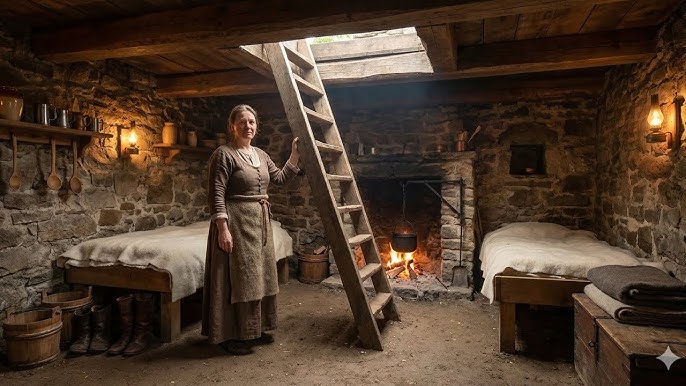
A narrow ladder, concealed beneath a rug and a wooden hatch she built herself.
A compact sleeping area—just enough for a mattress, blankets, and a small lantern.
Shelves carved into the walls, stocked with canned food, water, and basic supplies.
A battery-powered light.
Extra fire-starting tools.
Even a small vent system she rigged to allow air circulation without exposing the space.
It wasn’t beautiful.
It wasn’t comfortable in the traditional sense.
But it was secure.
And that mattered more.
—
When she finished, Lena stood in the center of her cabin, looking down at the hidden hatch.
For a moment, she felt something she hadn’t felt in a long time.
Pride.
Not the kind that comes from external validation.
But the quiet kind.
The kind that comes from knowing you can take care of yourself.
—
Winter arrived fast.
Faster than she expected.
By mid-November, the first heavy snow blanketed the forest, transforming everything into a silent, white expanse.
The road she had taken to reach the cabin disappeared.
The world narrowed.
Shrank.
Until it felt like the cabin existed in its own isolated reality.
And Lena adapted.
She settled into routines.
Morning fires.
Short walks to gather what she needed.
Evenings spent reading by lantern light.
There was a rhythm to it.
A simplicity she hadn’t known she needed.
—
But winter in the mountains doesn’t negotiate.
It doesn’t ease in gently.
And when it decides to show its full force—
It does so without warning.
—
The blizzard hit in late December.
The forecast had mentioned snow.
Nothing unusual.
Nothing alarming.
But by nightfall, the wind had picked up in a way that made Lena uneasy.
It howled against the cabin walls, rattling the windows with increasing violence.
Snow fell harder.
Faster.
And by midnight—
It was a full storm.
—
Lena barely slept.
She kept the fire going, checking the doors and windows repeatedly, her instincts on high alert.
Something didn’t feel right.
The wind wasn’t just strong.
It was relentless.
And the cold—
The cold was cutting deeper than anything she had experienced so far.
—
By morning, the situation had escalated.
The cabin was half-buried in snow.
The door was blocked.
The windows were coated in thick layers of ice.
And the wind showed no signs of stopping.
—
Lena moved quickly, shifting into a mindset she hadn’t needed until now.
Practical.
Focused.
She checked her supplies.
Still good.
Checked the fire.
Burning steady.
But then—
She noticed it.
A draft.
Subtle.
But wrong.
—
She followed it to the far corner of the cabin.
The wood there had weakened.
Cracked.
And under the pressure of the storm—
It was starting to give.
—
Her heart pounded.
Because she knew what that meant.
If the structure failed—
Even partially—
The temperature inside would drop fast.
Dangerously fast.
—
She didn’t panic.
Not outwardly.
But her movements became sharper.
Faster.
She reinforced what she could.
Added extra wood.
Tried to block the gap.
But the wind—
It was too strong.
—
A loud crack echoed through the cabin.
And suddenly—
The wall shifted.
Just slightly.
But enough.
Enough to let the cold rush in like a living thing.
—
Lena stepped back.
Her breath visible in the air now.
Her hands trembling.
Not from fear.
From the cold.
—
This was it.
The moment she had prepared for.
—
Without hesitation, she moved to the center of the room.
Pulled back the rug.
Lifted the hatch.
And climbed down into the hidden space.
—
The moment she closed the hatch above her, everything changed.
The sound of the wind became muffled.
Distant.
The cold, while still present, was manageable.
Contained.
—
She lit the lantern.
The small space glowed with a soft, steady light.
And for the first time since the storm began—
She exhaled fully.
—
Hours passed.
Maybe more.
Time blurred in the quiet.
Above her, the storm raged.
She could hear it.
Feel it, even.
But it couldn’t reach her.
Not here.
—
She rationed her food.
Wrapped herself in blankets.
Listened to the steady rhythm of her own breathing.
And waited.
—
At some point, exhaustion took over.
She slept.
Deep.
Heavy.
The kind of sleep that comes only when your body has no other choice.
—
When she woke, the silence was absolute.
—
For a moment, she didn’t move.
Didn’t breathe.
Because silence, out here, could mean many things.
—
Slowly, she reached up.
Pushed the hatch open.
—
Light spilled in.
Bright.
Blinding.
—
The storm was over.
—
Climbing back into the cabin, Lena took in the damage.
Part of the wall had indeed shifted.
Snow had pushed its way inside.
The temperature was dangerously low.
But the structure—
Still stood.
Barely.
But enough.
—
She stood there for a long time.
Taking it all in.
The destruction.
The survival.
The thin line between the two.
—
Then she looked down at the hatch.
At the space beneath her feet.
The space she had built with her own hands.
The space that had saved her life.
—
And for the first time since she had arrived—
She didn’t feel like she was running anymore.
—
She felt like she was staying.
—
Because starting over wasn’t about escaping everything.
It wasn’t about finding perfection.
Or building something flawless.
It was about learning what you needed.
What you could rely on.
What you could create for yourself when everything else fell away.
—
And sometimes—
It was about building a hidden room beneath your life.
Not because you expect everything to fall apart.
But because if it does—
You’ll be ready.
—
Lena stepped outside, the snow crunching beneath her boots.
The sky was clear now.
Endless blue stretching above a white, untouched world.
Cold.
Yes.
But beautiful.
—
She pulled her coat tighter around her and took a deep breath.
The air burned her lungs.
But it also filled them.
—
She wasn’t the same person who had arrived here months ago.
She wasn’t afraid in the same way.
—
Because now, she knew something she hadn’t known before.
—
She could survive the storm.
Even the worst one.
—
And she had built the place that made it possible.
Part 2: “What She Built After the Storm”
For three days after the blizzard, Lena didn’t leave the cabin.
Not because she couldn’t.
But because she was learning something new about stillness.
The kind that comes after survival.
—
The first morning, she focused on the essentials.
Fire first.
Always fire.
Her fingers were stiff, but steady as she rebuilt the flame in the wood stove. The warmth came slowly, inch by inch, pushing back the cold that had seeped into the walls.
Then water.
Then food.
Simple routines.
The same ones that had once felt like burdens… now felt like anchors.
—
By the second day, she began to assess the damage.
The crack in the wall was worse than it had looked at first light. Snow had melted and seeped into the wood, weakening it further.
She stood there, arms folded, studying it like a puzzle.
Not with panic.
But with purpose.
“I can fix this,” she murmured.
And for once, she believed herself without hesitation.
—
She worked methodically.
Layer by layer.
Reinforcing the damaged section with spare timber from the shed. Sealing gaps with insulation and cloth. Using every resource she had—not perfectly, but effectively.
It wasn’t pretty.
But it held.
And out here, holding was everything.
—
That night, she did something she hadn’t expected.
She opened the hatch again.
Not because she needed to.
But because she wanted to see it.
The hidden room.
Her hidden room.
She climbed down slowly, lantern in hand.
Everything was just as she had left it.
Orderly.
Safe.
Unshaken.
—
Lena sat on the narrow mattress, running her fingers along the wooden shelf she had carved herself.
This place had been a backup.
A precaution.
A “just in case.”
But now—
It was something more.
It was proof.
Proof that she could think ahead.
Adapt.
Protect herself.
—
She leaned back against the wall, letting the quiet settle around her.
And for the first time, the silence didn’t feel empty.
It felt earned.
—
On the fourth day, Lena stepped outside.
The world had transformed.
The snow stretched endlessly, untouched and blindingly white under the winter sun. Trees bowed under the weight of ice, their branches frozen in delicate, glass-like shapes.
It was beautiful.
In a way that felt almost unreal.
—
She took a few careful steps forward, boots crunching against the hardened snow.
The air was sharp, biting—but clean.
Alive.
—
And then she noticed something that made her pause.
Tracks.
Not hers.
—
They cut across the edge of the clearing, partially covered but still visible if you knew where to look.
Someone—or something—had passed by.
Recently.
—
Lena’s body tensed slightly.
Not out of fear.
But awareness.
Because isolation, she realized, was never absolute.
—
She followed the tracks a short distance, just enough to understand their direction.
They led toward the old forest road.
The one buried under snow.
—
Human.
Not animal.
The pattern was too deliberate.
—
For a moment, she considered ignoring it.
Going back inside.
Returning to her routines.
But something in her resisted that instinct.
Because a week ago—
Before the storm—
She might have turned away.
But now—
She was different.
—
Lena went back inside, grabbed her coat, gloves, and a small pack.
Just the basics.
Water.
A flashlight.
A few supplies.
—
Then she followed the tracks.
—
It wasn’t a long journey.
Maybe half a mile.
But the snow made it feel longer.
Heavier.
Each step required effort.
Focus.
—
Eventually, she saw it.
A vehicle.
Half-buried.
Tilted slightly to one side.
—
Her heart picked up.
Not from fear.
From urgency.
—
She approached carefully, calling out.
“Hello?”
No answer.
—
She moved closer, brushing snow from the driver’s side window.
Inside—
A man.
—
He was slumped forward, unmoving.
—
Lena’s breath caught for a second.
But then training—instinct—something deeper—kicked in.
She opened the door with effort, snow resisting every movement.
“Hey!” she called, shaking his shoulder gently.
The man stirred.
Barely.
But enough.
—
Relief hit her fast.
He was alive.
—
“Can you hear me?” she asked.
His eyes fluttered open slightly.
Disoriented.
Cold.
—
“My… truck…” he mumbled.
“I see it,” Lena said quickly. “You need to get out of here.”
—
Getting him back to the cabin wasn’t easy.
He was weak.
Disoriented.
But conscious.
And that made all the difference.
—
Step by step, they made their way back.
Slow.
Unsteady.
But moving.
—
When they reached the cabin, Lena didn’t hesitate.
She brought him inside, sat him near the fire, wrapped him in blankets.
His hands trembled violently.
His face pale.
—
“You’re safe now,” she said, more firmly than she felt.
—
It took time.
Warmth.
Water.
Food.
—
But gradually—
He stabilized.
—
His name was Daniel Carter.
A photographer.
He had been driving through the mountains, chasing winter landscapes, when the storm hit faster than expected.
He had tried to turn back.
Didn’t make it.
—
“I thought I was done,” he admitted quietly later that evening.
Lena didn’t respond immediately.
She just handed him a cup of warm tea.
—
“You weren’t,” she said finally.
—
That night, she made a decision.
One that surprised even her.
—
“Take the bed,” she told him.
“I’ll manage.”
—
And when he hesitated—
She added, almost casually—
“I’ve got another place.”
—
She didn’t explain further.
Didn’t need to.
—
For the first time since she built it, Lena chose to sleep in the hidden room—
Not out of fear.
But out of choice.
—
And somehow—
That changed everything.
—
Over the next few days, Daniel recovered.
Slowly but steadily.
—
He helped where he could.
Fixed small things.
Chopped wood.
Listened more than he spoke.
—
And Lena—
She noticed something she hadn’t expected.
She didn’t feel invaded.
She didn’t feel watched.
She didn’t feel controlled.
—
She felt… accompanied.
—
One afternoon, as the sunlight filtered softly through the frost-covered windows, Daniel glanced around the cabin.
“You built all this yourself?” he asked.
Lena nodded.
“Most of it.”
—
He looked impressed.
Not in a loud, exaggerated way.
But in a quiet, genuine one.
—
“You ever think about designing places like this for other people?” he asked.
Lena paused.
Because the question landed somewhere deep.
Somewhere she hadn’t let herself go in a long time.
—
“I used to design,” she said slowly.
“In the city.”
—
“And now?”
—
She looked around.
At the reinforced walls.
The stocked shelves.
The hidden hatch beneath the rug.
—
“Now I build what I need,” she said.
—
Daniel smiled slightly.
“Maybe other people need that too.”
—
The idea stayed with her.
Long after he said it.
—
Because for the first time, Lena realized—
What she had built here wasn’t just survival.
It was a way of living.
A different kind of safety.
One that didn’t come from walls alone—
But from knowing you could rebuild them if they broke.
—
Weeks later, when the road finally cleared and Daniel prepared to leave, the cabin felt… different again.
Not empty.
But changed.
—
At the door, he paused.
“You saved my life,” he said.
Lena shook her head gently.
“I just built a place that could.”
—
He smiled.
“Same thing.”
—
And then he was gone.
—
The silence returned.
But it wasn’t the same silence as before.
—
Lena stood in the center of the cabin, looking down at the hidden hatch one more time.
Then—
She grabbed a notebook.
And started sketching.
—
Not escape plans.
Not backup shelters.
—
But ideas.
Designs.
Spaces.
—
Because sometimes—
What saves you in the storm…
Becomes the thing you offer the world after it passes.