
“They All Laughed at Me,” She Said — Until She Saved His Failing Ranch
The men started laughing before she even finished her sentence.
“You’re digging in the wrong place,” she said, her voice calm but firm.
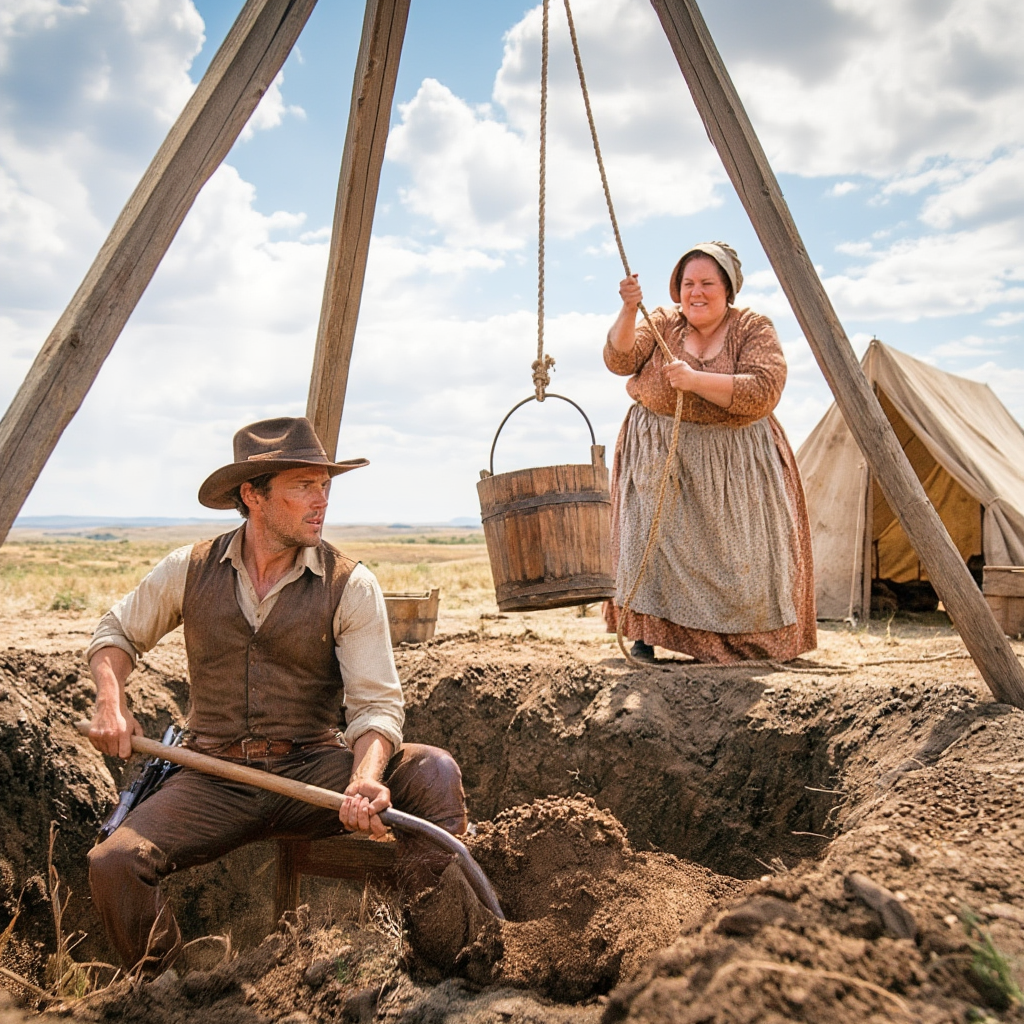
Thomas Hale leaned on the handle of his shovel, chest heaving, sweat dripping from beneath the brim of his brown cowboy hat. He stood in the shallow pit he’d been carving into the hard prairie dirt for two days. Around him, the ground was dry as bone—cracked, stubborn, unforgiving.
The ranch hands looked up at the woman standing beside the canvas tent.
She wore a bonnet that shaded her face, a patterned brown blouse, and a pale apron over her long skirt. One hand rested on the rope of the wooden tripod they’d built over the pit. The bucket hung halfway down, swaying slightly in the hot wind.
“You hear that?” one of the men chuckled. “She’s telling us how to dig.”
Another laughed louder. “Maybe she’s got a map under that bonnet.”
Thomas wiped his brow and looked up at her.
“What makes you say that?” he asked.
The laughter continued.
She ignored them.
“The soil’s wrong,” she said. “Too compacted. And there’s no green growth nearby. Water won’t sit here long.”
The tallest ranch hand snorted. “Lady, this is the only flat ground we got.”
She shook her head. “You need lower land. Where the grass thins, but not completely. And the wind—”
“Wind?” the man interrupted.
“Yes,” she replied. “It shifts moisture underground. You’re digging uphill.”
The men burst out laughing again.
Thomas didn’t.
He studied her instead.
She couldn’t be more than twenty-five. Dust clung to her skirt, and her sleeves were rolled slightly as if she’d already been working. She looked tired—but not uncertain.
“What’s your name?” Thomas asked.
“Emily Carter.”
“You ever dug a well before, Miss Carter?”
She hesitated. “Not myself. But my father did. I watched him.”
That set off another round of laughter.
“Watched him,” one man repeated. “Well, that settles it.”
Thomas rested both hands on the shovel.
His ranch was failing. The creek had dried two months ago. The cattle were thinning. Another week without water, and he’d have to sell half the herd—or lose everything.
He didn’t have time for pride.
“Where would you dig?” he asked.
The laughter stopped.
Emily looked surprised. “You’re serious?”
“Dead serious.”
She pointed toward a shallow dip about fifty yards away. “There. Just past that patch of shorter grass.”
The tallest hand shook his head. “Boss, we already tested that soil. Hard as stone.”
Emily nodded. “Because you only dug two feet. The clay layer’s thin. Below that, there’s sand. Sand holds seepage.”
Thomas glanced at the dip.
Then at the pit he’d already dug.
Then back at her.
“Alright,” he said finally. “We try it.”
Groans rose immediately.
“You can’t be serious,” one man protested.
Thomas stepped out of the pit. “We’re serious.”
The men exchanged looks but obeyed. They dismantled the tripod and dragged it across the dry prairie. The sun climbed higher, beating down on them. Dust rose with every step.
Emily helped guide the placement.
“Right here,” she said.
They began digging.
The first foot was brutal. Hard-packed earth resisted every strike. The men muttered under their breath.
“Waste of time,” someone said.
Thomas kept digging.
By the second foot, the soil lightened slightly.
By the third, it changed color.
Emily leaned forward. “There,” she whispered.
Thomas struck again. The shovel sank deeper than before.
The men noticed.
“Hold on,” one said.
They dug faster.
At four feet, the soil turned sandy.
The mood shifted.
No one laughed now.
They worked until sunset. The pit grew deeper. The bucket hauled dirt up steadily. Emily pulled the rope, arms straining, her boots braced in the dry grass.
By morning, the air felt cooler inside the pit.
At six feet, Thomas drove the shovel down—and the earth crumbled slightly.
Then he saw it.
Dampness.
Just a darkening at first. Then a slow seep.
He froze.
“Water,” he whispered.
Emily leaned over the edge. “Is it—”
“Yes.”
The men gathered around.
Within minutes, the sand began to glisten. A thin trickle formed at the bottom.
No one spoke.
Then one of the ranch hands laughed—but this time it wasn’t mocking.
“Well, I’ll be damned.”
Emily stepped back, eyes shining.
Thomas climbed out slowly, boots coated in wet sand. He looked at her.
“You just saved this ranch,” he said.
She shook her head. “It’s only a trickle.”
“It’s enough.”
The men reinforced the pit, lining it with stones. By afternoon, water pooled at the bottom—clear and steady.
They lowered the bucket.
Emily pulled the rope, smiling as the wooden bucket rose heavy and dripping. Sunlight caught the water as it spilled slightly over the rim.
She set it down.
Thomas knelt and dipped his hand in. Cool. Real.
Alive.
He looked up at her. “How’d you know?”
She hesitated. “My father used to say… the land tells you, if you listen.”
“You listened.”
She gave a small smile. “They all laughed at me.”
Thomas glanced at the ranch hands. They suddenly found the ground very interesting.
“Not anymore,” he said.
Over the next days, everything changed.
The cattle drank deeply. Grass near the well began to recover. The ranch hands worked with renewed energy. They built a proper wooden frame around the well and reinforced the tripod.
Emily stayed.
At first, she helped haul water. Then she organized the storage barrels. She suggested rotating grazing areas so the grass could recover.
Thomas watched her quietly.
“You ever run a ranch?” he asked one evening.
She shook her head. “No. But I’ve seen one fail.”
“What happened?”
“Drought,” she said softly. “We didn’t find water in time.”
He nodded.
“Well,” he said, “you found it here.”
Weeks passed. The well deepened. The water held steady. The ranch slowly pulled back from the edge.
One morning, Thomas found Emily already working, pulling the rope as the bucket rose from the well. The prairie stretched behind her under a wide blue sky dotted with clouds. Her bonnet fluttered in the breeze.
“You don’t have to do that alone,” he said.
She smiled. “I like it.”
He took the rope from her and pulled the last few feet. The bucket settled between them, sloshing gently.
“You saved more than the ranch,” he said.
She tilted her head. “What do you mean?”
“I was about ready to sell. Thought I’d lost it all.”
She looked at the water. “You didn’t.”
“No,” he said quietly. “You didn’t let me.”
She brushed dust from her apron. “They laughed at me, you know.”
He nodded. “I remember.”
Her eyes met his. “You didn’t.”
“I couldn’t afford to.”
She laughed softly.
The wind moved across the prairie, carrying the scent of damp earth—something that hadn’t existed there weeks before.
Thomas leaned against the wooden tripod, watching the sunlight glint off the water.
“You planning to stay?” he asked.
Emily looked out across the land. The cattle grazed peacefully. The tent fluttered behind her. The well stood strong.
“If you’ll have me,” she said.
Thomas smiled. “After what you did? I’d be a fool not to.”
She laughed again, lighter this time.
He picked up the bucket and handed it to her. Their hands brushed briefly.
The ranch, once dry and failing, now echoed with the sound of water rising steadily from the earth—pulled by the woman they had all laughed at.