
He Gave the Starving Girl Bread Each Morning — By Winter, He Made Her His Wife… and Handed Her the Keys to an Entire Bakery
The first morning he saw her, she was counting crumbs.
Daniel Harper had come into town before sunrise, dust still clinging to his coat from three days on the trail. The frontier town of Red Willow was just waking—lanterns dimming, horses snorting, and the smell of fresh bread drifting into the street like a promise.
That was what brought him to the bakery.
He pushed open the wooden door, the bell above it clinking softly. Inside, warmth wrapped around him. A brick oven glowed along the back wall. Flour dusted the air. Round loaves rested on wooden shelves, their crusts golden and cracked.
Behind the counter stood an older woman with gray hair pinned tight. She nodded without smiling.
“Mornin’,” Daniel said.
She gestured toward the bread. “Two cents a loaf.”
Daniel stepped forward, reaching for one. That’s when he noticed the girl.
She stood near the side wall, almost hidden behind a stack of empty flour sacks. Her dress was light blue but faded, patched at the elbows. A brown apron hung loosely around her waist. Her long dark hair was pulled back, though loose strands framed her thin face.
She wasn’t looking at the bread.
She was looking at the floor.
Daniel followed her gaze.
Crumbs.
Small pieces that had fallen from the cutting board.
The girl crouched slowly, glancing at the baker. When the older woman turned away, the girl swept the crumbs into her palm and closed her hand.
Daniel froze.
He’d seen hunger before. But there was something quiet about this—careful, practiced, ashamed.
The girl straightened, slipped the crumbs into her pocket, and stepped toward the door.
“Wait,” Daniel said.
She stopped, stiff.
He picked up two loaves and set them on the counter. “I’ll take these.”
The baker wrapped them in paper.
Daniel handed her four cents, then turned and walked toward the girl. He held one loaf out.
She stared at it.
“For you,” he said.
Her eyes widened. “I… I can’t.”
“You can.”
The baker glanced over, disapproving.
The girl shook her head. “I don’t have money.”
“I didn’t ask for any.”
She hesitated, then slowly took the loaf. Her fingers trembled.
“Thank you,” she whispered.
Daniel nodded. “Name?”
“Clara.”
“I’m Daniel.”
She clutched the bread like it might vanish and slipped outside.
Through the window, Daniel watched her cross the street, sit on a barrel, and tear into the loaf. She didn’t gobble it—she ate slowly, carefully, like she wanted it to last.
He finished his coffee and left.
The next morning, he came back.
Clara was there again.
This time she didn’t crouch for crumbs. She stood by the wall, hands folded, eyes lowered. When Daniel entered, she looked up, surprised.
He bought two loaves again.
He handed one to her.
“You don’t have to…” she began.
“I know.”
She accepted it.
“Thank you, Mr. Daniel.”
“Just Daniel.”
She smiled faintly.
On the third morning, she was already waiting.
On the fourth, she said, “I’ll work for it.”
Daniel leaned against the counter. “What kind of work?”
“I can sweep. Carry water. Wash pans.”
He shook his head. “You just eat.”
She frowned. “That ain’t fair.”
“Life rarely is.”
She looked at the loaf in her hands, then back at him. “I’ll pay you back someday.”
Daniel tipped his hat. “I’ll remember that.”
Days turned into weeks.
Every morning, he bought her bread.
Sometimes he added an apple. Sometimes cheese. Once, a small jar of jam that made her eyes shine.
They began to talk.
She told him she’d come to Red Willow six months earlier. Her father had died on a cattle drive. Her mother had taken ill shortly after. Clara had worked washing clothes, sweeping saloons, anything she could find.
“But winter’s comin’,” she said one morning. “Folks stop hirin’ when it gets cold.”
Daniel studied her. She couldn’t be more than nineteen. Thin, but strong. Quiet, but determined.
“You sleepin’ indoors?” he asked.
She nodded. “Above the stable. Owner lets me stay if I muck stalls.”
“That warm enough?”
She shrugged. “Warmer than outside.”
He didn’t like that answer.
One morning, he arrived to find her behind the counter.
Flour dusted her apron. Her sleeves were rolled up. She was shaping dough, hands moving carefully.
The older baker barked instructions. “Not too tight, girl. Let it breathe.”
Clara nodded.
Daniel approached. “You working here now?”
She looked up, smiling. “Just mornings. She lets me help. Pays me with leftovers.”
The baker grunted. “Girl’s quick learner.”
Daniel watched Clara place the dough onto a tray. Her movements were gentle, almost reverent.
“You ever baked before?” he asked.
She shook her head. “But I like it.”
The baker snorted. “She likes the smell.”
Clara laughed softly.
From then on, Daniel noticed changes.
Her cheeks filled out slightly. Her eyes brightened. Her dress looked cleaner. She began saving small coins in a pouch tied to her apron.
Every morning, he still bought her bread.
But now she sometimes refused.
“I got paid today,” she’d say.
“Then I’m celebratin’,” he’d reply.
She rolled her eyes but accepted.
Summer faded into autumn. The town cooled. Lanterns lit earlier. Horses’ breath fogged in the morning air.
One chilly day, Daniel found the bakery closed.
He frowned.
A note hung on the door: “Closed—illness.”
He asked around. The older baker had taken sick.
That afternoon, he found Clara outside the building, pacing.
“She’s real bad,” Clara said. “Doctor says she can’t work.”
“Who’s running the shop?”
“No one.”
Daniel looked at the shuttered windows.
“How much rent she payin’?” he asked.
Clara blinked. “Why?”
“Just askin’.”
Two days later, Daniel met with the building owner.
By week’s end, the bakery reopened.
Clara stood inside, nervous, flour already on her hands.
“You bought it?” she asked.
Daniel nodded. “Temporary.”
“I don’t know how to run a bakery!”
“You know how to bake.”
She swallowed. “Not enough.”
“I’ll help.”
And he did.
He hauled flour sacks. Fixed the oven. Delivered bread. Clara baked from sunrise to sunset, guided by scribbled notes the old baker left behind.
The first week, half the loaves burned.
The second week, customers returned.
By the third, the smell of fresh bread filled the street again.
Clara laughed more. She worked harder than anyone Daniel had ever seen. Her hair stayed pulled back, cheeks flushed, apron always dusted with flour.
One evening, as sunset painted the town gold, she set a perfect row of round loaves on the table outside.
Daniel joined her.
“You did it,” he said.
“We did,” she corrected.
He watched her smile. Warm. Real. Nothing like the hungry girl counting crumbs.
Winter crept in slowly.
Snow dusted rooftops. Horses wore blankets. People crowded inside for warmth.
The bakery thrived.
Clara created new recipes—honey bread, herb loaves, sweet rolls that sold out by noon. Children pressed coins into her hands. Ranchers ordered stacks for long drives.
One morning, she handed Daniel a loaf.
“On the house,” she said.
He raised a brow. “You sure?”
She nodded. “I’m payin’ you back.”
He took it. “You’re still short.”
She laughed.
On the first snowfall, Daniel arrived early.
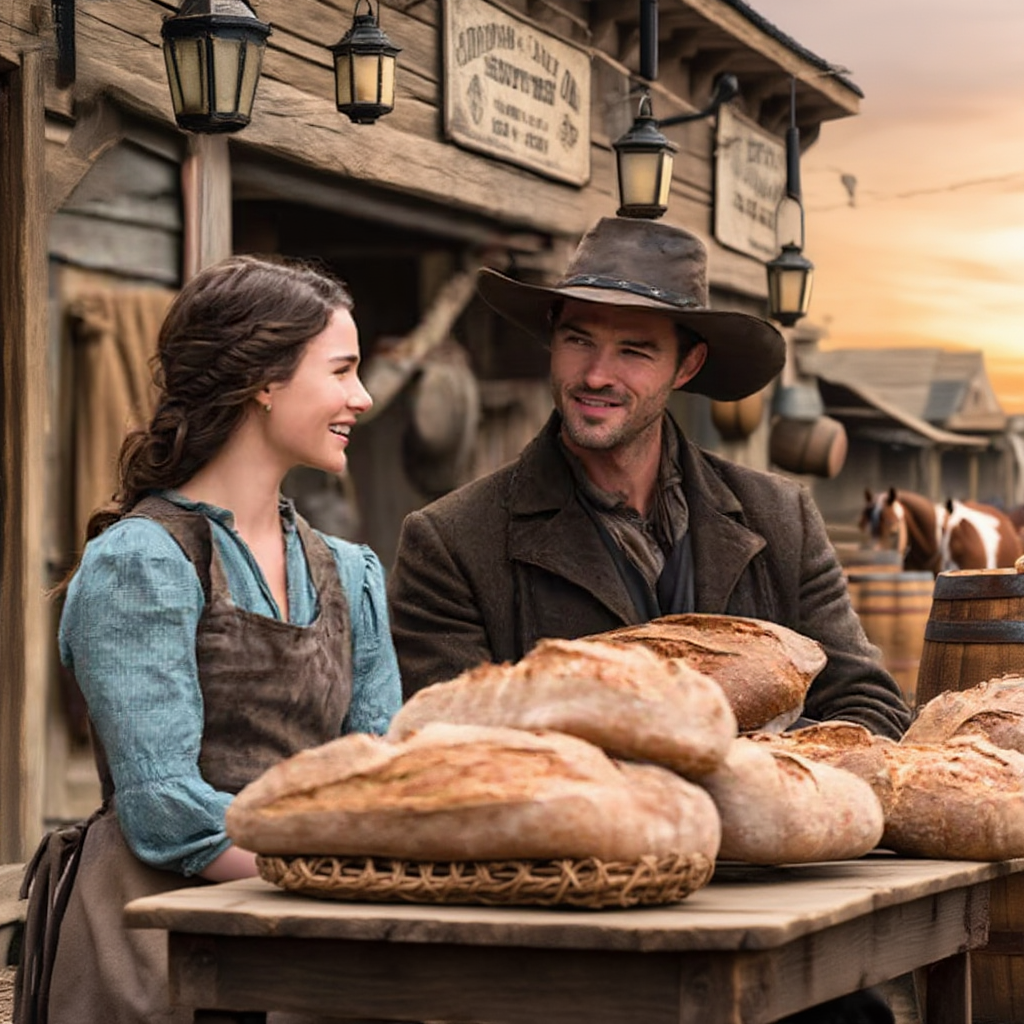
The storefront lanterns glowed. Clara stood outside arranging baskets of bread on a wooden table. Her light blue dress peeked beneath her brown apron. Her dark hair was tied back, though loose curls framed her face.
She looked up, smiling.
“You’re early.”
“Could say the same.”
They stood facing each other, warm breath drifting in the cold air. The town stirred behind them—horses stamping, barrels rolling, doors creaking open.
Daniel reached into his coat.
Clara tilted her head. “What’s that?”
He pulled out a small ring.
Her smile vanished.
“Clara,” he said quietly, “you remember when you said you’d pay me back?”
She nodded slowly.
“You did.”
Her eyes widened.
“You don’t owe me bread,” he continued. “But I was hopin’… maybe you’d give me somethin’ else.”
She whispered, “What?”
“Your hand.”
Silence filled the cold morning.
Snow drifted gently between them.
Clara’s eyes shimmered. “You’re serious?”
“Been serious since the day you tried to pay me for crumbs.”
She laughed softly, tears forming. “I don’t have much.”
Daniel gestured to the table overflowing with bread. “You got more than you think.”
She looked at the bakery. The lanterns. The warm light inside.
“You sure?” she asked.
“I’m sure.”
She nodded, voice barely audible. “Yes.”
Daniel slid the ring onto her finger.
She covered her mouth, smiling through tears.
“What happens now?” she asked.
He took her hand and placed a folded paper in it.
She opened it.
Her eyes widened.
“This… this says…”
“It’s yours,” he said.
“The bakery?”
“All of it.”
She stared at him. “You’re givin’ it to me?”
“You built it. You kept it alive. Seems right.”
Clara looked at the storefront, the baskets of bread, the rising sun warming the dusty street.
Then she threw her arms around him.
Customers began arriving, smiling at the scene. Someone clapped. A horse whinnied. The town buzzed softly.
Clara pulled back, still holding his hand.
“You gave me bread every morning,” she said.
Daniel smiled. “Guess it paid off.”
She laughed, then turned to the table. Fresh round loaves filled woven baskets. Steam curled into the golden winter light.
She handed him one.
“First loaf,” she said, “as your wife.”
Daniel took it.
The smell of warm bread filled the air as the frontier town came alive around them.