
How He Built His Cabin Against a Fallen Giant Pine — the Trunk Became His Warmest Wall
He hadn’t meant to stay.
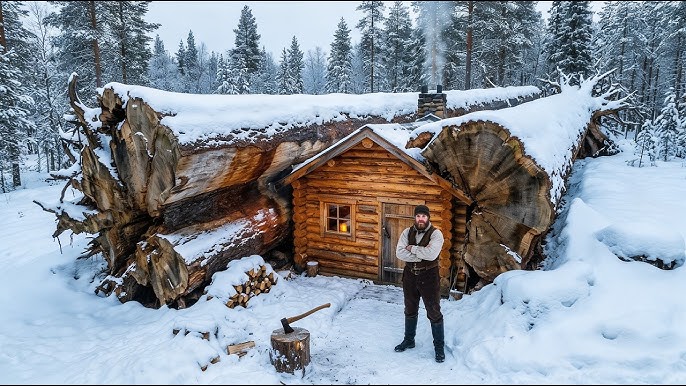
When Caleb Turner first stumbled into the clearing, boots soaked and lungs burning from the thin mountain air, the fallen pine looked like a ruin from another world—something ancient and defeated. Its trunk stretched across the slope like a giant laid to rest, bark split in jagged seams, sap hardened into amber tears. The roots clawed skyward behind it, still gripping chunks of earth like a hand that refused to let go.
Caleb dropped his pack and leaned against the trunk, pressing his cheek to the wood. It was warmer than the wind.
That was the first thing he noticed.
Warm.
Not the kind of warmth that came from sunlight or fire, but something deeper—like the tree still remembered life.
He exhaled slowly. “Guess we’re both not ready to give up, huh?”
The mountain didn’t answer, but the wind eased, just a little.
Three weeks earlier, Caleb had been just another man disappearing in plain sight.
No one noticed when he left the construction site in Wyoming. No one asked why he didn’t come back the next morning. He’d worked jobs like that for years—building houses for people who would never know his name, framing walls that would hold laughter he’d never hear.
It wasn’t one thing that pushed him away.
It was everything.
The silence after his wife died. The empty chair. The way his daughter’s drawings still clung to the fridge even though she hadn’t lived there in years—taken by her mother’s parents, “for stability,” they’d said.
Caleb didn’t fight it. Didn’t fight anything anymore.
He just left.
West. Then south. Then nowhere in particular.
Until he found the tree.
The first night nearly killed him.
Temperatures dropped fast in the mountains, and Caleb had nothing but a worn blanket and a stubborn refusal to turn back. He tried building a fire, but the wood was damp, the wind relentless. The flames sputtered and died more than they burned.
So he crawled up against the fallen pine.
The trunk blocked the wind almost completely on one side. The ground beside it was drier than anywhere else in the clearing, shielded by its massive bulk. And that strange warmth—faint, but real—seeped into his bones as he curled against it.
He slept.
Not well. Not comfortably. But enough.
When he woke, he was still alive.
That was something.
By the third day, Caleb stopped thinking of leaving.
He began to notice things.
How the trunk curved slightly inward along one stretch, forming a natural hollow. How the branches, though mostly broken, still created a partial canopy overhead. How the roots, twisted and exposed, formed a kind of barrier behind him.
It wasn’t a house.
But it could be.
Caleb stood in the clearing, hands on his hips, studying the fallen giant like a blueprint written by nature itself.
“You carried yourself this far,” he murmured to the tree. “Guess I can build the rest.”
The work gave him purpose.
He scavenged fallen branches, dragging them piece by piece into place. He lashed them together with strips torn from an old tarp. He packed mud and pine needles into the gaps to block the wind. Each day, the structure grew—not outward, but inward, shaped around the trunk like it was the spine of something living.
He built one wall from stone, stacking rocks carefully, remembering the techniques he’d learned years ago. Another wall leaned against the tree itself, reinforced with branches wedged into the bark’s natural grooves.
The trunk became more than support.
It became shelter.
At night, when the cold pressed in from all sides, the wood radiated that same quiet warmth. Caleb began to understand—it wasn’t heat in the usual sense. It was insulation, density, life held in stillness. The massive pine absorbed the day’s warmth and released it slowly, like a breath that never quite ended.
It kept him alive.
Weeks passed.
Caleb stopped counting them.
His beard grew thick. His hands hardened, skin cracking and healing over again. He learned the rhythms of the mountain—the way the light shifted, where water pooled after rain, which paths the animals followed.
And always, he returned to the trunk.
One evening, as the sun dipped low and painted the clearing in gold, Caleb sat with his back against the pine and laughed.
It startled him.
He couldn’t remember the last time he’d laughed.
“You’re doing a better job keeping me together than I ever did,” he said quietly, resting his palm against the bark.
For a moment, he imagined the tree answering—not with words, but with presence.
You’re still here.
The storm came without warning.
Dark clouds swallowed the sky, and the wind turned violent, tearing through the mountain with a fury that made Caleb’s chest tighten. Rain slammed against the cabin, soaking the outer walls, testing every weak point.
Caleb braced the door—a crude thing made of overlapping boards—and pressed his shoulder against it.
“Not tonight,” he muttered. “Not after all this.”
The wind howled.
A branch snapped somewhere above, crashing down with a force that shook the ground. Water seeped through the cracks in the walls, dripping onto the dirt floor.
But the trunk held.
It didn’t bend. Didn’t shift. Didn’t yield.
The fallen giant, already defeated once by nature, refused to fall again.
Caleb slid down against it, heart pounding, and realized something that hit him harder than the storm itself:
He wasn’t alone.
Not really.
Not anymore.
By morning, the storm had passed.
The clearing was a mess—branches scattered, mud churned, parts of the outer structure damaged.
But the cabin stood.
Caleb stepped outside, breathing in the sharp, clean air. Sunlight broke through the clouds, catching on the wet bark of the fallen pine and turning it into something almost luminous.
He ran a hand along the trunk, fingers tracing the deep grooves.
“You saved me,” he said simply.
And for the first time in a long while, he meant it.
The cabin changed over time.
What began as survival became something more.
Caleb carved shelves into the interior walls. He built a proper fireplace, using stones from the nearby creek. He fashioned a small window that let in light without sacrificing warmth.
And always, the trunk remained the heart of it all.
The warmest wall.
The strongest support.
The quiet companion that never left.
People found him eventually.
They always do.
A pair of hikers stumbled into the clearing one afternoon, their eyes widening as they took in the sight—a cabin built against the side of a fallen giant, blending so naturally with the landscape it seemed like it had grown there.
“Did you build this?” one of them asked, disbelief in his voice.
Caleb nodded.
“Using the tree?”
He smiled faintly. “The tree did most of the work.”
They laughed, thinking it was a joke.
But Caleb didn’t explain.
Some things didn’t need explaining.
Word spread.
More people came.
Some brought supplies. Some brought questions. A few brought stories of their own—loss, change, the quiet search for something they couldn’t name.
Caleb listened.
He didn’t have answers.
But he had a place.
A place built from what was left behind.
A place that proved something simple and powerful:
You don’t always need to start over.
Sometimes, you just need to build around what’s still standing.
Years later, when the cabin had become something almost legendary—a hidden refuge whispered about in towns miles away—Caleb sat once more with his back against the trunk.
Older now. Slower.
But still there.
He closed his eyes, feeling the same warmth that had saved him that first night.
“You were never just a tree,” he said softly.
The wind stirred, gentle this time, carrying the scent of pine and earth.
And for a moment, in the quiet hush of the mountain, it almost felt like an answer.
When Caleb Turner finally left the world, they didn’t take him far.
The people who had come to know him—travelers, wanderers, lost souls who had found something in that clearing—buried him near the roots of the fallen giant.
Right where it had all begun.
The cabin still stands.
The tree still holds.
And if you ever find your way into that clearing, if you press your hand against the trunk and close your eyes, you might feel it too—
That quiet, steady warmth.
Not just from the wood.
But from the life that chose to build instead of break.
The first winter after Caleb was gone nearly broke the place.
Snow came early that year, heavy and relentless, blanketing the clearing in silence so deep it felt like the world had forgotten it existed. The narrow path leading to the cabin vanished beneath drifts. The creek froze. Even the wind seemed different—sharper, lonelier, as if it, too, sensed something missing.
For weeks, no one came.
The cabin stood alone against the fallen giant pine, its roof burdened with snow, its door sealed shut by ice. Inside, the shelves Caleb had carved still held small remnants of a life—an old tin cup, a bundle of dried herbs, a folded blanket worn thin with years of use.
And the trunk—the warmest wall—remained.
Even in the dead of winter, when the air outside could freeze breath mid-exhale, the wood held its quiet heat. Not enough to make the cabin comfortable. But enough to keep it from becoming a tomb.
As if it refused to let the place die.
It was a girl who came first.
Her name was Lila Grant, nineteen years old, with a backpack too heavy for her frame and eyes that had already seen more than they should have. She hadn’t meant to find the cabin. Like Caleb, she had only been trying to keep moving.
Away from a home that didn’t feel like one.
Away from voices that told her she was too much, too loud, too broken to belong anywhere.
She had followed a trail marked on an old map someone had sketched for her in a roadside diner. There’s a place in the mountains, the woman had said. Built against a fallen tree. Folks say it helps you remember who you are.
Lila hadn’t believed it.
Not really.
But she’d gone anyway.
By the time she reached the clearing, the sky was already dimming.
Her fingers were numb, her boots soaked through, and every step felt heavier than the last. When she saw the cabin, she thought—just for a moment—that she was imagining it.
It looked unreal.
Half-hidden in snow, built into the curve of a massive fallen pine, like something grown instead of made.
“Please be real,” she whispered.
The door resisted when she pushed it, frozen at the edges, but it gave way with a sharp crack.
Inside, the air was cold—but not deadly.
Not like outside.
Lila stumbled in, dropping her pack, her legs giving out beneath her. She crawled toward the trunk almost instinctively, pressing her back against it the way Caleb once had.
And then she felt it.
Warm.
Faint, steady, undeniable.
Her breath caught.
“What…?” she murmured, placing her palm flat against the wood.
It didn’t make sense.
Nothing about this place did.
And yet, for the first time in weeks, she didn’t feel like she was about to disappear.
She stayed the night.
Then another.
Then another.
At first, it was just survival. She found the small stash of firewood left in a corner, dry enough to burn. She melted snow for water. She wrapped herself in the old blanket and slept curled against the trunk, drawing warmth from it like it was something alive.
But as the days passed, something shifted.
The silence of the cabin wasn’t empty.
It was… full.
Not of voices, not of ghosts—but of presence. Of effort. Of a life that had once been poured into every corner of that space.
She noticed the details.
The careful way the stones in the fireplace had been stacked. The grooves carved into the shelves. The way the walls leaned into the tree, not against it.
“This wasn’t just built,” she said one morning, running her fingers along the bark. “It was… trusted.”
The word surprised her.
But it felt right.
On the fourth day, she found the journal.
It had been tucked into a narrow gap between two wooden beams, wrapped in cloth to protect it from the damp. The cover was worn, the edges frayed.
Inside, the pages were filled with rough handwriting.
Caleb’s.
Lila sat by the trunk as she read, the fire flickering beside her.
At first, the entries were sparse—short notes about weather, supplies, the progress of the cabin.
Day 3: The trunk holds heat longer than expected.
Day 9: Reinforced the north wall. Wind still gets through.
Day 14: Slept better. First time in a while.
But then they changed.
They grew longer. Deeper.
I didn’t come here to build anything. I came here to disappear. Funny how that works.
The tree fell, but it didn’t rot. It held. Maybe that’s the difference.
If anyone finds this place someday—don’t tear it down. Don’t fix it too much either. Let it be what it is. It works because it’s not perfect.
Lila swallowed hard.
She turned the page.
You don’t need to be whole to build something that lasts.
She closed the journal and leaned her head back against the trunk.
“I don’t feel whole,” she whispered.
The cabin didn’t answer.
But the warmth remained.
Weeks passed, and the snow began to melt.
The path slowly revealed itself again, winding down the mountain like a thread reconnecting the cabin to the rest of the world.
Lila could have left.
She had enough strength now. Enough clarity.
But she didn’t.
Instead, she started repairing the damage winter had done.
She patched the roof where snow had seeped through. Reinforced the door. Gathered fresh wood and stacked it neatly in the corner.
She didn’t try to change the cabin.
She respected it.
Like Caleb had.
The second person arrived on a quiet afternoon.
An older man, maybe in his sixties, with tired eyes and a limp that made each step deliberate. He stopped at the edge of the clearing, staring at the cabin like he wasn’t sure it was real.
Lila stepped outside to meet him.
“Looking for something?” she asked.
He hesitated. “I heard about a place… built against a tree.”
She smiled faintly. “You found it.”
He nodded slowly, eyes drifting to the fallen pine.
“Does it… help?” he asked.
Lila glanced back at the cabin, at the trunk that had held her through her weakest nights.
“Yeah,” she said softly. “It does.”
More people came after that.
Not many. Never crowds.
Just a few at a time.
Each one carrying something heavy—grief, regret, exhaustion, the quiet weight of a life that hadn’t gone the way they’d planned.
And the cabin held them.
Not by fixing them.
Not by changing them.
But by giving them space to breathe.
To rest.
To build something small inside themselves again.
Lila stayed.
Seasons turned. Snow melted into spring, spring burned into summer, and summer softened into fall.
She learned the mountain the way Caleb had—its rhythms, its moods, its quiet lessons.
And sometimes, late at night, she would sit with her back against the trunk and read from the journal, her voice low and steady.
Not for herself.
But for him.
For the man who had built something out of what he thought was the end.
“You were right,” she said once, tracing the grooves in the bark. “It still works.”
The wind moved gently through the clearing.
And the warmth remained.
Years later, people would tell stories about the place.
About the cabin built against a fallen giant pine.
About the man who started it.
And the girl who kept it alive.
They’d say it was special.
That it healed people.
That it had something you couldn’t explain.
But the truth was simpler than that.
It wasn’t magic.
It was what happens when something broken is still strong enough to hold.
And if you ever find your way there—if you step into that quiet clearing and press your hand against the trunk—you might understand.
Not all things that fall are lost.
Some become the strongest walls we’ll ever lean on.