
Parents In Law Kicked Her Out, She Bought a Log Cabin for $5 — They Were Shocked What It Became
The wind never stopped on the prairie. It combed the dry grass flat, rattled the loose boards of abandoned barns, and whispered through the cracks of forgotten cabins like it was searching for someone who had left long ago.
On the day Emily Carter was told to leave, the wind followed her all the way down the long dirt road from her in-laws’ farmhouse.
She carried only one suitcase in one hand and her daughter Lily’s small fingers in the other. Her son Ben walked beside them, kicking stones, not fully understanding why Grandma hadn’t hugged them goodbye.
“Mom,” Lily asked quietly, “are we coming back later?”
Emily forced a smile. “No, sweetheart. We’re going somewhere new.”
Behind them, the white farmhouse shrank into the distance. It had once felt like a place of belonging. After Daniel—Emily’s husband—died in a logging accident two winters earlier, it became something else. A place of silent blame. Of whispered conversations. Of cold dinners and colder looks.
“You can’t stay here forever,” her mother-in-law had said that morning. “We’ve done enough. The farm can’t support three more mouths.”
Emily had nodded, though her throat burned. Daniel had helped build that farm. He’d patched the barn roof, dug irrigation lines, planted apple trees that were just beginning to fruit.
But grief makes people territorial. And she had no legal claim, no savings, no plan.
Only two children. And a stubborn refusal to break.
They walked until the sun climbed high, then caught a ride from a passing truck driver heading toward town. The man didn’t ask many questions. He just handed the kids two apples and said, “There’s always work somewhere, ma’am. You’ll find it.”
Emily hoped he was right.
The town of Red Willow wasn’t much more than a dusty main street, a feed store, and a faded sign announcing population: 318. She rented a single room above the general store for a week using the last of her money.
She spent three days looking for work. Washing dishes. Cleaning. Sewing. Anything.
On the fourth day, she found the notice.
It was pinned crookedly on the bulletin board outside the hardware store.
COUNTY AUCTION — FORECLOSED PROPERTIES — SATURDAY
Most people passed it without interest. But Emily stared at it like it might hold an answer.
On Saturday, she took Lily and Ben with her to the auction yard. Old men leaned against fences. Farmers examined tractors. A few investors talked quietly.
Properties were listed on a chalkboard:
• Abandoned barn – starting $100
• Dry pasture – $200
• Old windmill lot – $75
• Log cabin (damaged) – $5
Emily blinked.
Five dollars.
She walked closer. The description was barely legible: Remote. No utilities. Structural damage. Buyer assumes all risk.
“Where is this cabin?” she asked the auctioneer.
“Out west of the prairie ridge,” he replied. “Been sitting empty for years. Roof half gone. Probably collapse by winter.”
“Why only five dollars?”
He shrugged. “Nobody wants it.”
Emily reached into her coat pocket. She had seven dollars left.
Her heart hammered.
“Mom?” Ben whispered. “Are we buying something?”
She looked down at her children. At their tired shoes. At their hopeful eyes.
“Yes,” she said softly. “I think we are.”
When the item came up, no one else raised a hand.
“Five dollars?” the auctioneer called.
Emily lifted hers.
“Sold.”
The hammer fell with a hollow echo.
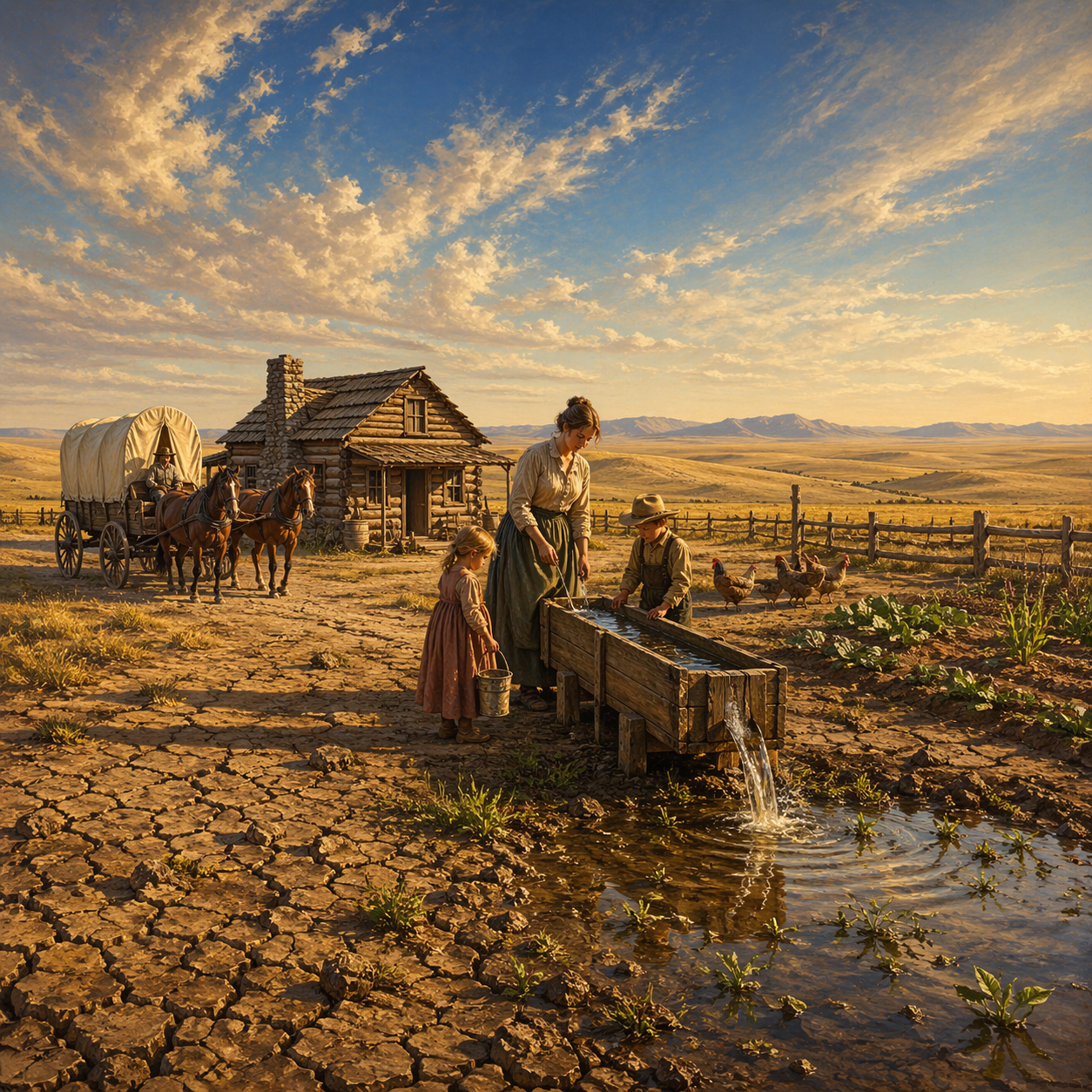
The cabin stood at the edge of the prairie like it had been forgotten by time.
A horse-drawn wagon carried them there the next morning, arranged by a kind farmer who had overheard her story. As they approached, Lily gasped.
It looked worse than Emily imagined.
The logs were gray and weathered. Part of the roof sagged. The door hung crooked. Tall weeds surrounded the structure, and the ground was cracked from drought.
But the sky above was enormous. Blue stretched forever, clouds drifting like slow ships. In the distance, mountains formed a faint silhouette.
“It’s… ours?” Ben asked.
Emily nodded.
The wind moved through the broken boards, sounding almost like laughter.
“Well,” she said, trying to sound cheerful, “we better get started.”
The first night, they slept inside their wagon. The cabin smelled of dust and old wood. A family of birds had nested in one corner. The floorboards creaked under every step.
Emily spent the morning sweeping out dirt while the children gathered stones.
Near the cabin stood an old wooden irrigation trough, half buried in the soil. Emily examined it carefully. It led from a shallow ditch that once carried water from a seasonal stream.
If she could clear it…
She grabbed a shovel.
The soil was hard as baked clay. Every scoop felt like lifting stone. But she kept digging.
By afternoon, Lily and Ben were helping, carrying small buckets of loose dirt. Chickens—wild and half feral—wandered near an old fence line, pecking at the ground.
“Mom!” Lily shouted suddenly.
A trickle of water seeped into the trough.
Emily froze.
The thin stream glimmered in the golden afternoon light. Slowly, steadily, it began to fill the wooden channel, then spill into a shallow pool on the cracked earth.
The children laughed.
“It’s working!” Ben yelled.
Emily sank to her knees, exhausted but smiling. Around the pool, dark soil began to soften. Tiny green shoots—barely visible—pushed through the dirt.
Life. Already returning.
The days became a rhythm.
Emily repaired the roof using salvaged boards. She patched holes with mud and straw. She stacked stones into a small chimney.
The children collected eggs from the wandering chickens. They built a fence from fallen wood. They planted seeds Emily bought with money earned washing laundry in town.
A small vegetable garden took shape: rows of beans, carrots, and potatoes.
The water trough became the heart of everything. It filled the small pool each morning, and Emily carefully redirected the overflow to the garden.
By late summer, green replaced brown. Crops sprouted. Chickens stayed close. The cabin looked less abandoned, more alive.
A passing wagon driver stopped one afternoon, surprised.
“Didn’t know anyone lived out here,” he said.
“We do now,” Emily replied.
He studied the thriving patch of land, then smiled. “You’ve done something special.”
Autumn painted the prairie gold. The children grew stronger, sun-tanned and laughing. Emily traded vegetables in town for flour and cloth.
Word spread.
“The woman who bought the five-dollar cabin,” people said.
Some came to see it. They expected ruin. Instead, they found a homestead.
One evening, as the sun sank low, a familiar wagon approached.
Emily’s heart tightened.
Her in-laws stepped down slowly, staring.
Her mother-in-law looked at the cabin, the garden, the chickens, the water trough shimmering in warm light.
“You… live here?” she asked.
Emily nodded.
The older woman walked toward the pool, watching water flow over the cracked earth. Small green sprouts surrounded it like a promise.
“I didn’t think…” she began, then stopped.
Ben ran past them, chasing a chicken. Lily carried a basket of vegetables.
“This place was five dollars?” her father-in-law asked quietly.
“Yes.”
He shook his head, amazed.
“You built all this?”
Emily looked around. The fence. The garden. The repaired cabin. The vast sky.
“We built it,” she said, nodding toward her children.
They stood in silence as the late afternoon sun stretched long shadows across the prairie.
Finally, her mother-in-law spoke.
“You didn’t just survive,” she said softly. “You made something beautiful.”
Emily felt the wind again, but this time it sounded different. Not lonely. Not searching.
It sounded like possibility.
That winter, snow dusted the plains, but the cabin held warm. Firewood stacked inside the walls insulated the logs. The roof no longer leaked. The garden rested beneath frost, waiting for spring.
Inside, Emily watched her children sleep and realized something.
Being forced to leave had felt like the end.
But it had been the beginning.
And sometimes, all it takes… is five dollars, a broken cabin, and the courage to believe the land can bloom again.