
Outlaws Laughed When the Stranger Rode Into the Saloon—Until He Said, “Who Took My Daughter’s Life?”
The laughter came first.
It rolled through the saloon like thunder over dry plains—loud, careless, and cruel. Glasses clinked, boots scraped against the warped wooden floor, and the smell of whiskey and sweat hung thick in the air. It was the kind of laughter that only came from men who thought themselves untouchable.
Then the door opened.
The hinges groaned low and slow, like they knew something the men inside didn’t. A gust of desert wind followed, carrying dust and the faint scent of rain that hadn’t yet arrived.
He stood there, framed by the sunlight.
A stranger.
Tall. Broad-shouldered. His coat was long and worn, the kind that had seen years of hard miles. His hat cast a shadow over his eyes, but there was no mistaking the stillness in him—a stillness that didn’t belong in a room full of noise and arrogance.
Someone snorted.
“Well look here,” one of the outlaws drawled, leaning back in his chair. “We got ourselves a preacher? Or maybe a lost soul lookin’ for salvation.”
More laughter.
The stranger didn’t move.
Didn’t smile.
Didn’t blink.
He stepped forward.
Each footfall echoed, measured and deliberate, cutting through the noise like a blade. The piano in the corner faltered, the player’s fingers stumbling over the keys before stopping altogether.
Now the laughter softened.
Not gone—but uncertain.
The stranger walked straight down the center of the room, past tables of men who suddenly found interest in their drinks. He stopped beneath the hanging lamp, where the light finally touched his face.
And what they saw there wasn’t anger.
It was worse.
It was grief.
Deep. Hollow. Carved into him like scars that never healed.
He removed his gloves slowly, one finger at a time.
Then he spoke.
“Who took my daughter’s life?”
Silence.
It came heavy, choking the room.
The outlaws glanced at each other. Some smirked, trying to reclaim the moment. Others shifted in their seats, hands drifting closer to holsters without quite meaning to.
Finally, a man near the bar barked a laugh.
“Hell of a way to introduce yourself, stranger,” he said. “You walk into our place and start askin’ questions like that?”
The stranger’s gaze didn’t leave him.
“My daughter,” he repeated, voice low. “Her name was Emily Carter.”
A flicker.
Just a flicker—but it passed between two men at a corner table.
The stranger saw it.
Of course he did.
He had been watching for it ever since he crossed into this town.
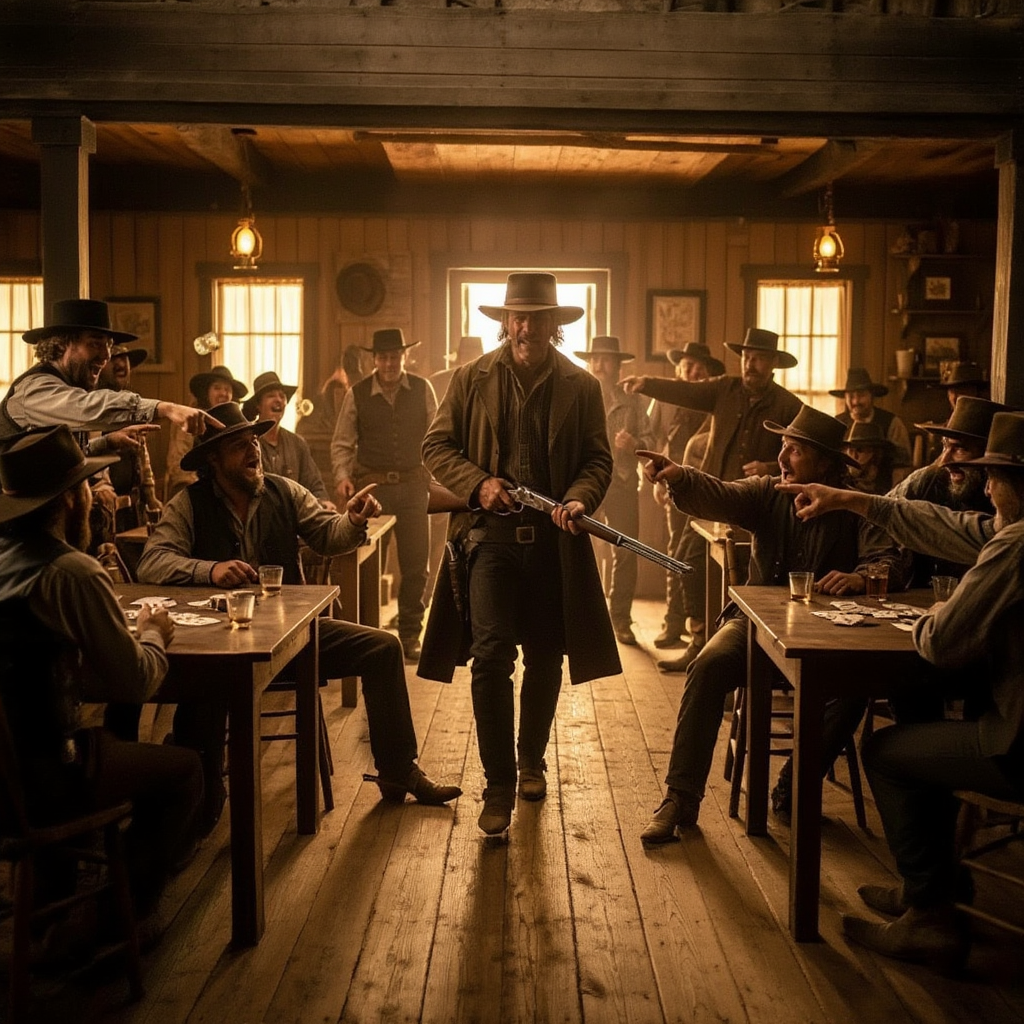
He took another step forward.
“She was seventeen,” he said. “She had a laugh that made people forget their troubles. She used to leave the door open when she slept, said she liked hearing the night.” His voice tightened, just slightly. “Three weeks ago, I found her in a ditch twenty miles from here.”
The room held its breath.
“She wasn’t alone when she died,” he continued. “There were boot prints. Six men, maybe more. And one of them…” He reached into his coat, slowly—carefully—and pulled out a small, tarnished sheriff’s badge. “…dropped this.”
The badge caught the lamplight.
A murmur spread.
Everyone in that room knew that badge.
It belonged to Deputy Hal Rooker.
Or at least—it had.
Rooker shifted in his seat near the back wall.
“You got a lotta nerve,” Rooker said, his voice sharp but not steady. “Walkin’ in here throwin’ accusations—”
“I didn’t say your name,” the stranger interrupted.
Rooker froze.
The silence deepened.
The stranger turned his head, just slightly, until his eyes met Rooker’s across the room.
“You said it yourself.”
A chair scraped loudly as someone stood.
“Now hold on—” another outlaw began.
But the stranger was already moving.
Not fast.
Not yet.
Just stepping closer.
Rooker’s hand dropped to his gun.
“You take one more step—”
The stranger stopped.
For a moment, it looked like the tension might break. Like the whole room might explode into gunfire and chaos.
Then the stranger did something unexpected.
He set the badge down on a nearby table.
Gently.
“I didn’t come here to kill men who had nothing to do with it,” he said. “But I will.”
No threat in his tone.
No raised voice.
Just certainty.
Rooker swallowed.
“You don’t know what you’re talkin’ about,” he said. “Girls like that—they wander. Get into trouble—”
The stranger’s fist slammed into the table.
The crack echoed like a gunshot.
“Say her name,” he said.
Rooker blinked.
“What?”
“Say her name,” the stranger repeated, louder now. “If you’re gonna talk about her—say her name.”
No one moved.
No one breathed.
Rooker licked his lips.
“…Emily,” he muttered.
The stranger nodded once.
“Now we understand each other.”
Another man stood—bigger than Rooker, with a scar running from his eye down to his jaw.
“This ain’t how things work around here,” he growled. “You come in, you drink, you leave. You don’t accuse—”
“I’m not accusing,” the stranger said.
He looked at all of them now.
One by one.
“I’m asking.”
The scarred man chuckled, but it sounded forced.
“And what if nobody answers?”
The stranger tilted his head slightly.
“Then I start removing possibilities.”
A long pause.
Then—
A chair tipped over.
A gun cleared leather.
And everything broke.
The first shot came from the left.
The stranger moved before the sound finished echoing.
His revolver was already in his hand—no one saw when he drew it—and he fired once.
The man who shot first hit the floor.
Screams erupted. Tables overturned. Glass shattered.
The stranger didn’t rush.
Didn’t panic.
He moved like a man who had already lived this moment a hundred times in his head.
Another outlaw lunged forward—shot.
A third tried to run for the door—shot.
Rooker ducked behind the bar, scrambling, knocking bottles aside.
“Damn it!” he shouted. “Kill him! Kill him!”
But the laughter was gone now.
All that remained was fear.
The stranger stepped over a fallen chair, his coat brushing the floor.
“Six men,” he said calmly, as if counting cattle. “That’s what I saw in the dirt.”
A man near the window raised his hands.
“I wasn’t there!” he shouted. “I swear—”
The stranger glanced at him.
Lowered his gun.
“Then sit down.”
The man did.
Fast.
Another figure bolted for the back door.
The stranger fired once without turning.
The man collapsed before reaching the handle.
“Four,” the stranger said.
Rooker peeked over the bar, gun shaking in his grip.
“You’re dead,” he snarled. “You hear me? Dead!”
“Maybe,” the stranger replied.
He stepped closer to the bar.
“But not before I finish this.”
A shot rang out.
The stranger staggered—just slightly—as the bullet grazed his shoulder.
Rooker grinned.
“Got you—”
The grin vanished as the stranger’s gun came up.
Two shots.
Rooker screamed as his gun flew from his hand, his fingers shattered.
He collapsed behind the bar.
The saloon fell silent again.
Smoke curled in the air.
Bodies lay scattered across the floor.
The stranger walked slowly to the bar and stepped around it.
Rooker was clutching his hand, blood seeping between his fingers, his bravado gone.
“Please,” he whispered. “I didn’t mean—”
“Who else?” the stranger asked.
Rooker shook his head frantically.
“I—I don’t know—”
The stranger crouched in front of him.
“You were there,” he said. “I can see it in your eyes.”
Tears welled up in Rooker’s.
“It wasn’t supposed to go like that,” he stammered. “We were drunk—just messin’ around—she fought—”
The stranger closed his eyes.
Just for a second.
When he opened them again, the grief was still there.
But now it burned.
“Names,” he said.
Rooker hesitated.
The stranger raised his gun slightly.
“Names.”
“…Dalton,” Rooker choked out. “Eli Graves… Tom Cutter… and—”
A shot cracked through the air.
Rooker’s head snapped back.
He slumped to the floor, lifeless.
The stranger turned.
In the doorway stood another man—older, dressed cleaner than the rest. A sheriff’s star gleamed on his chest.
Sheriff Boone.
“You should’ve left,” Boone said quietly.
The stranger stood.
“Five,” he said.
Boone’s jaw tightened.
“You don’t understand how things work here,” he said. “That girl—she was just—”
“Say her name.”
Boone hesitated.
Then looked away.
The stranger nodded slowly.
“That’s what I thought.”
Outside, thunder rumbled.
The storm had finally arrived.
Rain began to fall, tapping against the windows, washing dust from the world.
Inside the saloon, the stranger raised his gun.
“This ends tonight,” he said.
Boone drew his weapon.
For a moment, they stood there—two men on opposite sides of something that couldn’t be undone.
Then—
They fired.
The sound echoed into the storm.
And somewhere, far beyond the town, the wind carried it away—along with the laughter that would never return.
Outlaws Laughed When the Stranger Rode Into the Saloon — Part 2
The gunshots overlapped like thunder.
For a split second, neither man fell.
Then Sheriff Boone staggered.
His bullet had gone wide—splintering wood behind the stranger—while the stranger’s shot struck true, tearing through Boone’s side. Not clean. Not fatal—yet. But enough to drop him to one knee.
The stranger didn’t lower his gun.
Rain hammered the roof now, drowning the last echoes of violence inside the saloon. Water streamed through the open doorway, pooling on the warped floorboards, mixing with blood and dust until everything smelled like iron and earth.
Boone coughed, one hand pressed to his wound.
“You think this ends with me?” he rasped.
The stranger stepped forward, boots slow and steady.
“No,” he said. “It ends when I know everything.”
Boone let out a bitter laugh, then winced from the pain.
“You’re too late for that.”
The stranger stopped just out of arm’s reach.
“Try me.”
For a moment, Boone said nothing. His breathing came shallow, uneven. The storm outside seemed to press in closer, like the whole world was waiting for what came next.
Then Boone looked up.
“You ever been in a place like this?” he asked quietly. “A town that ain’t really a town? Just a stop along the way for men with no future and no past?”
The stranger didn’t answer.
Boone smirked faintly.
“Didn’t think so. You came ridin’ in here with purpose. With… righteousness.” He spat a little blood. “That don’t last long out here.”
“My daughter lasted seventeen years,” the stranger said.
Boone’s smile faded.
“Seventeen years,” he repeated. “That’s more than most get.”
The stranger’s jaw tightened.
“Finish your story,” he said.
Boone leaned back against the bar, grimacing.
“It wasn’t planned,” he said. “Not the way it happened. Rooker and the others—they were drunk, like he said. Found her out on the road. Alone.”
The stranger’s grip on his gun tightened, but he said nothing.
“They brought her in,” Boone continued. “Thought it’d be a joke. Something to pass the night.” His voice faltered for the first time. “I told them to let her go.”
A long pause.
“You told them?” the stranger asked.
Boone nodded weakly.
“I’m the sheriff. That’s what I’m supposed to do.” He gave a hollow chuckle. “But I didn’t stop them.”
Silence filled the space between them.
The stranger’s voice, when it came, was quieter than before.
“You watched.”
Boone closed his eyes.
“…Yes.”
The word barely existed.
The storm surged.
Wind rattled the windows, and somewhere outside, a sign tore loose and crashed into the mud.
“She fought,” Boone said. “Harder than any of us expected. Bit one of them. Broke another’s nose.” He swallowed. “That’s when things turned.”
The stranger’s breathing slowed.
Controlled.
Dangerous.
“Who killed her?” he asked.
Boone hesitated.
Then shook his head.
“It don’t matter.”
The stranger raised his gun slightly.
“It matters to me.”
Boone met his eyes.
“It was all of us.”
The words landed heavier than any gunshot.
For a moment, the stranger didn’t move.
Didn’t blink.
Didn’t breathe.
Rain filled the silence.
Then—
He lowered his gun.
Just an inch.
Boone noticed.
“See?” Boone whispered. “That’s the truth nobody tells. Out here, guilt ain’t clean. It spreads. Sticks to everyone.” His voice grew stronger, desperate now. “You kill me, you ain’t avengin’ her—you’re just addin’ to it.”
The stranger studied him.
Really studied him.
Not as a target.
Not as prey.
But as a man.
“You’re wrong,” he said.
Boone frowned.
“About what?”
The stranger stepped closer.
“About what this is.”
Before Boone could react, the stranger kicked his gun away and grabbed him by the collar, hauling him up despite the wound.
Boone gasped in pain.
“This isn’t revenge,” the stranger said, his voice low and steady. “It’s a reckoning.”
Boone struggled weakly.
“There’s no difference—”
“There is,” the stranger cut in. “Revenge is blind. This…” He tightened his grip. “…this is justice.”
Boone laughed again, but it broke halfway through.
“Justice?” he said. “You think shootin’ your way through a room full of men is justice?”
The stranger’s eyes didn’t waver.
“No,” he said. “This is.”
He released Boone just enough for him to slump back against the bar.
Then he reached into his coat.
Boone tensed—but the stranger didn’t draw his gun.
He pulled out something else.
A folded piece of cloth.
Carefully, he opened it.
Inside was a small silver locket.
Boone stared at it, confused.
The stranger held it up so the dim light caught its surface.
“She wore this every day,” he said. “Her mother gave it to her before she died.”
Boone said nothing.
“I found it in the dirt,” the stranger continued. “Broken. Covered in blood.” His voice faltered—just for a moment. “I fixed it.”
He pressed the locket into Boone’s hand.
Boone flinched as if it burned him.
“Why… why are you showin’ me this?” he asked.
The stranger crouched in front of him again.
“Open it.”
Boone hesitated.
Then, slowly, he did.
Inside was a tiny photograph.
A girl, smiling.
Bright-eyed. Alive.
Human.
Boone’s breath caught.
“She had a name,” the stranger said softly. “She had a life. She wasn’t just… something that happened on a bad night.”
Boone’s hand trembled.
“I know,” he whispered.
“No,” the stranger said. “You didn’t.”
Silence.
Then Boone’s shoulders sagged.
Something in him broke—not from the wound, not from fear—but from the weight of what he was finally seeing.
“I didn’t stop them,” he said again, louder this time. “I should have. I could have.” Tears mixed with rainwater on his face. “I was afraid.”
The stranger nodded once.
“I know.”
Boone looked up, surprised.
“You… know?”
The stranger’s gaze drifted for a moment—somewhere far beyond the saloon.
“I’ve been afraid too,” he said. “Every day since I found her.”
He looked back at Boone.
“But I didn’t let that stop me from coming here.”
Boone let out a shaky breath.
“What happens now?” he asked.
The stranger stood.
For a long moment, he didn’t answer.
The storm began to ease, the rain softening to a steady rhythm.
Dawn wasn’t far off.
“What happens now,” the stranger said slowly, “is you finish what you started.”
Boone frowned.
“I don’t—”
“You’re the sheriff,” the stranger interrupted. “Or you were.” He nodded toward the bodies scattered across the room. “That badge means something. Or it’s supposed to.”
Boone looked down at the locket still in his hand.
“You want me to turn myself in?” he asked.
“I want you to tell the truth,” the stranger said. “All of it. Names. What happened. No lies. No excuses.”
Boone swallowed.
“And if I don’t?”
The stranger’s hand rested lightly on his gun.
“Then I finish it my way.”
A long pause.
Boone closed the locket.
His fingers tightened around it.
“…There’s a judge in Carson City,” he said quietly. “Circuit rider. He’ll be passin’ through in a week.”
The stranger said nothing.
“I’ll wait,” Boone continued. “I’ll tell him everything.” He looked up. “That enough for you?”
The stranger studied him.
Searching for something.
Truth.
Regret.
Anything real.
Finally, he nodded.
“For her,” he said.
Boone exhaled, something like relief washing over him.
“For her,” he echoed.
The stranger turned toward the door.
“Wait,” Boone called weakly.
The stranger paused.
“You got a name?” Boone asked.
A beat.
Then—
“Carter,” he said. “John Carter.”
Boone nodded slowly.
“Your daughter… she’d be proud you came.”
Carter didn’t turn around.
“She would’ve been proud if I didn’t have to.”
And with that, he stepped out into the rain.
—
The town was quieter now.
The storm had washed the dust from the streets, leaving behind mud and silence. A few doors creaked open as people peeked out, drawn by the gunfire that had shattered the night.
They saw him.
The stranger.
Walking his horse down the street, coat dark with rain, hat pulled low.
No one stopped him.
No one spoke.
Because somehow, they all knew—
Something had changed.
Carter mounted his horse at the edge of town.
For a moment, he sat there, looking back.
At the saloon.
At the place where laughter had turned into something else.
Something final.
Then he reached into his pocket.
Pulled out a second locket.
Identical to the first.
He opened it.
Inside was the same photograph.
Emily.
Smiling.
Alive.
“I found him,” he said quietly.
The wind carried his words away.
“I found them all.”
He closed the locket.
Slipped it back into his coat.
Then, with a gentle nudge of his heels, he rode out into the morning light.
Behind him, the town would wake.
Stories would spread.
Truths would surface.
And somewhere, a man with a badge would decide whether it still meant something.
Ahead of him—
There was nothing but open land.
And the long, quiet road that comes after justice is done.