
Cast Out Before Winter, a Widow Filled a Cave With Firewood and Food — It Saved Her in the Deadly…
They told her she wouldn’t last a week.
By the time the first frost touched the grass, Martha Ellison had already been cast out.
The town council didn’t call it that, of course. They said things like “temporary relocation” and “unsuitable living conditions.” They spoke in careful voices, hands folded, eyes avoiding hers. But the meaning was plain enough.
Her husband had died in late summer—crushed beneath a fallen timber while repairing the mill bridge. The house they’d rented belonged to the mill owner. With no income and winter approaching, he wanted it back for one of his workers.
“I’ll pay,” Martha said quietly, sitting stiffly in the wooden chair inside the town hall.
“With what?” the owner asked, not cruelly, just blunt.
“I can sew. Cook. Clean.”
He shook his head. “Not enough.”
The councilman cleared his throat. “There’s a storage shed near the north road—”
“That roof leaks,” someone muttered.
Another voice: “Snow’ll bury it.”
Martha sat silently, hands folded in her lap.
“We’re sorry,” the councilman finished. “You’ll need to vacate by the end of the week.”
She walked home in the fading light, the town already preparing for winter—stacking wood, sealing windows, bringing livestock closer to barns.
No one stopped her.
No one offered anything.
By morning, she had a plan.
Not a good one.
But a plan.
The cave lay half a mile beyond the tree line, carved into a low hillside overlooking a frozen creek bed. Her husband had once shown it to her during a summer walk.
“Old trappers used this,” he’d said. “Stays warmer than outside.”
At the time, she’d laughed.
Now she stood at the entrance, staring into the dark.
The cave smelled of damp earth and old leaves. The ceiling curved low near the entrance but rose deeper inside. Roots poked through the dirt walls, and fallen branches littered the ground.
It wasn’t much.
But it was shelter.
Martha tied her shawl tighter and stepped inside.
She spent the first day clearing debris. She hauled rocks, swept dirt with a broken broom, and stacked fallen branches. By evening, her hands were raw, her back aching, but the cave looked less like wilderness and more like possibility.
She slept near the back wall, wrapped in her husband’s old coat.
The cold woke her before dawn.
She realized then: shelter alone wouldn’t save her.
She needed fire.
She needed food.
She needed to prepare before the snow came.
The next weeks became a blur of work.
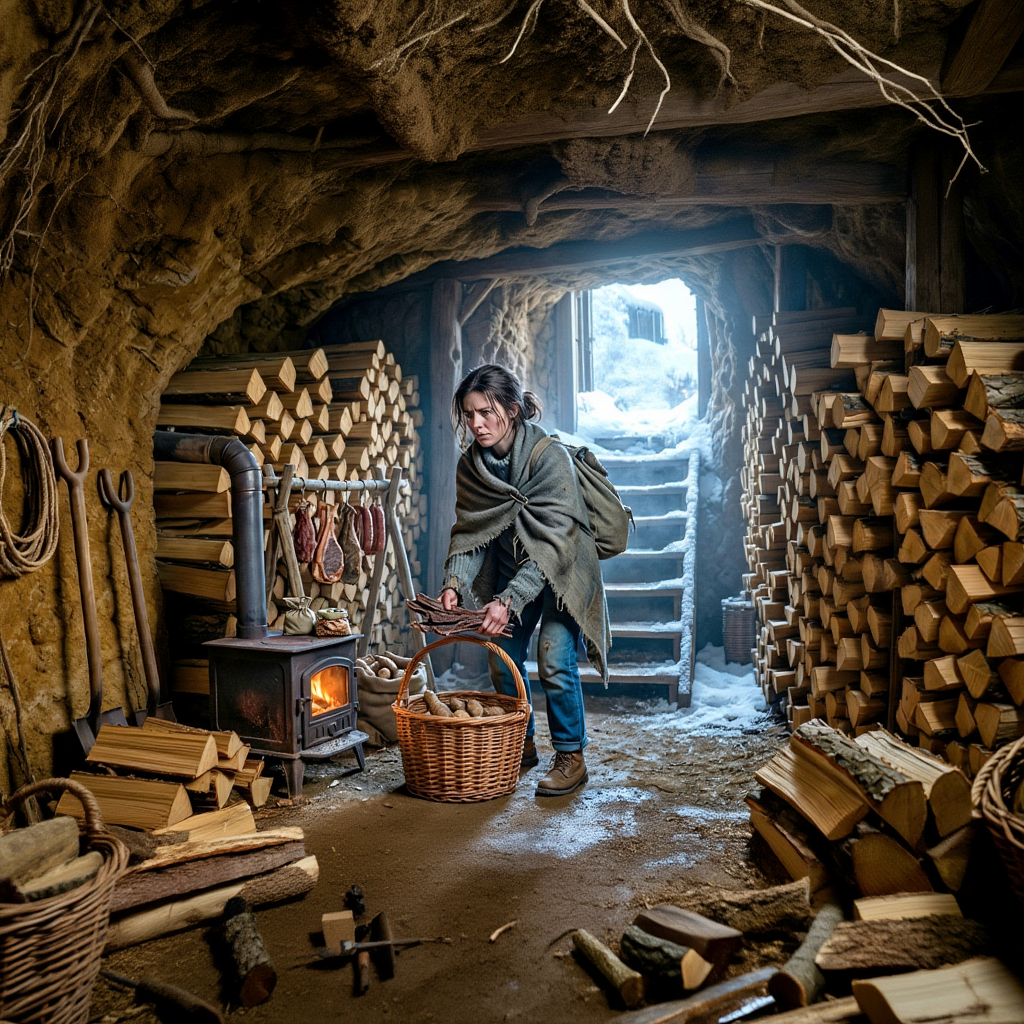
She rose at first light, walked to the forest, and gathered fallen limbs. She dragged them back in bundles, stacking them along the cave walls. At first, the piles looked small. By the fifth day, they rose waist-high.
She found a discarded cast-iron stove behind the abandoned blacksmith shed. It took two days to haul it—inch by inch—on a wooden sled she built from scrap boards. When she finally placed it inside the cave, she felt the first flicker of hope.
She patched the stovepipe with tin and clay. Smoke drifted weakly at first, then steadied.
The cave filled with warmth.
Martha stood in the glow, holding her hands near the fire.
She didn’t cry.
She kept working.
She traded her last silver brooch for a sack of potatoes from a farmer heading south. She dug a shallow pit in the cave floor and layered straw, then placed the potatoes inside. They’d last, if she was careful.
She strung ropes between wooden beams she hammered into the dirt ceiling. On them, she hung strips of meat she’d salted herself. Not much—but enough to stretch.
She gathered dried plants—wild onions, herbs, brittle twigs for kindling. She filled baskets and stacked them neatly near the stove.
Each day, the cave transformed.
Firewood lined both walls. Tools leaned neatly in one corner. A second basket held turnips. Another, dried berries.
Wooden steps—rough but sturdy—led from the cave floor up to the snowy slope outside.
By the time the first snow fell, she was ready.
The town noticed her less and less. They assumed she’d moved on. Or failed.
Winter arrived early.
The storm came at night.
Wind howled across the hills, driving snow into every crack and hollow. Trees groaned. The temperature plunged. By morning, the world was buried.
Inside the cave, Martha stirred the stove. Flames flickered bright orange. Warmth spread slowly through the earthen walls.
She boiled potatoes in a small iron pot. Steam rose, fogging the cool air near the entrance.
She listened to the storm rage outside—and felt safe.
For three days, snow fell without pause.
Her wooden steps vanished beneath drifts. The entrance narrowed to a bright, icy glow. But inside, the fire burned steadily.
She rationed carefully. One potato per meal. A strip of meat every other day. Melted snow for water.
The wood piles shrank slowly.
But they held.
On the fifth day, the storm stopped.
The silence afterward felt enormous.
Martha climbed the stairs and pushed open the snow-packed entrance. Sunlight flooded the cave, reflecting off the white landscape beyond.
The world was frozen solid.
No tracks. No smoke from town. Just endless snow.
She stepped back inside and closed the entrance partially with a wooden board.
The cave remained warm.
Days blended together. She read from her husband’s worn Bible. She mended her sweater. She sorted wood by size. Each routine gave shape to the long winter.
One evening, she heard something.
A faint sound outside.
Not wind.
A thud.
Then another.
She froze, listening.
A voice followed—weak, barely audible.
“Hello…?”
Martha grabbed her shawl and climbed the steps. She pushed aside the snow board and stepped into the glare.
A man lay half-buried near the entrance. His coat was torn. His face pale. A horse stood nearby, reins dragging.
“Help…” he whispered.
Martha hurried forward. She dragged him—slowly, painfully—into the cave. He collapsed near the stove, shivering violently.
She added wood to the fire. Warmth surged.
He blinked, staring at the cave—at the stacked wood, the hanging meat, the baskets.
“You… live here?” he croaked.
“Yes.”
“You’re… prepared.”
“I had to be.”
She gave him hot broth. He drank greedily, then coughed.
“My wagon tipped,” he explained weakly. “Been walkin’… thought I’d freeze.”
“You nearly did.”
He looked around again. “This… saved me.”
Martha said nothing.
Over the next days, he recovered slowly. His name was Daniel Brooks, a trader caught in the storm. He helped chop wood once he regained strength.
“You stocked all this yourself?” he asked, amazed.
“Yes.”
He shook his head. “Most folks in town weren’t ready for this storm.”
Her eyes lifted. “Town?”
“Road’s blocked. Snow too deep. They’re struggling.”
Martha stared at the fire.
The cave had saved her.
And now—it might save others.
Two days later, they heard distant voices.
Three men approached, stumbling through snow. Daniel waved them in. Martha opened the cave.
The men stepped inside, stunned by the warmth.
“You… you got food?” one asked.
She nodded.
They stayed the night.
Then more came.
A family with two children. An old rancher. A young woman nearly frozen.
The cave filled with quiet life. The stove burned constantly. The wood piles shrank—but slowly.
“They cast you out?” Daniel asked quietly one night.
Martha nodded.
“And now you’re saving them.”
She stared at the fire. “I prepared for myself.”
He smiled faintly. “Still saved them.”
When the snow finally melted weeks later, the group stepped out into a softened world. Smoke rose again from town chimneys. Roads reopened.
The townspeople looked at Martha differently now.
She didn’t say “I told you.”
She simply returned to the cave—still warm, still stocked, still hers.
They had cast her out before winter.
But she had filled the cave with firewood and food.
And when the deadly cold came, it didn’t just save her.