
Neighbor’s Laughed When He Built a Cabin on Top Of His Barn — Until It Heated His Floors All Night
When Noah Carter started building the second roof, his neighbors assumed he’d lost his mind.
They had watched him all summer raising the new barn—solid posts sunk deep into rocky ground, thick plank siding, and a steep metal roof meant to shed mountain snow. It stood at the edge of his property, taller than anything else in the valley except the old grain elevator by the river.
It should’ve ended there.
Barn below. Hayloft above. Maybe a small tack room.
That’s what everyone expected.
Instead, Noah brought in another load of lumber and began framing… a house on top of it.
By the third day, folks started stopping their trucks along the fence line.
By the fifth, they were laughing.
“You see Carter?” Hank Miller said at the feed store. “Man’s building himself a crow’s nest.”
“House on a barn,” someone chuckled. “Wind’ll carry him off come January.”
“Or the whole thing’ll freeze. Heat rises — he’ll burn through wood like crazy.”
Noah heard it all. Coldwater County was small. Nothing stayed quiet.
He just kept building.
The truth was simple: Noah Carter didn’t have much left.
Two winters earlier, his old farmhouse burned down in the middle of the night. A cracked chimney, the fire marshal said. He’d gotten out with nothing but the clothes on his back and his dog, Rusty. Insurance covered some of the loss, but not enough to rebuild the big place his grandfather had built.
So he lived in a camper while he worked.
First came the barn. He needed shelter for his animals before anything else. Six goats, two horses, and a handful of chickens were all he had left. They were his livelihood.
But while he framed the barn, he kept thinking about winter.
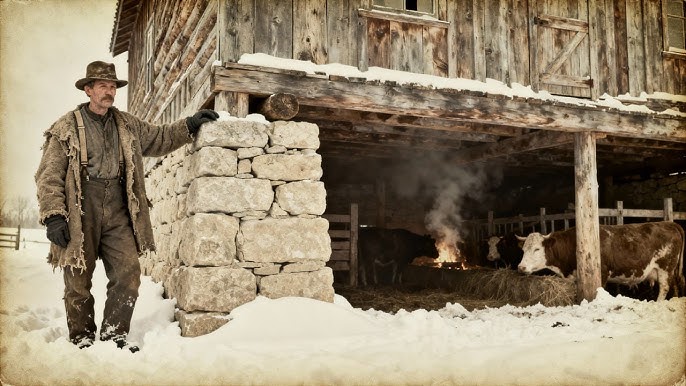
The valley dropped to negative twenty most nights in January. Wood was expensive. Propane worse. He’d spent two miserable winters waking to frozen water and numb fingers.
Then he remembered something his grandfather once told him.
“Animals make heat, boy. Lot more than folks realize. Old timers used to sleep above stables.”
The idea stuck.
So he designed something strange.
The lower level would be the barn—insulated thick with straw and packed animals. Above it, he’d build a small cabin. Between them, he left a hidden air chamber, with vents and channels he’d carefully mapped.
Heat rises.
That was the entire plan.
By October, the cabin walls stood tall. A simple one-room layout: kitchen corner, wood stove backup, small bed near the window, and thick plank floors above the hayloft.
His neighbor, Earl Jennings, leaned on the fence one afternoon, chewing tobacco.
“You really gonna live up there?” Earl asked.
“Yes.”
“In winter?”
“Yes.”
Earl shook his head. “You’re gonna freeze.”
“Maybe,” Noah said calmly.
Earl squinted. “Or cook.”
“Maybe that too.”
Earl laughed. “Well… I’ll bring coffee when you come crawling back down.”
Noah smiled faintly. “Deal.”
By early November, the first snow dusted the valley. Noah finished sealing the roof and moved in. Rusty bounded up the stairs first, tail wagging.
Inside, the cabin smelled like fresh pine.
Noah lit the wood stove for the first night, just to test everything. The temperature climbed quickly, but he let the fire die before bed.
The real test would be without it.
Below him, the animals shifted in the barn. Horses snorted softly. Goats rustled in straw. Chickens murmured.
Warm air began rising through the hidden vents.
Noah lay in bed, watching his breath.
At first, he could see it clearly.
Then… less.
An hour later, the air felt… mild.
By midnight, he kicked off his blanket.
He sat up, surprised.
The floor beneath his feet felt warm.
Not hot—just gently warm, like a low radiant heater.
He grinned in the dark.
Outside, the temperature dropped to twelve degrees.
Inside, the cabin held steady at sixty.
By morning, Noah woke to sunlight and a comfortable room. The water bucket hadn’t frozen. Rusty stretched lazily.
No wood burned overnight.
He climbed down to feed the animals, shaking his head in disbelief.
It worked.
The real storm came two weeks later.
Weather radio warned of an Arctic front. Temperatures predicted to drop below zero for three nights straight. Winds up to forty miles per hour.
Neighbors stocked propane. Some drove to town for extra heaters.
Earl Jennings knocked on Noah’s ladder the evening before.
“You serious about staying up there?” Earl asked.
“Yes.”
“You got enough wood?”
“Some.”
Earl frowned. “You’re stubborn.”
“Probably.”
Earl sighed. “If it gets bad, come over. My spare room’s open.”
“Thanks.”
That night, the wind began.
By midnight, snow slammed sideways against the cabin walls. The barn below creaked but held. Animals clustered together instinctively.
Noah lay in bed, listening.
The temperature outside dropped to negative eight.
Inside… sixty-two.
He laughed softly.
By morning, the valley looked buried. Drifts piled against fences. Smoke poured from chimneys everywhere — except Noah’s.
Earl noticed first.
He trudged through snow to the barn and climbed the ladder, expecting frost.
Instead, he stepped into warm air.
“What the—”
Noah handed him coffee. “Morning.”
Earl looked around. No fire burning. No propane heater.
“How warm is it?”
“About sixty.”
Earl stomped the floor. “This warm?”
“Heat’s coming from below.”
Earl leaned over the railing and looked into the barn. Animals packed together, steam rising faintly.
He shook his head slowly. “You’re heating the house… with livestock.”
“And insulated air.”
Earl laughed in disbelief. “Well I’ll be…”
Word spread fast.
By afternoon, two more neighbors came. Then three. They climbed the ladder, stomping snow from boots, expecting a gimmick.
Every one of them paused.
Warm floors.
No roaring stove.
No fuel tank.
Just quiet heat.
“You’re telling me this lasts all night?” one asked.
“Noah nodded. “Animals never stop generating heat. The chamber traps it.”
“And the vents?”
“Pull warm air up slowly.”
A rancher scratched his beard. “That’s… clever.”
That night, the cold hit harder. Negative sixteen. Wind howling.
Across the valley, heaters struggled. One propane line froze. Another neighbor burned through half a cord of wood overnight.
Noah slept soundly.
Morning came. His cabin still warm.
Two days later, Earl showed up with blueprints.
“Mind drawing that chamber?” he asked.
Noah smiled. “Sure.”
By December, three neighbors started modifying their barns.
By January, the county extension office drove out to see the design. They took photos, measurements, and notes.
“You invented a passive radiant livestock heat system,” one engineer said.
Noah shrugged. “Just used what I had.”
The coldest night of the winter arrived in February.
Negative twenty-three.
Pipes froze across the valley. One family moved into a motel. Another burned furniture to stay warm.
Noah’s cabin stayed sixty.
He woke at midnight sweating slightly and cracked a window.
Rusty wagged his tail.
Below them, the animals shifted, unknowingly heating the space above.
A week later, Earl finished his own barn-top cabin. He climbed up the ladder with a thermometer.
Fifty-eight degrees.
No fire.
He laughed so loud the horses startled.
Spring came early that year. Snow melted. The valley turned green again.
One afternoon, Noah leaned against the railing, watching his animals graze. Earl walked over, hands in pockets.
“You know,” Earl said, “we all laughed at you.”
“I know.”
“You weren’t building crazy.”
“No.”
“You were building smart.”
Noah looked out across the valley. Three barns now had cabins above them.
“Just didn’t want to freeze again,” he said.
Earl nodded. “Funny thing is… you warmed half the valley.”
Noah smiled.
Above the barn, the cabin sat quietly in the sun — the strangest house anyone had ever laughed at…
Until it kept him warm all night long.
By the second winter, Noah Carter’s barn-top cabin had become something of a legend.
People didn’t laugh anymore.
They drove past slowly, pointing. Some stopped to ask questions. Others came with notebooks, measuring tape, and skeptical expressions that melted the moment they climbed the ladder and felt the warmth.
Noah never charged anyone. He simply showed them the vents, the insulated chamber, and the slow airflow path that carried heat from the animals below to the floor above.
“Heat rises,” he would say simply. “Just gave it somewhere to go.”
But not everyone liked the attention.
One afternoon in early November, a black pickup rolled into Noah’s driveway. The man who stepped out wore a pressed jacket and expensive boots — not the kind meant for mud.
“Mr. Carter?” he asked.
“That’s me.”
“I’m Victor Langley. Langley Development.”
Noah nodded slowly.
“I’ve heard about your structure,” Langley said, glancing up at the cabin. “Innovative. Efficient. Very marketable.”
Noah frowned. “Marketable?”
“We build rural housing developments. I’d like to purchase your design.”
“I didn’t patent it.”
“That’s why I’m here. We can handle that. You sign rights over, we pay you upfront. Generous sum.”
Noah leaned against the railing. “How generous?”
“Fifty thousand dollars.”
It was more money than Noah had seen in years.
Langley smiled, sensing hesitation. “We mass-produce prefab barn-cabins. Sell them nationwide. You walk away comfortable.”
Noah looked down into the barn. The horses shifted. Goats nibbled hay. Steam rose faintly in the cold.
“I built this because I was broke,” Noah said quietly. “People here needed something cheap.”
Langley nodded. “Exactly. We’ll refine it. Sell at scale.”
“How much?”
“Depends. Maybe two hundred thousand per unit.”
Noah’s eyes hardened.
“That’s not cheap.”
Langley shrugged. “Innovation costs.”
Noah shook his head. “Not interested.”
Langley’s smile faded slightly. “You’re turning down a life-changing offer.”
“I already changed my life.”
Langley handed him a card. “If you reconsider.”
He drove away.
That night, Noah sat on the cabin floor, Rusty curled beside him. Snow began falling again — the first real storm of the season.
The floor warmed gradually, just like before.
He thought about fifty thousand dollars.
Then he thought about Earl, about Mrs. Hargrove, about the Carters down the valley who’d nearly frozen the year before.
He tossed the card into the wood box.
The storm lasted three days.
On the second morning, a knock came from below. Noah climbed down to find a young woman standing in the barn doorway, shivering.
“Sorry,” she said. “I’m Emma Doyle. My heater went out last night.”
Noah nodded. “Come up.”
She climbed the ladder carefully, eyes widening as she entered the warm cabin.
“This is… incredible,” she whispered.
“You can stay till your place warms up.”
She exhaled, relief flooding her face. “Thank you.”
Emma stayed two nights. They talked quietly over coffee. She was a schoolteacher in town, recently moved into her grandfather’s old farmhouse.
“Pipes froze solid,” she said. “I thought I’d made a mistake moving here.”
Noah smiled faintly. “Winters test you.”
She tapped the warm floor. “This… passes the test.”
When the storm cleared, she left with a grateful smile.
Two weeks later, she returned — this time with a basket of fresh bread.
“Payment,” she said.
Noah shook his head. “Didn’t need—”
“I wanted to.”
She stayed for coffee.
Then again the next week.
And the next.
Winter deepened. Snow piled high. Emma began helping Noah feed the animals. She wasn’t strong like him, but she worked steadily.
One evening, she stamped snow off her boots and laughed. “You know half the town wants one of these cabins now.”
“They can build them.”
“Some don’t know how.”
He shrugged. “I’ll help.”
“You always help everyone?”
“Mostly.”
She smiled softly.
That night, the temperature plunged to negative twenty again. Emma had stayed late, and the wind rose suddenly.
“You shouldn’t drive back,” Noah said.
She hesitated. “You sure?”
“Road’s bad.”
She stayed.
He gave her the bed and took the chair. Around midnight, she woke and padded across the floor.
“It’s warm,” she whispered.
“Yeah.”
“No fire?”
“No.”
She sat beside him, pulling the blanket around her shoulders.
“This place feels… safe,” she said quietly.
He nodded.
Morning came bright and clear. They shared breakfast watching steam rise from the barn below.
By February, Emma was visiting almost daily.
Earl noticed first.
“You courting her?” he asked one afternoon.
Noah frowned. “No.”
“Looks like it.”
Noah glanced toward the ladder where Emma’s laughter drifted down.
“Maybe,” he admitted.
Spring arrived again, melting snow into muddy streams. Grass returned. The animals spread across pasture.
One evening, Emma stood beside Noah on the cabin balcony.
“You know,” she said, “people stopped laughing.”
“I noticed.”
“They’re copying you now.”
“That’s good.”
She looked at him. “You warmed more than floors.”
He didn’t answer, but a small smile touched his face.
Later that summer, Noah added something new.
He extended the cabin slightly — a second small room.
Earl leaned on the fence again. “What’s that for?”
Noah shrugged. “Guest space.”
Earl grinned. “Or something more permanent?”
Noah didn’t deny it.
By the time the second winter came, Emma’s coat hung beside Noah’s door permanently. Her boots sat by the stairs. Rusty followed her everywhere.
The first snow fell quietly.
They stood together in the cabin, watching flakes drift past the window. The floor warmed beneath their feet.
Emma slipped her hand into his.
“Still the strangest house in the valley,” she said.
Noah nodded.
“But the warmest,” she added.
Below them, the animals settled into straw, their quiet warmth rising slowly through the hidden chamber.
And above the barn, the cabin that once made neighbors laugh now glowed gently through the night — heating its floors, warming its walls…
…and finally, warming the life Noah had rebuilt from nothing.