
Neighbor’s Laughed When Ex-Sniper Built a Second Wall Around His Cabin — Until the Blizzard Came
When Caleb Rourke came to Black Hollow, people noticed two things immediately.
First, he didn’t talk much.
Second, he worked like a man who had something to outrun.
The cabin he bought sat at the far edge of town, where the trees thickened into a dark, whispering forest and the mountains rose like a warning. It was small, weather-beaten, and leaning just slightly to one side—as if even the land had grown tired of holding it up.
Most folks wouldn’t have given it a second glance.
Caleb saw potential.
Or maybe he just didn’t care.
“City boy?” old Mr. Grady had asked on the day Caleb first showed up at the general store.
Caleb shook his head once. “No.”
“Then what brings you out here?”
Caleb paused just long enough to make it clear he wasn’t going to answer.
“Quiet,” he said finally.
That was the last full sentence anyone heard from him for weeks.
—
By the end of the first month, the town had already decided what kind of man Caleb Rourke was.
Strange.
Unfriendly.
Probably running from something.
Mrs. Wilkes, who had lived in Black Hollow for nearly forty years and considered herself the unofficial historian of everyone’s business, claimed he had “that look.”
“You know the one,” she whispered to anyone who would listen. “Like he’s seen things he shouldn’t have.”
They weren’t wrong.
Caleb had seen things.
Too many.
Too close.
But Black Hollow didn’t need to know about deserts that swallowed men whole, or nights lit by gunfire instead of stars, or the quiet weight of decisions that never really left you.
So he worked.
Every day from sunrise to dusk, Caleb rebuilt the cabin.
He replaced rotten beams, patched the roof, reinforced the door. He moved with precision—each measurement exact, each cut deliberate.
And then, one morning, he started building the second wall.
That’s when the laughter began.
—
“What in God’s name is he doing now?”
Earl Benson leaned against the fence across the road, squinting at Caleb’s property.
“Looks like he’s building another cabin,” someone joked.
“No,” Earl said, shaking his head. “Look closer. He’s building a wall… around the cabin.”
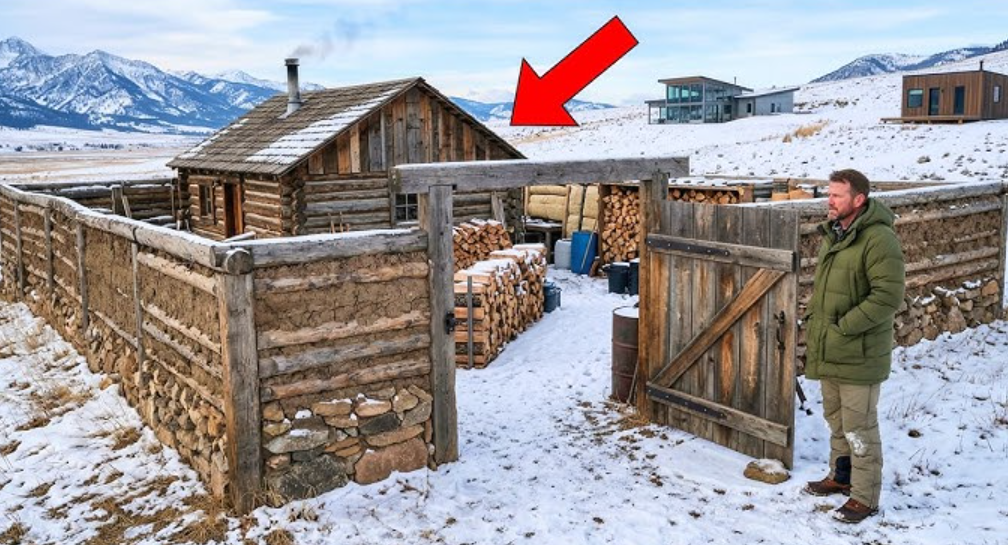
Sure enough, Caleb had begun constructing a second outer shell—thick wooden planks, reinforced with packed earth and stone, forming a narrow gap between the original cabin walls and the new structure.
It was strange.
Unnecessary.
And, to the townsfolk, deeply amusing.
“Maybe he thinks he’s under attack,” Earl laughed.
“From what? Squirrels?” another man added.
Even Mrs. Wilkes couldn’t resist.
“Mark my words,” she said with a smirk, “that man’s got more ghosts in his head than sense in his bones.”
Caleb heard the laughter.
Of course he did.
Sound carried easily in the cold mountain air.
But he didn’t stop.
Didn’t even slow down.
Because Caleb wasn’t building for them.
He was building for what they didn’t understand.
—
The first snow came early that year.
A light dusting at first—just enough to turn the mountains white and make the town look like something out of a postcard.
People smiled.
Children played.
Shop owners hung decorations, convinced it would be a beautiful, gentle winter.
Caleb knew better.
He had seen storms that started softly.
He had seen how quickly quiet could turn into something deadly.
So he worked faster.
He sealed the second wall completely, filling the gap with layers of insulation—wood, earth, even dried moss. He reinforced the windows with shutters and built a narrow air channel to prevent freezing drafts.
Inside, he stocked supplies.
Firewood.
Water.
Food that would last.
He checked everything twice.
Then three times.
By the time the real cold hit, Caleb Rourke was ready.
Black Hollow wasn’t.
—
The blizzard arrived at night.
No warning.
No gradual build.
Just wind.
Howling, violent wind that tore through the valley like a living thing.
Snow followed—thick, relentless, blinding.
Within hours, the roads vanished.
By morning, doors wouldn’t open.
Windows froze over.
Power lines snapped like brittle twigs.
Inside their homes, the people of Black Hollow began to understand something was wrong.
Very wrong.
—
Earl Benson tried to laugh at first.
“Just a storm,” he told his wife, though his voice lacked conviction. “We’ve seen worse.”
But they hadn’t.
Not like this.
The temperature dropped faster than anyone expected. Their old heater struggled, then failed completely. The cold crept in through every crack, every seam.
By the second night, they could see their breath inside the house.
“Earl…” his wife whispered, her hands trembling. “It’s getting colder.”
He knew.
He could feel it in his bones.
Outside, the storm raged without mercy.
Inside, the walls did nothing to stop it.
—
Across the valley, Caleb sat inside his cabin.
Or rather, inside the space between his two walls.
The temperature inside remained steady. The insulation held. The wind howled outside, but only a faint whisper reached him.
He listened carefully.
Not to the storm.
But beyond it.
There.
Faint.
A sound.
A knock.
Caleb stood instantly, every muscle alert.
Another knock.
Weak.
Desperate.
He moved quickly, pulling on his heavy coat and grabbing a lantern. The outer door groaned as he forced it open against the snow that had already begun to pile high.
“Help!”
The voice was barely audible over the wind.
Caleb pushed forward, boots sinking deep into the snow.
A figure stumbled toward him—Earl Benson.
His face was pale, his movements sluggish.
“Please…” Earl gasped. “My wife… she’s—she’s freezing—”
Caleb didn’t hesitate.
“Bring her,” he said.
Earl blinked, as if surprised by the immediate answer.
“You… you’ll help us?”
Caleb’s expression didn’t change.
“Now.”
—
Getting back to Earl’s house was nearly impossible.
The snow came down in thick sheets, the wind threatening to knock them off their feet with every step.
But Caleb moved with purpose.
He tied a rope around his waist and handed the other end to Earl.
“Don’t let go,” he said.
They reached the house just as Earl’s wife collapsed near the doorway.
Caleb checked her quickly—pulse weak, skin ice-cold.
“Hypothermia,” he muttered.
He lifted her without another word.
“Stay behind me,” he told Earl.
The return trip felt longer.
Harder.
But Caleb didn’t slow.
When they finally reached the cabin, he pulled them inside, sealing the door behind them.
The difference was immediate.
Warmth.
Not blazing heat—but enough.
Enough to save a life.
Earl stared around in disbelief.
“How… how is it warm in here?”
Caleb set his wife down near the fire, wrapping her in blankets.
“Second wall,” he said simply.
Earl swallowed hard.
“The one we… laughed at.”
Caleb didn’t respond.
He didn’t need to.
—
Word spread quickly.
As much as it could, anyway.
One by one, neighbors began making their way through the storm, following makeshift trails, guided by desperation and the faint glow of Caleb’s lantern.
He didn’t turn anyone away.
By the third day, his cabin was full.
People huddled together, sharing what little space there was, their earlier mockery replaced by quiet gratitude—and shame.
Mrs. Wilkes sat near the fire, her hands wrapped around a cup of hot water.
“I called you crazy,” she admitted softly.
Caleb glanced at her briefly.
“Didn’t matter.”
She shook her head.
“It should have.”
There was a long silence.
Then she added, “You saved us.”
Caleb looked toward the door, listening to the storm that still raged outside.
“No,” he said. “This did.”
He tapped the wall beside him.
“The wall you built,” Earl said.
Caleb’s gaze hardened slightly.
“I built it because I’ve seen what happens when you don’t prepare.”
No one asked what he meant.
They didn’t need to.
—
When the storm finally passed, it left Black Hollow buried.
Houses damaged.
Supplies gone.
But people alive.
Because of one man.
And one wall.
In the days that followed, the town changed.
Not overnight.
But enough.
People nodded to Caleb when they passed him.
Some even spoke.
“Morning,” Earl said one day, offering a small smile.
Caleb nodded back.
It wasn’t much.
But it was something.
Mrs. Wilkes baked him a pie.
He accepted it with a quiet “Thank you.”
And for the first time since he arrived, Caleb Rourke didn’t feel like he was just hiding from the world.
He felt… part of it.
—
Spring came slowly to Black Hollow.
The snow melted.
The roads reopened.
Life returned to something close to normal.
But one thing remained.
The second wall.
People still talked about it.
But not with laughter anymore.
With respect.
Sometimes even with admiration.
And occasionally, when the wind picked up just a little too strong, someone would glance toward Caleb’s cabin and feel a small, quiet sense of relief.
Because they knew something now.
Something they hadn’t understood before.
Preparation wasn’t madness.
Silence didn’t mean weakness.
And sometimes…
The man everyone laughed at…
Was the only reason they were still alive.
Spring didn’t erase what the blizzard had done to Black Hollow.
It revealed it.
As the snow receded, it uncovered warped fences, collapsed roofs, and roads carved into jagged scars by ice and wind. The town looked like it had survived something it hadn’t fully understood—and maybe never would.
But people were alive.
And every one of them knew why.
Caleb Rourke didn’t wait for thanks.
He went back to work.
—
The second wall still stood, solid and quiet around his cabin, as if the storm had never touched it.
Caleb inspected it piece by piece, running his hand along the wood, checking for warping, testing the seals. It had held. Exactly as he intended.
That didn’t bring him pride.
Just confirmation.
He had learned a long time ago that survival wasn’t something to celebrate.
It was something you built.
Maintained.
Prepared for again.
So he started reinforcing it.
Adding another layer where the wind had pressed hardest. Strengthening the air channels. Expanding the storage space.
Because storms didn’t ask permission to return.
—
“Morning.”
The voice caught Caleb off guard.
He turned to see Earl Benson standing just beyond the edge of his property, hat in hand.
Earl looked different now.
Not weaker.
Just… quieter.
“Morning,” Caleb replied.
Earl hesitated before stepping closer.
“I was hoping…” he began, then stopped, as if unsure how to continue.
Caleb waited.
Earl cleared his throat.
“I was hoping you might show me how to build one.”
Caleb frowned slightly.
“A second wall?”
Earl nodded.
“For my place. And maybe… others too.”
There it was.
Not just gratitude.
Understanding.
Caleb studied him for a moment.
“You’ve got the tools?” he asked.
Earl blinked, surprised.
“I—yeah. I can get them.”
Caleb nodded once.
“Then I’ll show you.”
Earl let out a breath, something like relief crossing his face.
“Thank you.”
Caleb shrugged lightly.
“Don’t thank me yet. It’s hard work.”
Earl gave a small smile.
“I believe that now.”
—
Word spread faster than before.
But this time, it wasn’t laughter that traveled through Black Hollow.
It was purpose.
Within a week, three more homes had started building second walls.
By the end of the month, nearly half the town had begun reinforcing their houses.
Caleb didn’t lead.
He didn’t give speeches or gather people together.
He just worked.
And they watched.
And learned.
Mrs. Wilkes surprised everyone most of all.
At nearly sixty, she showed up at Caleb’s cabin one morning carrying a hammer twice as old as she was.
“Well?” she said, planting it on the ground. “Are you going to teach me, or do I have to figure it out myself?”
Caleb raised an eyebrow.
“You sure about this?”
She scoffed.
“I survived that storm, didn’t I? I think I can handle a few planks of wood.”
Caleb almost smiled.
Almost.
“Alright,” he said. “Let’s start with the foundation.”
—
But as the town rebuilt stronger, something else crept quietly beneath the surface.
Something Caleb noticed before anyone else.
Patterns.
Small things.
Out of place.
It started with footprints.
Not unusual in a town rebuilding—but these were different.
Too precise.
Too deliberate.
They appeared near the tree line, just beyond the far edge of town, then vanished without a trace.
Caleb crouched near them one evening, studying the impressions in the soft earth.
Not random.
Not wandering.
Watching.
His jaw tightened.
Old instincts stirred—ones he had buried deep beneath routine and silence.
He stood slowly, scanning the forest.
Nothing moved.
But that didn’t mean nothing was there.
—
“Something’s wrong.”
Earl’s voice was low as he stood beside Caleb the next morning.
“You feel it too?” he asked.
Caleb nodded once.
“Tracks,” he said. “Out by the trees.”
Earl frowned.
“Animals?”
Caleb shook his head.
“No.”
That single word carried more weight than a longer explanation ever could.
Earl swallowed.
“What do we do?”
Caleb looked toward the town—toward the homes now wrapped in second walls, toward the people who had started to feel safe again.
“We prepare,” he said.
—
The sheriff didn’t take it seriously at first.
“Probably hunters passing through,” he said with a dismissive wave. “Or kids from the next county over.”
Caleb didn’t argue.
He didn’t need to.
Because he knew what careless tracks looked like.
And those weren’t careless.
—
Two nights later, the power went out again.
Not from a storm.
The sky was clear.
The wind still.
But one by one, the lights in Black Hollow flickered and died.
Darkness swallowed the town.
Inside his cabin, Caleb didn’t move.
He had expected this.
He lit a lantern, its soft glow casting long shadows against the inner wall.
Then he listened.
There.
A sound.
Faint.
Metal against wood.
Testing.
Caleb’s eyes hardened.
“They’re here,” he murmured.
—
The first break-in attempt failed.
The second wall held.
The intruders—whoever they were—had expected weak homes, easy entry, quick work.
They hadn’t expected resistance.
They hadn’t expected preparation.
Across the town, doors remained closed.
Windows stayed sealed.
And for the first time, the advantage wasn’t with the ones who came in the dark.
It was with the ones who had learned from the storm.
—
Earl banged on Caleb’s door just before midnight.
“They tried my place,” he said, breathless. “Couldn’t get through. The wall—it worked.”
Caleb nodded.
“How many?”
“I saw two. Maybe more.”
Caleb stepped outside, the cold night air sharp against his face.
“Stay inside,” he told Earl.
“What about you?”
Caleb glanced toward the tree line.
“I’m going to make sure they don’t come back.”
Earl hesitated.
“That’s not your job.”
Caleb’s expression didn’t change.
“It is tonight.”
—
The forest felt different at night.
Darker.
Closer.
Caleb moved through it silently, each step deliberate, controlled.
He wasn’t the man he used to be.
But some things didn’t leave you.
They waited.
And when called upon…
They returned.
A twig snapped somewhere ahead.
Caleb stopped.
Listened.
Then moved again—faster now.
He found them near the ridge.
Three men.
Armed.
Arguing in low voices.
“…told you this place wasn’t worth it—”
“They’re hiding something, I swear—”
Caleb stepped into the open.
“That’s far enough.”
The men spun around, startled.
“Who the hell—”
“Turn around,” Caleb said calmly. “Walk away.”
They laughed.
Wrong move.
One of them raised his weapon.
Caleb moved first.
Fast.
Precise.
The kind of movement that came from years of experience no one in Black Hollow had ever seen.
Within seconds, the confrontation was over.
No gunshots.
No chaos.
Just silence.
The men fled.
They didn’t look back.
—
By morning, the sheriff finally understood.
“They weren’t hunters,” he admitted grimly.
Caleb didn’t say anything.
“They were looking for easy targets,” the sheriff continued. “After the storm… they thought we’d be vulnerable.”
Caleb glanced at the second walls rising across town.
“Not anymore.”
—
That night, the lights returned.
The town gathered quietly in the center, not for celebration—but for something deeper.
Recognition.
Earl stepped forward.
“We owe you,” he said simply.
Murmurs of agreement followed.
Caleb shook his head.
“No,” he replied. “You don’t.”
He gestured around them.
“You built this. You learned. That’s what kept you safe.”
Mrs. Wilkes crossed her arms.
“Don’t be modest,” she said. “We might’ve built the walls… but you taught us why.”
Caleb looked at them—all of them.
People who had once laughed.
Who now stood stronger.
Wiser.
Together.
For a moment, he didn’t know what to say.
Then he nodded.
“Then keep building,” he said. “Not just walls.”
They understood.
—
Later, as the town settled into a quiet, hard-earned peace, Caleb stood outside his cabin once more.
The second wall stood firm behind him.
But now, it wasn’t just his.
It belonged to all of them.
A symbol.
Not of fear.
But of readiness.
Of survival.
Of a lesson learned the hard way.
And as the wind stirred gently through Black Hollow—no longer a threat, just a reminder—Caleb Rourke allowed himself something he hadn’t felt in a long time.
Not just peace.
But purpose.