
They Were Burning the Ranch When the Nameless Gunman Rode In… They Shouldn’t Have Let Him See That
The first thing the nameless gunman saw was the smoke.
It rose in a black column against the pale Wyoming sky, thick and ugly, the kind that didn’t come from cooking fires or controlled burns. This was wild smoke—angry smoke. It carried the smell of pine resin, scorched hay, and something else… something bitter.
Burning paint.
Burning wood.
Burning someone’s life.
He slowed his horse at the top of the ridge.
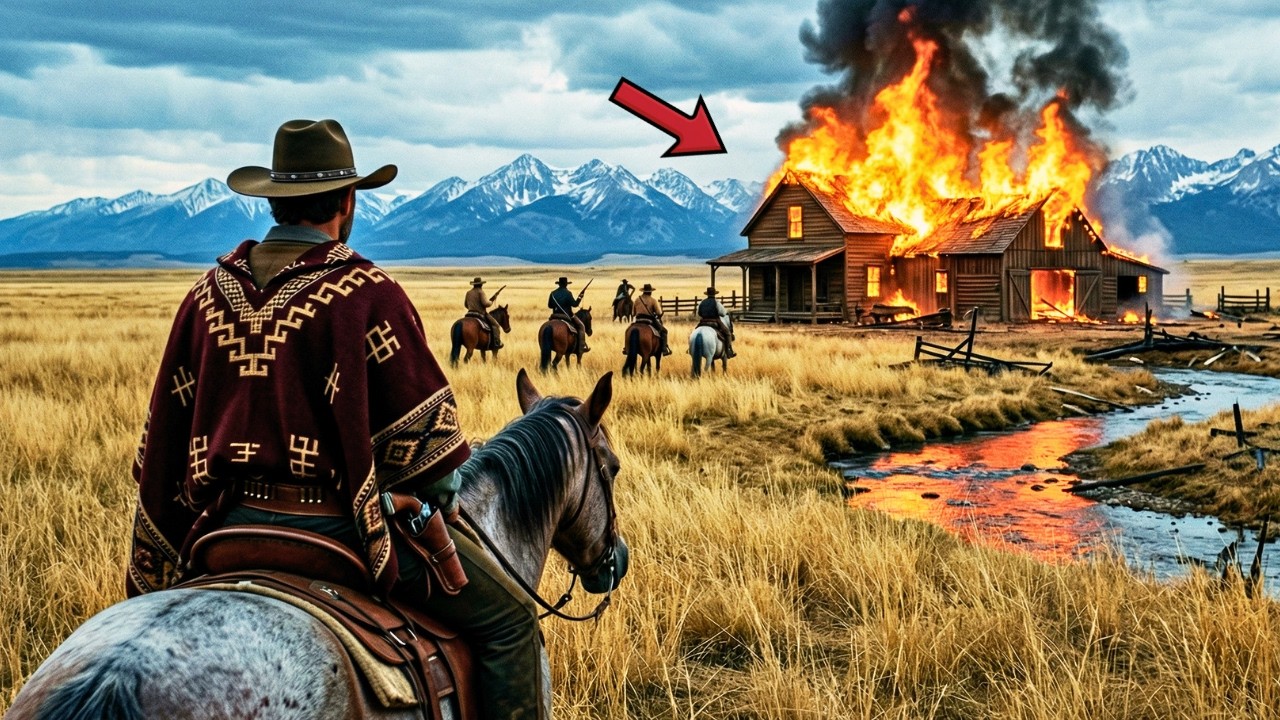
Below him, the ranch spread across the valley floor—fences running crooked along dry pastures, a long barn near the creek, and a two-story house with a wide porch. Flames crawled along the roof like living things. Men moved around the yard, silhouettes through smoke, throwing torches, laughing, shouting.
Six of them.
Maybe more.
The gunman didn’t move for a long moment. Wind lifted the hem of his coat. Dust settled around his boots. His hands rested near the grips of his two Colts, worn smooth by years no one counted.
He watched.
And they shouldn’t have let him.
A woman ran out of the house coughing, her hair loose, her dress smeared with ash. She stumbled on the porch, fell to her knees, and tried to drag something behind her—no, someone.
A boy.
Ten, maybe eleven.
Unconscious.
One of the men laughed. “Let ’em burn, Clara! Land’s ours soon as you sign!”
She shook her head, clutching the boy. “You’re murderers!”
Another man kicked the porch rail. “You had your chance. Bank don’t wait forever.”
The gunman’s eyes narrowed.
He nudged his horse forward.
Hooves clicked on stone, quiet but steady. The sound carried across the yard.
One of the men turned. “Hey—”
The others looked up.
The rider emerged from the smoke like something carved out of it. Long coat. Low hat. Two holsters hanging forward, one on each hip.
No badge.
No fear.
Just silence.
“Who the hell—” the leader began.
The gunman stopped ten yards away.
“You’re burning a ranch,” he said.
His voice was calm. Flat. Like stating weather.
The leader spat into the dirt. “Not your concern.”
The gunman looked at the house, then at the boy, then at the torches in their hands.
“It is now.”
The men laughed. Six against one.
The leader stepped forward. “You passing through, friend? Best keep riding. This here’s legal business.”
“Legal,” the gunman repeated.
“Debt. Foreclosure. She refused to leave. Fire’s quicker.”
The woman shouted, “That’s a lie! They want the water rights!”
The leader snapped, “Shut her up.”
One of the men started toward her.
The gunman’s hand moved—barely.
The Colt appeared.
A shot cracked.
The man’s boot heel exploded in dust inches from his foot. He froze, staring down.
The gunman’s pistol was already back in the holster.
“Don’t,” he said.
Silence swallowed the yard.
The leader’s smile faded. “You fast.”
“Yes.”
“You alone?”
“Yes.”
The leader gestured to the others. “You see a problem here?”
The gunman looked at each man slowly, memorizing faces, distance, hands.
“No,” he said.
The leader chuckled. “You’re brave. Or stupid.”
The gunman tilted his head slightly. “Put out the fire.”
“No.”
The word hung heavy.
The gunman slid off his horse.
Boots hit dirt.
Wind pushed sparks across the yard.
“You shouldn’t have let me see that,” he said.
The leader’s eyes hardened. “Boys—”
He never finished.
Two flashes.
Two thunderclaps.
Two torches fell.
Two men screamed, clutching bleeding hands.
The gunman’s Colts smoked, one in each hand.
The remaining men staggered back.
The leader drew.
The gunman fired once.
The revolver spun from the leader’s grip.
The yard froze.
No one breathed.
The gunman stepped forward, both pistols low, steady.
“Put it out,” he said again.
This time, they moved.
Buckets flew. Boots stomped sparks. One man dragged a barrel toward the porch. Another climbed onto the roof, beating flames with a blanket.
The woman stared, stunned, still holding the boy.
The gunman holstered one Colt, kept the other ready, eyes never leaving the men.
Minutes passed.
Smoke thinned.
The house still burned in spots, but the worst was contained.
Finally, the leader wiped sweat from his face. “You made your point.”
The gunman nodded once. “Leave.”
The leader laughed, though it sounded hollow. “You think this ends here? We got claims. Papers. We come back with the law—”
“Leave,” the gunman repeated.
The leader looked at his wounded men.
Then at the gray eyes watching him.
He swallowed anger.
“Mount up,” he muttered.
They backed away slowly, lifting their injured friends onto horses.
Before riding off, the leader leaned forward. “You just made yourself an enemy.”
The gunman didn’t respond.
They rode into the smoke and disappeared.
Only then did the gunman lower his weapon.
He turned toward the porch.
The woman was still staring.
“Is he breathing?” he asked.
She blinked. “Yes… yes, I think so.”
He stepped up, knelt, and checked the boy’s pulse.
“Smoke,” he said. “He’ll wake.”
She exhaled shakily. “You… you saved us.”
He stood.
“No,” he said. “You’re not safe yet.”
Her eyes widened. “They’ll come back?”
“Yes.”
She looked at the smoldering house, then at the empty horizon. “I don’t have anyone else.”
He glanced at the burned roof, the dry fields, the open valley.
“How many?” he asked.
“Seven. Maybe more. They work for Clay Bennett. Owns half the county.”
The gunman nodded.
He walked to the trough, dipped a cloth, and handed it to her. “Clean the boy’s face.”
She obeyed automatically.
“You staying?” she asked.
“For now.”
She swallowed. “What do I call you?”
He paused.
“Don’t,” he said.
—
They worked until dusk.
The gunman patched the roof where he could, hauled water, cleared burned boards. He moved without wasted motion, like he’d done this before.
The boy woke near sunset.
“Ma?” he croaked.
She hugged him tightly. “You’re alright, Tommy.”
The boy looked past her at the stranger. “Who’s he?”
The gunman tipped his hat slightly. “Passing through.”
Tommy nodded, as if that explained everything.
Night fell.
The gunman sat on the porch rail, watching the road. The woman—Clara—brought him coffee.
“You didn’t have to stay,” she said.
“Yes.”
“They’ll bring rifles.”
“Yes.”
“You still staying?”
“Yes.”
She studied him. “Why?”
He looked into the darkness.
“You were dragging him out,” he said quietly.
She didn’t understand.
He added, “Most run.”
She nodded slowly.
Far off, a coyote howled.
—
They came just before dawn.
Nine riders.
No torches this time.
Rifles.
Clara saw them first and gasped. “They’re back.”
The gunman stood.
“Inside,” he said.
She grabbed Tommy and hurried in.
The riders spread across the yard, surrounding the house.
The leader—Bennett himself—rode forward. Tall, clean coat, silver spurs.
“So,” he called. “You’re the one.”
The gunman didn’t answer.
“You cost me men,” Bennett continued. “Cost me time. Cost me money.”
The gunman rested his hands near the Colts.
Bennett smiled thinly. “One man against nine? You’re not leaving here.”
The gunman spoke.
“Then don’t shoot.”
Bennett laughed. “You threatening me?”
“No.”
“Then what?”
The gunman’s eyes hardened.
“Just telling you.”
Bennett raised his hand.
Rifles lifted.
The valley held its breath.
The first shot cracked.
The gunman moved.
Both Colts cleared leather in a blur.
Thunder rolled across the yard.
Riders shouted, horses reared, rifles fell.
He stepped sideways, firing left, then right, then left again.
Every shot precise.
Every movement controlled.
Within seconds, three men were disarmed, two clutching shoulders, one thrown from his saddle.
Bennett fired.
The bullet tore through the gunman’s coat.
The gunman fired back.
Bennett’s rifle spun into the dirt.
Silence slammed down.
Smoke drifted.
The gunman stood alone, both Colts steady.
“Leave,” he said.
Bennett stared, disbelief cracking his confidence.
“You… you can’t—”
The gunman took one step forward.
Bennett’s men shifted nervously.
No one wanted to draw.
Finally, Bennett spat. “This land ain’t worth dying for.”
He turned his horse.
“Ride!”
They fled.
Dust swallowed them.
The gunman lowered his Colts.
Clara stepped onto the porch, shaking. “You’re bleeding!”
He glanced at the tear in his coat. The bullet had grazed him.
“It’s nothing.”
“You could’ve been killed.”
“Yes.”
She looked at him, eyes shining. “Why risk it?”
He holstered his guns.
“They were burning your ranch,” he said.
She nodded slowly.
“You saw that,” she whispered.
“Yes.”
He picked up his reins.
“You leaving?” she asked.
“Yes.”
“But— they might come back.”
He looked toward the horizon. “They won’t.”
Tommy ran forward. “Mister! You forgot something!”
He held out a tin cup.
The gunman took it.
“Keep it,” Tommy said. “So you come back.”
The gunman hesitated.
Then he nodded once.
He mounted his horse.
Clara stepped forward. “Thank you… whoever you are.”
He tipped his hat.
Then rode away.
The sun climbed behind him, turning the smoke gold.
The ranch stood scarred—but alive.
And somewhere beyond the hills, the nameless gunman disappeared again…
leaving behind only silence—
and men who would never forget the day they burned a ranch…
and the stranger who made them regret it.