
Everyone Laughed at the Poor Farmer Raised His Paddle — Then the Entire Auction Froze
The crowd smelled of leather, dust, and money.
They gathered in a loose semicircle around the auction ring, boots grinding dry dirt, voices low but eager. Sunlight glinted off belt buckles and watch chains. Horses snorted nearby. A few bankers from town stood under the shade of a canvas awning, their polished shoes already turning brown with dust.
This wasn’t just another livestock auction.
This was the Whitaker estate sale.
Three hundred acres of river-bottom land. A crumbling farmhouse. Two barns. A dry well. And—more importantly—water rights tied to the south branch of the Cedar River.
Everyone knew that was the real prize.
“Going to be between Callahan and Boyd,” someone muttered.
“Unless the railroad man jumps in.”
“No chance. Too small for them.”
The auctioneer, a thin man in a black vest named Hal Bixby, wiped sweat from his forehead and tapped his gavel against the podium. “All right, gentlemen—and ladies—we’ll begin in just a moment.”
People shifted forward.
At the edge of the crowd stood a man most of them didn’t notice.
Eli Turner.
His hat was worn nearly white at the crown. His coat had been patched so many times it looked like a quilt. Dust coated his boots, but not the confident kind that came from owning land—this was the dust of someone who walked too much because he couldn’t afford to ride.
He held nothing but a folded paper and an old pencil.
Two ranchers nearby noticed him and smirked.
“Turner,” one whispered. “What’s he doing here? He can’t afford a fence post.”
The other chuckled. “Maybe he’s buying the dirt. Might be the only thing he can afford.”
Eli didn’t react. He kept his eyes on the ring.
The Whitaker property had been abandoned for nearly a year. Drought had hit hard. Old Mr. Whitaker died. His sons moved east. The bank took everything. Now it was up for auction.
Everyone assumed one of the big landowners would scoop it up cheap.
Eli knew that too.
But he had come anyway.
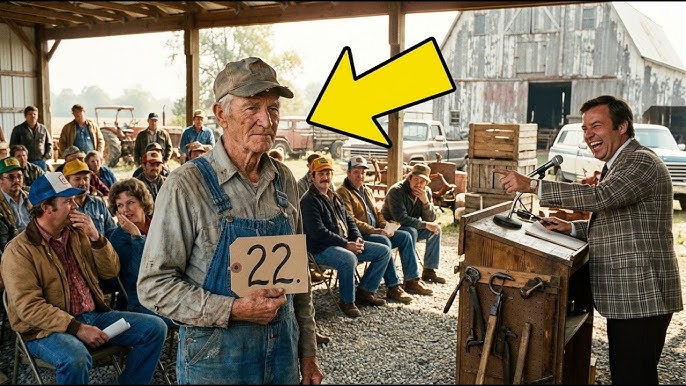
Hal Bixby cleared his throat. “We’ll start with Lot One: Whitaker South Parcel. Three hundred acres, as-is. Includes structures, water rights, and all improvements. Opening bid—five thousand dollars.”
A murmur rolled through the crowd.
Five thousand was already low.
“Five thousand,” called a voice.
“Five-five,” another answered.
“Six.”
“Seven.”
The bids rose steadily, calm, predictable. Callahan, Boyd, and a banker from town traded numbers like men playing cards they’d already counted.
Eli watched, silent.
At eight thousand, the smaller ranchers dropped out. At ten thousand, only three remained.
“Ten-five,” Boyd said lazily.
“Eleven,” Callahan replied.
The banker hesitated, then shook his head. He stepped back.
Now it was just two.
Everyone leaned in. This was the real fight.
“Eleven-five,” Boyd said.
Callahan scratched his beard. “Twelve.”
Boyd nodded once. “Twelve-five.”
Eli’s heart pounded.
This was higher than he’d hoped—but still within reach if no one pushed too far.
He looked down at the folded paper in his hand. It wasn’t a check. It wasn’t even a guarantee. Just a note signed by the local credit union, agreeing to lend him money… if he secured the land.
A gamble.
A dangerous one.
“Thirteen,” Callahan said.
Boyd hesitated.
The crowd murmured. Boyd usually pushed harder. But the drought had hit him too.
He exhaled slowly. “I’m out.”
Callahan smirked.
Hal Bixby lifted his gavel. “Thirteen thousand—going once—”
That was when Eli raised his paddle.
It wasn’t even a real paddle. Just a thin wooden board he’d picked up at the registration table.
“Thirteen-five,” he said.
The laughter came instantly.
Heads turned. Some men actually chuckled out loud.
Callahan blinked, then frowned. “That a joke?”
Hal hesitated. “Bid recognized. Thirteen-five.”
Someone in the back whispered loudly, “Turner can’t even pay his feed bill.”
Another voice: “He’s buying it with hope and prayers.”
More laughter.
Eli didn’t lower his paddle.
Callahan studied him. “You sure about that, Turner?”
Eli nodded once. “Yes.”
Callahan shrugged. “Fourteen.”
Eli raised the paddle again.
“Fourteen-five.”
The laughter faded.
People started looking at each other.
This wasn’t a joke anymore.
Callahan narrowed his eyes. “You got money, Turner?”
Eli answered calmly, “I bid fourteen-five.”
Hal cleared his throat. “Bid stands.”
Callahan hesitated. He didn’t like uncertainty. He didn’t like the idea of some poor farmer bluffing him—but he also didn’t want to overpay.
“Fifteen,” he said.
The crowd went quiet.
All eyes turned to Eli.
He swallowed. This was the line he’d promised himself he wouldn’t cross.
But he also knew… if he stopped now, he’d lose everything he’d planned for.
Slowly, he raised the paddle.
“Fifteen-five.”
The entire auction froze.
No laughter. No whispers.
Just silence.
Even the horses seemed to stop moving.
Callahan stared at him. “You don’t have that kind of money.”
Eli met his gaze. “Bid stands.”
Hal’s voice sounded different now—careful. “Fifteen-five. Do I hear sixteen?”
Callahan didn’t answer immediately. He looked around, calculating. The land was worth more—but not by much in a drought. If Turner somehow actually paid, Callahan would lose the deal. If Turner couldn’t pay, the auction would restart… and Callahan might get it cheaper.
He took a breath.
Then shook his head.
“I’m out.”
A ripple went through the crowd.
Hal raised the gavel slowly. “Fifteen thousand five hundred… going once… going twice…”
Eli’s pulse roared in his ears.
“Sold!”
The gavel cracked.
Silence held for another second.
Then the questions exploded.
“You serious?”
“He can’t pay that!”
“Bank’ll never back him!”
Callahan stepped forward. “You better have the money, Turner.”
Eli folded his paddle and slipped it under his arm. “I will.”
The banker approached, frowning. “You understand you’ve got one hour to produce proof of funds?”
Eli nodded. “Yes.”
He turned and walked toward the road.
The crowd parted, still staring.
No one laughed now.
Forty minutes later, Eli returned.
Dust clung to his coat. He held an envelope in his hand.
Hal looked surprised. “You got something?”
Eli handed over the paper.
The banker took it, adjusted his glasses, and read carefully.
His eyebrows rose.
“This… this is a secured line of credit.”
Callahan leaned closer. “From who?”
The banker turned the document slightly. “Cedar Valley Cooperative.”
Murmurs spread again.
The cooperative wasn’t big—but it was respected. They didn’t lend recklessly.
The banker nodded slowly. “Funds guaranteed upon transfer.”
Hal exhaled. “Well… I guess that settles it.”
Callahan stared at Eli. “Why?”
Eli looked toward the distant hills.
“Because everyone sees dry land,” he said. “I see water.”
Callahan scoffed. “Whitaker well’s been dry a year.”
Eli shook his head. “Not the well.”
He unfolded another paper—an old survey map.
“My grandfather worked that land,” Eli said. “He told me there’s a buried irrigation line running from the Cedar branch. Clay pipe. Covered decades ago.”
The banker leaned in. “You sure?”
Eli nodded. “I walked it last winter. Found the markers.”
Callahan’s expression changed.
Water rights… plus hidden irrigation?
That meant the land wasn’t dying—it was dormant.
“You’re gambling,” Callahan muttered.
Eli met his eyes. “No. I’m remembering.”
The crowd fell quiet again.
For the first time, they understood.
Eli Turner hadn’t raised his paddle blindly.
He had raised it with knowledge.
And that changed everything.
Three months later, the laughter was gone.
Men gathered again at the edge of the Whitaker land—now Turner land. Fresh green rows stretched across the field. Corn shoots stood knee-high. A repaired irrigation ditch shimmered with flowing water.
The old clay pipe had been there exactly where Eli said.
He’d dug it out by hand.
Callahan stood at the fence, arms crossed. “You really did it.”
Eli nodded. “Took some work.”
The banker joined them. “Property value’s doubled already.”
Callahan let out a low whistle. “Maybe tripled come harvest.”
Eli rested his hands on the fence. “It’ll pay back the loan.”
“And then some,” the banker said.
Callahan glanced at him. “You know… if you ever sell—”
Eli shook his head. “Not selling.”
Callahan smirked slightly. “Didn’t think so.”
They stood quietly, watching the wind ripple across the growing crops.
Finally, Callahan spoke again. “You know… when you raised that paddle… I thought you were a fool.”
Eli smiled faintly. “Most people did.”
Callahan nodded. “Then the whole auction froze.”
Eli looked out over the land that had once belonged to someone else, then to no one, and now—finally—to him.
“Sometimes,” he said quietly, “you only need one moment… to change how everyone sees you.”
The wind carried the scent of water across the fields.
And no one laughed anymore.