
Kicked Out at 14, He Bought a Broken House for $5 — What It Became Changed Everything
When Daniel Carter turned fourteen, the world didn’t end with a bang.
It ended with a slammed door.
“Don’t come back,” his stepfather muttered, tossing a duffel bag onto the dirt driveway. Inside it were two shirts, a pair of jeans, and a loaf of bread already going stale.
Daniel stood there for a long time after the door shut. The small wooden house he had once called home looked exactly the same—the peeling paint, the crooked porch, the rusted mailbox—but something invisible had shifted. It no longer belonged to him.
He didn’t cry. Not then.
Instead, he picked up the bag, slung it over his shoulder, and started walking down the long gravel road that led out of town.
The town of Millridge, Montana, wasn’t the kind of place where people noticed things quickly. It sat quietly between rolling hills and endless sky, where everyone knew each other’s names—but not always each other’s struggles.
Daniel walked until the sun dipped low and painted the sky in shades of orange and gold. His stomach growled, and his feet ached, but he kept moving.
That’s when he saw it.
At the edge of town, past an overgrown field, stood a house that looked like it had been forgotten by time itself.
The roof sagged like a tired old man. Windows were shattered or boarded up. The front door hung crooked on its hinges, creaking in the wind.
A broken house.
Daniel stopped.
For some reason, he stepped closer.
The yard was wild with weeds, nearly swallowing the narrow path to the porch. He climbed the steps carefully, each one groaning under his weight.
Inside, the air smelled like dust and rain-soaked wood. Sunlight filtered through cracks in the walls, casting thin beams across the floor.
There was nothing inside except debris—old newspapers, splintered boards, and a rusted stove that looked like it hadn’t worked in decades.
But Daniel didn’t see a ruin.
He saw something else.
He saw space.
He saw possibility.
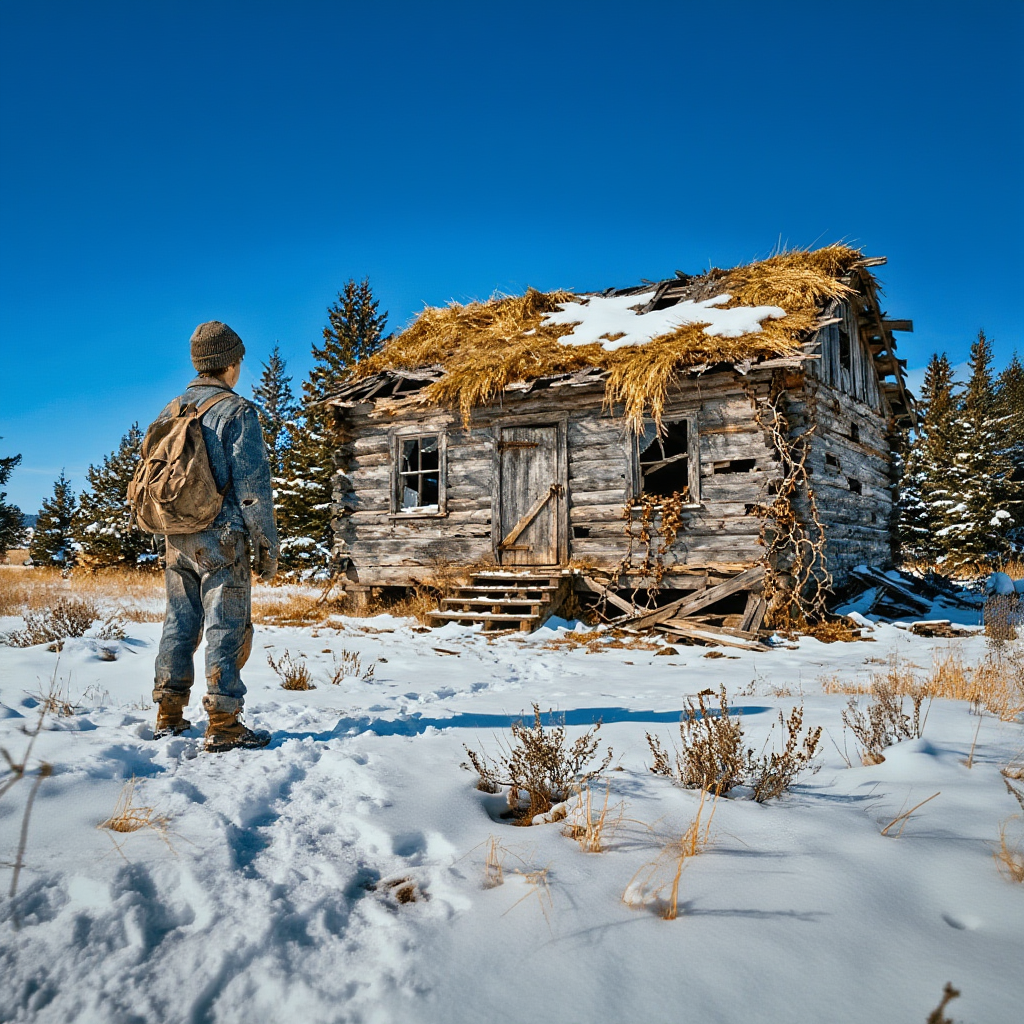
The next morning, Daniel found himself standing in front of Old Man Harlan’s general store.
Mr. Harlan was known for two things: his gruff attitude and his sharp memory for every piece of property in Millridge.
Daniel stepped inside, clutching the last of his courage.
“Sir… that broken house out by the field,” Daniel began. “Who owns it?”
Harlan didn’t look up at first. He kept counting coins behind the counter.
“That dump?” he grunted. “Been abandoned for years. Belonged to the Wilkes family before they skipped town.”
Daniel swallowed. “Is it… for sale?”
Now Harlan looked up.
He studied the boy for a long moment—his worn clothes, his tired eyes, his determined stance.
“Got money?” Harlan asked bluntly.
Daniel reached into his pocket and pulled out a crumpled five-dollar bill.
It was everything he had.
Harlan raised an eyebrow.
Then, surprisingly, he chuckled.
“Kid,” he said, “that house ain’t worth the wood it’s built from. But if you’re foolish enough to want it…”
He paused, then shrugged.
“Five bucks. It’s yours.”
That’s how Daniel Carter became a homeowner at fourteen.
The first night in the house was cold.
The wind slipped through cracks in the walls, whispering through the empty rooms. Daniel huddled in a corner with his duffel bag as a pillow, staring up at the broken ceiling.
For the first time since being kicked out, he let himself cry.
Not because he was afraid.
But because he realized something terrifying—and powerful.
There was no one coming to save him.
The next morning, he got to work.
He didn’t have tools. He didn’t have experience.
What he had was determination.
Daniel started by clearing the debris. He dragged broken boards outside, swept the dirt into piles, and opened every window he could to let in fresh air.
His hands blistered quickly. His back ached. But every small improvement felt like a victory.
By the third day, he had carved out a single livable room.
By the end of the week, he had patched the front door well enough to keep it closed.
People in town started to notice.
At first, it was just curious glances.
Then came the whispers.
“That Carter boy… living out there alone?”
“Fixing that old Wilkes place?”
“Won’t last a week.”
But Daniel did last.
He lasted through the first storm, when rain leaked through the roof and soaked everything he owned.
He lasted through hunger, learning to stretch a single loaf of bread for days.
He lasted through loneliness, when the silence of the house felt louder than any noise.
And slowly, something changed.
One afternoon, as Daniel struggled to hammer a loose board into place, a voice called out from behind him.
“You’re doing that wrong.”
Daniel turned to see a man in his sixties leaning against the fence, arms crossed.
It was Mr. Harlan.
Daniel frowned slightly. “Then show me how to do it right.”
Harlan smirked.
That was the beginning.
Harlan didn’t come every day.
But when he did, he brought knowledge.
How to properly swing a hammer.
How to reinforce a beam.
How to seal cracks before winter.
He never said he was helping.
But he stayed longer each time.
Soon, others followed.
Mrs. Greene from down the road brought leftover soup “by accident.”
A local carpenter named Joe left behind a box of old tools, claiming he “didn’t need them anymore.”
Even kids from town started stopping by, watching Daniel work like it was some kind of quiet miracle.
Months passed.
The broken house began to transform.
The roof was patched.
The walls were reinforced.
Windows were replaced with mismatched glass that still let in sunlight.
It wasn’t perfect.
But it was alive again.
And so was Daniel.
Winter came hard to Montana.
Snow buried the fields, and icy winds tested every weak spot in the house.
But this time, Daniel was ready.
He had a stove that worked.
He had blankets donated by neighbors.
He had food stored away.
For the first time in his life, he didn’t feel like he was surviving.
He felt like he was building something.
One night, as snow fell softly outside, Daniel sat by the fire and looked around.
The room wasn’t empty anymore.
It was filled with small pieces of effort, kindness, and persistence.
He realized something then.
This house… wasn’t just a shelter.
It was proof.
Proof that he could take something broken—and make it whole.
Years passed.
Daniel grew taller, stronger.
The boy who had been kicked out at fourteen became a young man with calloused hands and steady eyes.
And the house?
It became something no one expected.
Daniel started fixing other things.
First, it was small jobs—repairing fences, patching roofs.
Then bigger ones.
People began to trust him.
“Call Daniel,” they’d say. “He’ll figure it out.”
By the time he turned twenty, Daniel had turned his $5 house into a fully restored home.
But he didn’t stop there.
He bought another abandoned property.
Then another.
Each one cheaper than it should have been.
Each one written off as worthless.
Each one transformed.
Eventually, Daniel Carter became known as the man who could bring dead homes back to life.
But that wasn’t what made him special.
What made him different was this:
He never forgot what it felt like to have nowhere to go.
So he did something no one expected.
He opened his first house—the one he bought for $5—to others.
Teenagers with nowhere else to turn.
Runaways.
Kids who had been told they didn’t belong.
He didn’t just give them a roof.
He gave them a chance.
“Help me fix this place,” he’d say. “And you can stay.”
They learned the same way he had.
By doing.
By failing.
By trying again.
The house became more than a home.
It became a beginning.
Years later, a reporter came to Millridge to write a story about the man who turned abandoned houses into thriving homes.
She stood in front of the first house, now beautifully restored, and asked Daniel the question everyone wanted answered.
“Why did you buy this place?” she asked. “Out of all the things you could have done… why this?”
Daniel looked at the house for a long moment.
He could still see it the way it had been—broken, empty, forgotten.
Then he smiled.
“Because it was the only thing that looked like me,” he said quietly.
The reporter paused.
“And what did it become?” she asked.
Daniel glanced around at the people moving in and out of the house—laughing, working, living.
His voice was steady.
“It became proof,” he said.
“Proof that being broken doesn’t mean being finished.”
And that changed everything.
Kicked Out at 14, He Bought a Broken House for $5 — What It Became Changed Everything
Part 2
The first boy arrived on a rainy Thursday.
Daniel noticed him before anyone else did.
The kid stood across the dirt road, half-hidden behind the skeletal remains of a dead tree. He was thin—too thin—and soaked through, his clothes clinging to him like a second skin. He didn’t move, didn’t call out, didn’t even try to approach.
He just watched.
Daniel set down the plank he’d been measuring and wiped his hands on his jeans.
“Been standing there a while,” he called out.
No response.
Daniel walked closer, slow enough not to startle him. Up close, the boy looked younger than he’d first thought—maybe twelve, maybe thirteen. Dirt streaked his face, but it couldn’t hide the sharpness in his eyes.
“You hungry?” Daniel asked.
A pause.
Then a small nod.
That was enough.
Inside the house, the smell of soup drifted through the air. It was nothing fancy—just potatoes, carrots, and a bit of leftover beef—but it was warm.
The boy hesitated at the doorway.
“You don’t have to earn it first,” Daniel said. “Food comes before rules.”
That seemed to settle something.
The boy stepped inside.
He ate like someone who had learned not to expect a second chance at a meal. Fast at first, then slower as the warmth reached him.
“What’s your name?” Daniel asked.
The boy swallowed. “Eli.”
“Alright, Eli,” Daniel said, leaning back in his chair. “Here’s how this works. You can stay—but you help. We fix things. We build. We don’t quit.”
Eli stared at the table.
Then he nodded.
Eli didn’t talk much the first few days.
But he worked.
Daniel showed him how to sand down rough wood, how to measure twice before cutting, how to drive a nail straight without bending it.
Eli listened.
Watched.
Learned.
And for the first time since he’d arrived, he started to look like a kid instead of a survivor.
Word spread faster than Daniel expected.
Within a month, there were three more.
A girl named Mariah, who carried her belongings in a torn backpack and didn’t trust anyone.
Twins—Lucas and Levi—who spoke in half-sentences and finished each other’s thoughts.
Each of them came the same way.
Quiet.
Cautious.
Broken in ways that didn’t always show on the outside.
The house changed again.
Not in structure this time—but in spirit.
The silence was gone.
In its place came the sounds of something alive:
Laughter echoing through hallways.
Arguments over who burned the bread.
Footsteps running across the porch.
Daniel found himself standing in the middle of it one evening, listening.
It hit him suddenly.
This wasn’t just a house anymore.
It was a home.
But homes, Daniel knew, weren’t built only with wood and nails.
They needed something harder to fix.
Trust.
Mariah tested that first.
“You’re gonna kick us out eventually,” she said one night, arms crossed tightly over her chest.
They were sitting around the fire. The others had gone quiet.
Daniel didn’t answer right away.
Instead, he poked at the fire, watching the sparks rise.
“Someone kicked you out before?” he asked.
Mariah scoffed. “Everyone does eventually.”
Daniel nodded slowly.
“Then I guess we’ll have to be different.”
She frowned. “People don’t just decide to be different.”
“No,” Daniel said. “They prove it.”
Proving it wasn’t easy.
It meant staying calm when Eli snapped in frustration and nearly walked out.
It meant sitting with Lucas through nightmares he couldn’t explain.
It meant giving Mariah space when she pushed everyone away—and being there when she came back.
It meant showing up.
Every day.
No matter what.
Winter came again.
But this time, the house was full.
Five kids.
One man.
And something none of them had ever truly had before.
Stability.
One night, a storm hit harder than any before.
The wind howled like it was trying to tear the house apart. Snow slammed against the windows, and the lights flickered dangerously.
Eli looked up from his spot near the fire.
“Is it gonna hold?” he asked.
Daniel glanced at the ceiling, listening to the groan of the beams.
Then he smiled slightly.
“Yeah,” he said. “It’ll hold.”
Eli studied him for a moment.
“You sure?”
Daniel nodded.
“I built it stronger this time.”
But he wasn’t just talking about the house.
By spring, things had grown beyond what Daniel could manage alone.
The repairs. The kids. The constant need.
It was more than one person could carry.
Even someone like him.
That’s when help came—from an unexpected place.
A letter arrived one afternoon, addressed in neat handwriting.
Daniel turned it over in his hands before opening it.
Inside was a simple note.
I read your story.
I’d like to see what you’re building.
— Clara Bennett
She arrived a week later.
Clara wasn’t what Daniel expected.
She wasn’t older or stern like most social workers he’d imagined. She was in her thirties, sharp-eyed, with a calm presence that seemed to settle the air around her.
She walked through the house slowly, taking everything in.
The patched walls.
The mismatched furniture.
The kids, watching her carefully from a distance.
Finally, she turned to Daniel.
“You built this?” she asked.
Daniel shrugged. “Bit by bit.”
She nodded.
“And them?” she said, glancing toward the kids.
Daniel followed her gaze.
“They’re building themselves.”
Clara stayed longer than planned.
She asked questions.
Listened more than she spoke.
And then, one evening, she made an offer.
“You’re doing something important here,” she said. “But it won’t last—not like this.”
Daniel frowned. “What do you mean?”
“I mean,” Clara said gently, “you need structure. Support. Legal protection—for you and for them.”
Daniel stiffened.
“I’m not handing them over to the system.”
Clara shook her head. “That’s not what I’m suggesting.”
“Then what?”
She smiled slightly.
“I’m suggesting we build something bigger.”
It took time for Daniel to trust her.
But something in Clara’s approach felt different.
She didn’t try to take control.
She offered to help him keep what he’d built.
Months later, it became official.
The house—the $5 broken house—became the foundation of a small, registered program.
A place for kids who had nowhere else to go.
A place where they could learn, work, and rebuild their lives.
They called it Second Chance House.
Eli helped paint the sign.
Mariah picked the colors.
Lucas and Levi argued over the spacing of the letters until Daniel stepped in and fixed it himself.
And when it was done, they all stood back and looked at it.
Not perfect.
But real.
Years passed again.
More houses were added.
More kids came through.
Some stayed for months.
Some for years.
Some left and came back stronger.
Eli grew into a quiet, capable young man who could fix almost anything.
Mariah discovered she had a talent for design—turning broken spaces into something beautiful.
Lucas and Levi? They never stopped finishing each other’s sentences—but they also never stopped building.
And Daniel?
He finally understood something he hadn’t at fourteen.
That being thrown out of one place…
…had led him to create a place no one would ever have to be thrown out of again.
One evening, long after the sun had set, Daniel stood alone on the porch of the first house.
The same porch that had once creaked beneath his uncertain steps.
Now it was strong.
Steady.
Behind him, voices filled the air—laughter, conversation, life.
Clara stepped out beside him.
“You ever think about that day?” she asked quietly.
Daniel didn’t need to ask which one.
“All the time,” he said.
“And?” she asked.
He looked out across the land—the houses, the lights glowing in the distance, the lives being rebuilt piece by piece.
Then he smiled.
“I thought I lost everything that day,” he said.
Clara tilted her head. “And now?”
Daniel’s voice was calm.
“Turns out,” he said, “it was the day everything started.”
The wind moved gently through the fields, no longer harsh, no longer empty.
And the house that cost five dollars—
The one no one wanted—
The one everyone had forgotten—
Had become something no one could ignore.
A beginning.
For hundreds.
And counting.