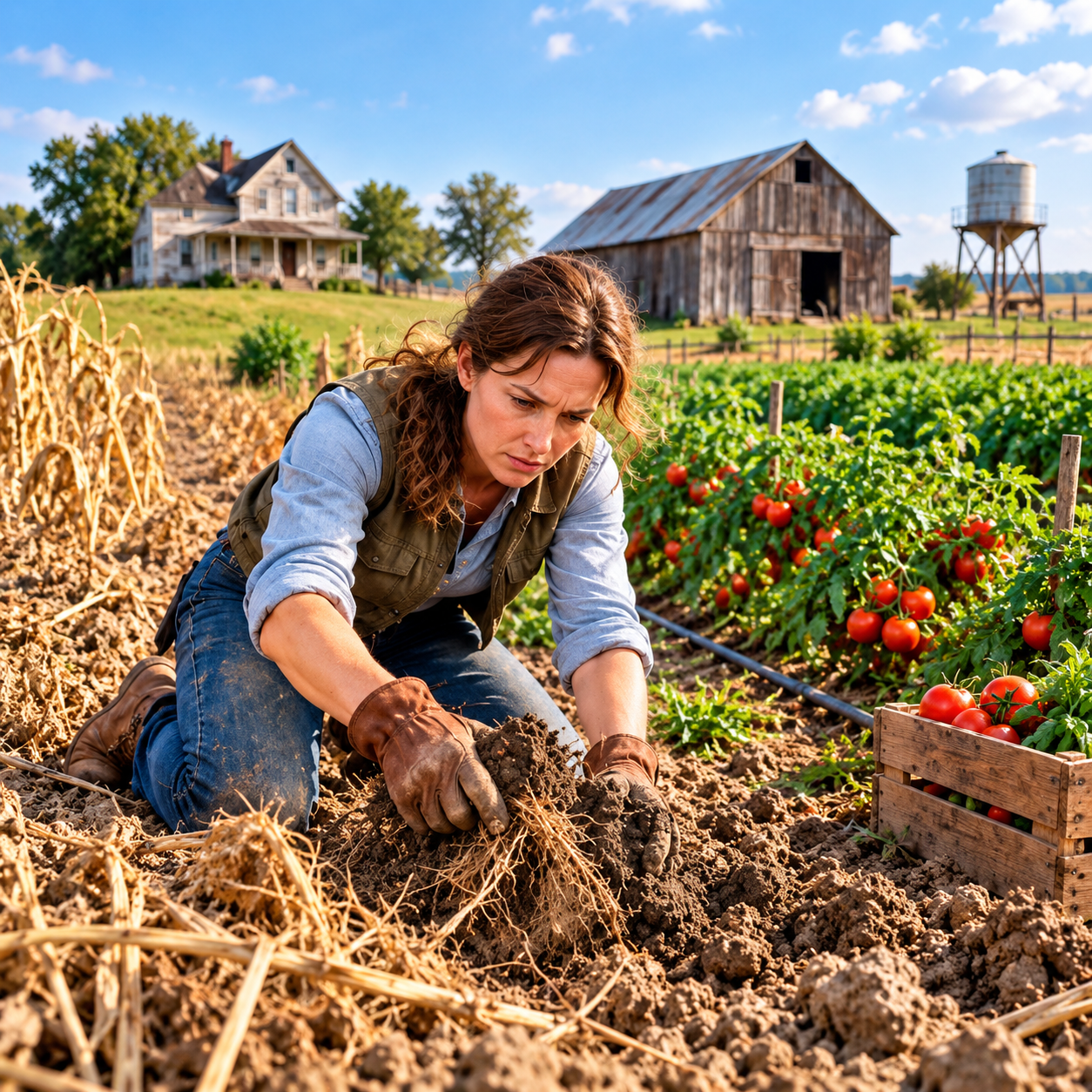
The first thing Claire Bennett noticed about the farm was how quiet it was.
Not peaceful quiet.
Dead quiet.
The August wind moved across forty-three acres of hard brown ground without finding much worth moving. Corn stalks from some long-forgotten planting stood gray and brittle along the western field. The old barn leaned slightly toward the road. Even the weeds seemed to have surrendered.
Claire stepped out of her dusty pickup and stared at the place she had just bought with nearly every dollar she had.
Behind her, a truck slowed.
Then another.
She heard laughter through an open window.
“That her?”
“Yep. City woman.”
“Paid eighty thousand for that?”
“More money than sense.”
Claire kept walking.
She had expected it.
For twelve years, she had worked in an office, first answering phones and eventually managing purchasing for a regional grocery distributor. She knew invoices, contracts, spreadsheets, and delivery schedules.
She did not look like a farmer.
And according to nearly everyone in town, she had just purchased the worst farm in the county.
Three previous owners had tried to make it profitable.
All three had failed.
The last farmer had planted corn twice and soybeans once. His yields had been so poor that he finally stopped planting the southern field altogether.
The locals called the property Bennett’s Dust Bowl, though Claire’s name had only been attached to it for six days.
That afternoon, her nearest neighbor, Earl Dawson, drove over.
He was sixty-two, broad-shouldered, sunburned, and had farmed the adjoining land since he was seventeen.
He climbed from his truck and looked across Claire’s property.
“You really bought all of it?”
“I did.”
Earl whistled.
“You get the soil tested?”
“Yesterday.”
“And?”
Claire handed him the report.
Earl read it.
His eyebrows rose.
“Organic matter’s barely one percent.”
“I know.”
“Compacted too.”
“I know.”
“Phosphorus is low.”
“I saw that.”
He handed the paper back.
“Lady, I’m not trying to be cruel.”
“Claire.”
“All right, Claire. I’m trying to save you some grief.”
She waited.
Earl pointed toward the field.
“That ground is finished.”
Claire looked down at the cracked earth beneath her boots.
“No,” she said quietly. “It’s hungry.”
Earl stared at her.
Then he laughed.
Within two weeks, nearly everyone knew about the city woman’s plan.
And that made the jokes worse.
Because Claire wasn’t ordering tons of synthetic fertilizer.
She wasn’t hiring someone to deep-plow the entire farm.
Instead, trucks began arriving with things nobody understood.
Wood chips.
Old straw.
Composted manure.
Leaves.
Several loads of spoiled hay.
Then Claire called a tree service company and asked if they needed somewhere to dump chipped branches.
The owner thought she was joking.
“You want them?”
“All of them.”
“You know that’s several truckloads a week?”
“I hope so.”
Soon mountains of wood chips appeared beside the barn.
Earl stopped again.
“What are you doing?”
“Building soil.”
“With garbage?”
“With carbon.”
He shook his head.
“That’s going to take years.”
“Some of it will.”
“And what are you going to live on while you’re waiting?”
Claire smiled.
“That’s the part I’m still figuring out.”
Earl laughed so hard he had to wipe his eyes.
But Claire wasn’t guessing as much as people assumed.
During her years in grocery distribution, she had become fascinated by one recurring problem.
Farmers were constantly buying expensive inputs.
Fertilizer.
Pesticides.
Irrigation.
Fuel.
Yet grocery stores, restaurants, tree services, horse farms, and homeowners were constantly paying to throw organic material away.
Claire had started wondering whether one person’s waste could become another person’s soil.
So she studied.
For three years.
She visited small farms on weekends. She learned about compost, cover crops, soil biology, water retention, crop rotation, reduced tillage, and mulch.
Now she finally had land of her own.
Her first move was not to plant forty-three acres.
It was to plant four.
That brought another round of ridicule.
“You bought forty-three acres to farm four?” Earl asked.
“For now.”
Claire divided the four acres into smaller sections.
She spread compost.
She covered pathways with wood chips.
She planted buckwheat, clover, peas, radishes, and other cover crops in areas where she wasn’t growing vegetables.
She laid drip irrigation instead of spraying water across entire fields.
Then she planted tomatoes, beans, squash, peppers, potatoes, onions, and herbs.
The first month was ugly.
Half the beans struggled.
Several rows of lettuce failed.
The tomatoes looked weak.
Then came a brutal stretch of heat.
For twenty-one days, almost no rain fell.
Across the county, irrigation pumps ran from morning until night.
Claire walked her fields at sunrise every morning, pushing her fingers beneath the mulch.
Underneath, the soil was still damp.
Not wet.
But damp.
Earl noticed.
One evening, he walked over.
“How often are you watering?”
“Depends on the bed.”
“Every day?”
Claire shook her head.
Earl frowned.
“My topsoil turns to powder by noon.”
Claire lifted several inches of straw.
“Feel this.”
He crouched reluctantly.
The soil underneath was cool.
Earl pressed his fingers into it.
His expression changed.
“What’d you put under here?”
“Nothing magical.”
“Then why is it wet?”
“Because the sun isn’t hitting bare dirt all day.”
Earl stood.
“Still doesn’t mean you’ll grow anything.”
“No,” Claire agreed. “It doesn’t.”
By October, however, she had grown enough vegetables to fill her pickup.
She sold them at a weekend market.
She didn’t make much money.
But she made something more important.
Proof.
That winter, instead of leaving the fields bare, Claire planted cover crops across another eight acres.
Neighbors drove past green fields in December and joked that the city woman had planted weeds on purpose.
Earl stopped laughing quite as loudly.
By spring, Claire’s cover crops had formed a thick living blanket.
She cut them down but didn’t haul them away.
She left the roots in the ground.
Then she planted directly into selected areas.
The second growing season began.
And something strange happened.
Her tomatoes exploded.
By June, the vines were thick enough to hide the stakes.
By July, red fruit hung in clusters.
Her peppers flourished.
The potato plants grew waist-high.
Earthworms appeared in soil where Claire had barely found any the previous summer.
When she dug into the earth with her hands, it no longer broke apart like concrete.
It crumbled.
Dark.
Soft.
Alive.
One morning, Claire was harvesting potatoes when she heard a truck door slam.
Earl approached slowly.
But he wasn’t smiling.
He looked at the field.
Then at Claire.
Then back at the field.
“How much fertilizer did you put down?”
“This year?”
“Yeah.”
“Almost none.”
He frowned.
“Come on.”
“I’m serious.”
“You expect me to believe tomatoes grow like that on this ground without fertilizer?”
Claire stood and pulled off one glove.
“Not without fertility.”
“What’s the difference?”
“Fertilizer is something you buy. Fertility is something you build.”
Earl stared at her.
Claire picked up a handful of soil.
“This was nearly dead when I got here. There wasn’t enough organic matter to hold water well. Every time someone tilled it aggressively, more moisture disappeared and more soil structure broke down.”
“So what changed?”
“I stopped treating the dirt like a container.”
Earl looked confused.
Claire smiled.
“I started treating it like something alive.”
He didn’t answer.
Then August arrived.
And so did the drought.
At first nobody worried.
Dry summers happened.
Then the second week passed without rain.
Then the third.
Then the fourth.
Creeks shrank.
Pastures browned.
Several shallow wells began struggling.
Corn leaves curled tightly beneath the relentless afternoon heat.
Earl’s irrigation costs climbed sharply.
Claire’s fields changed too.
But not in the same way.
Her uncovered patches hardened.
The areas she had restored didn’t.
The mulch reduced evaporation.
Organic matter held moisture.
Deep-rooted cover crops had opened channels through compacted soil.
When rare thunderstorms came, water soaked into Claire’s fields instead of rushing across them.
By September, the contrast was visible from the road.
Brown fields surrounded a patchwork of green.
Cars began slowing again.
But nobody laughed anymore.
Then one morning Claire walked outside and found three pickup trucks parked near her gate.
Earl stood beside them with two other farmers.
“Morning,” Claire said.
Nobody answered immediately.
Finally Earl cleared his throat.
“We want to see something.”
“What?”
“Your soil.”
Claire nearly smiled.
A year earlier, these men had called it dead land.
Now they wanted to inspect it.
She led them toward the tomato rows.
One farmer, Hank Mercer, crouched and dug his hand into the earth.
“Good Lord.”
Earl knelt beside him.
The soil was dark and crumbly.
Hank squeezed a handful.
It held together briefly, then broke apart.
“You truck this in?”
Claire shook her head.
“This was here.”
“No way.”
“This soil was always here. I just stopped losing it.”
Hank looked across the field.
“What exactly did you put on it?”
Claire started explaining.
Compost.
Wood chips.
Cover crops.
Minimal disturbance.
Crop diversity.
Living roots.
Drip irrigation.
No single technique sounded revolutionary.
That disappointed them.
“There has to be something else,” Hank said.
“There is.”
The men leaned closer.
Claire pointed toward the ground.
“Patience.”
Hank groaned.
“That’s not a farming technique.”
“It might be the hardest one.”
Earl chuckled.
But then Claire showed them something else.
She walked to an untreated section at the edge of the property and pushed a steel rod into the ground.
It stopped after several inches.
Then she moved twenty yards into a restored bed.
The rod slid down easily.
“Compaction,” Earl murmured.
Claire nodded.
Then she dug two small holes.
In the untreated ground, they found almost nothing.
In the restored soil, earthworms twisted through decaying roots.
Hank stared.
“I haven’t seen worms like that in my south field in years.”
Claire looked at him.
“What happens to your fields after heavy rain?”
“Water stands.”
“And after drought?”
“Hard as brick.”
“That isn’t only a water problem.”
Earl slowly nodded.
“It’s a soil problem.”
For the first time, Claire realized he understood.
But the biggest surprise came several weeks later.
Claire had been keeping detailed records.
Water usage.
Seed costs.
Compost expenses.
Fuel.
Labor.
Harvest weights.
Sales.
Earl sat at her kitchen table one evening while she showed him the numbers.
“You used how much less water?”
Claire turned the notebook around.
Earl read it again.
“That can’t be right.”
“It is.”
“And your yield?”
“Per acre?”
“Yeah.”
Claire showed him another page.
Earl went silent.
She wasn’t producing miraculous quantities.
That wasn’t the secret.
The real difference was that Claire’s expenses were falling while her soil was improving.
Most farmers Earl knew spent more every year just trying to maintain production.
Claire was doing the opposite.
She was rebuilding the thing production depended upon.
“So what are you going to do next year?” he asked.
“Expand to twelve acres.”
“Only twelve?”
“I don’t want forty-three acres of vegetables.”
“What do you want?”
Claire looked through the kitchen window toward the farm.
“A farm that gets better every year instead of worse.”
Earl nodded slowly.
The following spring, something happened Claire never expected.
Earl asked if he could borrow her seed drill.
“For cover crops?” she asked.
“Just twenty acres.”
She smiled.
“I thought those were weeds.”
“Don’t start.”
By midsummer, Hank Mercer had begun experimenting too.
Then another farmer.
Then another.
Claire never became the richest farmer in the county.
She didn’t discover a miracle chemical.
She didn’t uncover gold beneath the fields.
What she found was simpler.
The land everyone had called worthless wasn’t worthless at all.
It had simply been exhausted.
And exhausted things sometimes needed something different from what had failed them before.
Three years after Claire bought the farm, Earl stood beside her barn during a community field day.
More than fifty farmers had come.
Claire watched them dig holes, examine roots, compare moisture, and argue cheerfully about compost ratios.
Earl nudged her shoulder.
“Remember what I told you the first day?”
“That my ground was finished?”
“I was trying to help.”
“You laughed at me.”
“I did not.”
Claire raised an eyebrow.
“All right,” Earl admitted. “Maybe a little.”
“A lot.”
He smiled.
Then he looked toward the fields.
The tomato rows were heavy with fruit. Clover grew between sections. Bees moved through strips of flowering plants. Beyond them, the farmhouse and weathered barn stood against the evening sky.
“You know what bothers me most?” Earl said.
“What?”
“You didn’t have some big secret after all.”
Claire laughed.
“No.”
Earl shook his head.
“You just paid attention.”
Claire looked down and rubbed a handful of dark soil between her fingers.
A small earthworm disappeared beneath the surface.
“Sometimes,” she said, “that’s the secret.”
And across the road, on land that had been bare every fall for almost forty years, Earl Dawson’s new cover crop was already turning the field green.