
“I’ll Take You… And Every One of Those Kids” — The Mountain Man Who Defied the Whole Town
The first thing the town noticed about Caleb Rourke was that he never hurried.
Not when winter came early.
Not when wolves howled along the ridge.
Not even when a group of armed men rode up his mountain path one October morning, shouting his name like they owned it.
Caleb simply stepped out of his log cabin, barefoot in the snow, a rifle resting easily in his right hand.
He was shirtless despite the cold. His long dark hair fell over his shoulders, beard thick, chest marked with old scars. A heavy fur vest hung open, and his brown trousers were stiff with frost.
He looked like something carved from the mountain itself.
And the town hated him for it.
They called him wild. Dangerous. Uncivilized.
But they still came to him when storms buried the road, when traps needed fixing, when someone got lost in the high timber.
Caleb always helped.
Then he went back to being alone.
Until the night Sarah Whitaker knocked on his door.
It was already dark. The lantern by the cabin flickered in the wind, throwing amber light across the snow. Caleb had just finished stacking wood when he heard footsteps—stumbling, uneven.
He turned.
A woman emerged from the tree line.
Her dress was torn, wool soaked with melt. She clutched two children against her sides—one boy, maybe six, and a little girl no older than four. Their cheeks were red from cold, lips pale.
She didn’t stop walking until she reached him.
Then she collapsed to her knees.
“Please,” she whispered.
Caleb dropped the rifle into the crook of his arm and moved forward instantly.
“You’re freezing,” he said quietly.
She shook her head. “They… they’ll take them.”
“Who?”
“The town council,” she said, breath trembling. “They said I can’t keep them. Said I don’t have land… or husband… or money.”
The boy clutched her tighter.
“They’re my babies,” she whispered. “I walked all day. Someone told me… told me you help people.”
Caleb studied her carefully.
Not just tired. Terrified.
He looked at the children.
Bare hands. Thin shoes. Hunger in their eyes.
Then he stepped aside and opened the door.
“Come in,” he said.
Inside, the cabin filled with warmth from the stone hearth. The children stared at the fire like they’d never seen one so close. Caleb handed them blankets, then ladled stew into three bowls.
They ate like wolves.
Sarah tried to slow them, apologizing, but Caleb shook his head.
“Let them eat.”
She did.
Later, after the children fell asleep curled together, Sarah finally spoke.
“There are more,” she said quietly.
Caleb leaned back in his chair.
“More?”
She nodded. “Orphans. Widow’s kids. Families that couldn’t pay taxes. The council’s sending them east… to workhouses.”
Caleb’s jaw tightened.
“How many?”
“Eight,” she whispered. “Including mine.”
He stared at the fire.
“Why you?” he asked.
She laughed bitterly. “Because I said no.”
Morning came hard and bright.
And with it, hoofbeats.
Caleb stepped outside.
Five riders approached the cabin. Town men. Hats low. Coats heavy.
At their front rode Elias Caldwell.
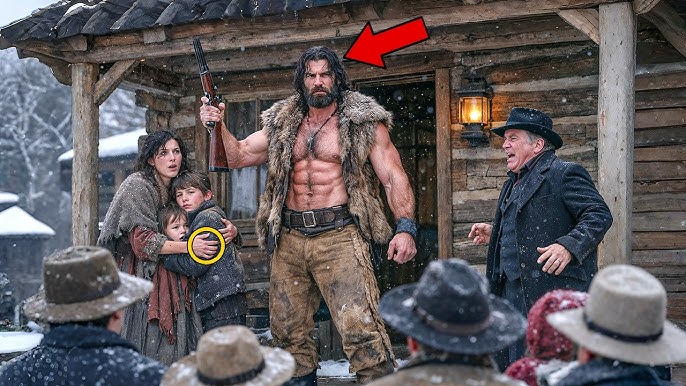
Older. Thin lips. Sharp eyes. Black overcoat and tall top hat. He looked like he belonged in a courtroom, not on a mountain.
He dismounted stiffly.
“You’re harboring her,” Caldwell said immediately.
Caleb didn’t answer.
Sarah stepped out behind him, children clinging to her.
Caldwell’s face flushed red.
“You were instructed to report to town,” he snapped. “Those children are wards now.”
“They’re mine,” Sarah said.
“They’re property of the council,” Caldwell corrected.
Caleb’s fingers tightened on the rifle.
“Leave,” he said calmly.
Caldwell scoffed. “You don’t understand. The town has decided. These children are going east. Labor placements. Better lives.”
The boy began to cry quietly.
Sarah hugged both children tighter.
“They’re not taking us,” she whispered.
Caldwell stepped forward.
“Men,” he said.
Two riders moved closer.
That’s when Caleb stepped between them.
Snow crunched under his bare feet.
He raised the rifle—not aiming, just holding.
The men stopped.
“You don’t want trouble,” Caldwell said.
Caleb’s voice stayed low.
“You come here to take children,” he said. “That’s trouble already.”
“They’re not yours.”
Caleb looked at Sarah.
Then at the kids.
Then back at Caldwell.
“I’ll take you,” he said.
Caldwell frowned.
“What?”
Caleb’s voice carried across the cold air.
“I’ll take you… and every one of those kids.”
Silence.
The watching men stiffened.
Sarah blinked, stunned.
Caldwell laughed harshly. “You? Feed eight children? House them? Educate them?”
Caleb didn’t blink.
“Yes.”
“You live in a one-room cabin.”
“I’ll build more.”
“You hunt for your food.”
“I’ll hunt more.”
“You don’t even belong to this town.”
Caleb shrugged.
“They don’t either.”
The wind moved across the clearing.
Caldwell’s face darkened.
“This isn’t charity,” he snapped. “The town needs labor. Structure. Order.”
“They need a home,” Caleb replied.
The tension thickened.
More townspeople had followed quietly—watching from behind. Hats low. Shoulders stiff.
Sarah’s grip tightened around her children.
“You can’t do this,” Caldwell insisted.
Caleb shifted his stance slightly, snow crunching.
“Watch me.”
Caldwell turned to the crowd.
“You see this? This wild man thinks he can defy the town. He’ll starve them all by spring.”
No one answered.
Caleb spoke again.
“Bring them,” he said. “All of them.”
Caldwell stared.
“You’re serious.”
“Yes.”
The older man leaned close, voice cold.
“If you fail… they die.”
Caleb didn’t hesitate.
“They die anyway if you take them.”
The words landed hard.
Even the wind seemed to pause.
Caldwell mounted his horse slowly.
“You have three days,” he said. “Then we return.”
He turned.
The riders left.
Sarah sagged against Caleb, trembling.
“You didn’t have to—”
“Yes,” he said softly. “I did.”
The next three days turned the mountain into a storm of work.
Caleb cut timber nonstop. Logs fell. Smoke rose. He built a second cabin beside the first. Then a lean-to. Then a wood shelter.
Sarah cooked.
The children gathered sticks.
By the second night, lanterns glowed in multiple windows.
On the third morning, wagons appeared.
Eight children climbed down—thin, quiet, uncertain.
They stared at Caleb like he was a myth.
He knelt.
“You’re home,” he said simply.
That afternoon, Caldwell returned with half the town.
They expected chaos.
Instead, they found smoke from chimneys, children laughing, stew simmering, wood stacked higher than a man.
Caldwell’s face went pale.
“You can’t sustain this,” he said.
Caleb looked at the children running in snow.
“I don’t need your permission.”
The crowd shifted.
One woman stepped forward.
“My sister’s boy… can he stay too?”
Caleb nodded.
Then another voice.
“I got blankets.”
“I got flour.”
“I got tools.”
The town began to change.
Caldwell realized too late.
He had come to take children.
Instead, he watched the mountain give them back a future.
Sarah stood beside Caleb, tears in her eyes.
“You defied them all,” she whispered.
Caleb shook his head.
“No,” he said.
He looked at the children chasing each other in the snow.
“They just needed someone to start.”