
“I Haven’t Eaten In 3 Days, Feed Me And I’ll Serve You” Said The Giant Cowboy To The Rich Woman
The first thing Eleanor Whitmore noticed about the man was his shadow.
It stretched long across the marble floor of her veranda, dark and uninvited, cutting through the afternoon sunlight like a warning. She looked up from her porcelain teacup, irritation already forming—until she saw the man himself.
He was enormous.
Not merely tall, but broad in a way that seemed carved from the same stubborn earth that surrounded her estate. His coat hung in tatters, sun-bleached and wind-torn, and beneath it his shirt clung to a body worn thin by hunger. Dust coated his boots, his hands, even his face—except for his eyes.
Those were sharp. Awake. Watching.
“I haven’t eaten in three days,” he said, voice rough as gravel. “Feed me, and I’ll serve you.”
Eleanor set her cup down slowly.
She had seen desperate men before. Ranch hands begging for work. Drifters spinning lies. Thieves pretending to be saints. But this one didn’t beg—not really. He stood straight despite the exhaustion in his bones, as if offering a bargain rather than pleading for mercy.
“You’re bold,” she said coolly.
“Hungry,” he corrected.
Silence stretched between them, broken only by the distant rustle of wind through dry grass.
Behind Eleanor, the doors to the house stood open, revealing polished floors, gleaming chandeliers, and the quiet luxury of someone who had never gone without a meal. In front of her stood a man who clearly had.
She studied him.
“What can you do?” she asked.
“Anything that needs doing.”
“That’s not an answer.”
“It’s the truth.”
She almost smiled at that.
Most men tried to impress her. They listed skills, exaggerated talents, promised more than they could deliver. This one offered only effort—and something else she couldn’t quite name.
Pride, perhaps.
Or stubbornness.
“Name?” she asked.
“Caleb Rourke.”
“Where are you from, Mr. Rourke?”
He hesitated, just a fraction too long. “Far enough.”
That was answer enough.
Eleanor leaned back in her chair, considering. Her estate was vast—too vast, some would say—for a woman living alone. The ranch hands she employed came and went, never staying long under her strict expectations. And lately… things had gone missing. Small things at first. Tools. Supplies.
Trust was a luxury she could not afford.
And yet—
“Mary,” she called.
A moment later, her housekeeper appeared in the doorway.
“Yes, ma’am?”
“Bring food.”
Mary’s eyes flicked to Caleb, widening slightly at his size and state. But she nodded and disappeared without question.
Eleanor stood, smoothing the folds of her dress.
“You’ll eat,” she said. “Then you’ll work. If you steal, lie, or cause trouble, you’ll be gone before sunset. Do you understand?”
Caleb met her gaze without flinching. “Yes, ma’am.”
“And you will address me as Miss Whitmore.”
A faint flicker of something—amusement?—touched his expression.
“Yes, Miss Whitmore.”
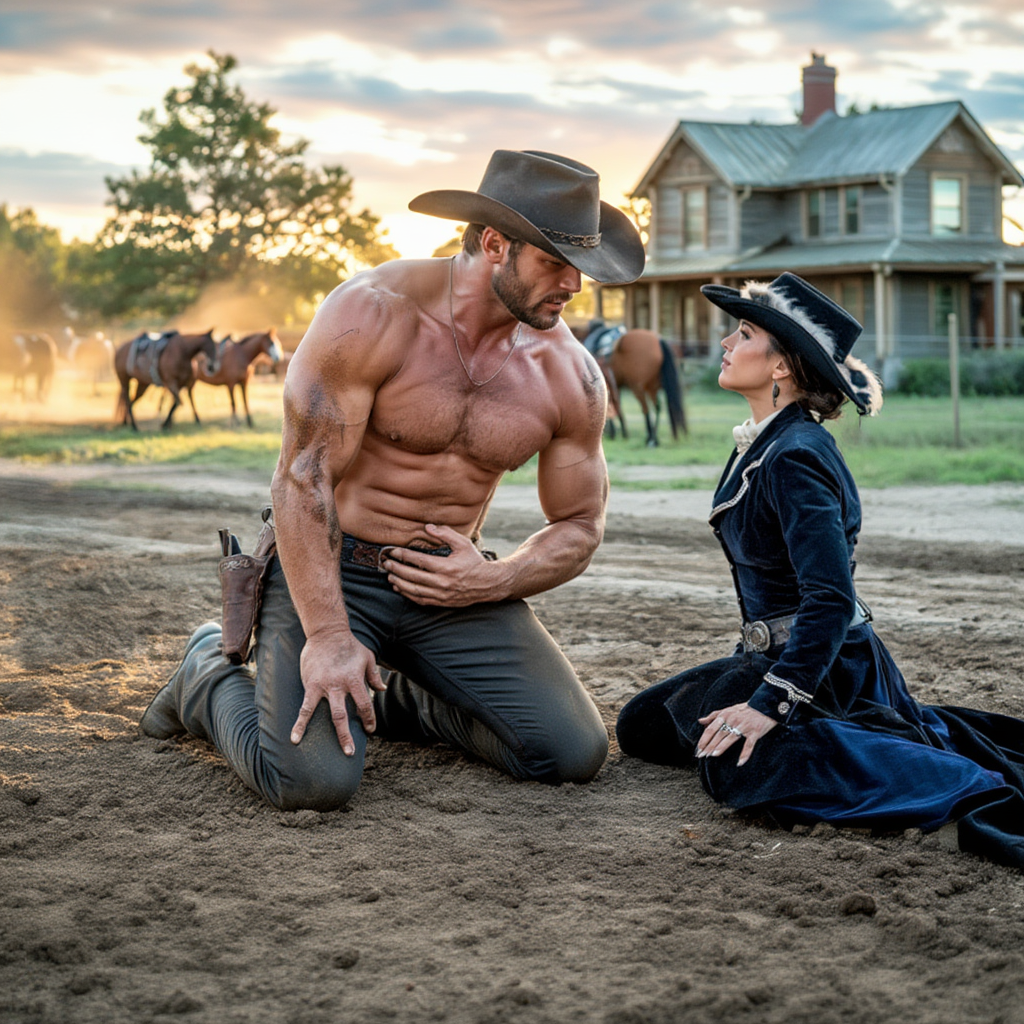
He ate like a man trying not to.
That was the first thing Eleanor noticed as she watched from across the kitchen. Caleb didn’t devour the food the way a starving man might. Instead, he ate steadily, deliberately, as if forcing himself to slow down.
Bread first. Then meat. Then more bread.
Mary hovered nearby, clearly fascinated.
“Would you like more?” she asked.
Caleb hesitated, then nodded. “If it’s not trouble.”
“It’s no trouble at all,” Mary said, already moving.
Eleanor folded her arms.
“You’ve got manners,” she observed.
“My mother insisted.”
“And where is she now?”
He didn’t look up from his plate. “Gone.”
Something in his tone ended the conversation.
Eleanor turned away, hiding her curiosity. She had no interest in a drifter’s past. All that mattered was whether he could work.
And whether he could be trusted.
The work began immediately.
The fence along the north pasture had been damaged in a recent storm, and several sections needed replacing. It was grueling labor under the relentless sun—exactly the kind that drove most men away within hours.
Caleb lasted all day.
Eleanor watched from horseback as he worked, his movements efficient despite the lingering weakness in his frame. He didn’t complain. Didn’t pause more than necessary. Didn’t even look toward the house.
By evening, half the fence was repaired.
“Not bad,” she said, riding up beside him.
He leaned on the post driver, breathing hard but steady. Sweat darkened his shirt, and dirt streaked his face, but his eyes were still sharp.
“Told you,” he said.
“That you could do anything?”
“That I’d work.”
She considered him for a moment.
“You can stay,” she said. “For now.”
Days turned into weeks.
Caleb became a fixture on the estate—silent, dependable, always working. He rose before dawn and didn’t stop until the light faded. Fences were repaired. Fields cleared. Broken equipment restored.
And nothing went missing.
Eleanor found herself watching him more often than she intended.
There was something unusual about him. Not just his size or strength, but the way he carried himself. Like a man who had lost everything—and chosen to keep going anyway.
One evening, as the sun dipped low over the horizon, she found him sitting by the barn, staring out at the fields.
“You’re wasting daylight,” she said.
He didn’t turn. “Work’s done.”
“For today.”
“That’s enough.”
She dismounted, tying her horse nearby.
“You don’t strike me as a man who believes in ‘enough.’”
A faint smile touched his lips. “Maybe I’m learning.”
She studied him in the fading light.
“Why did you come here, Caleb?”
He was quiet for a long moment.
“I was passing through,” he said finally. “Saw the place. Figured someone like you might need help.”
“Someone like me?”
“Someone with more land than people.”
She huffed softly. “You’re observant.”
“Comes from needing to be.”
Silence settled between them.
Then, quietly, he added, “And I was hungry.”
Eleanor looked away, something tightening in her chest.
The trouble came at night.
Eleanor woke to the sound of shouting—angry voices, unfamiliar. She sat up, heart pounding, and reached for the small pistol she kept by her bedside.
More shouting. The crash of something breaking.
She threw on a robe and rushed downstairs.
The front door stood open.
Outside, three men were arguing near the supply shed. One held a lantern, its light casting wild shadows across their faces. Another was trying to force open the door.
Thieves.
Her grip tightened on the pistol.
Before she could act, a fourth figure stepped into the light.
Caleb.
He moved like a storm.
One moment he was standing still; the next, he was in the middle of them. A single swing of his arm sent one man sprawling. Another lunged at him—only to be caught and thrown aside like a rag doll.
The third tried to run.
Caleb caught him by the collar and slammed him to the ground.
“Leave,” he said, voice low and dangerous.
They didn’t argue.
Within seconds, the men scrambled to their feet and fled into the darkness.
Caleb stood there, breathing hard, watching until they were gone.
Only then did he turn.
His eyes met Eleanor’s.
For a moment, neither of them spoke.
Then she lowered the pistol.
“You could have been killed,” she said.
“So could they.”
“That’s not the point.”
“It is to me.”
She stepped closer, studying him.
“You didn’t hesitate.”
“They were stealing from you.”
“That’s happened before.”
“Not anymore.”
Something in his tone made her pause.
“Why?” she asked. “Why do you care?”
He held her gaze.
“You fed me.”
The simplicity of the answer struck her harder than anything else.
After that night, things changed.
Not all at once. Not in ways that could be easily named. But something shifted between them.
Eleanor found herself speaking more, asking questions she wouldn’t normally ask. Caleb, in turn, began to answer—sparingly at first, then with more ease.
He had been a rancher once, he told her. Owned land. Had a family.
“What happened?” she asked.
“Drought,” he said. “Debt. Bad luck.”
“And your family?”
He looked away. “Gone.”
She didn’t press further.
Some losses didn’t need details.
Winter came early that year.
The fields turned brittle, the air sharp with cold. Work grew harder, but Caleb didn’t slow down.
Neither did Eleanor.
They worked side by side more often now, the distance between employer and worker gradually fading. Conversations came easier. Silences felt less heavy.
One evening, as snow began to fall, they found themselves in the barn, sheltering from the wind.
“You could leave,” Eleanor said suddenly.
Caleb looked at her. “What?”
“You’ve worked enough to earn a stake. A fresh start somewhere else.”
“And go where?”
“Anywhere.”
He shook his head. “I’m fine here.”
“You don’t belong here,” she said.
“Why not?”
“Because this isn’t your land.”
He stepped closer.
“Then whose is it?”
“Mine.”
“Then I belong where I’m needed.”
Her breath caught slightly.
“That’s not the same thing.”
“Feels the same to me.”
For a moment, the world outside the barn seemed to disappear—the wind, the snow, the cold.
All that remained was the space between them.
“You made a bargain,” Eleanor said softly. “Food for service.”
“And I kept it.”
“You’ve done more than that.”
He didn’t answer.
She took a step closer.
“So have you,” he said quietly.
Spring brought new life to the land.
The fields greened. The air warmed. And the estate—once quiet and lonely—felt alive again.
So did Eleanor.
She stood on the veranda one morning, watching as Caleb worked in the distance. The same man who had once appeared as nothing more than a shadow now stood at the center of everything she had rebuilt.
Mary approached, smiling.
“He’s not leaving, is he?”
Eleanor shook her head.
“No,” she said. “He’s not.”
“Good,” Mary said. “Would be a shame to lose him.”
Eleanor watched as Caleb paused, looking toward the house.
Their eyes met across the distance.
For a moment, neither moved.
Then, slowly, he smiled.
And for the first time in years, Eleanor Whitmore smiled back.
The bargain had been simple.
Feed me, and I’ll serve you.
But somewhere along the way, it had become something else entirely.
Not a transaction.
Not a debt.
But a promise.
One neither of them intended to break.
Title: Bread, Dust, and a Promise — Part II
The first storm of spring came without warning.
One moment, the sky above the Whitmore estate was a pale, forgiving blue. The next, it darkened into something restless and wild, wind sweeping across the fields in long, low howls. Eleanor stood on the veranda, one hand gripping the railing as she watched the clouds roll in like a gathering army.
“Caleb!” she called.
He was already moving.
Out in the pasture, he drove the last of the cattle toward shelter, his movements quick and precise despite the rising wind. There was no hesitation in him anymore—no trace of the starving man who had once stood on her doorstep.
Now he moved like someone who belonged.
The thought settled quietly in Eleanor’s chest.
He belongs here.
The realization startled her—not because it was new, but because it had finally become undeniable.
The storm hit hard.
Rain lashed against the house in sharp, relentless sheets. Thunder cracked overhead, shaking the windows. Inside, the estate seemed smaller somehow, the vast rooms pulled inward by the weight of the storm.
Eleanor paced.
She told herself it was concern for the property—the livestock, the structures, the work they had poured months into rebuilding. But every time lightning split the sky, her thoughts went to one place.
Caleb.
The door burst open.
He stepped inside, drenched, hair plastered to his forehead, chest rising and falling with heavy breaths. For a moment, he just stood there, water pooling at his boots.
“All accounted for,” he said. “No animals lost.”
Relief hit her faster than she expected.
“Good,” she said, a little too quickly.
Mary rushed forward with a towel, fussing over him.
“You’ll catch your death out there,” she scolded.
“Not today,” he replied, taking the towel.
Eleanor watched him, something shifting again beneath the surface.
“You should rest,” she said.
He shook his head. “Fence on the south side might not hold.”
“It can wait.”
“So can I.”
“It’s a storm, not a war.”
He met her gaze, rainwater still dripping from his jaw.
“Storms don’t wait for permission.”
For a moment, they stood in quiet opposition—her, used to control; him, shaped by survival.
Then she exhaled.
“Five minutes,” she said. “Then you can go back out and play the hero.”
A faint smile tugged at his mouth.
“Yes, Miss Whitmore.”
That night, the storm passed—but something else lingered.
Eleanor couldn’t sleep.
She lay awake, staring at the ceiling, listening to the soft, steady quiet that followed chaos. It should have been comforting.
Instead, it felt… unfinished.
Finally, she rose.
The house was still, lit only by the faint glow of lanterns. She moved through the halls without thinking, her steps carrying her somewhere she hadn’t consciously chosen.
The barn.
A single lantern burned inside.
Caleb sat on a bale of hay, his shirt half-dried, sleeves rolled, hands resting loosely between his knees. He looked up as she entered, surprise flickering across his face.
“Couldn’t sleep?” he asked.
“No.”
He nodded, as if that made perfect sense.
She stepped closer, the scent of damp hay and earth filling the space.
“You stayed out here?”
“Didn’t want to track mud through your floors.”
“They’re just floors.”
“They’re yours.”
The simple statement held more weight than it should have.
Eleanor leaned against a post, studying him.
“You don’t have to keep proving yourself,” she said.
“I’m not.”
“Then what are you doing?”
He was quiet for a moment.
“Staying.”
The word settled between them.
“Why?” she asked softly.
He looked at her—not past her, not through her, but directly at her.
“Because this is the first place that’s felt… steady.”
Her breath caught slightly.
“Steady?”
“Yeah.” He glanced around the barn, then back at her. “You built something here. Something that holds.”
Eleanor swallowed.
“And you think you’re part of that?”
“I think I want to be.”
The honesty in his voice left no room for doubt.
The trouble returned a week later.
This time, it wasn’t thieves.
It was men with papers.
Eleanor stood in the front room, her posture rigid as three well-dressed men spread documents across her table. Their boots were clean, their coats untouched by dust—a stark contrast to the life outside.
“You’re behind on payments, Miss Whitmore,” one of them said smoothly.
“I am not.”
He slid a paper toward her.
“According to our records—”
“Your records are wrong.”
“Debts don’t disappear because you disagree with them.”
Eleanor’s jaw tightened.
“I’ve paid every cent owed.”
“Perhaps,” the man said. “But interest has a way of… accumulating.”
Caleb stood in the doorway, silent but unmistakably present.
The men noticed him.
“And who might this be?” one asked.
“Someone who works here,” Eleanor said sharply.
“Ah.” The man’s smile thinned. “Then he should understand the importance of obligation.”
Caleb didn’t move.
“Seems to me,” he said calmly, “obligation goes both ways.”
The room went still.
“You’ll want to be careful,” the man replied. “This is a legal matter.”
“And you’ll want to be honest,” Caleb said.
Eleanor shot him a warning look—but it was too late.
The tension had already shifted.
“We’re offering you a solution,” the man continued, turning back to her. “Sell a portion of your land. Clear the debt. Walk away with dignity.”
“No.”
The answer came without hesitation.
“Think carefully—”
“I have,” she said. “And my answer is no.”
The man studied her for a long moment.
Then he gathered the papers.
“We’ll return,” he said. “With less patience.”
They left without another word.
The silence that followed was heavy.
Eleanor stood still, her hands resting on the table.
“You didn’t tell me,” Caleb said.
“There was nothing to tell.”
“That didn’t look like nothing.”
“It’s handled.”
“Doesn’t sound like it.”
She turned sharply.
“I didn’t ask for your opinion.”
“And I didn’t give it,” he said evenly. “I asked a question.”
They faced each other, tension crackling.
Finally, she looked away.
“It’s an old claim,” she said quietly. “From before… everything.”
“Before what?”
“Before I took over the estate.”
Caleb waited.
“My father made bad deals,” she continued. “Left debts behind when he died. I’ve spent years clearing them.”
“And this one?”
“I already paid it.”
“So they’re lying.”
“Yes.”
He nodded slowly.
“Then we prove it.”
“It’s not that simple.”
“Why not?”
“Because men like that don’t care about truth. They care about power.”
Caleb’s expression hardened.
“Then we make it costly.”
Eleanor let out a short, humorless laugh.
“You think this is a fight you can win with strength?”
“No,” he said. “But it’s one we can’t win by backing down.”
The word we hung in the air.
She noticed it.
So did he.
The days that followed were tense.
The men returned—this time with more pressure, more threats, more insistence that the land would soon no longer be hers.
Eleanor refused every offer.
Caleb stayed close.
Not hovering. Not interfering. Just… there.
A presence. A constant.
And slowly, something began to change—not in the men, but in her.
For the first time in years, she wasn’t facing it alone.
The confrontation came at dawn.
They arrived with a sheriff.
Papers were presented. Claims were made. Voices were raised.
Eleanor stood her ground.
“I will not sign,” she said.
“You may not have a choice,” the sheriff replied.
Caleb stepped forward.
“She does.”
The sheriff frowned. “And you are?”
“Someone who knows what a real claim looks like.”
He reached into his coat and pulled out a folded document.
Eleanor’s eyes widened.
“What is that?” she whispered.
“Something I should’ve shown you sooner.”
He handed it to the sheriff.
The man read it once.
Then again.
His expression changed.
“This… where did you get this?”
“It’s a record of the original debt,” Caleb said. “Signed. Settled. Witnessed.”
Eleanor stared at him.
“You had this?”
“For a while.”
“Why didn’t you—”
“Because I wasn’t sure it mattered.” He met her gaze. “Until now.”
The sheriff looked at the other men.
“This claim is invalid,” he said.
Their composure cracked.
“That’s impossible—”
“It’s documented,” the sheriff said. “You’re done here.”
The men left without another word.
The silence that followed felt different this time.
Lighter.
Eleanor turned to Caleb.
“You saved the estate.”
He shook his head. “You did. I just… helped.”
She stepped closer.
“You had the proof.”
“And you had the fight.”
For a moment, neither spoke.
Then she said, “Why did you really stay?”
He didn’t hesitate.
“You.”
The word landed softly—but it changed everything.
Eleanor felt it, deep and undeniable.
“This wasn’t part of the bargain,” she said.
“No,” he agreed. “It wasn’t.”
“Then what is it?”
He took a step closer.
“Something better.”
Her breath caught.
“And if I ask you to stay?” she said.
“I already am.”
She smiled—slow, certain, real.
“Good,” she said.
Months later, the estate stood stronger than ever.
Not just in fences and fields, but in something less visible.
Something built on trust.
On choice.
On a promise that had grown far beyond its beginnings.
One evening, as the sun dipped low, Eleanor stood beside Caleb on the veranda.
“You know,” she said, “you never finished your end of the bargain.”
He raised an eyebrow. “Didn’t I?”
“You said you’d serve me.”
“And I have.”
She shook her head, smiling.
“No,” she said. “You stayed.”
He looked out over the land, then back at her.
“Yeah,” he said quietly. “I did.”
And this time, it wasn’t because he was hungry.
It was because he had finally found something worth keeping.