
Her Sisters Took Everything — Beneath the Floor, Her Mother Hid a Lifeline
In the winter of 1887, the snow came early to the hills outside Ash Hollow, Montana, drifting across the prairie in long silver sheets and burying fence posts until only their tops remained. The wind screamed across the valley like something alive, rattling shutters, bending pine trees, and finding every crack in every house.
And on the far edge of town, where the dirt road disappeared into frozen timber, stood the Wainwright farmhouse.
Once, people had called it the warmest home in Ash Hollow.
Now they called it cursed.
Inside its weathered walls lived three sisters.
And only one of them had ever truly been loved.
Margaret Wainwright had been born last.
At twenty-two, she was quiet where her sisters were sharp, strong where they were cruel, and kind in ways the frontier rarely rewarded.
She had her mother’s dark chestnut hair, her father’s gray eyes, and hands roughened by work no lady was meant to do.
She chopped wood.
Milked cows.
Mended harnesses.
Dug potatoes from frozen soil.
And after both parents died within six months of each other—first fever, then grief—Margaret did all of it alone.
Her sisters made certain of that.
Eleanor, the eldest, believed birth order was a crown.
Charlotte, the middle sister, believed beauty was power.
Together, they believed Margaret existed to serve them.
And after the funeral, they wasted no time proving it.
“I suppose Father’s papers make it clear,” Eleanor said one morning, seated by the fire in their mother’s rocking chair.
She unfolded a brittle document and smiled without warmth.
“The house belongs to us.”
Margaret looked up from scrubbing the kitchen floor.
“All of us.”
Charlotte laughed softly.
“Oh, Maggie…”
She leaned against the mantel, examining her polished nails.
“You should know better than to interrupt.”
Margaret slowly rose.
“What exactly does that paper say?”
Eleanor folded it carefully.
“It says the property goes to the elder daughters.”
“That’s not true.”
Eleanor’s eyes hardened.
“Are you calling me a liar?”
Margaret said nothing.
That was answer enough.
Charlotte stepped closer.
“You’re lucky we’re family.”
Then she smiled.
“Otherwise you’d already be out in the snow.”
By Christmas, everything had changed.
Margaret’s bedroom was given to Charlotte.
Her father’s horse was sold.
Her mother’s sewing chest disappeared.
The silverware, the china, the wedding Bible—
Gone.
Each time Margaret asked where anything had gone, she got the same answer.
“It wasn’t yours.”
Eventually, she stopped asking.
Instead, she slept in the attic under a patched quilt, rising before dawn to do the chores while her sisters slept near the stove.
And every night, before bed, she touched the small brass key hanging from a ribbon beneath her dress.
Her mother had given it to her the week before she died.
She had pressed it into Margaret’s hand with trembling fingers.
And whispered:
“When they take everything… look beneath the floor.”
Then she had closed her eyes.
And never opened them again.
For six months, Margaret carried that key.
And said nothing.
Because keys were only useful if you knew what they opened.
And she had no idea.
Until the dog found it.
His name was Rusty.
A shaggy golden mutt her father had rescued as a pup.
Too ugly to sell.
Too stubborn to train.
Too loyal to leave.
On the first night of January, while snow hammered against the shutters, Rusty began scratching at the pantry floor.
Margaret looked up from peeling potatoes.
“Rusty.”
Scratch.
Scratch.
Scratch.
Charlotte groaned from the next room.
“Make that mutt stop.”
Rusty barked once.
Then scratched harder.
Margaret stood.
Walked into the pantry.
And froze.
The dog wasn’t scratching randomly.
He was scratching one exact spot.
A loose plank.
Her pulse quickened.
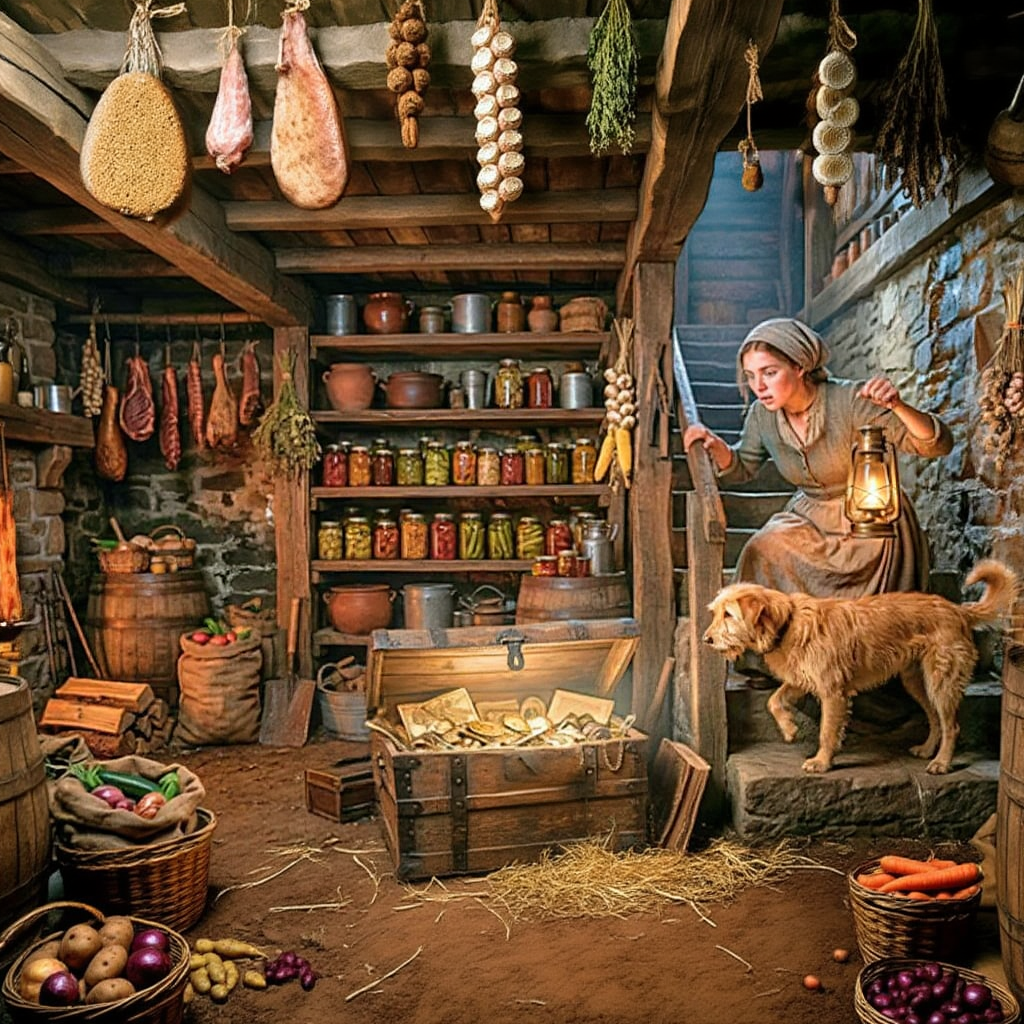
That night, after her sisters had gone upstairs, Margaret returned with an oil lantern.
Rusty waited by the pantry.
Tail wagging.
She knelt.
Ran her fingers across the floorboards.
And there—
A narrow seam.
Almost invisible.
She slipped a butter knife beneath the plank.
Pried.
Wood creaked.
Dust rose.
And a square section of flooring lifted.
Beneath it—
Stone steps.
Descending into darkness.
Margaret’s breath caught.
Rusty barked softly.
She reached beneath her dress.
Pulled out the brass key.
And for the first time…
Noticed a small iron door at the bottom of the stairs.
The cellar smelled of earth, cedar, and old secrets.
Lantern light flickered across stone walls and timber beams.
Margaret descended slowly, Rusty at her side.
At the bottom stood a weathered iron lock.
Her hands shook.
She inserted the key.
Turned.
Click.
The sound echoed through the chamber.
She pulled.
And the door swung open.
Margaret stood frozen.
Before her stretched an underground storeroom larger than the house itself.
Shelves lined the walls—
Filled with jars of peaches.
Pickled beans.
Corn.
Tomatoes.
Honey.
Soap.
Candles.
Medicines.
Flour.
Sugar.
Salt.
Barrels of dried apples.
Sacks of potatoes.
Onions.
Carrots.
Cured hams hung from rafters.
Garlic braided overhead.
Bundles of herbs dried in neat rows.
And in the center…
A heavy wooden chest.
Margaret stepped closer.
Lifted the lid.
And gasped.
Gold coins.
Silver bars.
Jewelry.
Land deeds.
Bank certificates.
And on top…
An envelope.
With her name.
Her fingers trembled as she opened it.
Inside was her mother’s handwriting.
Strong.
Precise.
Alive.
My dearest Margaret,
If you are reading this, then I was right.
Your sisters took what could be seen.
So I hid what mattered where only the faithful would find it.
This cellar was built by your grandfather during the war.
Everything here belongs to you.
Not because you are youngest.
Not because you are my favorite.
But because you are the only one who ever learned the difference between ownership… and stewardship.
Use this wisely.
Build something no one can take.
And never beg those who stole from you.
Love always,
Mother
Margaret sat on the dirt floor.
And cried for the first time in months.
Rusty rested his head in her lap.
And somewhere above—
The wind screamed against the house.
But down there…
For the first time…
Margaret felt safe.
By spring, Ash Hollow began to whisper.
Because while Eleanor and Charlotte spent money like queens…
Margaret quietly changed.
Her dresses became cleaner.
Her boots newer.
Her shoulders straighter.
And every Saturday, wagons arrived at the farmhouse.
Flour wagons.
Seed wagons.
Lumber wagons.
Cattle.
Tools.
Even a piano.
Eleanor watched from the porch, stunned.
“Where is she getting money?”
Charlotte’s face paled.
“She’s hiding something.”
They searched her attic.
Her trunk.
Her mattress.
Her coat pockets.
Nothing.
Then one night—
Charlotte saw lantern light beneath the pantry door.
And followed.
She waited until Margaret left.
Then crept inside.
Found the loose plank.
Lifted it.
And climbed down.
Smiling.
Until she reached the iron door.
Locked.
She shook it.
Pounded.
Kicked.
Nothing.
Then footsteps above.
Margaret’s voice.
Calm.
Cold.
“Enjoying yourself?”
Charlotte spun.
“How did you—”
Margaret removed the ladder.
Charlotte’s face went white.
“You can’t leave me here!”
Margaret held the lantern above.
Her shadow stretching across stone walls.
“You left me in the attic in January.”
Charlotte’s lips trembled.
“That’s different.”
Margaret looked down at her.
“No.”
She said quietly.
“It isn’t.”
Then she lowered the ladder again.
Because unlike her sisters—
She had her mother’s heart.
By summer, the truth came out.
The deed.
The bank papers.
The hidden inheritance.
And the final clause in their father’s estate—
One Eleanor had never shown anyone.
Because it invalidated her claim.
Everything belonged to Margaret.
Everything.
The land.
The livestock.
The house.
The accounts.
All of it.
Provided she remained on the property until age twenty-two.
And she had.
Exactly three weeks earlier.
The sheriff arrived on a hot July afternoon.
Eleanor screamed.
Charlotte cried.
Margaret said nothing.
She simply stood on the porch beside Rusty.
Watching as her sisters’ trunks were loaded into a wagon.
Eleanor pointed at her.
“You planned this!”
Margaret shook her head.
“No.”
Then she smiled faintly.
“Mother did.”
The wagon disappeared in a cloud of dust.
And silence settled over the valley.
Margaret looked at the old farmhouse.
The fields.
The barn.
The mountains beyond.
And then down toward the hidden cellar.
Toward the place where her mother had hidden not just gold…
But hope.
A lifeline beneath the floor.
And for the first time in her life—
Nothing had been taken from her.
Because what mattered most…
Had been waiting for her all along.