
Her Late Father Left Her a Sealed Cellar Door — Forty Steps Down, the Air Was Warm Year Round
Snow came early to northern Montana that year.
By the second week of November, the roads outside Elk River Pass were already buried under two feet of powder, and the pine forests that climbed the mountains looked as if heaven itself had spilled flour across every branch.
At thirty-four years old, Emily Carter had not planned to return.
Not to the mountains.
Not to the old family land.
And certainly not to the weather-beaten timber house perched alone at the edge of seven hundred acres of pine, granite, and silence.
She had spent fifteen years in Chicago building a life that had nothing to do with dirt roads, wood stoves, or the ghosts of family promises.
But when her father died in late September, there was no one else.
No brothers.
No sisters.
No cousins willing to make the drive.
Only Emily.
And a single sentence written in his will:
“To my daughter Emily—everything above ground is yours.
Everything below it… you must find for yourself.”
She had read that line three times in the lawyer’s office.
Then once more in her hotel room.
Then once more while sitting in her car outside the airport.
It made no sense.
Her father, Daniel Carter, had always been a practical man.
A carpenter.
A hunter.
A veteran.
The kind of man who fixed broken fences with his bare hands and never wasted words.
He did not speak in riddles.
And yet, somehow, that final message felt exactly like him.
So now, on a bitter November afternoon, Emily stood in knee-deep snow outside the Carter cabin, staring across the frozen clearing where she had once built snow forts as a child.
The cabin looked smaller than she remembered.
The cedar siding was faded silver.
The stone chimney leaned slightly west.
Smoke no longer rose from its top.
Everything was still.
Everything was cold.
She unlocked the front door.
The hinges groaned.
Inside, dust floated through pale shafts of winter sunlight.
The smell hit her first.
Cedar.
Ash.
Leather.
Her father.
Emily stood motionless in the doorway, gloves still on, breath clouding in the freezing air.
For a moment she was ten years old again.
Running through these rooms.
Laughing.
Listening to her father whistle while he sharpened axes by the fireplace.
But now the house was silent.
And silence, she discovered, weighed more than grief.
The first week passed in practical work.
Pipes.
Generator.
Roof leaks.
Inventory.
Firewood.
She slept under three blankets near the old stone fireplace, listening to wind scrape branches across the roof.
At night she thought about her father’s words.
Everything below it…
Below what?
The house?
The land?
The mountain?
She searched the basement first.
Nothing but old tools, canning jars, and a rusted snowblower.
She searched the barn.
Nothing.
She searched the root cellar behind the smokehouse.
Nothing.
By the eighth day, frustration had become obsession.
Her father had hidden something.
She knew it.
He had raised her to notice details.
To see what others missed.
So she started looking differently.
Not for rooms.
Not for doors.
But for patterns.
And on the ninth morning, she found it.
A brass key.
Hanging alone on a nail beside the fireplace.
Tiny.
Old.
Unmarked.
She could have sworn it hadn’t been there before.
Emily turned it over in her palm.
Then looked up.
Above the fireplace mantle hung an old black-and-white photograph.
Her father.
Younger.
Maybe thirty.
Standing outside the cabin with a shovel over his shoulder.
And behind him—
Snow.
Pines.
And what looked like…
A wooden hatch in the ground.
Her pulse quickened.
She grabbed her coat.
Her shovel.
And the photo.
The hatch was fifty yards behind the cabin.
Buried beneath drifted snow and decades of pine needles.
If not for the photograph, she would never have found it.
She shoveled for nearly an hour.
Sweating despite the freezing wind.
Until finally—
Thunk.
Wood.
Emily dropped to her knees and brushed away the snow.
A square outline.
Heavy oak planks.
Iron hinges.
And a rusted brass lock.
Her hands trembled as she inserted the tiny key.
For a moment nothing happened.
Then—
Click.
The lock opened.
Emily pulled.
The hatch groaned upward.
A gust of air rushed from below.
She expected cold.
Instead—
Warmth.
Not hot.
Not stale.
Warm.
Like stepping into a house in autumn.
Emily froze.
Her breath vanished in the rising current.
She leaned closer.
Darkness.
Stone.
Stairs.
Descending.
Farther than she could see.
She swallowed hard.
Then switched on her flashlight.
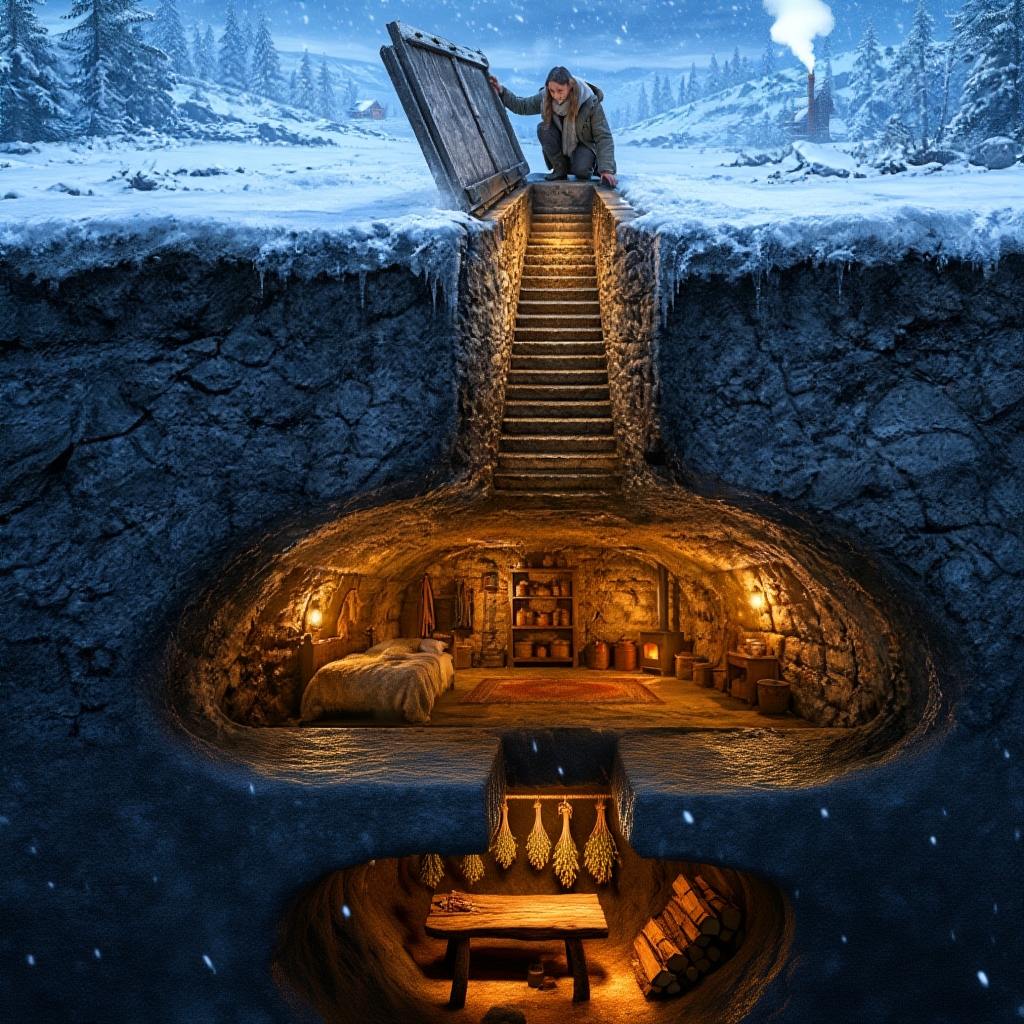
Forty stone steps.
Exactly forty.
Vanishing into earth.
She whispered aloud:
“Dad… what did you build?”
And began descending.
By the tenth step, the sound of wind disappeared.
By the twentieth, the smell of pine faded.
By the thirtieth, the earth itself seemed to breathe.
And by the fortieth—
Emily stopped.
Her flashlight lowered.
Her mouth fell open.
Before her stood a room.
Not a cellar.
Not a bunker.
A home.
Built entirely underground.
Stone walls.
Timber beams.
Shelves lined with canned food.
Blankets.
Books.
Lanterns.
A woven rug.
A cast-iron stove.
And beside it—
A bed.
Neatly made.
As if someone had left only moments ago.
Emily’s eyes filled with tears.
“Dad…”
Her voice echoed softly.
She stepped forward, touching the stone.
Still warm.
Not from fire.
Not from machinery.
The room itself was warm.
Perfectly warm.
Seventy degrees, maybe.
She knelt beside the stove.
Cold.
Unused.
So where was the heat coming from?
Then she noticed another passage.
Narrow.
Descending farther.
She picked up a lantern from a hook on the wall.
Lit it.
And followed.
The second chamber sat another twenty feet below.
Smaller.
Rounder.
Older.
Barrels lined the walls.
Wooden crates stacked to the ceiling.
Tools.
Salt.
Flour.
Medical supplies.
Water tanks.
Enough provisions for years.
But it wasn’t the supplies that stopped her.
It was the journal.
Sitting on a wooden crate.
Leather-bound.
Her father’s handwriting across the cover.
For Emily.
She sat on an old barrel and opened it.
The first page read:
If you’re reading this, then I’m gone.
And if you found this place, then I was right.
You were always the one who paid attention.
Emily wiped her eyes.
Kept reading.
This mountain is alive.
Not with ghosts.
Not with secrets.
With heat.
Forty feet below the frost line, the earth keeps its own temperature.
Fifty-six degrees year round.
Stone holds it.
Air moves it.
And if you build with patience, the mountain becomes home.
Emily turned pages.
Blueprints.
Measurements.
Ventilation diagrams.
Geothermal airflow.
Thermal storage walls.
Emergency plans.
Food rotation schedules.
Every page written in meticulous detail.
Her father hadn’t built a cellar.
He had built a survival system.
A place no storm could touch.
A place no winter could freeze.
A place that could outlast generations.
And on the final page:
I built this after your mother died.
Because I promised myself no one I loved would ever be left in the cold again.
Emily stopped breathing.
Her tears dropped onto the paper.
For years she had believed her father became distant after her mother’s death.
Hard.
Silent.
Emotionless.
But here, forty steps underground, she realized—
He hadn’t stopped loving.
He had simply started building.
That winter became the worst in Montana in forty-two years.
Blizzards buried highways.
Power lines snapped.
Temperatures dropped to thirty below.
Neighboring ranches lost heat.
Livestock froze.
Fuel deliveries stopped.
Emergency crews couldn’t reach half the mountain roads.
And at Carter Pass—
Emily opened the cellar.
One family at a time.
The Wilsons.
The Harpers.
Old Mr. Donnelly.
A young couple with twin boys.
By Christmas, eleven people lived beneath the mountain.
Sleeping in shifts.
Eating from barrels.
Laughing around the old stove.
Safe.
Warm.
Alive.
And every night, before bed, Emily would run her fingers across the journal’s final page.
Hearing her father’s voice in every line.
Stone holds it.
Air moves it.
And if you build with patience…
The mountain becomes home.
Spring came late.
When the snow finally melted in April, the world above ground looked broken.
Fences down.
Trees split.
Roofs collapsed.
Roads washed out.
But below ground—
Nothing had changed.
The cellar remained warm.
Steady.
Alive.
Just as her father designed.
By summer, Emily made her decision.
Chicago could wait.
Promotions could wait.
Corporate meetings could wait.
Some things mattered more.
She filed the paperwork.
Sold her condo.
Packed her life into a truck.
And came home.
For good.
By autumn, people across Montana had started calling the Carter property something new.
Not the old cabin.
Not the mountain house.
Not the Carter ranch.
They called it—
Warmth Below.
And every winter, when the first snow fell across the pines and the mountains turned white beneath the cold pale sky—
Emily would walk across the frozen clearing.
Brush snow from the heavy wooden hatch.
Open it.
Feel that familiar breath of warm earth rise from below.
And smile.
Because forty steps down—
Her father was still keeping people alive.