
Her Husband Left Her a Field of Useless Stone — She Stacked It Into the Warmest House in the County
When Martha Ellison first saw the land her husband had bought, she thought he’d made a terrible mistake.
It wasn’t a meadow. It wasn’t farmland. It wasn’t even proper forest. The entire field behind their small wooden cabin was covered in stone—gray, jagged, scattered rocks of every size. Some barely larger than her hand, others half-buried like sleeping animals in the soil.
“You can’t grow anything here,” she said, hands on her hips.
Samuel only smiled, wiping sweat from his brow. “Maybe not crops.”
“Then why buy it?”
He nudged one of the larger rocks with his boot. “Because stone lasts longer than wood.”
Martha shook her head. “Stone doesn’t keep you warm.”
Samuel laughed. “You’d be surprised.”
But he never explained further.
That was early autumn. They spent the following weeks repairing the cabin, stacking wood, and preparing for winter. Samuel occasionally hauled stones into small piles near the house, but he never seemed in a hurry.
Then the snow came.
And two weeks later, Samuel never came back from town.
The search lasted three days. They found his horse near the river. By the fifth day, the neighbors stopped hoping.
Martha stood alone in the doorway of their cabin, staring out at the frozen field of useless stone.
She felt anger first.
Then grief.
Then fear.
Winter had only begun, and the cabin leaked cold through every seam. Wood burned fast. Wind crept through the walls. Each night she piled blankets higher and still woke shivering.
The stones outside seemed to mock her.
Samuel had spent money on rocks instead of lumber.
Rocks instead of insulation.
Rocks instead of safety.
By mid-December, Martha’s woodpile had shrunk dangerously low.
She rationed fires—small ones during the day, slightly larger at night. The cabin stayed cold. Frost formed along the inside walls. Her breath fogged in the morning.
One afternoon, she stepped outside to gather more wood and nearly slipped on the snow-covered stones. Her boot struck one, sending it rolling.
She kicked it in frustration.
It didn’t move much.
Solid. Heavy.
She stared at it.
Samuel’s words echoed faintly.
“Stone lasts longer than wood.”
She looked back at the cabin. Thin walls. Drafts everywhere.
Then she looked at the field.
Thousands of stones.
A slow idea began forming—uncertain, stubborn, almost ridiculous.
But she had little else.
That evening, Martha dragged the first stone to the cabin.
It took nearly ten minutes. The rock scraped across snow, leaving a shallow trail. Her gloves soaked through. Her arms burned.
She set it beside the wall.
It looked out of place.
She went back for another.
And another.
By sunset, she had a small pile near the cabin’s base. She sat on the porch, exhausted, staring at them.
“This is foolish,” she muttered.
But she didn’t stop.
The next day, she stacked them.
Not carefully at first—just piling stones against the outer wall. She filled gaps with smaller rocks. The structure looked rough, uneven.
But it blocked wind.
That night, she noticed something surprising.
The cabin felt… slightly warmer.
Not much.
But enough to notice.
Encouraged, she continued.
Trip after trip, she hauled stones from the field. Her shoulders ached constantly. Her hands blistered. Snow fell heavier, making each trip harder.
Neighbors noticed.
Old Ben Carter stopped by, shaking his head.
“You building a fortress?” he asked.
“Trying not to freeze,” Martha replied.
He studied the growing stone wall around her cabin. “That’s a lot of work for one person.”
“So is freezing.”
He nodded slowly and left.
By Christmas, one side of the cabin was covered in stacked stone—nearly waist high. Martha packed snow between gaps, letting it freeze solid.
Inside, the difference became undeniable.
The wind no longer seeped through that wall. Heat from the fireplace lingered longer.
She pressed her palm against the interior wall.
It felt warmer.
Not just blocking wind—holding heat.
Her heart quickened.
She worked harder.
She dragged larger stones, stacking them more carefully. She began shaping corners. The cabin slowly transformed—wood hidden behind a growing shell of stone.
The field shrank.
The house thickened.
Snowstorms came and went. Martha worked through them all. Some mornings she woke too sore to move—but she forced herself up.
She began building higher.
She borrowed a ladder from Ben Carter. Climbing it in winter felt dangerous, but she moved slowly, placing stones one by one.
The structure took shape—stone rising to window height, then higher.
Villagers began talking.
“She’s covering the whole cabin.”
“She’ll collapse the roof.”
“She’s gone half mad from grief.”
Martha ignored them.
By late January, the cabin looked entirely different. A stone shell wrapped around the wooden structure. Only the roof remained wood.
Inside, warmth changed dramatically.
The fireplace burned in the evening. The stone walls absorbed heat slowly. Hours later, the cabin still felt comfortable.
She no longer woke shivering.
The stones radiated warmth long after the fire dimmed.
She smiled more often.
One morning, she stepped outside and realized something else—her woodpile wasn’t shrinking as quickly. She needed smaller fires now. The stone held heat.
Samuel had been right.
Stone lasted longer.
February brought the coldest week of winter. Temperatures dropped sharply. Wind roared across the valley, rattling wooden cabins.
Smoke rose from chimneys all day as neighbors burned through precious wood.
Martha lit her fire at dusk.
By midnight, she let it die.
She expected cold.
But the cabin stayed warm.
The stone walls radiated steady heat. Not hot—just enough.
She slept peacefully.
In the morning, frost coated the outside windows—but inside, warmth lingered.
That afternoon, Ben Carter returned.
He stepped inside and stopped.
“Well, I’ll be,” he murmured.
He touched the stone interior wall. “Still warm?”
Martha nodded. “Fire’s been out since midnight.”
He whistled softly. “Warmest place I’ve stepped into all week.”
Word spread quickly.
Neighbors came, stamping snow from boots, crowding inside. They felt the walls, the air, the floor.
Each reacted the same way—surprise, admiration, disbelief.
“You built this alone?”
Martha nodded.
Someone laughed quietly. “Her husband left her rocks… and she turned them into a house.”
The phrase stuck.
Warmest house in the county.
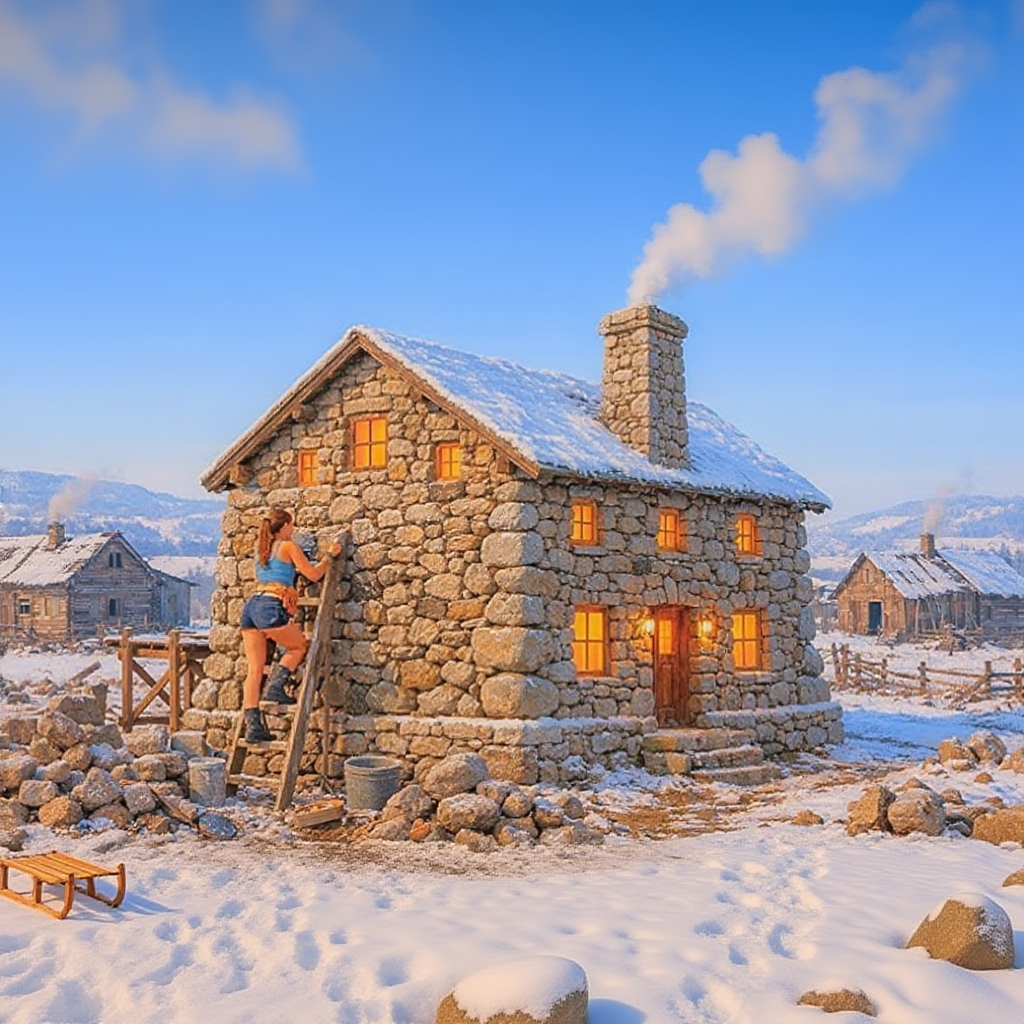
By early March, the snow began melting. The stone cabin stood solid, glowing warm in the low sun. Smoke rose lazily from the chimney.
Martha climbed the ladder one final time, adjusting stones near the roofline. She wore a blue top despite the cold, sleeves rolled slightly, working steadily.
Below, footprints crisscrossed the snow. A wooden bucket sat nearby. A small sled leaned against the wall. Scattered rocks marked where she’d last hauled them.
The valley looked peaceful—wooden cabins in the distance, mountains shining white.
Her stone cabin stood different.
Stronger.
Warmer.
She climbed down, stepping carefully onto packed snow.
Ben Carter approached, smiling. “You know, folks are copying you.”
She looked across the valley.
Indeed, small stone piles had begun appearing near other cabins.
She smiled faintly.
“Samuel would’ve liked that,” she said softly.
Ben nodded. “Seems he knew what he was doing.”
Martha turned toward the field.
Only a few scattered rocks remained.
What once looked useless now felt like a gift.
She placed her hand against the warm stone wall, sunlight heating it gently.
Winter had tried to break her.
Grief had nearly frozen her spirit.
But stone by stone, she built something stronger.
And when the next winter came, Martha Ellison slept in the warmest house in the county—built from the very rocks she once thought worthless.