
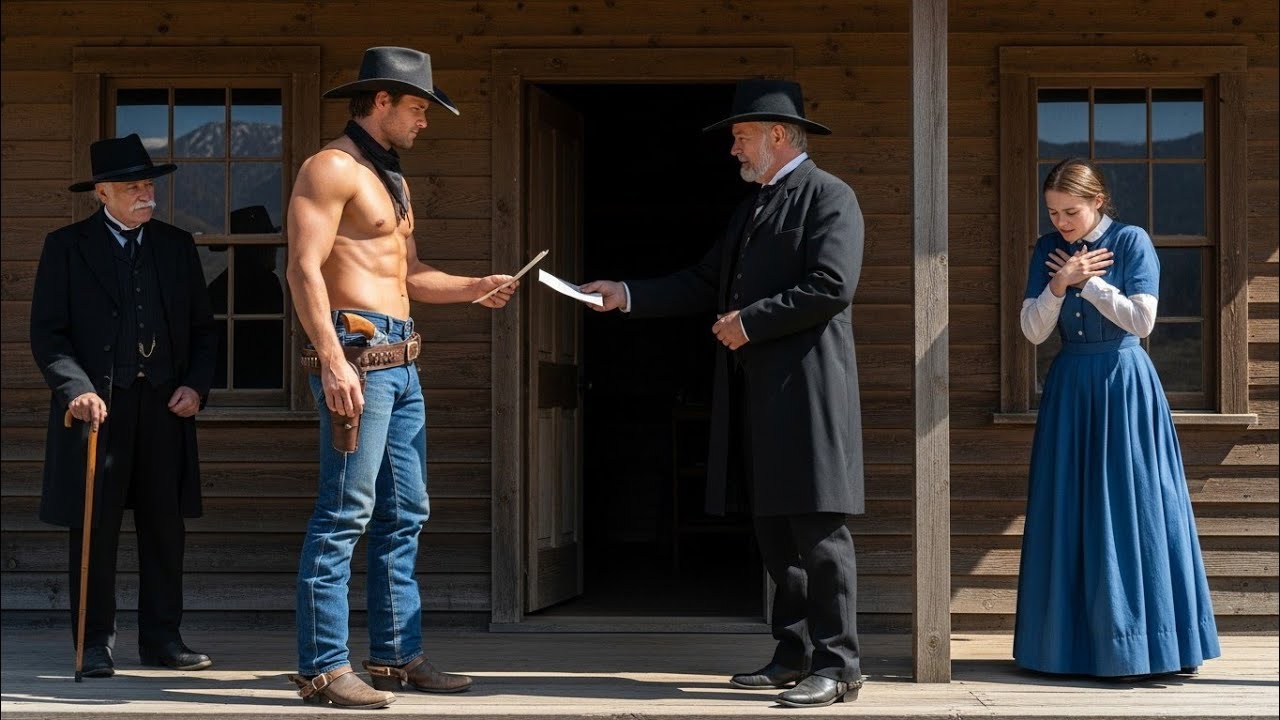
Her Family Sold Her as ‘Infertile’ But a Rancher Got Her Pregnant in Three Days—and Truly Loved Her
They said she was broken.
In the dry hills outside Amarillo, Texas, where fences leaned with the wind and gossip traveled faster than pickup trucks, word spread quickly that Emily Carter couldn’t have children. At twenty-two, that single sentence defined her more than her quiet smile, more than the calluses on her palms, more than the way she sang to the horses when she thought no one was listening.
Her stepmother had told everyone first.
“Doctor says she’s infertile,” Marlene Carter announced at the feed store, loud enough for the entire town to hear. “No man wants a barren wife.”
Emily stood two aisles away, holding a sack of oats, her chest tightening as laughter drifted toward her. She hadn’t even seen the doctor herself. Marlene had taken her years ago, after Emily fainted during hay season. The appointment lasted ten minutes. Marlene came out with a tight smile and a story that followed Emily like dust.
Her father didn’t argue. He rarely argued about anything.
Bills were stacking up. The ranch wasn’t doing well. Drought had turned their pastures into brittle gold. Cattle prices dipped. The bank called weekly.
Then one afternoon, a man named Walter Briggs came by.
He owned a small ranch two counties over and needed help—housekeeping, cooking, maybe light chores. He’d recently lost his wife. He didn’t want to hire “just anyone.”
Marlene smiled like she’d been waiting.
“You take Emily,” she said. “She’s strong. Quiet. Doesn’t cause trouble. And… well… you won’t have to worry about babies.”
Walter glanced at Emily, who stood by the doorway, frozen.
“How much?” he asked.
Emily’s stomach dropped.
Marlene named a number.
Walter nodded.
Her father looked away.
That night, Emily packed her small suitcase. Two dresses, one pair of boots, a worn Bible, and a photo of her mother who’d died when Emily was ten. No one stopped her. No one hugged her goodbye.
Walter’s truck rattled down the dirt road before sunrise.
They drove for hours. He wasn’t cruel, just quiet. Occasionally he cleared his throat, like he wanted to say something but didn’t know how.
“You’ll have your own room,” he finally said. “I don’t expect more than what we agreed.”
Emily nodded, staring out the window.
When they reached his ranch, she was surprised. It wasn’t large, but it was clean. The fences were repaired. Horses grazed peacefully. A small white house sat under a cottonwood tree.
Inside, the place felt… lived in. Not neglected.

“You hungry?” he asked.
She hesitated. “Yes, sir.”
“Don’t call me sir. Walter’s fine.”
He made scrambled eggs while she watched, unsure what to do. He placed a plate in front of her. She murmured thanks. He didn’t stare at her like others did. Didn’t ask invasive questions.
That alone felt like kindness.
The first day, she cleaned. The second, she cooked. By the third morning, she was already up before sunrise, feeding chickens. Walter found her in the barn, gently brushing a chestnut mare.
“You don’t have to do that,” he said.
“I like horses,” she replied softly.
He leaned on the stall door. “You’re good with her. She don’t trust many.”
Emily smiled faintly. “Animals don’t believe rumors.”
Walter studied her then, really studied her. “People talk too much.”
She looked down. “Yes, they do.”
They worked side by side that afternoon repairing a fence. The Texas sun hung low, warm but not punishing. Emily handed him nails, steady and precise.
“You married?” he asked carefully.
“No.”
“You ever… wanted to be?”
She shrugged. “I suppose. Not much point.”
“Why’s that?”
“You heard what they said.”
Walter wiped sweat from his brow. “I don’t believe everything I hear.”
She looked at him, surprised.
He met her gaze without embarrassment. “Doctors can be wrong. People lie. And sometimes… folks decide things about you that ain’t true.”
Her throat tightened. No one had ever said that.
That night, a storm rolled in. Thunder cracked across the sky, and rain hammered the roof. The power flickered out. Emily stepped into the hallway, unsure, and nearly collided with Walter carrying a lantern.
“You okay?” he asked.
She nodded. “Storms don’t bother me.”
“Good. But the roof in the back room leaks. You might want to move your things.”
He helped her carry her suitcase into the guest room closer to his. Lightning flashed. Thunder followed.
They sat in the kitchen, sharing coffee while rain drummed around them. Conversation came easier in the dark.
Emily told him about singing to horses. Walter told her about losing his wife to pneumonia three winters ago. Silence between them felt comfortable, not heavy.
“You’re not what I expected,” he admitted.
“What did you expect?”
“Someone… defeated.”
She gave a small smile. “I’ve had practice pretending.”
Another crack of thunder shook the house. Instinctively, she reached for the table. His hand brushed hers.
Neither pulled away.
It wasn’t sudden. It wasn’t rushed. It was two lonely people realizing they weren’t alone anymore.
He asked quietly, “Emily… are you sure… about what they said?”
She swallowed. “I don’t know. I never heard it from a doctor. Just… from my stepmother.”
He frowned. “That don’t sound right.”
She laughed softly. “Does anything about my life?”
Their hands still touched.
When he finally leaned closer, he moved slowly enough for her to stop him. She didn’t. Their first kiss was gentle, hesitant, almost unsure.
The storm outside softened.
Three days after she arrived, they sat on the porch at sunrise. Emily rested her head against his shoulder. Neither spoke. It felt natural, like something long overdue.
“I don’t want to rush you,” Walter said. “But I… I like you, Emily. More than I planned.”
She exhaled. “I like you too.”
“You don’t owe me anything. I didn’t buy—”
“I know,” she interrupted softly. “You never treated me like that.”
He nodded. “Still. I want this to be… your choice.”
“It is,” she whispered.
They grew closer in the days that followed. Working together, sharing meals, laughing over burnt biscuits. Walter built her a new shelf for her books. She stitched a tear in his favorite jacket.
Weeks passed.
Then Emily noticed she was tired. More than usual. The smell of frying bacon made her dizzy. She brushed it off. But when morning sickness came, she froze.
Her hands trembled.
It couldn’t be.
She waited another week. When her monthly cycle didn’t come, fear mixed with something fragile and bright.
Walter found her sitting on the edge of the bed, pale.
“You alright?”
She handed him the small folded paper from the clinic in town. He read it once. Then again.
Pregnant.
His eyes lifted slowly.
Emily’s voice shook. “I didn’t plan this… I didn’t even know if—”
He crossed the room in two steps and pulled her into his arms.
She stiffened. “You’re not… upset?”
He laughed softly, almost disbelieving. “Emily… I’m… I’m happy.”
Tears slipped down her cheeks. “They said I couldn’t…”
“They were wrong,” he murmured. “They were dead wrong.”
She clutched his shirt. “You don’t have to marry me. I know this changes things.”
He pulled back, holding her face gently. “It changes things because I love you.”
She blinked. “You… what?”
“I love you,” he repeated. “Didn’t expect it. Didn’t plan it. But it’s true.”
Her breath caught. “Walter…”
“I want this baby. And I want you. Not because of the baby. Because of you.”
She broke then, sobbing into his chest, years of rejection washing away.
He married her two weeks later under the cottonwood tree. No big crowd. Just the local pastor and a neighbor who brought pie. Emily wore a simple white dress Walter bought in town. He couldn’t stop smiling.
Months later, when her belly rounded and the news reached Amarillo, gossip exploded again.
Marlene arrived unannounced one afternoon, stepping out of a shiny sedan.
“I heard something ridiculous,” she snapped. Then she saw Emily, visibly pregnant.
Her mouth fell open.
“That’s impossible.”
Emily stood calmly on the porch. “Looks like it wasn’t.”
Walter stepped beside her, protective. “You got business here?”
Marlene’s eyes narrowed. “She lied to us.”
Emily shook her head. “No. You did.”
Her father remained in the car, unable to meet her eyes.
Walter placed an arm around her shoulders. “You’re not welcome here.”
Marlene sputtered, but eventually left.
Emily watched the dust trail fade, then leaned into Walter.
“You okay?” he asked.
“Yes,” she said quietly. “I think I finally am.”
Their son was born in early spring. Strong lungs, bright eyes. Walter cried when he held him. Emily laughed through tears.
They named him Daniel.
At night, Emily sat by the window rocking the baby, humming the same songs she once sang to horses. Walter often found them like that, moonlight washing the room.
“You saved me,” she told him once.
He shook his head. “No. We saved each other.”
Years later, the ranch grew. More cattle. More horses. Another child—a daughter with Emily’s eyes. The house filled with laughter.
People stopped calling her “infertile.” They called her Mrs. Walker. Mother. Rancher’s wife. Strong woman.
But Walter still called her Emily, the way he did that first stormy night.
And every time he did, she remembered the girl who arrived with a suitcase and a broken label… and the man who loved her enough to prove the world wrong in just three days.
Spring warmed the ranch, and with it came a rhythm Emily had never known before—one filled with small socks drying on the line, baby laughter echoing in the kitchen, and Walter’s boots thudding softly across wooden floors before dawn. Their son Daniel grew fast, sturdy like his father, curious like his mother. By the time he learned to walk, he followed Walter everywhere, wobbling toward the barn with determined little steps.
Emily watched them from the porch, one hand resting on her swelling belly.
Walter noticed and grinned. “You sure you’re okay doing chores?”
“I’m pregnant, not fragile,” she teased.
He shook his head. “Still. I’ll handle the heavy stuff.”
She smiled, warmth spreading in her chest. It still surprised her sometimes—how gently he treated her, how carefully he protected not just her body but her dignity. No one had ever done that before.
Their daughter arrived late that summer, during a golden sunset that painted the fields amber. Walter paced the hallway while the midwife worked. When the baby cried, loud and healthy, he nearly collapsed with relief.
“It’s a girl,” the midwife announced.
Walter entered slowly, like he was stepping into something sacred. Emily looked exhausted but radiant, the tiny bundle in her arms.
“She has your eyes,” he whispered.
Emily smiled. “And your stubborn chin.”
They named her Lily.
Life settled into a deeper happiness. Two children meant less sleep, more work, and endless chaos—but Emily thrived in it. She braided Lily’s fine hair as it grew, patched Daniel’s overalls, and filled the house with warm bread and laughter.
Yet not everyone celebrated their joy.
One afternoon, nearly two years after Emily first arrived, a black pickup rolled onto the ranch. Walter recognized it instantly.
Emily’s father stepped out alone.
Emily froze in the doorway, Lily balanced on her hip. Daniel clung to her leg.
Walter walked toward the man, jaw tight. “What do you want?”
Her father looked older. Thinner. Regret etched deep in his face. “I’d like to speak to Emily.”
Walter glanced back. Emily nodded slowly.
Her father approached cautiously, as though afraid she might disappear.
“You… you look well,” he said.
Emily’s voice remained calm. “I am.”
He looked at the children, eyes softening. “These… mine?”
“Your grandchildren,” she replied.
He swallowed. “I didn’t know… I didn’t think…”
“You didn’t ask,” she said gently, but firmly.
Silence hung between them.
“I came to say I’m sorry,” he finally whispered. “I should’ve protected you. I should’ve taken you to the doctor myself. I should’ve… stopped her.”
Emily’s grip tightened around Lily. Old wounds stirred, but they no longer bled the same way.
“You let me go,” she said. “You watched.”
“I know.” His voice cracked. “I regret it every day.”
Walter stood nearby, ready if she needed him, but he didn’t interrupt.
After a long moment, Emily stepped forward. “I can’t change what happened. But I won’t carry anger forever. You can visit… if you respect my family.”
Her father’s eyes filled. “I will.”
Daniel tugged her skirt. “Mama, who’s that?”
Emily looked down at her son. “That’s… your grandpa.”
The man knelt slowly. “Hi there.”
Daniel studied him carefully, then offered a toy horse. “He’s fast.”
The old man smiled through tears. “Thank you.”
That afternoon didn’t erase the past, but it softened it. Her father began visiting once a month. He helped mend fences, brought small gifts for the children, and slowly tried to rebuild what he’d lost.
Marlene never came again.
Years passed. Daniel turned five, then six. Lily followed close behind. The ranch prospered. Walter expanded the herd. Emily began managing accounts, discovering she had a knack for numbers.
One autumn evening, as the family sat around the table, Walter cleared his throat.
“I’ve been thinking,” he said. “We could buy the neighboring land. Double our pasture.”
Emily’s eyes widened. “That’s a big step.”
“I wouldn’t do it without you,” he replied. “This is our ranch.”
Daniel piped up, “Can we get more horses?”
Walter laughed. “That’s the idea.”
Emily looked around the table—her husband, her children, the warm light filling the room—and nodded. “Let’s do it.”
They signed the papers two weeks later.
On the day they walked the new land, Emily paused, gazing across rolling fields that now belonged to them. Wind tugged at her hair. Walter slipped his hand into hers.
“You ever think about that first day?” he asked.
“All the time,” she admitted.
“You scared me, you know. Standing there with that tiny suitcase.”
“You scared me too,” she laughed. “You were so quiet.”
“I was afraid I’d say the wrong thing.”
“You said the right things,” she whispered. “When it mattered.”
Daniel and Lily ran ahead, chasing each other through tall grass.
Emily watched them, heart full. “They told me I was broken.”
Walter squeezed her hand. “You were never broken.”
“They said no one would want me.”
“I wanted you from the start,” he said softly.
She leaned against him. “You gave me everything.”
He shook his head. “No, Emily. You gave me a family. You gave me laughter back. You gave this ranch life.”
The sun dipped lower, painting the sky gold. The children’s laughter carried on the wind.
Emily closed her eyes for a moment, remembering the girl she used to be—quiet, unwanted, labeled. Then she opened them to the life she had now—love, children, land, and a man who had chosen her without hesitation.
Three days had changed everything.
But it was the years after—built on kindness, respect, and quiet devotion—that proved their love was never about chance.
It was always meant to grow.