
He Roofed an Old Fort’s 2-Foot Stone Walls — and Never Felt the Cold Again
The first snow came early that year.
It swept down from the northern peaks in long white curtains, swallowing pine forests, stone ridges, and forgotten trails as if the mountains had decided to erase their own history.
By the time Ethan Walker crossed the final ridge, there was no trail left behind him.
Only his footprints.
And even those were disappearing.
He paused on the crest of the hill, his breath rising in silver clouds, his heavy pack pulling at his shoulders. His brown canvas jacket was crusted with frost, his blue jeans stiff with ice at the knees. Snow clung to the leather straps of his backpack.
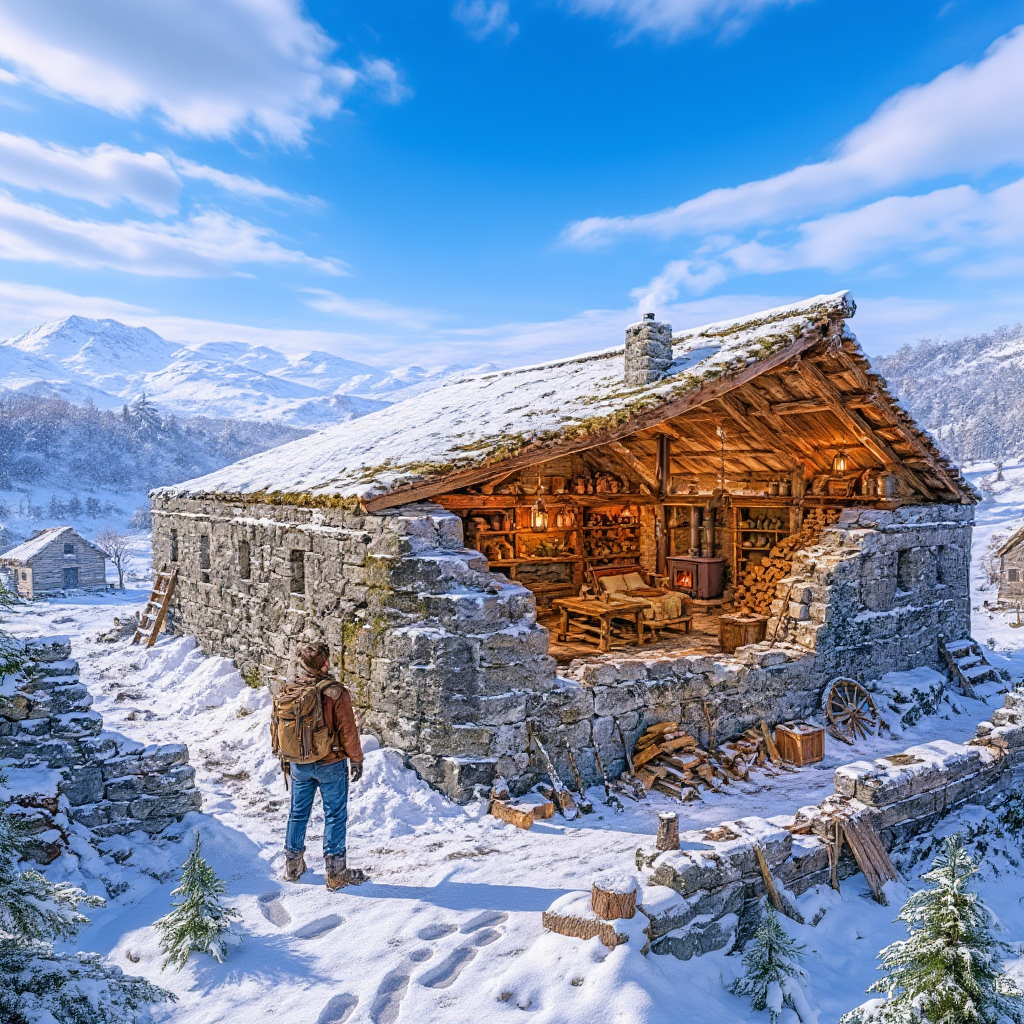
Below him, nestled in a valley of white, stood the ruin.
At first glance, it looked like the skeleton of some ancient fortress—stone walls rising from the snow like the ribs of a buried giant.
Two feet thick.
Gray.
Unmoving.
Forgotten.
Ethan lowered his binoculars and stared.
“Found you,” he whispered.
For three months he had searched the Rocky Mountain backcountry for the abandoned military outpost his grandfather once spoke of.
A stone fort built before roads reached these mountains.
A place where men survived winters that killed horses.
A place nobody could burn down.
Most people in town called it a myth.
Ethan had believed otherwise.
And now…
There it was.
Half-buried in snow.
Waiting.
The descent took nearly an hour.
By the time Ethan reached the structure, his gloves were soaked and his calves burned from fighting through drifts.
Up close, the place looked even older.
Massive stone walls stood nearly eight feet high, built from hand-cut granite blocks mortared together with something harder than cement. Moss and ice clung to the cracks.
Part of the roof had collapsed decades ago.
One side had caved inward.
Snow filled the interior like a frozen lake.
But the walls…
The walls hadn’t moved an inch.
Ethan placed a gloved hand against the stone.
Cold.
Solid.
Immortal.
He smiled.
“This’ll do.”
Two months earlier, Ethan had lost everything.
Not in a fire.
Not in an accident.
Not even in some dramatic collapse.
No.
He lost it in silence.
One bank meeting.
One stack of paperwork.
One signature.
The construction company he’d spent twelve years building—gone.
A partner he trusted had emptied the accounts and disappeared to Mexico.
Debt collectors took the trucks.
The state took the office.
The bank took the house.
At thirty-eight, Ethan Walker owned exactly what fit inside one backpack.
And somehow…
That felt cleaner.
No mortgage.
No payroll.
No meetings.
No lies.
Just mountains.
And a story his grandfather told by firelight:
If the world ever turns its back on you, find stone. Stone never leaves.
The first night inside the fort nearly killed him.
He cleared just enough snow from one corner to pitch his canvas shelter.
The wind howled through the broken roof like wolves.
Temperatures dropped below zero.
His tiny camp stove barely fought back.
By morning, ice had formed on his beard.
His water bottle was frozen solid.
And his left boot was stiff as wood.
Ethan stood in the dawn light, staring up at the ruined roof.
“That changes today.”
He spent the next week working like a man possessed.
Every morning began before sunrise.
Every night ended by lantern.
He cut pine logs from the nearby slope.
Dragged them one by one through knee-deep snow.
Trimmed them with an old hatchet.
Raised them across the stone walls like giant ribs.
By day five, a skeleton roof stretched overhead.
By day seven, he covered it in planks.
By day ten, layers of bark, clay, pine boughs, and packed snow sealed every gap.
By day twelve…
For the first time in decades…
The old fort had a roof again.
Outside, the valley remained frozen.
Inside…
Silence.
No wind.
No snow.
No screaming mountain air.
Just stillness.
Ethan stood in the center of the stone room, lantern glowing against granite walls.
He smiled.
Then laughed.
Then sat down in the middle of the floor and laughed until tears froze on his cheeks.
But shelter wasn’t enough.
Not in these mountains.
Warmth meant life.
And life meant fire.
He spent another week gathering stones from the creek.
Granite.
Slate.
River rock.
He built a stove against the north wall.
A heavy iron barrel became the firebox.
Clay sealed every seam.
A chimney rose through the new roof.
On the eighteenth night, Ethan lit the first fire.
Orange flames danced inside iron.
Smoke curled upward.
Heat spread through the room.
And something miraculous happened.
The stone walls began to change.
At first they were cold.
Then cool.
Then warm.
Then…
Radiant.
The two-foot granite absorbed the fire’s heat like giant batteries.
Holding it.
Saving it.
Returning it slowly.
Hour after hour.
Long after the fire burned low.
Long after midnight.
Long after the mountain outside dropped to twenty below.
The walls stayed warm.
Ethan touched the stone and stared.
“My God.”
He understood then.
The soldiers who built this place hadn’t just built walls.
They’d built survival.
Two feet of granite.
Thousands of pounds of thermal mass.
A roof low enough to trap heat.
A fire centered perfectly.
No drafts.
No wasted warmth.
No modern insulation.
Just intelligence.
And stone.
He wasn’t repairing a ruin.
He was learning from masters.
By Christmas, Ethan had transformed the fort.
The interior glowed with golden lantern light.
Wooden shelves lined the walls.
Jars of dried venison, beans, rice, and berries filled every corner.
A heavy pine table stood near the stove.
Books.
Maps.
Tools.
A rocking chair.
A wool blanket.
And a bed built against the warmest wall.
The stone behind it stayed warm all night.
He no longer woke shivering.
He no longer saw ice in his breath.
He no longer counted firewood with fear.
For the first time in years…
Ethan slept.
Really slept.
Then the blizzard came.
Locals later called it The White Week.
Winds over eighty miles per hour.
Snowdrifts higher than pickup trucks.
Temperatures below thirty.
Cabins collapsed.
Roads vanished.
Power lines snapped.
Even town generators failed.
For seven days, the mountains disappeared.
And Ethan Walker sat inside an old stone fort…
Drinking coffee.
Reading.
Feeding the fire twice a day.
Listening to wind pound uselessly against two-foot walls.
The roof never shifted.
The chimney never failed.
The walls never cooled.
Not once.
Not for a second.
Outside, winter declared war.
Inside…
Stone won.
On the eighth day, the sky cleared.
Blue.
Bright.
Silent.
Ethan opened the heavy timber door.
Snow stood nearly six feet high.
The valley looked untouched.
As if civilization had never existed.
He stepped outside.
Boots crunching.
Breath steaming.
And then he saw movement below.
A snowmobile.
Then another.
Three figures climbing toward him.
By noon, the sheriff stood in front of Ethan’s fort, speechless.
Sheriff Daniel Harper had known Ethan since high school.
He stared at the roof.
The chimney.
The smoke rising peacefully.
Then at the stone walls.
“Walker…”
Ethan grinned.
“Morning.”
Daniel shook his head.
“We thought you were dead.”
Ethan shrugged.
“Been warmer than town.”
Daniel laughed.
Then stopped.
“You serious?”
Ethan opened the door.
Heat rolled out into the freezing air.
The deputies behind Daniel stepped closer.
Eyes widening.
One of them whispered:
“Holy hell.”
By nightfall, all three men sat around Ethan’s stove drinking coffee from tin cups.
Snow melted from their boots.
Steam rose from their jackets.
And nobody wanted to leave.
Daniel ran his hand along the warm granite wall.
“This stone’s warm.”
Ethan nodded.
“Been warm for four days.”
“That’s impossible.”
Ethan smiled.
“No.”
He tapped the granite.
“It’s old.”
Word spread.
By spring, hikers came to see the stone fort.
Builders came to study it.
Historians came to document it.
Some called it a restoration.
Some called it survival architecture.
One magazine called it:
The Warmest Ruin in America.
Ethan hated the title.
But he liked what came next.
People listened.
They wanted to learn.
How stone held heat.
How old designs beat modern shortcuts.
How simplicity outlived convenience.
And Ethan taught them.
Not as a businessman.
Not as a contractor.
Not as a man chasing money.
But as someone who had lost everything…
…and found something stronger.
Years later, children visiting the mountains would point at the smoke rising from the valley and ask:
“Who lives down there?”
And their parents would smile.
“The man who roofed an old fort.”
“Why?”
The parents would look toward the mountains.
Toward stone.
Toward smoke.
Toward survival.
And answer:
“Because once he found walls that never gave up…”
“…he never felt cold again.”