
He Inherited an Abandoned Mansion — Until He Found a Staircase Hidden Behind the Wall
When Daniel Harper received the letter, he assumed it was a mistake.
The envelope was thick, cream-colored, and addressed in careful ink. Inside was a short message from a law office in Vermont informing him that he had inherited property from a distant relative he barely remembered: Eleanor Whitmore.
Daniel read the letter twice.
He had met Eleanor once when he was eight years old. She had been tall, stern, and silent, handing him a peppermint before disappearing into another room. After that, nothing—no visits, no calls, no cards. He hadn’t even known she was still alive.
Now she had left him a mansion.
The lawyer’s note included an address and a request that he visit as soon as possible.
Daniel almost ignored it. He lived in Ohio, worked long hours repairing HVAC systems, and barely had time for anything else. But curiosity gnawed at him. A week later, he took two days off, packed a small bag, and drove north.
The road narrowed as he approached the address. Trees crowded the shoulders, branches arching overhead like ribs. The GPS finally chirped, and he turned onto a gravel drive barely visible beneath fallen leaves.
The mansion appeared slowly.
It stood on a hill, three stories tall, wrapped in ivy and silence. Its windows were dark, its porch sagging, its paint peeled down to gray wood. One wing looked older than the rest, as if it had been expanded over decades. A rusted iron gate leaned open behind him, creaking in the wind.
Daniel stepped out of his truck and stared.
This wasn’t a house.
It was a forgotten world.
The lawyer met him at the front steps—a thin man named Caldwell who carried a folder and a polite smile.
“She left everything to you,” Caldwell explained as they walked inside. “No other heirs. Taxes are paid through the end of the year.”
The front door groaned open. Dust floated in the air. The foyer stretched wide, with a curved staircase leading up to a balcony. A chandelier hung overhead, coated in cobwebs. Furniture sat under white sheets like sleeping ghosts.
Daniel let out a low whistle.
“You said abandoned,” he murmured.
“It has been empty nearly fifteen years,” Caldwell replied.
They toured quickly—parlor, dining room, library, kitchen. The house felt larger with every turn. Hallways branched into other hallways. Doors led to rooms he barely had time to register.
“Utilities?” Daniel asked.
“Disconnected.”
“Structural problems?”
“Roof leaks in the west wing. Otherwise… surprisingly sound.”
Daniel walked slowly through the library last. Floor-to-ceiling shelves lined the walls, most still filled with books. A fireplace sat cold at the far end. Something about the room felt different—quieter, heavier.
“You’ll need to decide whether to keep or sell,” Caldwell said gently.
Daniel nodded but didn’t answer.
He was still looking at the walls.
He stayed the night in his truck.
The house felt too silent, too unfamiliar. But the next morning, he stepped inside again with a flashlight and determination. He started cleaning—opening curtains, sweeping floors, dragging sheets off furniture.
By afternoon, sunlight filled the foyer.
By evening, he had chosen a small bedroom upstairs as a temporary space. He brought in a camping stove, a lantern, and blankets. The mansion creaked around him like it was remembering how to breathe.
Over the next three days, Daniel worked steadily. He repaired a broken window, cleared debris from the porch, and explored rooms one by one. The house revealed itself slowly—old portraits, carved banisters, hidden cupboards.
Still, the library bothered him.
He couldn’t explain why.
On the fourth day, he returned to it with a broom. Dust coated everything, but one section of wall seemed cleaner—just slightly. The shelves there held fewer books, and the floor beneath looked faintly scuffed.
Daniel frowned.
He knocked on the wall.
Solid.
He moved a chair and climbed up, removing the books carefully. Behind them, the wood paneling looked seamless—except for a hairline gap running vertically near the edge.
His pulse quickened.
He pressed the panel.
Nothing.
He pushed harder.
Still nothing.
Then his hand brushed something small—a metal ridge hidden inside the trim. He pressed it instinctively.
A soft click echoed.
The panel shifted inward.
Daniel stepped back.
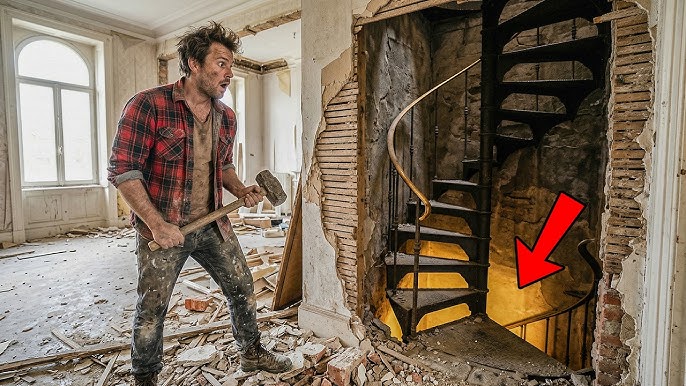
Slowly, the wall swung open, revealing darkness beyond.
A narrow staircase descended into shadow.
He stared, heart pounding.
The air smelled old—dry wood, faint earth. He grabbed his flashlight and hesitated. Every instinct told him to close it and call someone. But curiosity won.
He stepped inside.
The staircase creaked under his weight. Dust covered the steps, undisturbed for years. The beam of his flashlight cut through the dark, illuminating stone walls instead of wood.
The stairs turned once, then again.
Finally, they ended at a small landing.
Daniel reached the bottom and swept the light across the space.
It wasn’t a basement.
It was a hidden level.
The room stretched wider than he expected, with a low ceiling supported by thick beams. Shelves lined one wall. A desk sat in the corner. Everything was covered in dust but intact.
He exhaled slowly.
“What were you hiding?” he whispered.
He moved forward carefully. The shelves held ledgers, rolled maps, and small wooden boxes. The desk contained drawers—locked, but brittle with age. On the far wall, another door stood half-open.
Daniel pushed it gently.
Inside was a narrow corridor leading to three small rooms. One held stacks of trunks. Another contained tools—old but well-kept. The third looked like a sleeping area: a narrow cot, blankets folded neatly, and a lantern sitting beside it.
Someone had lived here.
Recently? No. The dust was thick. But everything looked prepared, as if the occupant expected to return.
Daniel felt a chill unrelated to the temperature.
He returned to the main room and opened one of the ledgers. Handwritten entries filled the pages—dates, numbers, notes. The handwriting looked elegant, precise.
Eleanor Whitmore.
He recognized the signature from the letter.
She had used this place.
But why?
Daniel explored for nearly an hour, cataloging what he saw. Nothing dangerous—just mysterious. The final discovery came when he opened a small metal box on the desk.
Inside lay photographs.
Black-and-white images of the mansion from decades earlier. Workers repairing the roof. A younger Eleanor standing near the woods. And one photo that made him pause:
The library wall—open.
The staircase visible.
Someone had built this intentionally.
Daniel climbed back upstairs slowly, mind racing. The hidden space changed everything. This wasn’t just an old mansion—it was designed with secrets.
He closed the panel carefully. The wall slid back into place, hiding the staircase completely.
The house felt different now.
Like it was watching him.
That night, wind rattled the windows. Daniel lay awake in his upstairs room, replaying what he’d found. Why would Eleanor hide an entire level? Storage? Safety? Something else?
He decided to return the next morning with better light.
But when he entered the library at dawn, he noticed something strange.
The panel looked slightly ajar.
He was certain he had closed it.
Daniel stepped closer, pulse rising. He pushed gently. The panel swung open easily, revealing the staircase again.
Cold air drifted upward.
He grabbed his flashlight and descended.
The room looked unchanged—dust undisturbed, objects where he left them. But one thing was different.
The lantern in the sleeping room had moved.
It now sat upright, not tilted as before.
Daniel froze.
Had he moved it? Maybe. He wasn’t sure.
He forced himself to stay calm. Old houses shifted. Memory played tricks.
Still, he checked every corner carefully.
Nothing else seemed different.
He climbed back up slowly, uneasy.
For the rest of the day, he worked outside, trying to shake the feeling. But the hidden staircase lingered in his thoughts. By evening, he returned again—almost against his will.
This time, he brought a notebook.
He documented everything: layout, items, measurements. As he sketched the corridor, he noticed something subtle—the far wall didn’t align with the house above.
Meaning…
There might be more.
He tapped the stone carefully.
One section sounded hollow.
Daniel’s heart pounded.
He pushed.
Nothing.
He searched along the edges until his fingers found a small indentation. He pressed.
Another click.
The stone panel slid sideways.
Beyond it, a second staircase descended even deeper.
Daniel stared into the darkness.
The mansion, it seemed, wasn’t finished revealing its secrets.
Part 2 — He Inherited an Abandoned Mansion — Until He Found a Staircase Hidden Behind the Wall
Daniel didn’t move for a long time.
The second staircase yawned beneath him, narrower than the first, its stone steps worn smooth by time. Cold air drifted upward—older somehow, heavier, carrying the scent of earth and something faintly metallic.
He almost turned back.
Instead, he tightened his grip on the flashlight and began to descend.
The steps spiraled tighter than before. The ceiling lowered enough that he had to duck slightly. Dust coated everything, but here and there he noticed faint disturbances—like something had shifted long ago and settled again.
The beam of his flashlight reached the bottom.
He stepped onto packed dirt.
This level was different. No finished beams, no tidy shelves. The walls were stone, rough-cut and uneven, as if carved directly into the hillside. The ceiling arched slightly, supported by thick wooden braces darkened with age.
A narrow tunnel extended forward.
Daniel swallowed.
“Okay,” he muttered quietly. “You inherited a mansion with a tunnel. Sure.”
He walked slowly, each step echoing softly. The tunnel opened into a circular chamber about fifteen feet wide. At its center stood a heavy wooden table, scarred and faded. Around the edges sat crates—old, iron-bound, stacked two high.
He approached the nearest one and brushed away dust.
Whitmore & Co. — 1932
He frowned. He’d seen the name in the ledgers upstairs. Eleanor’s family, perhaps.
He pried open the lid carefully. The hinges groaned, then gave way.
Inside lay stacks of cloth-wrapped bundles.
He opened one.
Documents.
Deeds. Letters. Bank slips. Newspaper clippings.
Daniel scanned a headline:
LOCAL BANK FAILS — DEPOSITS LOST
Another:
FARMERS PROTEST FORECLOSURES
He flipped through more pages. Dates from the 1930s. Notes in the margins. Numbers circled. Names underlined.
This wasn’t random storage.
This was a record.
He moved to the table. A large map lay rolled across it, held down by a brass weight. He unrolled it carefully.
The surrounding valley.
Properties marked in pencil.
Some circled. Some crossed out.
One symbol repeated—a small triangle.
He leaned closer.
The triangle marked locations… including the mansion itself.
Daniel felt his pulse rise again.
He turned when something caught his eye—a narrow archway beyond the crates. He stepped through and found a smaller room carved deeper into the earth.
This one was different.
Cleaner.
More deliberate.
Shelves lined the wall, holding metal boxes. A lantern hung from a hook, long extinguished. A wooden chair sat beside a small desk.
And on the desk—another ledger.
He opened it carefully.
The handwriting looked older than Eleanor’s, but similar—perhaps her father or grandfather.
The first page read:
Emergency Storage — Not to be revealed.
Daniel exhaled slowly.
He flipped pages.
Entries described deliveries, dates, quantities. Food, fuel, documents. The notes hinted at preparation—fear of economic collapse, distrust of banks, plans to protect assets.
This hidden level wasn’t just a secret.
It was a safeguard.
He closed the ledger and leaned back.
The Whitmore family had built a hidden archive beneath their own mansion—insurance against uncertain times. The first staircase led to a working room. The second led to deeper storage.
He almost smiled.
Then he noticed something else.
Footprints.
Faint—but real.
Not fresh. Dust partially filled them. But they weren’t his.
Daniel crouched.
The prints were smaller than his boots, narrow, pointed slightly inward. They led from the tunnel into the chamber… then toward the crates.
His stomach tightened.
Someone else had been here.
Not recently—but after the dust settled.
He followed the prints slowly. They stopped near one crate that had been shifted slightly. He opened it.
Inside were empty spaces where bundles should have been.
Daniel stood very still.
Something had been removed.
He scanned the room again. The air felt colder now—not physically, but in his mind. The hidden space suddenly seemed less abandoned.
He backed away slowly and returned to the staircase.
The climb up felt longer. When he reached the library, sunlight streaming through the windows felt almost blinding.
He closed the panel carefully.
The mansion seemed quieter than before.
That afternoon, Daniel drove into town for the first time. The nearest place—Ashbury—sat ten miles away, a small cluster of buildings and a diner. He ordered coffee and asked casually:
“You ever hear of the Whitmore family?”
The waitress paused.
“Old mansion on the hill?”
“Yeah.”
“Been empty a long time.”
“Anyone ever go there?”
She shrugged. “Teenagers, maybe. Not in years.”
An older man at the counter turned.
“You inherited it?” he asked.
Daniel nodded.
The man studied him. “Eleanor Whitmore was… private. Kept to herself. Folks said she stored things. Never trusted banks.”
Daniel nodded slowly.
“Anyone visit her before she died?” he asked.
The man shook his head. “Not that I know of. Why?”
Daniel hesitated.
“Just curious.”
He finished his coffee and left, unease lingering.
Back at the mansion, he returned to the library at dusk.
The panel opened smoothly. He descended again, flashlight steady. The rooms looked unchanged—but he checked everything carefully.
The footprints remained.
The missing bundles remained missing.
He examined the map again. The triangles—there were several beyond the mansion. Properties across the valley.
He traced one with his finger.
Another hidden place?
Daniel leaned back, mind racing.
The Whitmores hadn’t just built one secret.
They had built a network.
He carefully rolled the map and carried it upstairs. The mansion creaked softly as night settled. He spread the map across the dining table and studied it under lantern light.
Six locations.
All within fifteen miles.
All marked decades ago.
He felt the thrill of discovery mix with unease.
What else had been hidden?
And who had taken those missing bundles?
Wind brushed the windows. The house groaned gently.
Daniel folded the map slowly.
The inheritance wasn’t just a mansion anymore.
It was a puzzle.
And somewhere beneath its walls, behind hidden staircases and silent tunnels, the past was still waiting to be uncovered.