
He Inherited A Lonely Ranch After His Father’s Death — Then A Native Woman Changed Everything
The wind never stopped on Blackridge Ranch.
It rolled down from the distant mountains like something alive—cold in the mornings, restless in the afternoons, and hollow at night. It carried dust through broken fence lines, whispered through dry grass, and rattled the loose tin roof of the old barn like a warning no one had listened to in years.
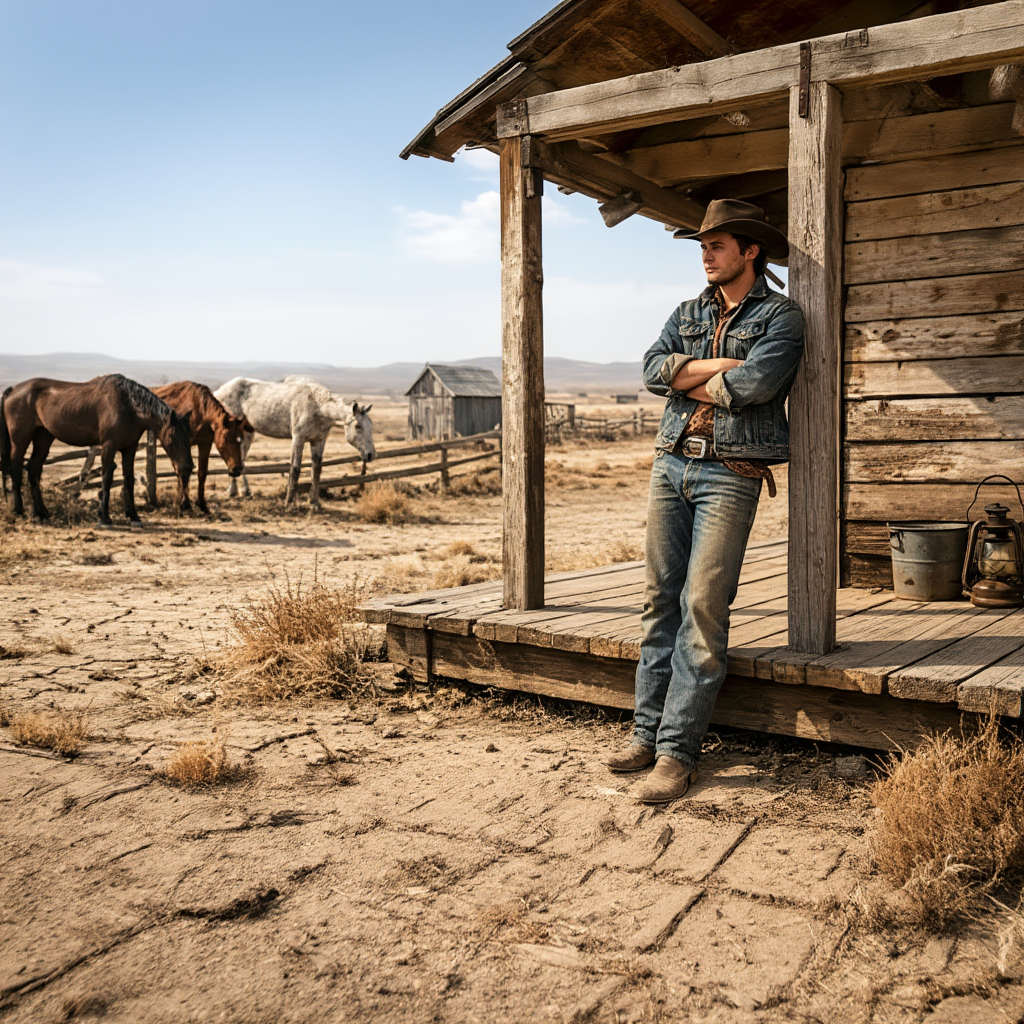
Daniel Mercer stood on the porch the day he arrived, his boots still too clean for the land beneath him. The key to the front door hung loosely in his hand, cold and heavier than it should’ve been. His father had died three weeks ago, and this—this silent, forgotten stretch of land in Wyoming—was what remained.
No goodbye worth remembering. No final advice. Just a will, a name, and a place Daniel hadn’t set foot in since he was sixteen.
“I don’t belong here,” he muttered to himself.
The ranch didn’t answer.
It never did.
Inside, the house smelled like dust and old wood. The furniture hadn’t moved in years. A coffee cup still sat on the table, stained dark at the bottom as if his father had just stepped outside and forgotten to come back.
Daniel swallowed.
He had left this place the first chance he got—joined the army, built a life in cities where things moved, where people talked, where silence didn’t sit on your chest like a weight.
And now he was back.
Because there was nowhere else to go.
The first week was nothing but work.
Fences needed repair. The well pump groaned like it might give out any second. Half the cattle had wandered off or died, and the rest looked like they were waiting for the same fate.
Neighbors?
There weren’t any close enough to matter.
Blackridge Ranch sat on the edge of reservation land, miles from the nearest town. Growing up, Daniel had been warned not to wander too far east.
“Stay on our side,” his father used to say. “Nothing good comes from crossing that line.”
Daniel had believed him back then.
Now, standing alone with cracked hands and a back that ached by sunset, he started to wonder if his father had been wrong about more than just that.
He saw her for the first time at dusk.
Daniel had been fixing a section of broken fence when he felt it—that strange, quiet shift in the air, like being watched.
He turned slowly.
At the far edge of the field, near the tree line, stood a woman.
She didn’t move.
Long dark hair fell over her shoulders, stirred gently by the wind. She wore simple clothes—worn, but clean—and stood with a stillness that felt deliberate, like she belonged more to the land than to the moment.
Daniel raised a hand slightly.
“Hey!”
No answer.
Just her eyes on him.
Then, as quietly as she had appeared, she turned and disappeared into the trees.
Daniel exhaled slowly.
“Great,” he muttered. “I’m already seeing things.”
But he knew he hadn’t imagined her.
She came back the next day.
And the next.
Always at a distance. Always silent.
Watching.
By the fourth day, Daniel had had enough.
“Alright!” he called out, stepping toward her. “You gonna keep doing this, or are you gonna say something?”
She didn’t run this time.
Didn’t disappear.
Instead, she waited.
And when Daniel finally got close enough to see her clearly, he realized something that stopped him mid-step.
Her expression wasn’t curious.
It was… sad.
“You’re standing on our land,” she said quietly.
Her voice was calm, steady, but carried something deeper—like history pressed into every word.
Daniel frowned. “This is my ranch.”
She shook her head slightly. “It was taken. A long time ago.”
He hesitated.
“I inherited it from my father,” he said, a bit more defensively than he intended.
“I know who your father was.”
Something in her tone made his chest tighten.
“I’m not him,” Daniel said.
She studied him for a moment, as if weighing that statement.
“I know,” she replied softly.
Her name was Aiyana.
She lived on the reservation just beyond the eastern ridge. She didn’t explain why she kept coming, not at first. And Daniel didn’t ask.
Not because he wasn’t curious—but because something about her made questions feel… unnecessary.
Days passed.
Then weeks.
And slowly, something began to change.
It started small.
Aiyana showed him where the land still held water beneath the dry surface.
“You’re digging in the wrong place,” she told him one morning, watching him struggle with the well.
Daniel wiped sweat from his brow. “Oh yeah? And you just know where to dig?”
She nodded once.
He didn’t believe her.
Not until he tried.
And struck water.
Then there was the cattle.
“You’re feeding them wrong,” she said, crouching near a thin calf one afternoon.
Daniel sighed. “Let me guess—you know a better way.”
“I do.”
He folded his arms. “Alright. Show me.”
She did.
And within days, the animals started to recover.
Daniel didn’t say it out loud, but he began to rely on her.
Not just for the ranch—but for the quiet.
The kind that didn’t feel empty.
One evening, as the sun bled orange across the horizon, they sat on the porch together.
“You hated him,” Daniel said suddenly.
Aiyana didn’t look at him. “Your father?”
He nodded.
She was quiet for a long moment.
“Yes.”
Daniel swallowed. “Why?”
She finally turned her gaze toward him.
“Because he knew,” she said.
“Knew what?”
“That this land wasn’t his.”
The words hit harder than Daniel expected.
“He fought my people when they tried to reclaim it. He threatened families. Took more than he needed.”
Daniel looked down at his hands.
“I didn’t know,” he said quietly.
“I believe you.”
That surprised him.
“You do?”
Aiyana nodded. “You listen.”
The wind shifted that night.
For the first time since he’d returned, it didn’t feel like something pushing him away.
It felt… different.
Weeks turned into months.
The ranch began to heal.
So did Daniel.
And somewhere along the way, Aiyana stopped standing at a distance.
She walked beside him instead.
But peace doesn’t last forever.
It rarely does.
The men came just after sunrise.
Three trucks. Loud. Out of place.
Daniel stepped out of the house, tension already building in his chest.
Aiyana stood beside him.
“You know them?” he asked.
Her jaw tightened.
“Yes.”
The men got out slowly, boots crunching against gravel. Their leader—a broad-shouldered man with a sharp smile—looked around like he already owned the place.
“Well,” he said. “This is it.”
Daniel stepped forward. “Can I help you?”
The man’s eyes flicked to Aiyana, then back to Daniel.
“You must be the son.”
Daniel didn’t like the way he said it.
“Who are you?”
“Name’s Carter,” the man replied. “And this land? It’s about to change hands.”
Daniel frowned. “Not happening.”
Carter smiled wider.
“You might want to check your paperwork.”
By noon, Daniel had.
And his stomach dropped.
A clause. Buried deep. A debt his father had taken—and never paid.
The ranch wasn’t fully his.
Not anymore.
“They’ll take everything,” Daniel said, pacing the porch.
Aiyana stood still.
“No,” she said quietly.
He stopped. “You don’t understand—”
“I do.”
Her eyes met his.
“This land was never meant to belong to men like them.”
Daniel let out a bitter laugh. “Yeah? And what am I supposed to do? Fight them off?”
Aiyana stepped closer.
“No,” she said.
“Trust me.”
That night, under a sky thick with stars, Aiyana led him east.
Beyond the ridge.
Onto land Daniel had never dared to walk before.
They reached a circle of stones.
Old. Worn. Sacred.
“What is this?” Daniel whispered.
“A place of truth,” Aiyana said.
She turned to him.
“If you want to save your ranch… you have to understand what it really is.”
The wind fell silent.
For the first time in his life, Daniel heard nothing.
No past.
No doubt.
Just the steady beat of his own heart.
And in that silence…
He understood.
The next morning, when Carter returned, Daniel was waiting.
But he wasn’t alone.
Aiyana stood beside him.
And behind her—
Dozens more.
Men. Women. Elders.
Watching.
Present.
Unyielding.
“This land,” Daniel said, voice steady, “was taken. And I won’t be part of that anymore.”
Carter scoffed. “You don’t have a choice.”
Daniel shook his head.
“I do.”
He held out the deed.
“I’m giving it back.”
Silence.
Then—
Something shifted.
Carter’s smile faded.
Because for the first time—
He wasn’t the one in control.
Weeks later, the trucks were gone.
The threats stopped.
And Blackridge Ranch…
Was no longer Blackridge Ranch.
It had a new name now.
One Daniel couldn’t pronounce perfectly yet.
But he was learning.
He stood on the porch again one evening, watching the wind roll across the land.
Only now…
It didn’t feel lonely.
Aiyana stepped beside him.
“You stayed,” she said.
Daniel smiled slightly.
“Yeah,” he replied.
“I guess I finally found where I belong.”
The wind whispered through the fields.
Not as a warning.
But as a welcome.
He Inherited A Lonely Ranch After His Father’s Death — Then A Native Woman Changed Everything
Part 2
The first snowfall came earlier than expected.
Daniel noticed it before dawn—the way the air had shifted overnight, heavier, quieter. When he stepped outside, the world had softened under a thin layer of white, the land no longer sharp and unforgiving, but hushed… almost patient.
He stood on the porch, hands tucked into his jacket, watching as flakes continued to fall.
Behind him, the house felt different now.
Lived in.
Not by ownership—but by purpose.
Aiyana stepped out a moment later, wrapping a woven blanket around her shoulders. She didn’t say anything at first. She just stood beside him, as she often did, sharing the silence rather than filling it.
“It’s going to be a hard winter,” Daniel said.
Aiyana nodded slightly. “It always is.”
He glanced at her. “You sound like that doesn’t worry you.”
“It doesn’t,” she replied. “Not the way it used to.”
Daniel exhaled slowly. “Because of the people?”
She shook her head once.
“Because of you.”
That caught him off guard.
He turned toward her, brow furrowed. “I haven’t done anything special.”
Aiyana looked out over the snow-covered land. “You chose to stay,” she said. “Most wouldn’t have.”
Daniel thought about that.
She wasn’t wrong.
Even now, part of him still felt like a stranger here. But it wasn’t the same kind of distance anymore. It wasn’t the land pushing him away—it was something he was still learning to step into.
The ranch—no, the land—had changed in more ways than one.
After Daniel handed over the deed, the tribal council had met for days. There were long conversations, some heated, some quiet, but all necessary.
In the end, they made a decision that surprised him.
They didn’t ask him to leave.
Instead, they asked him to stay.
Not as an owner.
But as a steward.
“You know the work,” one of the elders had told him. “And more importantly—you’re willing to listen.”
Daniel had agreed, though the weight of that trust still sat heavily on his shoulders.
Now, the land belonged to the people again.
And for the first time in a long time, it was beginning to breathe.
Winter settled in quickly after that.
Snow piled along fence lines. The wind returned—not harsh, but constant. The kind that reminded you that survival here wasn’t guaranteed.
But Daniel wasn’t alone anymore.
Every few days, members of the community came by. Some helped reinforce the barn. Others brought supplies—dried meat, blankets, tools.
In return, Daniel worked alongside them.
Fixing.
Building.
Learning.
It wasn’t easy.
One morning, before the sun had fully risen, Daniel found himself struggling to free a frozen gate. His gloves were soaked through, fingers numb as he pulled against the ice.
“Stop,” Aiyana’s voice came from behind him.
He turned, breath fogging in the cold. “It’s stuck.”
“I can see that.”
She stepped closer, crouching near the hinge. For a moment, she didn’t move—just observed.
Then she reached down, brushing snow away, revealing the metal beneath.
“Water freezes here first,” she said. “Because of the way the wind hits the barn.”
Daniel frowned. “So what do I do?”
She looked up at him. “You prepare before it happens.”
He let out a quiet laugh. “Helpful.”
Aiyana’s lips curved slightly, almost a smile.
Then she stood and handed him a small container.
“Oil,” she said. “Next time, use it before the storm.”
Daniel took it, shaking his head. “You always make it sound so simple.”
“It is simple,” she replied.
He raised an eyebrow. “Then why didn’t I figure it out?”
Aiyana met his gaze.
“Because you were taught to fight the land,” she said. “Not understand it.”
That stayed with him.
More than he expected.
Days grew shorter.
Nights longer.
And with the cold came stories.
One evening, after a long day of work, Daniel sat inside the main house with several members of the community. A fire crackled in the hearth, casting warm light against the wooden walls.
An elder named Thomas sat across from him, hands folded over a carved walking stick.
“You carry your father’s face,” Thomas said suddenly.
Daniel shifted slightly. “I’ve been told that.”
Thomas studied him for a moment. “But not his spirit.”
Daniel wasn’t sure how to respond to that.
“I don’t know what his spirit was,” he admitted.
Aiyana, sitting beside him, spoke softly.
“It was heavy,” she said.
The room fell quiet.
Thomas nodded once. “He was a man shaped by fear,” he added. “And fear makes people hold tighter than they should.”
Daniel stared into the fire.
“I don’t want to be like that,” he said.
Aiyana’s voice came gently beside him.
“You’re not.”
Outside, the wind howled.
But inside…
There was warmth.
As winter deepened, so did something else Daniel hadn’t expected.
Belonging.
It didn’t come all at once.
It showed up in small moments.
In shared meals.
In quiet nods of acknowledgment.
In the way people began to greet him not as a stranger—but as someone who was… part of things.
And in Aiyana.
One night, as the storm raged harder than usual, Daniel found her standing alone near the edge of the field, staring out into the darkness.
“You’re going to freeze out here,” he called, walking toward her.
“I won’t,” she replied.
He stopped beside her, pulling his jacket tighter. “What are you looking at?”
“The storm,” she said.
Daniel squinted. “I don’t see anything but snow.”
Aiyana smiled faintly. “Exactly.”
He glanced at her. “You always talk like there’s something deeper going on.”
“There usually is.”
Daniel hesitated.
Then, more quietly, he asked, “Why did you keep coming back? Before… all this.”
Aiyana didn’t answer right away.
The wind howled between them, carrying snow in sharp bursts.
Finally, she spoke.
“Because I saw something in you.”
Daniel let out a small breath. “You barely knew me.”
“I didn’t need to,” she said.
He looked at her, confused. “Then what did you see?”
Aiyana turned, meeting his eyes fully.
“Someone who didn’t belong to the past,” she said.
The words settled deep.
Spring felt impossibly far away.
But slowly…
The days began to change.
The snow softened.
The wind eased.
And beneath the frozen ground, life waited.
One morning, Daniel woke before sunrise and stepped outside.
The air was different.
Warmer.
Just enough.
He walked out toward the fields, boots crunching lightly against the thinning frost.
And then he saw it.
A single patch of green.
Small.
Fragile.
But alive.
He crouched beside it, staring.
After everything—the cold, the storms, the silence…
It had survived.
“You found it.”
Aiyana’s voice came softly from behind him.
Daniel smiled without turning. “Yeah.”
She stepped beside him, looking down at the small sprout.
“This is how it begins,” she said.
Daniel nodded.
“I think I’m starting to understand that.”
He stood, brushing dirt from his hands.
Then looked out over the land.
Not as something to own.
Not as something to conquer.
But as something to be part of.
“Aiyana,” he said.
She looked at him.
“I’m glad you came back,” he added.
Her expression softened.
“I never left,” she replied.
The wind moved gently across the fields.
No longer cold.
No longer empty.
And for the first time in his life—
Daniel Mercer didn’t feel like he was standing alone.