
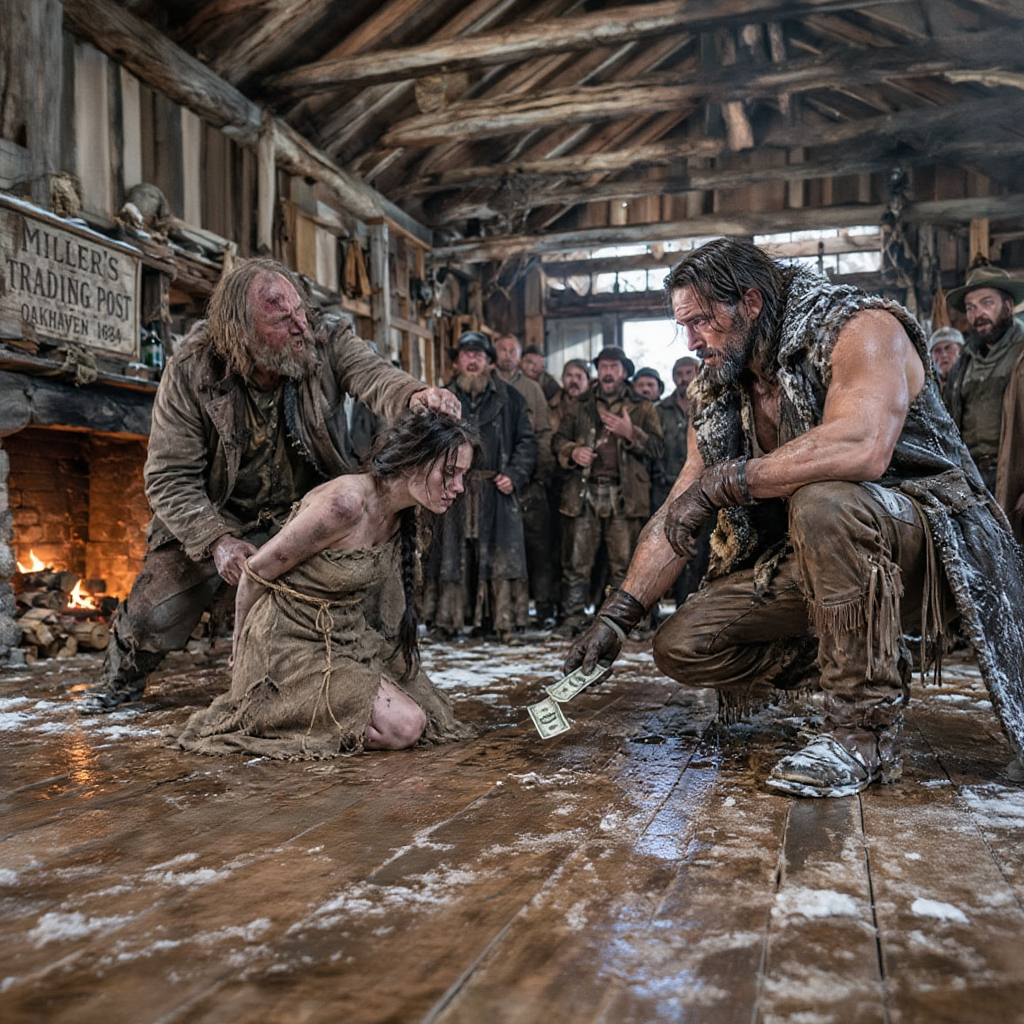
He Bought a Girl for $20… But What She Asked Next Broke the Mountain Man’s Heart
The crowd gathered around the fireplace like wolves around fresh meat.
Inside Miller’s Trading Post, entertainment was scarce during winter.
That afternoon, the entertainment happened to be a girl.
She knelt in the center of the room.
Her wrists bound.
Her face bruised.
Her clothes torn.
The men surrounding her laughed and argued over what she was worth.
Twenty dollars.
Fifteen.
Ten.
A bottle of whiskey.
Nobody asked her name.
Nobody cared.
Then the door opened.
Cold wind rushed inside.
Standing in the entrance was Elijah Walker.
A giant mountain trapper known throughout the Rockies.
His beard reached his chest.
His arms looked like tree trunks.
A scar crossed one side of his face.
Most people avoided him.
Not because he was cruel.
Because he looked like a man who had survived things nobody should survive.
Elijah immediately noticed the girl.
“What happened here?”
A trader grinned.
“Simple sale.”
“Sale?”
The man shrugged.
“Girl’s got no family left. Somebody’s gotta feed her.”
Elijah studied the young woman.
Unlike the others, she didn’t look angry.
She looked defeated.
As if she’d stopped believing tomorrow would come.
Something about that expression bothered him.
The bidding continued.
Nobody wanted to pay much.
Eventually Elijah stepped forward.
“Twenty dollars.”
Silence.
The trader’s eyes widened.
“Sold.”
Money exchanged hands.
The rope changed owners.
The crowd lost interest.
The spectacle ended.
Elijah cut the girl’s bindings immediately.
Her wrists were red and swollen.
She rubbed them carefully.
“Can you walk?” he asked.
She nodded.
“Name?”
“Clara.”
“Come on, Clara.”
They left the building.
Snowflakes drifted through the gray afternoon.
For several minutes neither spoke.
Then Elijah led her into a diner.
He ordered stew, bread, and coffee.
Clara stared suspiciously.
“You should eat.”
Slowly she began.
At first she took tiny bites.
Then hunger took over.
She devoured everything.
Elijah pretended not to notice.
When she finished, tears rolled down her cheeks.
“It was good,” she whispered.
Those words hit him harder than expected.
Nobody should cry over a bowl of stew.
Nobody.
Outside again, they prepared to leave town.
Elijah adjusted supplies on his horse.
Clara stood quietly nearby.
Then she spoke.
“Can I ask something?”
“What?”
She hesitated.
Her lips trembled.
“Will you bury my baby?”
Elijah froze.
The world seemed to stop.
Even the wind felt silent.
“What did you say?”
“My baby.”
She looked toward the snow-covered hills.
“He died three days ago.”
Her voice cracked.
“They made me leave him beside the trail.”
Elijah couldn’t move.
Couldn’t speak.
Couldn’t breathe.
Because twenty-two years earlier, his wife and infant son had died during a winter fever.
He had buried them himself.
Two graves beneath a pine tree.
Two losses he carried every day.
Clara continued speaking.
“I know where he is.”
Tears streamed down her face.
“I just couldn’t dig through the frozen ground.”
The mountain man looked away.
His eyes burned.
For years he had hidden every emotion behind silence.
Yet this stranger had shattered that wall in seconds.
“Show me.”
The journey took nearly a day.
The location lay deep in the foothills.
Eventually Clara stopped beside a cluster of rocks.
“There.”
Elijah removed his hat.
A tiny bundle remained partially covered by snow.
The sight nearly broke him.
Carefully, respectfully, he lifted the child.
No bigger than a sack of flour.
No heavier than memory itself.
The next morning Elijah dug through frozen earth using a pickaxe and shovel.
The work took hours.
His hands bled.
His shoulders ached.
But he refused to stop.
When the grave was finished, Clara placed wildflowers beside the tiny blanket.
Flowers preserved from summer.
Flowers she’d carried for months.
A pastor from a nearby settlement said a prayer.
Then they buried the child.
When it ended, Clara collapsed sobbing.
Elijah simply sat beside her.
Neither spoke.
Neither needed to.
Sometimes grief understood grief.
Over the following months Clara remained at Elijah’s cabin.
Not as property.
Not as a servant.
As a guest.
Winter slowly became spring.
Spring became summer.
Clara learned trapping, gardening, and hunting.
Elijah learned something too.
He learned that loneliness was not strength.
One evening Clara asked him a question.
“Why did you help me?”
Elijah stared into the fire.
Finally he answered.
“Because somebody should’ve helped my wife.”
Clara understood immediately.
No further explanation was necessary.
Years later people in nearby towns created stories about Elijah Walker.
Some claimed he’d rescued a girl from slavery.
Others claimed he’d fought ten men to save her.
The legends grew larger every year.
But the truth remained simple.
A mountain man spent twenty dollars.
A grieving girl asked him to bury her baby.
And in that moment, two wounded souls recognized the pain they carried.
The purchase meant nothing.
The money meant nothing.
What mattered was the question.
A question so heartbreaking that even a giant of the mountains couldn’t ignore it.
“Will you bury my baby?”
And from that moment forward, neither of them had to carry their grief alone.