
Forced Out at 18, She Found an Old Cabin in the Woods — Inside Was More Than Just Shelter
The day Emily Carter turned eighteen, her stepfather handed her a cardboard box and told her to leave.
There was no shouting, no dramatic argument. Just a quiet, cruel finality. The kind that didn’t invite negotiation.
“You’re an adult now,” Mark said, leaning against the kitchen counter as if he were discussing the weather. “Time to stand on your own feet.”
Emily stared at him. “You’re serious?”
Her mother sat at the table, eyes fixed on her coffee cup. She didn’t speak. She didn’t look up. That silence hurt more than anything Mark could’ve said.
“I don’t have anywhere to go,” Emily whispered.
Mark shrugged. “You’ll figure it out. People always do.”
The box contained everything he’d allowed her to keep—three shirts, two pairs of jeans, a worn sweater, and a framed photo of her and her mother from years ago, before the house felt like borrowed space.
By noon, she was standing at the edge of town with a backpack and thirty-two dollars in her pocket.
It was early October in northern Montana. The wind carried the smell of pine and winter. Emily pulled her sweater tighter and started walking.
She didn’t have a plan. Only distance.
By sunset, the road had narrowed into gravel, then dirt, then something barely recognizable as a path. Her legs trembled, her stomach twisted with hunger, and the temperature dropped fast.
She knew she couldn’t keep walking.
That’s when she saw the trail.
It veered off the road, nearly hidden by tall grass and fallen branches. Something about it felt untouched—like no one had walked it in years.
Emily hesitated. Wandering into the woods alone at night wasn’t smart. But freezing beside the road wasn’t either.
She stepped onto the trail.
The forest swallowed sound. The deeper she went, the quieter the world became. Pine needles softened her steps. The air grew colder, sharper.
Then she saw it.
A cabin.
Small. Weathered. Leaning slightly to one side like it had grown tired of standing. Moss covered the roof. One shutter hung crooked. The door looked swollen from years of rain.
Emily approached cautiously.
“Hello?” she called.
Only wind answered.
She pushed the door.
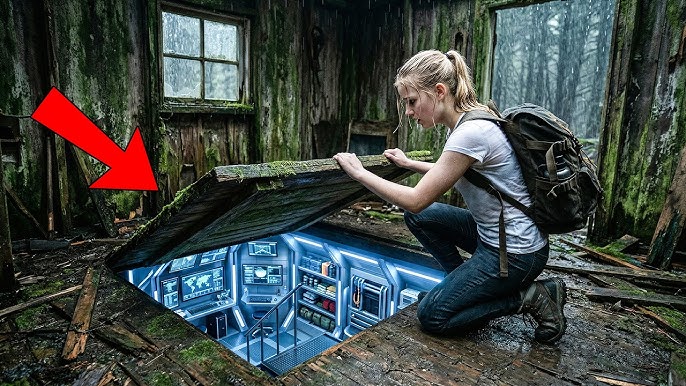
It creaked open, releasing the smell of old wood and dust. Inside, the cabin was simple—one room, a stone fireplace, a small table, a narrow bed frame without a mattress, and shelves lined with empty jars.
But it was dry.
It was shelter.
Emily stepped inside and closed the door behind her. For the first time all day, her shoulders relaxed.
She gathered sticks from outside, hands numb, and tried to build a fire the way she remembered from summer camp years ago. It took three attempts and most of her patience, but eventually a small flame flickered to life.
Warmth spread slowly.
Emily sat on the floor, hugging her knees, watching the fire.
“I guess this is home,” she murmured.
That night, she slept in her sweater, curled near the fireplace. The wind howled outside, rattling the cabin, but it held.
Morning brought pale sunlight through dusty windows. Emily stretched, stiff and sore, but alive.
She began exploring.
Behind the cabin, she found a rusted hand pump. It groaned but eventually produced cloudy water. After letting it run, it cleared enough to drink.
Near the edge of the clearing, she discovered a small woodshed—half-collapsed, but still holding dry logs beneath the top layer. Someone had stacked them neatly long ago.
Emily smiled.
“Thank you,” she whispered, though no one was there.
Inside again, she noticed something she’d missed before. The table drawer.
It stuck at first, but she pulled harder.
Inside lay a leather-bound notebook.
The cover was cracked. Dust coated the edges. Emily opened it carefully.
The first page read:
If you’re reading this, you needed this place as much as I once did.
Emily blinked.
She turned the page.
My name is Thomas Hale. I built this cabin in 1978 when I had nowhere else to go. I lost my job, my house, and nearly my will to live. The woods gave me silence. This cabin gave me time.
Emily sat down slowly.
She kept reading.
If you found this, then maybe you’re running too. Or hiding. Or just trying to breathe. There’s food buried beneath the loose board by the fireplace. It won’t last forever, but it’s a start.
Emily’s heart pounded.
She dropped to her knees near the fireplace, scanning the floor. One board looked slightly different. She pried it up using a knife from her backpack.
Underneath was a small metal tin.
Inside: canned beans, dried rice, two protein bars, and a sealed bottle of vitamins.
Emily laughed—a shaky, disbelieving sound. Then she cried.
“Thank you… thank you…”
She clutched the tin like treasure.
Over the next few days, Emily read more of Thomas’s journal.
He’d written about loneliness. About rebuilding. About planting a small garden behind the cabin. About learning to live with less—and finding peace in it.
Following his notes, Emily found tools hidden in the woodshed: a hatchet, a shovel, and a small fishing pole.
It felt like Thomas had left breadcrumbs through time.
She cleaned the cabin. Swept dust. Stacked wood. Boiled water. Cooked rice and beans in an old dented pot she discovered hanging near the fireplace.
Each small act made the space feel more hers.
Days turned into a week.
Emily built routines. Morning: fetch water. Afternoon: gather wood. Evening: read the journal.
On the tenth day, she reached a final entry.
If you’re still here, it means you didn’t give up. That matters. There’s one more thing. Check under the bed frame.
Emily crouched and lifted the frame.
Taped underneath was an envelope.
Her hands trembled as she opened it.
Inside was a folded paper and a key.
The paper read:
The old truck behind the barn still runs. I left it for whoever needs a way forward. It isn’t much, but it’ll get you to town. You deserve more than survival. You deserve a future.
Emily’s breath caught.
“Barn?”
She rushed outside, scanning the trees.
About fifty yards behind the woodshed, hidden by overgrowth, stood a leaning structure she hadn’t noticed.
She ran.
Inside the barn, beneath a faded tarp, sat an old green pickup truck. Rust spotted the sides, but the tires looked intact.
Emily climbed in.
The key fit.
She turned it.
The engine coughed… sputtered… then roared to life.
Emily gasped and burst into laughter.
“I can’t believe this!”
She rested her forehead on the steering wheel, overwhelmed.
Thomas Hale—whoever he was—had left more than shelter. He’d left hope.
Emily didn’t leave immediately. She stayed another week, preparing. She read the journal again. Cleaned the cabin. Restocked the food tin with what she could forage.
On her final night, she added her own entry to the notebook.
My name is Emily Carter. I arrived scared and alone. You gave me warmth, food, and a path forward. I’m leaving tomorrow to find work and build something of my own. I promise to come back one day and make this place ready for the next person who needs it.
She signed it.
The next morning, she packed the truck and drove slowly down the narrow trail, heart pounding.
When she reached the main road, she didn’t look back immediately. She gripped the wheel, breathing deeply.
Then she whispered, “Thank you, Thomas.”
The town she reached was small—barely more than a grocery store, gas station, and diner.
Emily found work washing dishes. The owner, a kind woman named Carol, let her sleep in a storage room for a few weeks. Emily worked hard, saved every dollar, and eventually rented a tiny studio.
Months passed.
Winter came and went.
Emily kept Thomas’s journal with her. On difficult nights, she reread his words.
One year later, she drove back.
The cabin looked smaller somehow—but warmer.
She repaired the roof. Fixed the shutter. Brought blankets, canned food, and fresh tools. She even added a small solar lantern.
Before leaving, she wrote another note:
To whoever finds this next: You’re not alone. This place helped me survive. I hope it helps you too.
Emily closed the notebook and placed it back in the drawer.
As she stepped outside, the wind rustled the pines softly, like a quiet goodbye.
She realized then that the cabin had given her more than shelter.
It had given her proof.
Proof that strangers could care. That endings could become beginnings. That even when someone pushed you out, the world might open another door—hidden among trees, waiting patiently.
Emily climbed into the truck and started the engine.
This time, when she drove away, she wasn’t running.
She was going forward.