
Evicted at 73, She Bought a Rusted Shed for $5 — When She Turned the Key, Everything Changed
The county clerk slid the paper across the counter as if it might crumble in her hands.
“Seventy-three?” he asked, peering over his glasses.
Margaret Ellis nodded once. Her fingers, thin and freckled with age, rested on the worn leather strap of her suitcase. “Seventy-three,” she repeated. “And still able to sign my own name.”
He cleared his throat and pushed the document closer. “This is… well… it’s a storage structure. Condemned, technically. No utilities. No warranty.”
“I didn’t ask for a warranty,” she said gently.
The clerk hesitated. “It cost five dollars.”
Margaret slid a wrinkled bill onto the counter.
“I know.”
He stamped the paper. The sound echoed in the small rural office like a gavel.
Just like that, she owned a rusted shed.
Two days earlier, Margaret had stood on the sidewalk outside her apartment building with everything she owned packed into one suitcase.
The eviction notice still sat folded in her cardigan pocket. She had read it so many times the ink had begun to fade. The landlord hadn’t been cruel. He had actually looked uncomfortable as he explained rising taxes, renovations, new tenants willing to pay triple.
“I’m sorry, Mrs. Ellis,” he’d said. “You’ve been here twenty-eight years. But I can’t hold the unit.”
She had nodded, thanked him, and left quietly.
No children to call. No husband to lean on. Harold had passed eleven winters earlier, leaving behind his toolbox, a stack of unpaid medical bills, and the memory of a laugh that once filled rooms.
Margaret never asked for help. Pride, maybe. Or simply habit.
So she took a bus heading nowhere in particular and got off where the land turned flat and empty, where dry grass stretched to the horizon like a faded blanket.
That’s when she saw the sign.
County Auction — Abandoned Lots — Today Only
She hadn’t meant to stop. But something in the wind felt like an invitation.
Most buyers clustered around parcels of farmland. A few eyed an old barn. Nobody even glanced at the rusted corrugated metal structure sitting at the edge of the property.
It leaned slightly to one side. Dry vines crawled up its walls. The wooden door hung crooked. It looked like it had been forgotten by time itself.
“Five dollars,” the auctioneer said, almost apologetically. “Condemned shed. Sold as-is.”
No one moved.
Margaret raised her hand.
Now she stood before it.
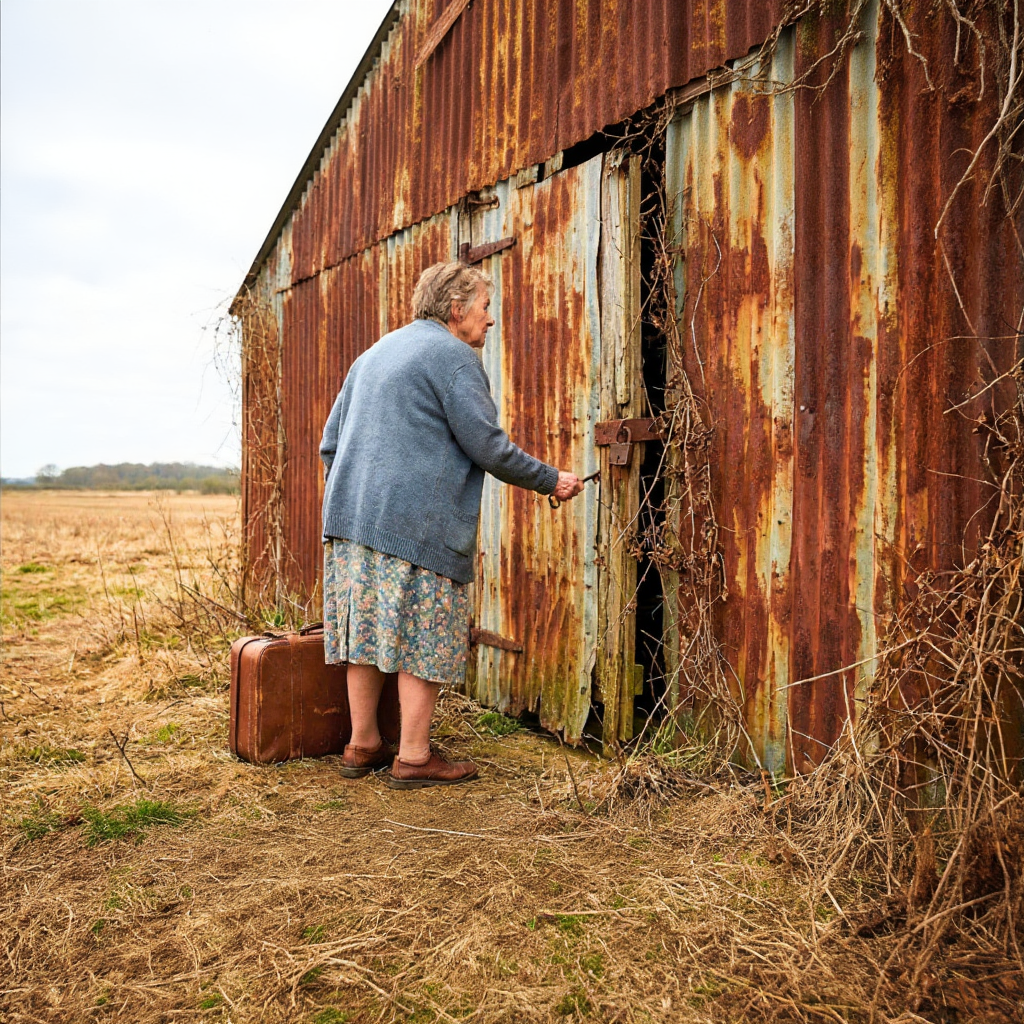
The vast countryside stretched behind her—yellow-brown grass whispering under a pale sky. The wind tugged lightly at her blue cardigan. Her floral skirt brushed against her calves as she stepped forward.
Her vintage brown suitcase rested beside her on the ground. It looked small against the wide, empty landscape.
Margaret reached out.
The key trembled slightly in her fingers.
She didn’t know what she expected. Dust. Rot. Maybe a raccoon.
Certainly not hope.
The lock resisted at first, grinding like it hadn’t been touched in decades. She leaned closer, steadying herself.
“Come on now,” she whispered.
The key turned.
A metallic click echoed louder than it should have.
She pushed the wooden door.
It creaked open slowly.
And everything changed.
The air inside smelled dry but not rotten. Sunlight filtered through gaps in the corrugated metal, cutting bright stripes across the floor.
Margaret stepped inside carefully.
The shed wasn’t empty.
In the center sat a long wooden workbench, covered in tools—old, but neatly arranged. Wrenches. Chisels. A hand plane. Rusty, yes, but organized.
She blinked.
Someone had cared about this place.
On the back wall hung shelves stacked with mason jars filled with nails, screws, and bolts sorted by size. Beneath them stood a small cast-iron stove, its surface dusty but intact.
Her heart began to beat faster.
She walked farther in.
In the corner rested a metal cabinet. The door was slightly ajar. She opened it.
Inside were notebooks.
Dozens of them.
She pulled one out. The cover read:
“Project Plans — 1984”
Her fingers trembled as she opened it.
Detailed drawings filled the pages. Measurements. Structural diagrams. Notes about insulation using hay bales. Rainwater collection systems. Solar heating angles.
This wasn’t just a shed.
Someone had been building something.
Margaret flipped through more pages.
A blueprint caught her eye.
It showed the shed—expanded underground.
Rooms carved into earth. A sleeping nook. Storage. Ventilation shafts.
Her breath caught.
“This…” she whispered. “This is a home.”
A folded letter slipped from the notebook and fluttered to the floor.
She picked it up.
The paper was yellowed but legible.
If anyone finds this,
I started building after the drought of ’83. The idea was simple — live small, live hidden, live safe.
Never finished it. Health got me first.
But the foundation is done. Beneath this floor, you’ll find the hatch.
— Thomas Weaver
Margaret stared at the floor.
Her pulse pounded.
She moved the rug—she hadn’t even noticed it before—revealing a square wooden panel.
A hatch.
She knelt slowly, joints protesting. Her fingers curled under the edge.
The hatch lifted.
Cool air rose from below.
A ladder descended into darkness.
Margaret swallowed.
Then she climbed down.
The underground space wasn’t large, but it was real.
Packed earth walls reinforced with timber. A small built-in bed frame. Shelving carved directly into the soil. A ventilation pipe leading upward.
It felt… safe.
Protected.
Like the world couldn’t push her out again.
Margaret sat on the edge of the wooden frame.
For the first time since the eviction, she allowed herself to cry.
Not loudly. Not dramatically.
Just quiet tears sliding down wrinkled cheeks.
“I think I can live here,” she whispered.
And for the first time in weeks, she believed it.
The first night was cold.
She wrapped herself in her cardigan and used her suitcase as a pillow. The wind rattled the metal walls above, but underground, it was calmer.
She slept deeply.
The next morning, she got to work.
Margaret cleaned the tools carefully, oiling them one by one. She swept dust. Reorganized shelves. She found a rain barrel outside buried under weeds and dragged it upright.
Days turned into a rhythm.
Morning: clear weeds.
Afternoon: repair gaps in the shed.
Evening: plan improvements from Thomas’s notebooks.
She patched holes with scrap metal. Reinforced the door. Dug a shallow trench for rainwater runoff.
By the end of the week, the shed looked less abandoned.
By the end of the second, it looked intentional.
A truck slowed on the dirt road one afternoon.
A man in his forties leaned out the window. “You living out here?”
Margaret straightened. “I am.”
He looked confused. “In that shed?”
“Yes.”
He hesitated. “You need anything?”
She smiled politely. “I’m alright.”
But the next day, he came back.
He left a small bundle near the door.
Inside: two blankets, canned soup, and a thermos.
Margaret watched from inside until he drove away.
She folded the blankets carefully.
Maybe the world hadn’t forgotten kindness after all.
Word spread.
The “old woman in the rust shed” became a quiet curiosity.
A retired teacher brought books.
A farmer dropped off fresh eggs.
A teenager offered to fix the ventilation pipe.
Margaret accepted only what she needed.
In return, she fixed things.
Buttons. Torn jackets. A squeaky gate hinge. A cracked chair leg.
Her hands, stiff but steady, remembered every skill she’d learned over decades.
One afternoon, the county clerk pulled up in a dusty sedan.
He stepped out, staring.
“I… didn’t think you’d actually stay.”
Margaret smiled. “Neither did I.”
He walked around the shed. “You’ve improved it.”
“I had help.”
He looked at the door, now reinforced, the vines trimmed neatly.
“You know,” he said slowly, “this land parcel… technically extends another fifty feet.”
She blinked. “It does?”
He nodded. “If you wanted… you could expand.”
Margaret glanced at the dry grass stretching beyond.
For the first time, she imagined more.
A small garden.
A bench.
Maybe even flowers.
Spring arrived quietly.
Green pushed through yellow grass. The air softened.
Margaret planted seeds in a narrow patch beside the shed. Tomatoes. Beans. Marigolds.
The first sprout made her laugh out loud.
Visitors came more often.
Not out of pity anymore—but curiosity.
“How’d you build this?”
“Can you show me that rain system?”
“Did you really buy this for five dollars?”
She answered each question patiently.
One evening, the man who’d left blankets returned.
“My sister,” he said, nodding toward the shed. “She just lost her place. Mind if she stays a few nights?”
Margaret looked at the underground space.
Then at the sky.
“Yes,” she said. “There’s room.”
That night, she realized something.
The shed hadn’t just given her shelter.
It gave her purpose.
By summer, the place looked transformed.
The rusty metal still showed, but now it was framed by growing vines—alive ones, green and flowering. A wooden bench sat beside the door. The garden thrived.
Inside, shelves were stocked. The underground space expanded slightly with careful digging.
People started calling it “Margaret’s Haven.”
She laughed at the name—but it stuck.
One afternoon, a young reporter arrived with a camera.
“You’re the woman who bought a shed for five dollars?”
Margaret nodded.
“And now people stay here?”
“Sometimes.”
“Why?”
She looked out at the wide countryside.
“Because everyone needs a place that doesn’t push them away.”
The article ran a week later.
Donations followed—but Margaret refused money.
Instead, she asked for tools. Seeds. Books.
Things that built, not replaced.
On her seventy-fourth birthday, the community gathered outside the shed.
Someone brought a cake. Another brought folding chairs.
The county clerk handed her a small envelope.
Inside was a document.
“What’s this?” she asked.
“Petition,” he said. “Signed by everyone. We’re reclassifying the land as a community shelter. You’re the caretaker… if you want.”
Margaret’s hands trembled.
“I started with five dollars,” she whispered.
“And turned it into something priceless,” he replied.
She looked at the shed—the rusted walls, the repaired door, the vines dancing in the breeze.
A year ago, she had nowhere.
Now, she had a home.
A purpose.
A community.
She reached into her pocket and felt the original key.
The same key she’d turned on that quiet, windy day.
Everything had changed.
Not because the shed was valuable.
But because she refused to believe her life was finished.
Margaret Ellis, evicted at seventy-three, had unlocked more than a door.
She unlocked a second beginning.