
Everyone Mocked Her Salt-Buried Floor Until Their Own Cabins Filled with Frozen Condensation
By the time the first real snow came to Bitterroot Valley, most folks had already decided that Martha Whitlock had finally gone strange.
Not eccentric.
Not stubborn.
Strange.
And in 1887, on the western edge of Montana Territory, strange could be more dangerous than poor.
The gossip started on a Tuesday.
It began, as most trouble did, at Miller’s Feed & Supply, where men gathered around potbellied stoves pretending to discuss cattle prices while really discussing everyone else.
“She bought two hundred pounds of salt.”
“Salt?”
“Coarse rock salt.”
“Woman got no livestock.”
“Maybe she plans to pickle herself through winter.”
The laughter rolled like wagon wheels over frozen mud.
Even Samuel Pike, who usually kept his opinions to himself, smirked into his coffee.
“Widow’s finally lost her senses.”
And by sunset, the whole valley knew:
Martha Whitlock was burying salt beneath her cabin floor.
Martha heard every whisper.
She heard them in church.
She heard them at the creek.
She heard them when children passed her fence and giggled loud enough for her to notice.
Old Widow Whitlock.
Salt Witch.
Floor Woman.
The names didn’t hurt her.
Not anymore.
At sixty-three, pain had long since changed shape.
It no longer came from words.
It came from memory.
From empty chairs.
From boots that would never again stand beside the door.
From the silence after twenty-two winters without Henry Whitlock.
She lived alone now on twenty rough acres at the northern edge of the valley.
One log cabin.
One smokehouse.
One half-finished shed.
Three hens.
A mule too old to complain.
And knowledge.
Knowledge Henry had collected from trappers, miners, immigrants, and mountain men who understood one truth:
Nature only looked simple to fools.
The first sack arrived at sunset.
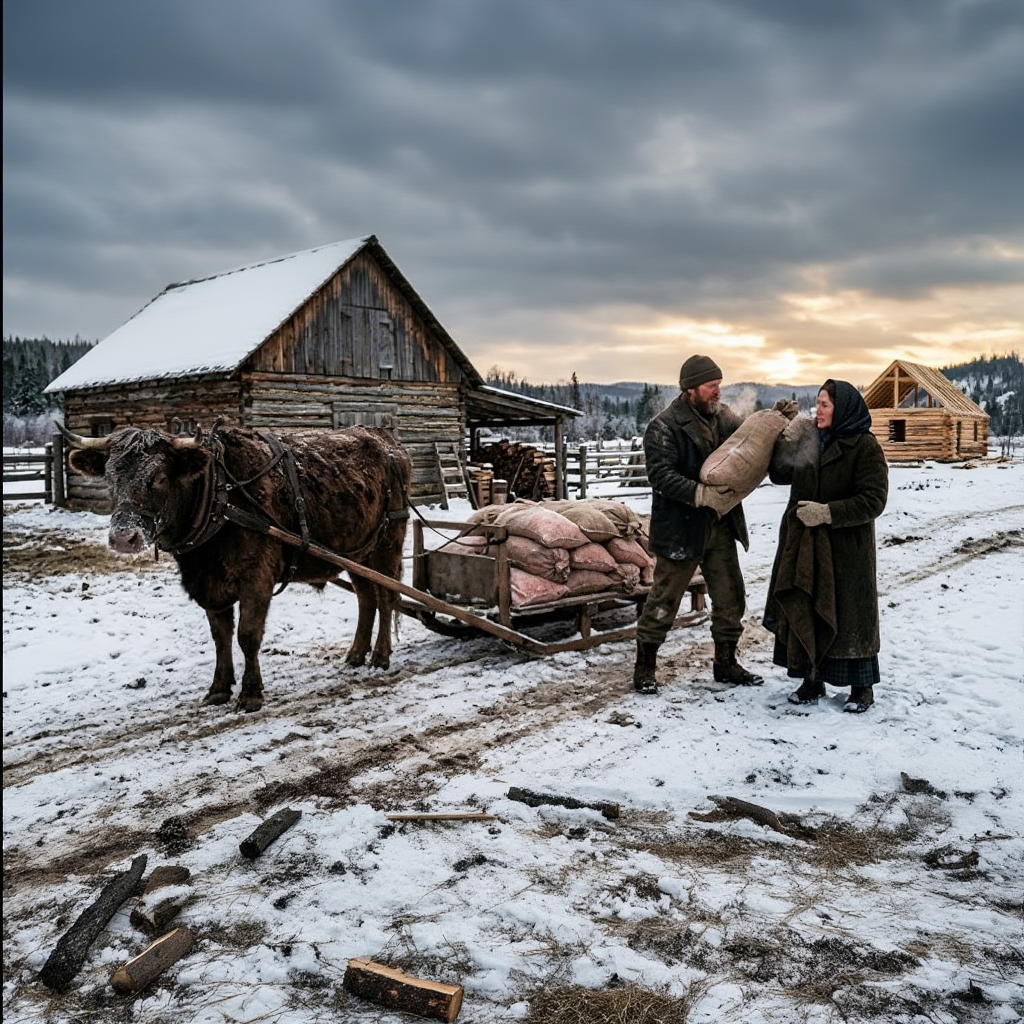
A heavy burlap bag slung from the back of an ox-drawn sledge.
Driving it was Elias Boone, thirty-four, broad-shouldered, bearded, quiet.
He wasn’t family.
Wasn’t even close.
But since Henry’s death, Elias had helped Martha when fences collapsed or roofs needed patching.
Not from charity.
From respect.
He climbed down from the sledge, boots sinking in muddy snow.
“You sure about this?”
Martha adjusted her headscarf.
“Brought all four?”
Elias glanced at the sacks.
“Four hundred pounds.”
She nodded.
“Good.”
He studied her.
“Mind telling me why?”
She smiled faintly.
“You’ll know by January.”
They worked until dark.
Pulling up loose pine planks.
Digging shallow trenches into frozen earth.
Sweat steaming in lantern light.
Elias said nothing.
Martha said even less.
Bag after bag, they poured coarse grey salt beneath the floor.
Spread it evenly.
Covered it with straw.
Then packed clay over top.
Then replaced the boards.
By midnight, the cabin looked untouched.
As if nothing had changed.
As if no one had buried half a quarry beneath her feet.
Elias wiped his brow.
“Either you’re the smartest woman in Montana…”
He looked around.
“…or I’m helping a mad one.”
Martha placed another plank.
“Sometimes those are the same thing.”
The winter came early.
And hard.
By November, temperatures dropped to twenty below.
By December, windows frosted from the inside.
Trees cracked in the night like rifle shots.
Livestock died standing.
Water buckets turned solid before sunrise.
And inside nearly every cabin in Bitterroot Valley…
something worse began.
Moisture.
At first, nobody thought much of it.
A little fog on the glass.
A little dampness on the rafters.
Then ice.
Then dripping.
Then mold.
Then blankets freezing stiff where they hung.
Children waking with wet hair.
Babies coughing.
Mattresses soaking.
Ceilings weeping.
Walls sweating.
And by Christmas…
cabins across the valley felt like frozen caves.
At Samuel Pike’s place, his wife woke screaming when a sheet of ice broke loose from the ceiling and shattered beside the bed.
At the Cooper ranch, two children developed fever from sleeping under damp quilts.
At Miller’s, sacks of flour turned clumpy from moisture.
Nobody understood.
They burned more wood.
Sealed windows tighter.
Stuffed cracks with moss.
Built bigger fires.
And somehow…
everything got worse.
Because the tighter the cabins became—
the less they breathed.
And the more moisture stayed trapped inside.
Freezing.
Melting.
Freezing again.
Then someone noticed something strange.
At Martha Whitlock’s cabin—
there was no frost.
No dripping.
No mold.
No frozen blankets.
Smoke rose steady.
Windows stayed clear.
Laundry dried soft.
Even the walls looked dry.
And people started asking questions.
Questions turned into visits.
Visits turned into suspicion.
Then desperation.
The first knock came on a January morning.
Samuel Pike.
Hat in hand.
Pride frozen harder than the ground.
Martha opened the door.
Warm air drifted out.
Dry.
Comfortable.
Smelling faintly of cedar and stew.
Samuel stared.
“How?”
Martha looked at him.
“You called me crazy.”
Samuel shifted.
“I may have.”
She folded her arms.
“You laughed.”
He nodded.
“I did.”
She waited.
Finally—
he swallowed.
“My grandson’s coughing.”
Silence.
Then Martha stepped aside.
“Come in.”
Within an hour, Samuel sat at her kitchen table while Martha poured coffee.
He looked down at the pine floor.
“You buried salt.”
Martha nodded.
“Salt pulls moisture.”
He frowned.
“From the air?”
“From the ground first.”
She pointed downward.
“Earth breathes.”
Then upward.
“So do cabins.”
She tapped the boards.
“Cold comes up. Warmth goes down. Moisture gets trapped between.”
Samuel stared.
She continued.
“Salt absorbs what the soil gives off before it rises.”
He looked around again.
Dry beams.
Dry walls.
Dry blankets.
Dry lungs.
Dry life.
And suddenly—
Samuel Pike felt very, very foolish.
By the next week…
there was a line outside Martha’s cabin.
Farmers.
Ranchers.
Widows.
Hunters.
Families.
All of them.
The same people who’d mocked her.
The same people who’d laughed.
The same people who’d called her witch.
Now standing in snow…
holding hats in both hands.
Asking questions.
Begging for help.
Elias Boone watched from the porch, arms crossed, fighting a grin.
“You enjoying this?”
Martha kept writing measurements onto scraps of paper.
“Not nearly as much as you think.”
Elias smirked.
“Little.”
She paused.
Then smiled.
“Little.”
For two weeks…
the valley became one giant construction site.
Cabin floors came up.
Salt went down.
Straw.
Clay.
Planks.
Again.
And again.
And again.
Elias hauled sacks from town.
Oxen dragged sledges through snow.
Children carried straw.
Men who’d once laughed hardest now dug deepest.
And slowly—
the dripping stopped.
The frost disappeared.
The coughing eased.
The mold dried.
And cabins breathed again.
By February…
Bitterroot Valley looked different.
Not from outside.
Snow still buried fences.
Smoke still curled into grey skies.
The cold still bit.
But inside—
families slept dry.
Children woke warm.
Walls stayed clean.
And windows remained clear enough to watch sunrise.
All because one old widow had remembered something nobody else thought worth learning.
In March, when the thaw finally came, the town gathered at the church hall.
Not for worship.
Not for mourning.
Not for business.
For Martha.
Samuel Pike stood first.
Hat over his chest.
Voice rough.
“I laughed at this woman.”
The room went silent.
He swallowed hard.
“And because I laughed…”
He looked toward Martha.
“…I nearly froze my own family.”
Nobody moved.
Then Samuel raised a small wooden plaque.
Hand-carved.
Simple.
Honest.
On it were burned five words:
WHEN PRIDE FROZE, SHE TAUGHT.
Martha stared at it for a long time.
Long enough that some thought she might cry.
But Martha Whitlock had spent too many winters learning another truth:
Tears freeze quickly.
Wisdom doesn’t.
She took the plaque.
Ran rough fingers over the letters.
Then looked around the room.
At neighbors.
At doubters.
At friends.
At fools.
At survivors.
And finally said—
“Next winter…”
She smiled.
“…we insulate the roofs.”
The room exploded with laughter.
Real laughter.
Warm laughter.
The kind that didn’t wound.
And outside—
under melting snow…
beneath dozens of cabins…
hundreds of pounds of buried salt quietly kept doing what wisdom always does—
working long after the mocking stops.