
Everyone Gave Up on the Cowboy’s Triplet Girls — Until an Obese Housemaid Found What Doctors Missed
The first thing people noticed about the three little girls was how quiet they were.
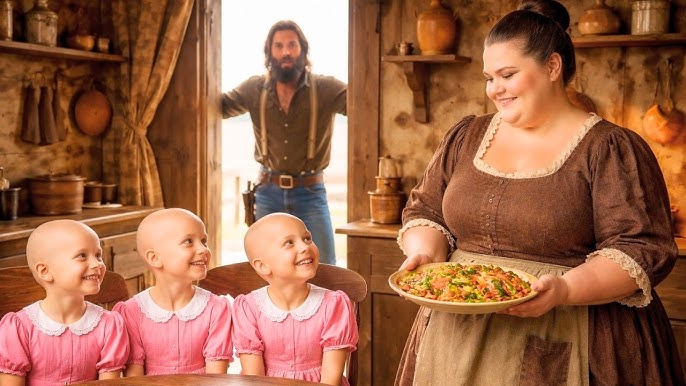
Triplets usually meant chaos—three voices at once, three sets of footsteps, three personalities colliding like summer thunder. But in Caleb Dawson’s small prairie house, silence settled like dust. The girls sat side by side at the wooden table, identical in pink dresses, their heads smooth and pale, their eyes bright but tired. They watched the world more than they lived in it.
Doctors had called it a mystery.
Neighbors called it a tragedy.
And after two years of searching for answers, Caleb Dawson had begun to call it hopeless.
He was known across the county as a man who never gave up. He’d survived droughts that cracked the earth into broken plates. He’d rebuilt his barn after lightning burned it down. He’d buried his wife with steady hands and went back to work the next morning because the cattle needed feeding.
But his daughters… they were something he couldn’t fight.
Emma, Ellie, and Eden had been born healthy—tiny but strong. For the first six months, they laughed, crawled, and pulled at each other’s sleeves. Then the fevers started. Not high enough to panic, but enough to worry. Then came the weakness. They stopped crawling. They lost their hair. They ate less. They grew thinner, quieter.
Doctors tested everything. Blood work. Scans. Specialists in two different states. One suggested a rare genetic disorder. Another suspected an autoimmune disease. A third recommended experimental treatments that cost more than Caleb’s entire ranch.
Nothing worked.
By the time they turned three, the girls spent most of their days sitting at the table, smiling faintly, conserving energy like candles burning low.
That was the week the housemaid arrived.
Her name was Martha Briggs, and she came with a single suitcase and a letter from the church. She was large—soft-faced, round-shouldered, with kind eyes that crinkled when she smiled. Her dress was simple brown cotton, and she moved carefully, as if she’d learned long ago to make herself smaller than she really was.
Caleb almost sent her away.
“I don’t need help,” he told her, standing in the doorway, hat in hand.
The wind pushed dust across the yard. Behind him, the girls sat at the table, watching.
The letter had said she was “good with children” and “seeking honest work.” Caleb figured that was church talk for someone nobody else wanted to hire.
“I won’t cost much,” Martha said gently. “Just room and meals. I can cook. Clean. Keep an eye on the little ones.”
“They don’t need watching,” Caleb said, too quickly. “They don’t… move much.”
Martha didn’t flinch. She simply looked past him at the three identical faces.
“They look like they could use someone to talk to,” she said.
That was what made him hesitate.
The house had been too quiet.
So he stepped aside.
Martha entered like she belonged there. She washed her hands, tied on an apron, and immediately began tidying the kitchen with calm, efficient movements. The girls watched her, eyes following every step.
“You must be Emma,” she said to the first.
The girl smiled.
“And Ellie.”
Another small smile.
“And Eden.”
The third nodded.
Martha crouched—slowly, carefully—until she was eye level with them.
“Well,” she said, “I suppose we’re going to be friends.”
No one had spoken to them like that in months.
That first evening, she cooked stew. Not the thin broth Caleb usually made, but something thick and fragrant. She chopped vegetables finely, simmered bones for hours, and added herbs she pulled from her suitcase.
The girls ate more than usual.
Caleb noticed.
“She never eats that much,” he said quietly.
Martha nodded but said nothing.
The next morning, she woke early and opened every window. She dusted shelves, scrubbed counters, and threw away two sacks of old flour from the pantry.
“This smells funny,” she said.
“It’s fine,” Caleb replied. “I’ve used it for months.”
Martha didn’t argue. She just replaced it.
She began cooking differently—fresh eggs, vegetables from the garden, broth simmered daily. She mashed everything soft so the girls wouldn’t tire chewing. She fed them slowly, patiently, talking the whole time.
By the third day, she noticed something else.
The girls drank very little water.
“Do they always refuse?” she asked.
“They don’t like the taste,” Caleb said.
Martha filled a cup, sniffed it, and frowned.
It smelled faintly metallic.
“Where does your well run?” she asked.
“Back behind the barn.”
She walked there that afternoon. The bucket creaked as she lowered it. When she lifted it, the water looked clear—but she noticed a faint reddish ring along the inside of the bucket.
She dipped a finger in and tasted it.
Her brow furrowed.
That night, she boiled the water before serving it.
The next day, she used rainwater she’d collected.
On the fourth day, something changed.
Ellie—always the quietest—laughed.
It was a small sound, but it stopped Caleb mid-step.
He turned.
The three girls were sitting on the floor with wooden blocks Martha had carved from scrap lumber. Ellie stacked two pieces, and when they fell, she giggled.
Caleb hadn’t heard that sound in months.
“What did you do?” he asked.
Martha shook her head. “Nothing special.”
But she kept observing.
She noticed the girls’ pale gums. Their fatigue. Their slow recovery after meals. She noticed how their hands trembled slightly when they lifted cups.
She remembered something from years ago—before she’d taken housework jobs, before her life shrank to kitchens and laundry. She’d worked briefly in a rural clinic, assisting a doctor who specialized in environmental illnesses.
Heavy metals, he’d called them.
Poison in plain sight.
She didn’t want to assume. But she couldn’t ignore the possibility.
“Have they ever tested your well?” she asked Caleb.
He looked surprised. “Tested? For what?”
“Minerals. Contaminants.”
“No. It’s been there for decades.”
Martha nodded slowly.
The next morning, she walked two miles to the nearest town. She spent her own savings on a simple water test kit.
When she returned, she filled the vial.
They waited.
The strip turned dark.
Too dark.
Martha swallowed.
“Caleb,” she said softly. “You need to see this.”
He stared at the result. “I don’t understand.”
“It means there’s something in your water. Likely iron… maybe more. Possibly lead.”
The word hit him like a hammer.
“Lead?” he whispered.
She nodded.
“It can cause weakness. Development delays. Hair loss. Fatigue… especially in children.”
Caleb’s hands shook.
“All this time…”
He looked toward the house, where the girls were sitting in sunlight, playing quietly.
“All this time… I’ve been giving them poison?”
“You didn’t know,” Martha said gently.
He sank onto the porch step, face pale.
“What do we do?”
“We stop using the well. Immediately.”
They hauled rain barrels. Martha boiled water constantly. Caleb rode into town and bought bottled water with money meant for feed.
Within a week, the changes became undeniable.
Emma stood for the first time in months.
Eden began asking questions—soft, hesitant words.
Ellie laughed often.
Their appetites grew. Color returned to their cheeks. They tired less easily. They played together, bumping shoulders, whispering secrets.
Neighbors began to notice.
“Those girls look different,” one woman said at church.
“They’re smiling,” another whispered.
Caleb could barely speak about it. Gratitude filled his throat every time he watched them run—slowly at first, then faster.
The doctor confirmed it two weeks later.
Blood tests showed elevated lead levels—dropping steadily.
“You caught it in time,” he told Caleb. “Another year… it could’ve caused permanent damage.”
Caleb turned to Martha.
She stood quietly near the door, hands folded, as if she didn’t belong in the conversation.
But she did.
More than anyone.
That evening, he found her in the kitchen kneading dough.
“You saved them,” he said.
She shook her head. “I just noticed something.”
“No,” he said firmly. “Doctors missed it. Specialists missed it. I missed it. You didn’t.”
She looked uncomfortable.
“I’ve had time to watch,” she said softly. “Sometimes that’s all it takes.”
The girls ran in then—laughing, breathless.
“Papa! Papa! Look!”
They’d built a crooked tower of blocks.
It collapsed, and they burst into giggles.
Caleb’s eyes filled.
Later that night, after the girls slept, he sat across from Martha at the table.
“You don’t have to leave,” he said.
“I wasn’t planning to,” she replied with a small smile.
“I mean… stay. For good. The girls… they need you.”
She hesitated.
“I’m just a housemaid.”
“You’re family,” he said simply.
She looked down, blinking quickly.
Weeks passed. Then months.
The girls grew stronger each day. Their hair began to return—soft fuzz at first, then fine curls. They chased chickens, argued over dolls, and followed Martha everywhere.
Caleb fixed the well—professionally sealed and filtered. He installed a rain collection system. He learned more about water safety than he ever imagined.
But what changed most was the house itself.
It wasn’t quiet anymore.
It was alive.
One afternoon, as sunlight poured through the window, the girls sat at the table again—like before. But this time they weren’t silent. They were chattering, giggling, and helping Martha decorate a pie.
Caleb stood in the doorway, watching.
For a moment, he remembered the fear. The hopelessness. The long nights thinking he was losing them.
Then Ellie looked up.
“Papa! Come taste!”
He stepped forward.
Martha handed him a slice.
It was warm, sweet, imperfect.
Just like everything else now.
“Best pie I’ve ever had,” he said.
The girls cheered.
Martha smiled quietly.
And Caleb realized something simple, something profound:
Everyone had given up on the cowboy’s triplet girls.
But the woman nobody believed in… the woman others overlooked, judged, and dismissed…
She had seen what no one else saw.
And because of her, three little lives were no longer fading.
They were beginning.
By early spring, the Dawson ranch no longer felt like a place holding its breath.
It felt like laughter.
Emma, Ellie, and Eden had discovered running—real running, not the slow shuffling steps they once took. They chased each other between fence posts, their identical curls bouncing, their pink dresses replaced by patched overalls Martha had sewn from old denim. Dust followed them like a golden cloud.
Caleb leaned against the porch rail, arms folded, watching them.
Six months earlier, he’d measured their strength in minutes—how long they could sit, how long they could hold a spoon. Now he measured it in distance. Ten yards. Twenty. Then across the yard entirely.
Every step felt like a miracle.
“They’re going to wear holes in the earth,” he muttered.
Martha stepped beside him, wiping her hands on her apron.
“Better that than wearing holes in chairs,” she said softly.
He glanced at her, smiling.
She had changed, too. She still moved carefully, still spoke gently, but there was confidence in her now. The girls followed her like ducklings. Even the ranch dogs obeyed her voice.
And the neighbors—those who once whispered—now greeted her with respect.
Still, Martha didn’t seek attention. She focused on routines: meals, clean water, fresh air, rest. She tracked the girls’ progress in a small notebook. Weight. Energy. Appetite. Sleep.
She had become their quiet guardian.
One afternoon, as the girls played, Eden suddenly stopped.
She pressed a hand to her stomach.
“I’m tired,” she whispered.
Martha noticed immediately.
She walked over and knelt. “All three of you, come sit.”
Emma and Ellie obeyed.
Their breathing was heavier than usual. Not alarming—but enough.
Caleb stepped forward, worry flashing across his face.
“What is it?”
“Nothing serious,” Martha said calmly. “Just pushing too hard. Their bodies are still recovering.”
She handed them cool water—filtered, always filtered—and sliced apples. She watched carefully until their color returned.
Later, inside, Caleb spoke quietly.
“I thought we were past this.”
“We are,” Martha said. “But healing isn’t a straight road. They lost two years. Their muscles… their stamina… it’ll take time.”
He nodded, though unease lingered.
That night, after the girls slept, Martha reopened her notebook.
She studied the entries.
Something tugged at her mind.
The girls were improving—no doubt—but they still tired faster than expected. Their hair was growing back, yet thinner than average. Occasionally, they complained of headaches.
Most doctors would call it recovery.
But Martha had learned something: when it came to children, “almost normal” sometimes meant something was still wrong.
The next morning, she changed breakfast.
Instead of biscuits and eggs, she served oatmeal with chopped spinach and molasses.
Caleb raised an eyebrow.
“That looks… green.”
“It’s iron,” she said.
“They don’t need more iron. The water already—”
“Not that kind,” she replied gently. “Good iron. For blood.”
He shrugged. “If they’ll eat it.”
They did.
Not eagerly—but they ate.
Over the next week, Martha quietly adjusted everything. More leafy vegetables. Liver once a week. Beans. Bone broth thick with marrow. She added lemon to help absorption, something she remembered from the clinic years ago.
She also insisted on more rest between play.
The girls protested.
“We’re not babies!”
“No,” Martha agreed. “You’re growing.”
That seemed to satisfy them.
Two weeks later, another change appeared.
Emma climbed the porch steps without stopping.
Ellie carried a bucket half full of water.
Eden asked to help feed the chickens—and finished without sitting down.
Caleb stared in amazement.
“They’re… stronger.”
Martha nodded, pleased but unsurprised.
At their next doctor visit, the results confirmed it.
“Blood counts are improving,” the physician said. “They were mildly anemic. Common after lead exposure. But whatever you’re doing—keep doing it.”
Caleb looked at Martha again.
He was getting used to that feeling—watching professionals confirm what she had already figured out.
On the ride home, the girls fell asleep in the wagon, heads resting on each other’s shoulders.
Caleb spoke quietly.
“You saw that before the doctor did.”
“I suspected,” she said. “Their gums were pale. They tired easily. It fit.”
“You ever think you should’ve been a doctor?”
She shook her head with a small smile.
“I’m exactly where I’m meant to be.”
Spring turned warm. Then green.
The ranch transformed. Wildflowers bloomed along the fence lines. The creek filled with snowmelt. The girls discovered mud—and Caleb discovered that three muddy children could destroy a clean kitchen in under a minute.
Martha laughed more now.
One evening, as she washed dishes, Emma tugged her sleeve.
“Miss Martha?”
“Yes, sweetheart?”
“Were we really sick before?”
Martha paused.
“Yes. But you’re getting better.”
“Did you fix us?”
Martha shook her head gently.
“No. Your bodies fixed you. I just helped them.”
Ellie frowned thoughtfully.
“But Papa says you saved us.”
Martha glanced toward the porch, where Caleb was mending a saddle.
“I helped him,” she said quietly. “He did the rest.”
Eden wrapped her arms around Martha’s waist.
“You’re staying forever, right?”
Martha hesitated—just a second.
Then she rested her hand on Eden’s head.
“Yes,” she said softly. “If you’ll have me.”
The girls cheered.
Summer arrived with heat and long golden evenings. The triplets now ran across the fields with the dogs, their laughter echoing all the way to the barn. Their strength no longer came in fragile bursts—it flowed steadily.
One afternoon, Caleb organized a small gathering.
Neighbors arrived with pies and lemonade. Children from nearby farms came to play. Everyone wanted to see the girls—the miracle triplets who had once faded and now shone.
Emma climbed onto a hay bale and waved.
Ellie chased a butterfly.
Eden handed out wildflowers.
An older rancher leaned toward Caleb.
“Never thought I’d see them like this,” he said.
“Neither did I,” Caleb admitted.
The man nodded toward Martha, who sat under a tree, mending a dress.
“She’s something special.”
Caleb followed his gaze.
“Yes,” he said quietly. “She is.”
As the sun dipped low, the girls ran to Martha, breathless.
“Come play!” they begged.
She laughed. “I’ll break the ground if I run.”
“Then sit with us!”
They pulled her down into the grass.
Caleb watched them—three identical girls leaning against a woman the world once overlooked. The light caught their hair, now full and shining. Their cheeks were pink. Their eyes bright.
For the first time in years, he felt something settle deep in his chest.
Peace.
Later that night, after everyone left, the girls fell asleep quickly.
Caleb and Martha sat on the porch.
Crickets hummed. The sky stretched wide and endless.
“You know,” Caleb said slowly, “everyone gave up on them.”
Martha looked toward the open window where the girls slept.
“Sometimes people give up because they don’t know what else to do.”
“And you?”
“I just kept looking.”
He nodded.
“I’m glad you did.”
Silence settled comfortably.
Inside, one of the girls laughed in her sleep.
Martha smiled.
And Caleb realized the truth had grown even bigger than before:
She hadn’t just found what doctors missed.
She had found hope—quiet, stubborn, and patient—and given it room to grow until three little girls could run beneath the wide American sky again.