
Orphan Holding a Newborn Was Being Auctioned, Until a Infertile Mountain Man Took Them Home
They weren’t selling cattle that morning.
They weren’t selling tools, wagons, or land.
They were selling her.
The crowd gathered in the dusty street outside the trading post, boots kicking pale dirt into the warm morning air. Wooden storefronts lined both sides, sun-bleached and crooked. A bright blue sky stretched above, scattered with thin clouds, but the mood below felt heavy.
A table stood in the center.
Coins clinked.
And beside it stood the girl.
Her dark hair hung loose and tangled, strands sticking to her dirt-streaked cheeks. A faded light-purple dress clung to her frame, worn thin at the elbows. In her arms, wrapped tightly in brown cloth, a newborn slept, tiny face barely visible.
She held the baby protectively, arms locked around him as if the world might tear him away.
The older man in the black coat raised a wooden gavel.
“Orphan girl,” he announced loudly. “No family, no land, no provisions. Infant child included. Bids for guardianship and labor rights begin now.”
Murmurs rippled.
Some people looked uncomfortable.
Others leaned forward.
The girl’s eyes moved across the crowd, searching—not for rescue, but for mercy. She found neither.
“How old?” someone asked.
“Seventeen,” the auctioneer replied.
“And the baby?”
“Two weeks.”
The girl tightened her grip.
A man in a dusty vest stepped forward. “I’ll take the girl. Don’t need the child.”
She shook her head instantly. “No.”
The auctioneer frowned. “You don’t decide.”
“I won’t go without him,” she said, voice trembling but firm.
The baby stirred, letting out a soft cry.
The man shrugged. “Then I withdraw.”
Another voice: “I’ll take both. Three dollars.”
Laughter broke out. “Three? For two mouths?”
“Girl can work,” the bidder said. “Child grows later.”
The girl swallowed hard.
“Four dollars,” another called.
The gavel hovered.
The baby whimpered again, and she rocked him gently, whispering under her breath.
Dust swirled across the street.
That’s when he stepped forward.
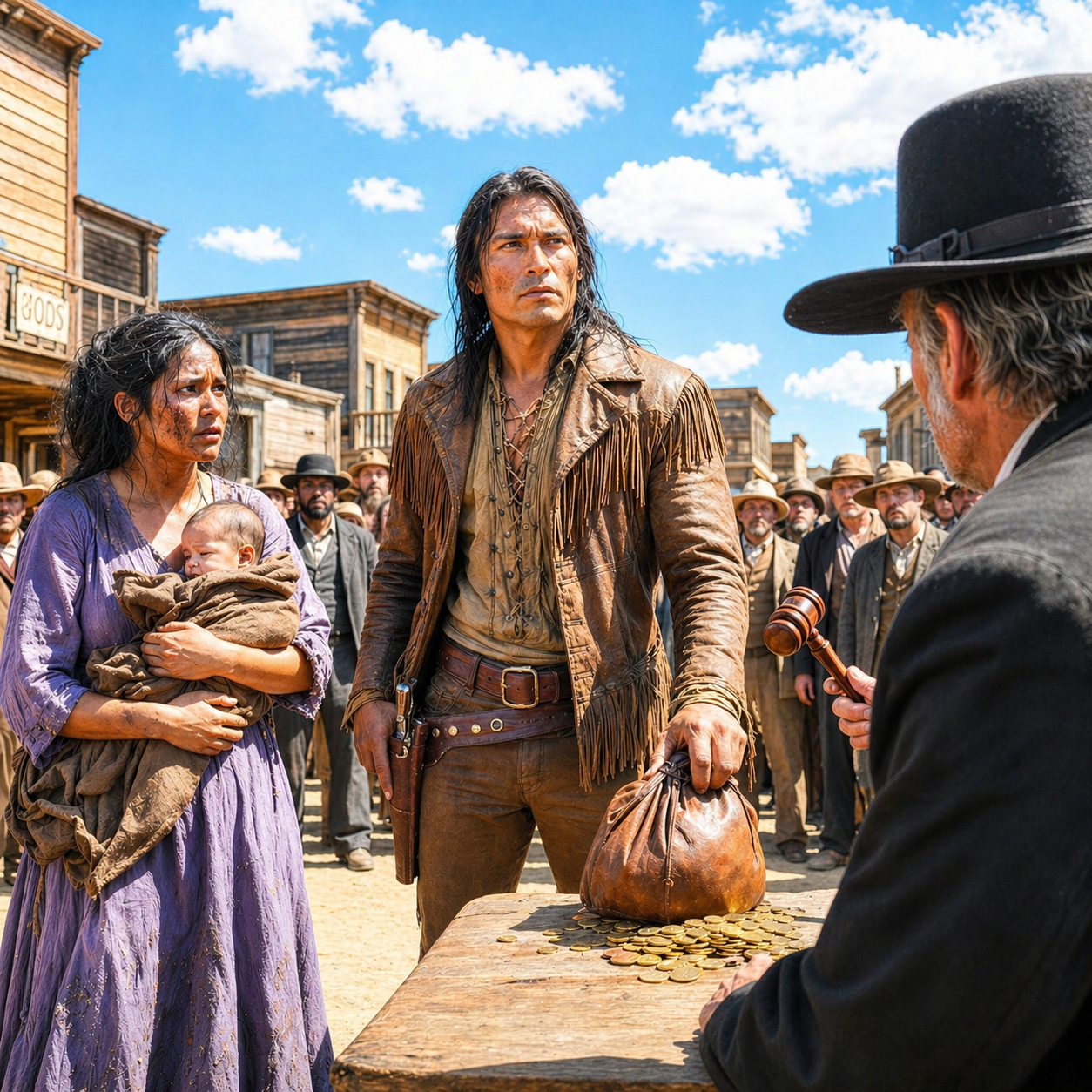
He came from the edge of the crowd, tall and broad, long dark hair brushing his shoulders. His brown leather jacket hung heavy, fringed and worn by mountain travel. A lace-up shirt showed beneath, tucked into brown trousers with a wide belt. His boots left deep prints in the dust.
His right hand rested near his pistol.
His left dropped a leather pouch onto the table.
Coins spilled.
The sound silenced the street.
The auctioneer blinked. “Name?”
“Jonas Hale.”
“You bidding?”
Jonas nodded once.
The girl looked at him, wary.
He didn’t stare at her like the others. His gaze shifted instead to the baby, then back to her face.
“How much?” the auctioneer asked.
Jonas pushed the pouch forward. Gold coins glinted in sunlight.
The crowd gasped.
“That’s… that’s more than—” the auctioneer stammered.
“I take both,” Jonas said quietly.
The gavel lowered slightly. “You sure?”
“Yes.”
The earlier bidders stepped back, defeated.
The auctioneer cleared his throat. “Sold.”
The gavel struck wood.
The sound echoed.
The girl stiffened.
She didn’t move.
Jonas picked up the pouch, leaving the coins scattered. He looked at her gently.
“What’s your name?” he asked.
“Emily,” she whispered.
“And him?”
“Samuel.”
Jonas nodded.
“You coming?” he asked.
She hesitated.
“You don’t have to carry everything,” he added softly. “I’ll help.”
She adjusted the baby, unsure.
“Why?” she asked.
Jonas paused.
“Because you shouldn’t be sold,” he said simply.
The words landed like something fragile.
Emily stepped forward slowly.
The crowd parted as they walked.
Behind them, whispers followed.
“Mountain man,” someone muttered.
“He paid gold for them.”
“Must want labor.”
Emily heard it all.
She expected harshness.
Silence filled the ride.
Jonas’s wagon creaked along the dusty trail, leaving town behind. The mountains rose ahead, green slopes fading into blue distance.
Samuel slept.
Emily clutched him tightly.
“You hungry?” Jonas asked after a while.
She nodded.
He handed her bread and dried meat.
She ate slowly, still wary.
“Where are we going?” she asked.
“My place. Up in the mountains.”
“You live alone?”
“Yes.”
She nodded.
The cabin appeared near sunset—small, sturdy, tucked among pines. Smoke drifted from the chimney.
Jonas climbed down and opened the door.
“Inside,” he said.
Warmth greeted them.
A fire burned low. A bed stood in one corner. Another smaller one nearby.
Emily froze.
“You… expected someone?” she asked.
Jonas shook his head. “Just prepared.”
He set water to boil.
Emily sat carefully, rocking Samuel. The baby stirred, crying softly. Jonas handed her a cloth, then stepped back, giving her space.
Days passed.
Jonas worked outside, chopping wood, checking traps. Emily stayed inside, caring for Samuel, cooking simple meals.
He never raised his voice.
Never demanded.
One night, she asked quietly, “Why did you buy us?”
Jonas stared into the fire.
“Doctor said I can’t have children,” he said.
She blinked.
“Never thought I’d hear crying in my house,” he added.
Samuel fussed softly as if on cue.
Jonas almost smiled.
Emily watched him differently after that.
He built a cradle from spare wood. Carved it slowly, carefully. When Samuel slept in it, Jonas stood nearby, silent but content.
Winter crept closer.
Snow dusted the mountains.
Emily found herself smiling more. Samuel grew stronger. The cabin filled with life.
One evening, she placed three plates on the table.
Jonas noticed.
He didn’t comment.
But he looked… grateful.
Months later, spring thawed the valley.
Samuel laughed for the first time.
Emily laughed too.
Jonas leaned in the doorway, watching both of them.
He had taken them home.
And for the first time, the mountain cabin felt full.