
He Sealed an Iron Cylinder and Turned It Into a Home — It Stayed Warm When Every Cabin Froze
No one in Black Hollow believed Elijah Boone when he said he would survive the winter inside a piece of scrap.
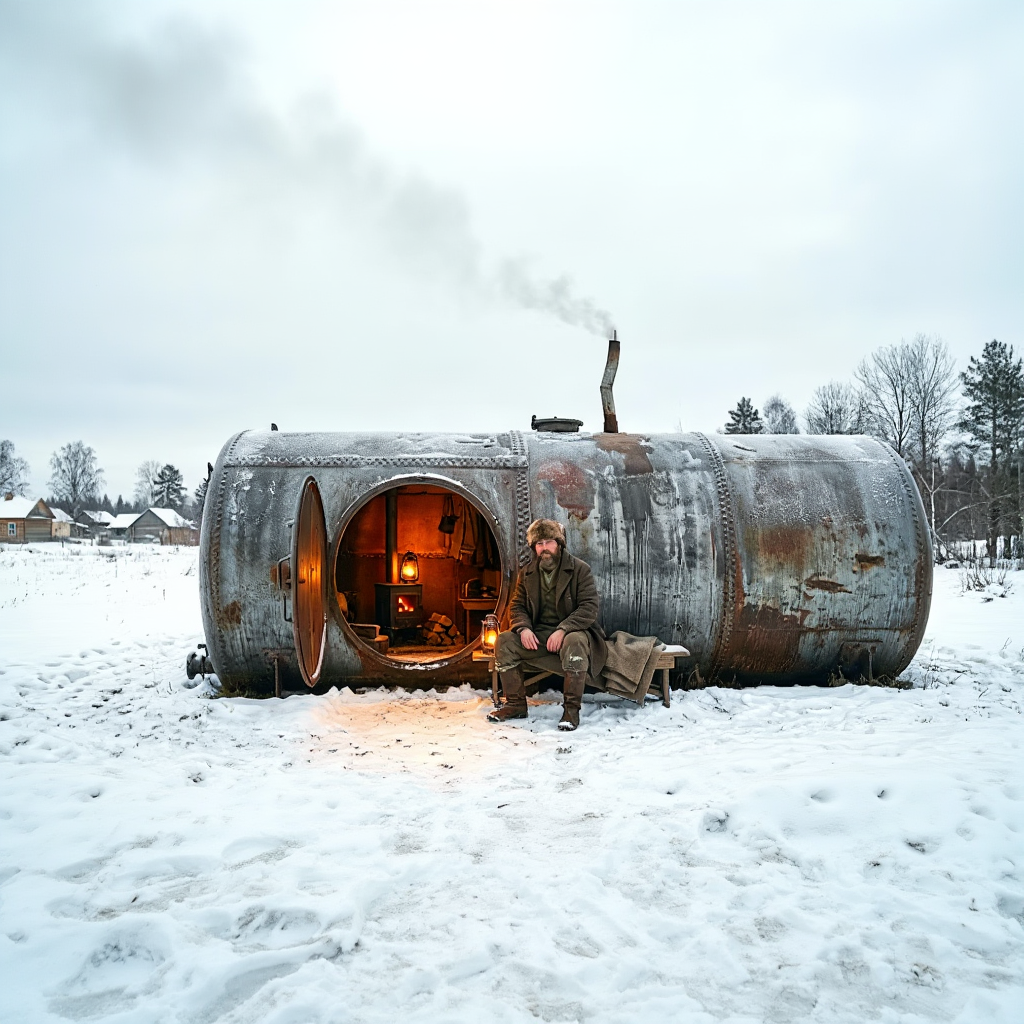
They laughed the first time he dragged the iron cylinder into town—a rusted relic from an abandoned oil rig, dented and scarred, taller than a man and just wide enough for a coffin to feel generous.
“Planning to bury yourself early, Boone?” someone called from the porch of Miller’s Store.
Elijah didn’t answer. He never did when the jokes came easy. He just kept pulling, boots grinding against frozen dirt, breath fogging in the early November air.
Because he knew something they didn’t.
He had already frozen once.
1. The Winter That Took Everything
Three years earlier, Elijah had lived in a proper cabin—pine logs, stone chimney, a roof patched with care. It wasn’t much, but it had been his.
And hers.
Clara.
She had loved the sound of the fire cracking at night, the way snow softened the world outside until it felt like they were the last two people alive. She used to say winter wasn’t cruel—it was just honest.
But that winter had been different.
The cold came early. Brutal. It sank into the wood, crept through the chinks between logs, and turned their breath into ghosts even inside the cabin. Elijah burned through his firewood faster than he ever had. He patched, sealed, stacked, prayed.
It wasn’t enough.
The night the fire died, he woke to silence—the kind that feels wrong. Too still. Too heavy.
Clara wasn’t breathing.
He carried her out into the snow before sunrise, screaming her name into a sky that didn’t care.
From that moment on, Elijah Boone stopped trusting wood, fire, and everything men had used for warmth for centuries.
2. The Idea No One Wanted
The idea came from a memory.
Before Black Hollow, before Clara, Elijah had worked in oil fields down south. He remembered the tanks—massive steel containers that held heat long after the sun had gone down. Even at night, you could press your hand against them and feel warmth trapped inside like a heartbeat.
Steel didn’t leak heat the way wood did.
Steel held it.
That was the difference.
So when he found the iron cylinder half-buried in weeds near an abandoned drilling site, something clicked into place in his mind with terrifying certainty.
This could work.
Not a cabin.
A shell.
A sealed space where heat couldn’t escape.
Where the cold couldn’t creep in.
Where no one would ever freeze again.
3. Building the Impossible
By the time December rolled in, Elijah had hauled the cylinder to the edge of his land.
The town kept watching.
And laughing.
“What’s he gonna do—live like a rat in a pipe?”
“He’ll suffocate before the cold gets him.”
“Man’s gone half-mad since Clara died.”
They weren’t entirely wrong.
Because Elijah worked like a man possessed.
He cut an entry hatch into one side, reinforcing it with salvaged hinges and a locking bar. He lined the interior with layers—first tar paper, then wool blankets, then sheets of hammered tin to reflect heat inward.
At the center, he installed a small cast-iron stove.
But that wasn’t the real secret.
The real secret was air.
He built a narrow intake pipe that snaked underground before rising above the cylinder, shielding it from direct wind. For exhaust, he fitted a flue with a hand-built damper to control airflow precisely.
Too much air—and heat escapes.
Too little—and you die.
Elijah measured everything.
Tested everything.
Lived inside it for hours at a time, adjusting, refining, learning how the metal breathed.
By mid-December, snow blanketed Black Hollow.
By Christmas, the temperature dropped so low that trees cracked in the night like gunshots.
That’s when Elijah moved in.
4. The Cold That Broke the Town
The storm came in January.
It wasn’t just snow—it was a siege.
Wind howled through the valley, tearing at roofs, forcing its way through cracks, sucking warmth from every cabin like a living thing. Fires struggled to stay lit. Pipes froze solid. Livestock died in their stalls.
People huddled together, burning anything they could—chairs, floorboards, heirlooms.
Still, the cold found them.
One by one, the cabins failed.
The Henderson boy got frostbite in his sleep.
Old Mrs. Carver didn’t wake up one morning.
Even Miller’s Store, the sturdiest building in town, couldn’t hold back the freeze.
And then there was Elijah.
Living inside a metal coffin.
Alone.
Everyone expected him to be the first to die.
5. The Night They Came
On the fourth night of the storm, Thomas Miller made a decision.
“Either that fool’s dead,” he said, pulling his coat tighter, “or he’s figured something out.”
He gathered three men.
They trudged through waist-deep snow, wind biting at their faces, until they reached Elijah’s land.
The iron cylinder stood half-buried in snowdrifts, its surface rimed with frost.
No smoke.
No sound.
“God help him,” one man muttered.
Miller stepped forward and banged on the metal.
Nothing.
He raised his hand again—
And stopped.
Because he felt it.
Warmth.
Faint, but unmistakable, seeping through the iron into his glove.
“…That ain’t possible,” he whispered.
Then, from inside—
A voice.
“Stop pounding. You’ll let the heat out.”
The hatch opened with a creak.
And a wave of warmth spilled into the frozen night like a miracle.
6. Inside the Iron Home
The men stared.
It wasn’t large—barely enough room for Elijah to stand and turn—but it was alive with heat. The small stove glowed steadily, not roaring, not struggling—just burning with quiet efficiency.
The walls felt warm to the touch.
No drafts.
No creeping cold.
“How…?” Miller breathed.
Elijah leaned against the interior wall, calm, steady.
“It’s not about making more heat,” he said. “It’s about not losing it.”
He pointed upward.
“Airflow’s controlled. Heat reflects back inward. Steel traps it. Once it’s warm, it stays warm.”
One of the men shook his head.
“You’re telling me this… this thing… stays warmer than a cabin?”
Elijah met his eyes.
“Cabins leak. This doesn’t.”
A gust of wind howled outside, rattling the cylinder.
Inside, the flame didn’t even flicker.
7. The Choice
Miller looked back toward town.
Toward freezing families.
Toward failing fires.
“You could fit… what, two more people in here?” he asked.
Elijah hesitated.
This had been his refuge.
His answer to loss.
His way of surviving alone.
But then he thought of Clara.
Of the night the fire died.
Of the silence.
He stepped aside.
“Three,” he said. “If we don’t mind breathing each other’s air.”
8. The Iron Shelter
Word spread fast.
By morning, people were coming.
Not all at once—there wasn’t room—but in shifts.
The worst off came first: children, the elderly, the sick.
Elijah adjusted the airflow constantly, balancing oxygen and heat, teaching others how it worked.
They brought blankets, food, stories.
And slowly, something changed.
The cylinder wasn’t just a shelter anymore.
It became hope.
Men who had mocked him now stood guard outside, clearing snow, maintaining the intake pipe, protecting the one place in Black Hollow that the cold couldn’t conquer.
For the first time since Clara’s death, Elijah wasn’t alone.
9. The Thaw
When the storm finally broke, it did so quietly.
The wind died.
The sky cleared.
And the sun returned, pale but persistent.
People stepped out of their cabins, blinking in the light, counting who remained.
Black Hollow had lost some.
But far fewer than it should have.
Because of a man who refused to trust wood.
Because of an idea no one believed.
Because of an iron cylinder that held warmth like a secret.
10. What Came After
By spring, things had changed.
Not just in Black Hollow—but in the way people thought.
Cabins were rebuilt differently—better sealed, better insulated.
Some even began constructing their own versions of Elijah’s design: metal-lined shelters, controlled airflow systems, heat-efficient spaces.
They didn’t laugh anymore.
They asked questions.
They listened.
As for Elijah…
He didn’t leave the cylinder.
Not entirely.
He expanded it—added a second chamber, a proper entryway, even a small window with thick glass.
But he kept the core the same.
Steel.
Sealed.
Unyielding.
Because it reminded him of something important.
That survival wasn’t about tradition.
It was about understanding the world as it is—and daring to build something new when the old ways fail.
11. The Story That Spread
Years later, travelers passing through Black Hollow would hear the story.
About the winter that froze an entire valley.
About the cabins that failed.
About the man who sealed himself inside iron—and lived.
Some said he was a genius.
Others said he was just stubborn.
But everyone agreed on one thing.
When the cold came, Elijah Boone had built the only home that didn’t surrender.
12. The Last Fire
On the anniversary of Clara’s death, Elijah lit a fire inside the cylinder.
Not because he needed to.
But because he remembered.
He sat in the quiet warmth, hand resting against the steel wall, feeling the heat linger, steady and sure.
And for the first time in years, the silence didn’t feel empty.
It felt… held.
Like the iron itself had learned something from him.
Or maybe—
He had learned something from it.
That even in the coldest places…
Warmth can survive.
If you refuse to let it escape.
The Iron That Wouldn’t Freeze — Part 2
Spring came slowly to Black Hollow, like a reluctant guest.
Snowmelt turned the valley into mud, roofs dripped for weeks, and the scars of winter revealed themselves one thawed inch at a time—collapsed barns, split beams, empty homes that would never be filled again.
But at the edge of town, the iron cylinder stood untouched.
Unbroken.
Unforgotten.
And now… no longer alone.
1. The Visitors
At first, it was just neighboring settlers.
They came on horseback or by wagon, asking about “the iron shelter.” They circled it, tapping the metal, peering at the intake pipe, the flue, the hatch.
Elijah didn’t like crowds.
But he understood something had changed.
So he showed them.
Not everything—not at first—but enough.
“It’s not magic,” he would say, crouching beside the stove, adjusting the damper with careful precision. “It’s control. Heat, air, space—you waste less, you live longer.”
Some listened.
Some nodded politely and left, unconvinced.
Others stayed longer, asking questions that told Elijah they were thinking beyond curiosity—thinking about survival.
By summer, three more iron shelters had been built within a day’s ride of Black Hollow.
Crude.
Imperfect.
But real.
2. The Man Who Wanted More
Not everyone came to learn.
Some came to take.
His name was Walter Griggs—a rancher from the lowlands, known for buying up land others couldn’t hold onto. He arrived in late June with polished boots and a smile that never reached his eyes.
“I hear you’ve built something special, Boone,” he said, walking a slow circle around the cylinder. “Something… valuable.”
Elijah leaned against the doorway, arms crossed.
“It kept people alive,” he said simply.
Griggs nodded, as if confirming a rumor.
“And that’s exactly why it shouldn’t stay here.”
Elijah’s eyes narrowed.
Griggs continued, smooth as oil. “You’ve got a design the whole territory could use. Properly built, mass-produced… sold. You’d make a fortune.”
“I’m not selling anything.”
“You will,” Griggs said lightly. “Everyone does. Eventually.”
Elijah said nothing.
But something cold—not winter cold, something sharper—settled in his chest.
3. A Summer of Building
The months that followed were busy.
Elijah worked with others now—men who had once mocked him, now carrying sheets of salvaged metal, digging trenches for intake pipes, learning how to measure airflow by feel and sound.
Black Hollow changed shape.
Not outwardly—still the same valley, same scattered homes—but underneath, in the way people thought about survival.
They stopped trusting size.
Started trusting efficiency.
They sealed cracks tighter.
Built smaller, smarter spaces.
Shared knowledge instead of guarding it.
And at the center of it all was Elijah’s iron home.
A place people came not just to survive—
But to understand.
4. The Fire in August
The trouble didn’t come from winter.
It came from heat.
In August, lightning struck dry brush along the ridge.
Within hours, fire spread across the hills, devouring grassland, racing toward Black Hollow with a speed no one expected.
Smoke choked the sky.
Ash fell like snow.
Panic returned—different from winter, but just as dangerous.
“Water won’t stop it,” Miller said, watching the flames crest the ridge. “Not this much.”
People began packing wagons, preparing to flee.
But Elijah stood still, eyes fixed on the approaching fire.
Then he turned.
“To the cylinder,” he said.
5. Fire Meets Iron
They didn’t understand at first.
“Are you crazy?” someone shouted. “That thing will turn into an oven!”
Elijah shook his head.
“Not if we control the air.”
He moved fast, directing people with a clarity that cut through fear.
“Close the intake halfway. Damp the flue. Keep oxygen low.”
They sealed the hatch.
Inside, it was dim.
Crowded.
Hot—but not unbearable.
Outside, the fire roared closer.
Then it arrived.
Flames swept over the land, surrounding the cylinder in a storm of heat and noise. The metal walls glowed faintly, ticking and groaning under the pressure.
Inside, people held their breath.
Children clung to their parents.
Someone whispered a prayer.
Elijah sat by the stove—not lit this time—hand on the wall, feeling the heat trying to push its way in.
But the same principle held.
Controlled space.
Controlled air.
The heat came—
But it couldn’t stay.
6. After the Flames
When the fire passed, it left silence behind.
And ash.
Black Hollow was scorched.
Fields gone.
Fences burned to nothing.
Cabins damaged or destroyed.
But the iron cylinder still stood.
Soot-covered.
Scarred.
But intact.
And inside—
Alive.
People stepped out into a changed world, blinking through smoke and sunlight.
Miller looked at Elijah, shaking his head in disbelief.
“First the cold,” he said. “Now fire.”
Elijah didn’t smile.
“Same problem,” he replied. “Different direction.”
7. Griggs Returns
Walter Griggs came back in the fall.
This time, he didn’t come alone.
Two wagons.
Five men.
And a contract already written.
“I’ll make this simple,” he said, handing the paper to Elijah. “You give me the design. I handle production, distribution. You get a share. Everyone wins.”
Elijah didn’t take the paper.
“And if I say no?”
Griggs’s smile faded.
“Then someone else will figure it out. And they won’t be as… generous.”
The air between them tightened.
People from the town gathered nearby, watching.
Listening.
Waiting.
Elijah looked at the cylinder.
At the marks left by fire.
At the door that had opened in the dead of winter and saved lives.
Then he looked back at Griggs.
“You’re right,” he said quietly.
Griggs relaxed slightly.
“Of course I am.”
Elijah continued.
“It shouldn’t stay here.”
Griggs’s smile returned.
“Now you’re thinking—”
“It should belong to everyone.”
The smile vanished.
8. The Choice That Changed Everything
Elijah didn’t sign the contract.
Instead, he did something no one expected.
He taught.
Fully.
Openly.
He gathered anyone willing to learn—farmers, builders, travelers—and walked them through every detail.
The airflow system.
The insulation layers.
The balance between heat and oxygen.
He drew diagrams.
Explained mistakes.
Shared everything he had learned through trial, failure, and loss.
Griggs watched it happen, fury barely contained.
“You’re throwing away a fortune,” he snapped.
Elijah met his gaze.
“I already lost what mattered.”
There was nothing Griggs could say to that.
He left the next morning.
And he never came back.
9. A New Kind of Home
By the next winter, Black Hollow was ready.
Not with bigger cabins.
Not with more wood.
But with better understanding.
Iron-lined shelters stood beside traditional homes.
Some were small, built for emergencies.
Others were larger, adapted for families.
Each one different.
Each one built with the same idea at its core:
Don’t fight the cold.
Control it.
When the snow came, people didn’t panic.
They prepared.
They adjusted airflow.
Managed heat.
Shared space when needed.
And when the temperature dropped lower than anyone had ever recorded—
Black Hollow held.
No deaths.
No desperate nights.
No silent mornings.
10. The Legacy of Iron
Years passed.
The story spread beyond the valley.
Some called it “Boone’s Cylinder.”
Others called it “the Iron Shelter.”
But in Black Hollow, they called it something simpler.
“The Second Chance.”
Because that’s what it had been.
For Elijah.
For the town.
For everyone who had stepped inside when the world outside turned deadly.
11. The Quiet Truth
One evening, long after the storms and fires had become stories instead of memories, Elijah sat inside the cylinder once more.
Older now.
Slower.
But still steady.
A young boy—Miller’s grandson—sat across from him, running his hand along the warm metal wall.
“Is this the strongest house in the world?” the boy asked.
Elijah thought for a moment.
Then shook his head.
“No,” he said.
The boy frowned. “But it survived everything.”
Elijah smiled faintly.
“It’s not the iron,” he said. “It’s the idea.”
“What idea?”
Elijah looked at the wall, at the place where heat lingered long after the fire burned low.
“That you don’t have to build bigger to survive,” he said. “You just have to build smarter.”
12. The Last Winter
The year Elijah Boone died, winter came early again.
Not as cruel as the one that took Clara.
Not as devastating.
But cold enough to remind people.
They gathered in the iron shelter on the first hard night—not because they needed to.
But because it felt right.
They lit a small fire.
Sat close.
Shared stories.
And someone told the tale of a man who sealed himself inside iron… and refused to freeze.
Outside, the wind howled.
Inside, warmth held.
Just like it always had.
And always would.
Because some homes aren’t made of wood or stone—
But of ideas strong enough to outlast the cold.