
Kicked Out at 70 With Her Dog and a Suitcase — She Found a Cabin in the Woods That Changed Her Life
The rain started just as the front door closed behind her.
Margaret Ellis stood on the porch, one hand gripping a worn leather suitcase, the other holding a thin leash. At the end of it, a gray-faced golden retriever pressed against her leg, sensing something was wrong. The dog’s name was Rusty, and he was the only thing she had left.
Inside the house, voices continued—muted now, but sharp.
“You can’t stay here anymore, Mom.”
“You’ll be more comfortable somewhere else.”
“We already made arrangements.”
Arrangements.
Margaret had heard that word too many times in the past week. Arrangements for her room. Arrangements for her belongings. Arrangements for her future—none of which included her opinion.
At seventy, she had expected many things. A quiet chair. A garden. Maybe afternoons with her grandchildren. She hadn’t expected a suitcase on a rainy porch.
Rusty nudged her hand.
“It’s alright, boy,” she whispered, though it wasn’t.
The door opened briefly. Her son stepped out, avoiding her eyes. He placed a small envelope on top of her suitcase.
“There’s some cash in there,” he said quickly. “The facility will call you tomorrow.”
“I don’t want a facility,” she replied softly.
“It’s temporary,” he said, already backing toward the door. “You’ll be safer.”
The door closed again.
Margaret stood still as rain soaked her coat.
After a moment, she picked up the suitcase.
“Come on, Rusty.”
They walked down the driveway slowly.
The bus station sat three miles away. By the time she reached it, her shoes were wet and her hands trembled from cold. She bought the cheapest ticket available—no destination in mind, just away.
The driver barely glanced at her.
Rusty lay at her feet as the bus rumbled into the hills. Towns blurred past. Fields gave way to forest. Hours slipped by.
By evening, the bus stopped at a small roadside junction.
“Last stop,” the driver called.
Margaret stepped down into silence.
No town. No lights. Just a narrow road winding into trees.
She looked at the driver. “Is there a motel nearby?”
He shook his head. “Nothing for twenty miles.”
The bus drove away.
Rusty sat beside her, tail brushing the gravel.
“Well,” she murmured, “we’ve had worse.”
They began walking.
The forest closed around them quickly. Pine trees rose tall and dark, and the air smelled damp and clean. The road curved upward, uneven and quiet.
After nearly an hour, Margaret’s legs trembled.
She spotted a narrow trail branching off the road.
“Let’s rest,” she told Rusty.
They followed it a short distance.
Then she saw it.
A cabin.
Small. Weathered. Half-hidden by trees. Smoke did not rise from the chimney, but the roof looked intact. A wooden porch sagged slightly, yet the door stood closed.
Margaret hesitated.
“Probably abandoned,” she whispered.
Rusty wagged his tail.
She stepped onto the porch and knocked gently.
No answer.
She tried the handle.
Unlocked.
The door creaked open.
Inside, the cabin smelled of cedar and dust. A table sat near the window. A stone fireplace lined one wall. A bed stood in the corner, covered with a folded blanket.
It wasn’t luxurious.
But it was dry.
Margaret stepped inside cautiously.
“Just for the night,” she told Rusty.
He circled and lay near the fireplace.
She set down her suitcase and sank into a chair. Exhaustion washed over her. For the first time since morning, she felt still.
She lit a small fire using leftover wood stacked neatly by the hearth.
Whoever owned the cabin had prepared it.
That thought lingered.
She opened her suitcase and pulled out a sweater. Rusty rested his head on her knee.
“You think we can stay?” she whispered.
He thumped his tail.
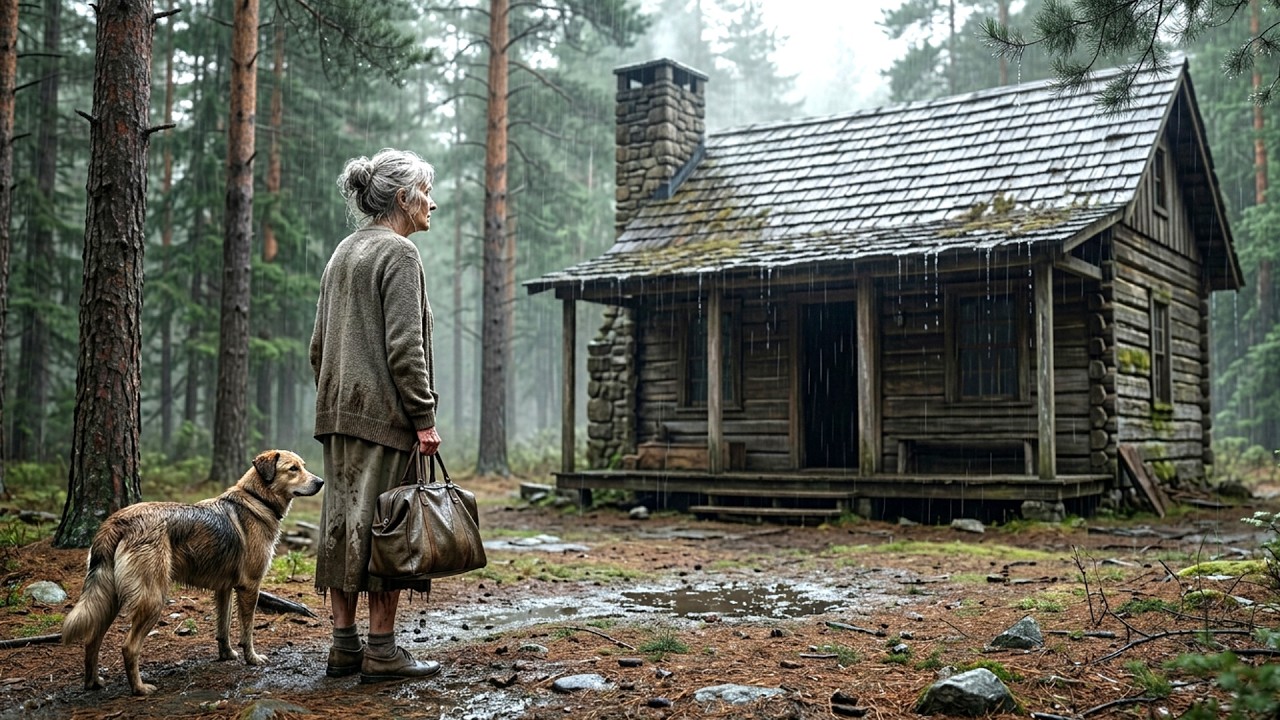
She fell asleep in the chair.
Morning sunlight filtered through the window. Birds chirped outside. For a moment, Margaret forgot everything. Then she remembered.
The house. The door. The suitcase.
She stood slowly.
Rusty barked softly at the window.
Outside, the forest glowed in soft light. A small creek ran behind the cabin. Wildflowers dotted the clearing.
It felt peaceful.
She stepped onto the porch and breathed deeply.
Then she noticed something nailed to the wall beside the door.
A wooden sign.
Hand-carved letters read:
“If You Found This Place, You Needed It. Stay As Long As You Must.”
Margaret stared.
Her throat tightened.
She ran her fingers over the words.
Inside the cabin, she began to explore. The shelves held canned food. A water pump worked outside. A stack of firewood sat covered near the back.
Someone had prepared this place deliberately.
Not abandoned.
Left.
For someone.
Days passed.
Margaret cleaned the cabin. She swept the floor, washed the windows, and mended a loose hinge. Rusty explored the woods, always returning to the porch.
She expected the owner to appear.
No one did.
Instead, she found small surprises.
A note in a drawer: “Check the garden behind the shed.”
She found rows of vegetables beginning to sprout.
Another note under a jar: “There’s fishing line under the sink.”
She caught her first fish in years.
It felt like someone was guiding her.
One evening, she discovered a journal tucked beneath the bed.
The first page read:
“To whoever finds this cabin — I built it after I lost everything. If you’re reading this, maybe you did too.”
Margaret sat slowly.
She turned the page.
The writer described grief. Loneliness. Starting over. The words felt personal, raw, honest.
Tears blurred her vision.
“This place saved me,” the journal read. “I hope it saves you too.”
Margaret closed the book gently.
Rusty rested his head in her lap.
“You hear that?” she whispered. “We’re not the only ones.”
Weeks passed.
Margaret grew stronger. She chopped wood carefully. She planted seeds. She laughed when Rusty chased squirrels. The forest no longer felt lonely — it felt like home.
One afternoon, she heard footsteps.
Her heart jumped.
A man stepped into the clearing. Mid-sixties, weathered face, kind eyes. He stopped when he saw her.
“You found it,” he said softly.
Margaret stood. “This is yours?”
He nodded. “I built it years ago. I come back sometimes.”
She swallowed. “I hope you don’t mind… I stayed.”
He shook his head. “That’s what it’s for.”
She gestured to the sign. “You meant that?”
“Yes.”
They sat on the porch.
“I was kicked out,” she admitted quietly. “Seventy years old… and nowhere to go.”
He nodded. “I was fifty when I built this. Lost my wife. My house. Thought life was over.”
“But it wasn’t,” she said.
He smiled faintly. “No. It just changed.”
Rusty leaned against her.
“You can stay,” the man added. “As long as you want.”
Margaret looked at the trees, the garden, the small cabin.
Her voice trembled.
“This place… changed everything.”
He nodded.
“That’s what it does.”