
Every day, the old man would pour sand onto the roof and then sweep it away. The same routine repeated itself day after day, seemingly pointless. People called him “the time-waster.” A snowstorm, accompanied by ice, enveloped the village…
Every morning before the sun reached the tops of the pine trees, the old man climbed onto his roof with a dented bucket and a worn wooden broom. From the bucket, he would scoop out handfuls of coarse river sand and scatter it carefully across the shingles. Then, just as deliberately, he would sweep it all away. Grain by grain. Stroke by stroke.
The ritual lasted nearly an hour.
People in the small mountain village watched him from their windows, from the road, from the general store porch. At first, they were curious. Then amused. Eventually, they grew dismissive.
“He’s wasting what little time he’s got left,” said Mr. Halpern, who ran the feed shop.
“He’s always been strange,” replied Mrs. Doyle, adjusting her wool shawl. “Lost his wife years ago. Lives alone. Probably not right in the head.”
Children laughed openly. They called him “the time-waster.” Some mimicked him, throwing handfuls of dirt into the air and sweeping invisible roofs with sticks. The nickname spread, and soon no one in Pine Hollow called him by his real name anymore.
But the old man never reacted.
He continued his daily routine—sand, sweep, sand, sweep—quietly, methodically, as if the world below did not exist.
His house stood at the edge of the village, slightly higher than the others. It was small but solid, built decades earlier from thick cedar logs. The roof sloped steeply, and the shingles were darkened by years of snow, sun, and rain. A narrow chimney leaned slightly to the west, always trailing a thin line of smoke in winter.
Inside, the old man lived simply. A cast-iron stove. A wooden table. A chair polished smooth by decades of use. On the wall hung a faded photograph of a woman with kind eyes and windblown hair. Below it sat a pair of worn snowshoes, carefully maintained.
Each evening, after supper, he would step outside and look toward the mountains, studying the clouds, the wind, and the shifting smell of the air. Sometimes he would nod to himself, as if confirming a private prediction.
Then, the first heavy winter arrived.
Snow began early that year, piling softly at first, then harder, denser. By mid-December, Pine Hollow was buried beneath a white blanket. Roofs sagged slightly under the weight. Chimneys puffed steadily. People shoveled paths and stacked firewood.
Still, every morning, the old man climbed his ladder.
Sand.
Sweep.
Sand.
Sweep.
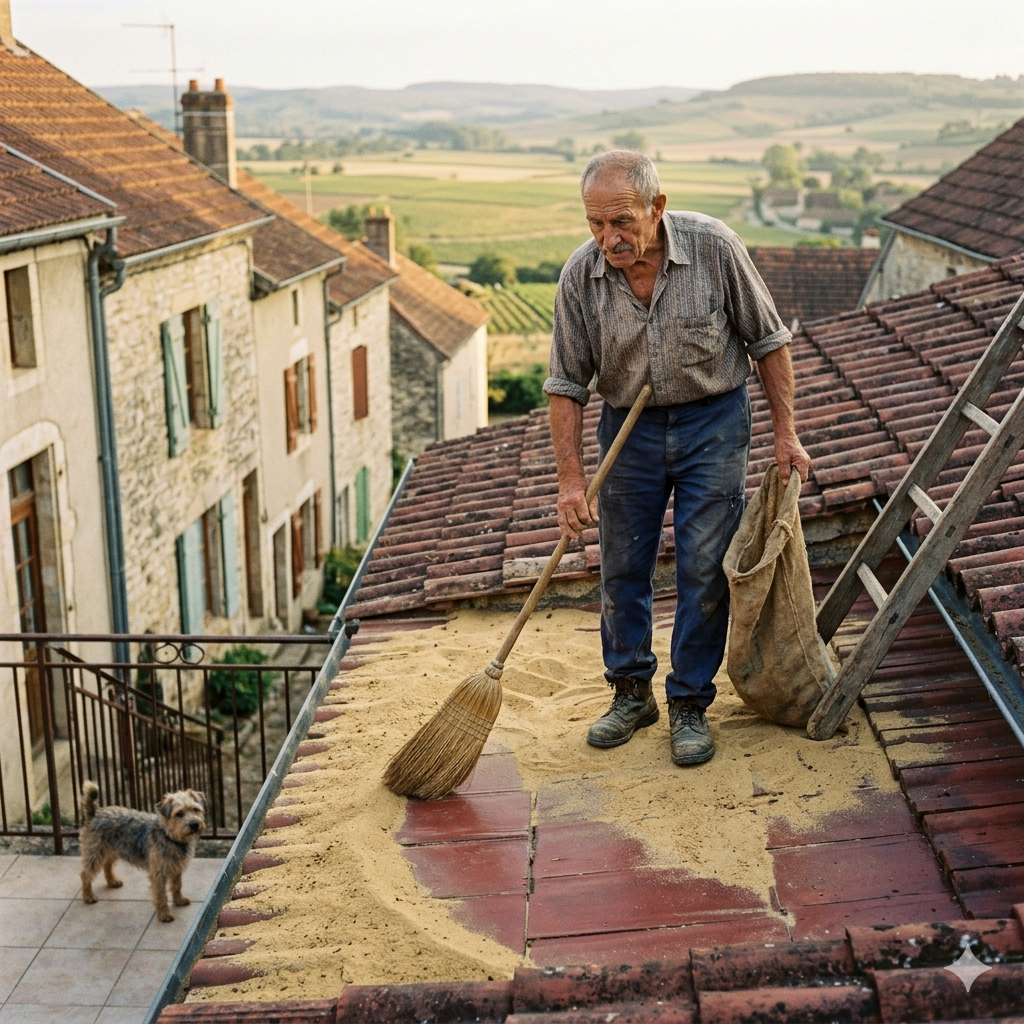
“You’d think he’d at least save his strength for chopping wood,” muttered Halpern.
“Or clearing his roof,” someone added. “That snow’s going to crush it.”
The old man said nothing.
Then, one afternoon, the sky darkened earlier than usual. The wind shifted sharply, howling down from the northern ridge. Snow began to fall—not soft flakes, but hard, needle-like crystals driven sideways by violent gusts.
By nightfall, the storm had become something else entirely.
Ice mixed with snow, coating everything in a brittle shell. Trees groaned. Power lines snapped. Visibility dropped to a few feet. The temperature plunged so quickly that windows frosted from the inside.
People huddled indoors, feeding their stoves, praying their roofs would hold.
By midnight, the storm intensified further.
Wind slammed into houses with explosive force. Snow accumulated unevenly, forming heavy drifts on leeward sides. Ice welded layers together, turning powder into dense slabs. Several roofs began to creak ominously.
At two in the morning, the first collapse came.
The Wilsons’ barn roof caved in with a thunderous crack. Livestock scattered in panic. The sound echoed through the storm, followed by shouting that was quickly swallowed by the wind.
An hour later, another collapse—this time the Miller house porch. Then the small storage shed behind the church.
By dawn, Pine Hollow looked like a battlefield.
Roofs sagged dangerously. Some had partially collapsed. Ice clung to shingles, locking heavy snow in place. People emerged cautiously, exhausted and frightened.
Then someone noticed the old man’s house.
It stood untouched.
The roof was clean—almost bare—despite the storm. Snow had slid off during the night, forming neat piles around the base. The shingles, dark and exposed, showed no sign of strain.
A few villagers gathered, staring upward.
“How…?” whispered Mrs. Doyle.
Halpern squinted. “Must’ve cleared it during the night.”
But no footprints surrounded the ladder. No signs of shoveling. No scrape marks.
Just smooth, fallen snow.
The old man opened his door, stepped outside, and calmly brushed frost from his sleeves.
“You’re… alright?” Halpern asked.
The old man nodded.
“What did you do?” someone else asked.
He looked at them, surprised by the attention.
“Nothing,” he said quietly. “Just my routine.”
They exchanged confused glances.
“The sand?” Mrs. Doyle asked.
He shrugged slightly. “Gives the roof texture. Keeps ice from bonding. Snow slides easier.”
They stared at him.
He continued, almost apologetically. “Ice forms when meltwater refreezes. Smooth shingles hold it. Sand roughens the surface. I sweep it off so it doesn’t trap moisture. Been doing it every day. Prevents buildup.”
Silence.
The explanation sounded simple. Too simple.
But they couldn’t argue with what stood before them: a roof that had survived untouched while others sagged under crushing weight.
That afternoon, another roof collapsed—this time the Thompsons’ garage. No one was hurt, but the fear spread quickly. Villagers began climbing their own roofs, shoveling frantically, hacking at ice with axes. It was dangerous work, and several slipped, barely catching themselves.
Meanwhile, the old man repeated his routine the next morning.
Sand.
Sweep.
Sand.
Sweep.
This time, no one laughed.
Instead, Halpern approached cautiously.
“You think… it would help mine?” he asked.
The old man looked at the sagging roof in the distance. “Better earlier than later. But yes.”
Halpern nodded. “Mind showing me?”
The old man gestured toward the ladder.
By midday, three villagers stood atop Halpern’s roof, spreading sand and sweeping carefully. Others watched, then began doing the same. Children carried buckets. Someone fetched extra sand from the frozen riverbank.
By evening, half the village had treated their roofs.
The storm lingered another two days, delivering fresh snow and freezing rain. But this time, something changed. On houses where sand had been applied and swept regularly, snow slid off more easily. Ice failed to anchor firmly. Roofs groaned less.
When the storm finally passed, Pine Hollow took stock of the damage.
Several structures were lost. Many roofs required repair. But those who adopted the old man’s method fared noticeably better.
Word spread quickly.
“No more calling him ‘time-waster,’” Mrs. Doyle said quietly.
Halpern nodded. “We owe him.”
They walked together to the edge of the village. The old man sat on his step, sipping from a metal mug, watching sunlight glitter across the snow.
Halpern cleared his throat. “We… wanted to thank you.”
The old man looked puzzled. “For what?”
“For showing us,” Mrs. Doyle said. “About the sand.”
He shook his head gently. “Just something I learned long ago.”
“Where?” Halpern asked.
The old man glanced toward the mountains. “My wife. She noticed ice stuck more where the roof was smooth. One winter, she threw sand up there so I wouldn’t slip while fixing the chimney. Next snowfall slid right off. We tested it after that. Every year.”
He paused, eyes distant.
“After she passed… I kept doing it. Habit, I suppose.”
They stood quietly.
Halpern finally spoke. “Funny thing. We all thought you were wasting time.”
The old man smiled faintly. “Preparation always looks like waste… until the day it isn’t.”
From that winter onward, the routine spread through Pine Hollow. Each autumn, villagers hauled sand to their roofs. Children helped sweep. It became tradition—almost ritual.
And every morning, the old man still climbed his ladder first.
Sand.
Sweep.
Sand.
Sweep.
But now, when people saw him, they didn’t laugh.
They nodded.
Some even followed his rhythm, broom strokes echoing across rooftops, a quiet chorus of preparation against the coming cold.
The nickname faded. Eventually, younger villagers never heard it at all.
Instead, they called him something else.
“The man who saw the storm coming.”
Winter did not end quietly in Pine Hollow.
After the storm passed, the village spent weeks repairing damage. Broken beams were replaced, collapsed sheds rebuilt, and sagging roofs reinforced. The old man helped where he could, though he rarely gave instructions unless someone asked. He worked slowly, deliberately, like everything else he did.
What surprised the villagers most was not just his method—but his patience.
He never rushed.
Even when helping Halpern reinforce the feed shop roof, he stopped at sunrise the next morning, climbed his own ladder, and completed his ritual first.
Sand.
Sweep.
Sand.
Sweep.
Then he returned to work.
Soon, others began copying him again—not just the technique, but the discipline. Some spread sand once a week. A few did it daily. Most forgot after the snow melted, returning to old habits.
But the old man never stopped.
Even in spring, when snow had vanished and warm winds softened the ground, he continued his routine. Sand. Sweep. Sand. Sweep.
Children asked why.
“No ice now,” one boy said.
The old man replied gently, “Habits don’t wait for emergencies. They prepare for them.”
By summer, the village had mostly forgotten the winter scare. Roofs dried under the sun, and life resumed its usual rhythm. Tourists passed through, buying jam and firewood. Farmers repaired fences. The river swelled with melted snow.
Only the old man continued his strange morning ritual.
Some newcomers chuckled when they saw him. “What’s he doing?” they’d ask.
The locals would answer simply, “Preparing.”
Late in August, something unusual happened.
The old man visited the general store—rare for him—and bought more sand than usual. Not just one bucket’s worth, but four heavy sacks. Halpern raised an eyebrow.
“Expecting another storm?” he joked.
The old man hesitated. “Maybe.”
Halpern leaned on the counter. “Winter’s months away.”
The old man nodded slowly. “Mountains don’t always follow calendars.”
That evening, he carried the sacks home one by one. Then he began spreading sand not just on the roof—but along the edges, near the gutters, and even lightly across the walkway leading to his door. Afterward, he swept most of it away, leaving only faint traces.
The next morning, he repeated it.
Neighbors noticed.
“You think he knows something?” Mrs. Doyle asked Halpern.
“He always seems to,” Halpern replied.
But the sky remained clear. Days passed. Nothing happened.
People shrugged. “Just the old man being careful.”
September arrived with cool nights. Leaves turned gold. The mountains grew quiet again.
Then, without warning, the first early-season cold front swept in.
It wasn’t snow.
It was freezing rain.
A thin mist coated everything overnight—trees, roads, roofs—then temperatures plunged below freezing. By dawn, Pine Hollow was trapped beneath a layer of clear, glassy ice.
Branches bent dangerously. Power lines sagged. Steps became treacherous. People slipped walking to their sheds.
But something else happened.
On houses where villagers had lightly sanded their walkways—copying the old man—ice failed to form a solid sheet. The roughened surface broke it apart. Traction remained.
At Halpern’s store, customers shuffled carefully across the entrance, surprised they weren’t sliding.
“You did this?” someone asked.
Halpern nodded. “Old man’s idea.”
Meanwhile, the old man walked normally to his mailbox, boots crunching confidently.
Mrs. Doyle, who hadn’t sanded her path, slipped and nearly fell. The old man reached her just in time, steadying her arm.
“You alright?” he asked.
She nodded, shaken. “I should’ve listened.”
He smiled gently. “Still can.”
By afternoon, villagers spread sand across paths, porches, and steps. The ice storm lasted two days, but injuries were minimal. No broken bones. No emergency evacuations.
That night, several neighbors gathered outside the old man’s house. They brought coffee, bread, and a small lantern. It was the closest thing Pine Hollow had to a thank-you ceremony.
Halpern spoke first. “You saved us again.”
The old man shook his head. “You saved yourselves. You listened.”
Mrs. Doyle looked at him thoughtfully. “How do you always know?”
He took a slow sip of coffee. “I don’t know. I just prepare for what’s possible.”
“Most of us only react,” Halpern admitted.
“Reaction is louder,” the old man said. “Preparation is quieter.”
The group sat in silence, listening to wind rattle the frozen branches.
After that, the village changed in small but meaningful ways.
People started stacking firewood earlier. Checking roofs before winter. Reinforcing doors. Clearing drainage channels. None of it dramatic—but together, it made Pine Hollow more resilient.
And always, at sunrise, the old man climbed his ladder.
Sand.
Sweep.
Sand.
Sweep.
Years passed.
Children grew into adults who remembered the storm. They told newcomers about the “time-waster” who wasn’t wasting time at all. The nickname became a story, then a lesson.
One particularly harsh winter, long after the first storm, another blizzard hit Pine Hollow—stronger than before. Winds tore through the valley. Snow piled high. Ice sealed everything again.
But this time, the village was ready.
Roofs had been treated. Walkways sanded. Supplies stored. Neighbors checked on one another before the storm even arrived.
When morning came, Pine Hollow stood firm.
No collapses.
No injuries.
No panic.
Halpern walked through the quiet, snow-covered street and stopped at the old man’s house. The roof was, as always, clean—snow slid neatly to the sides.
But something was different.
No footprints.
No ladder marks.
The old man’s door remained closed.
Concerned, Halpern knocked gently.
No answer.
He pushed the door open slowly.
Inside, the stove had burned low but still glowed faintly. The chair sat beneath the photograph. On the table rested a metal mug, half full. The old man sat in his chair, head slightly bowed, as if asleep.
Peaceful.
Still.
Halpern removed his hat.
Word spread quietly through Pine Hollow. People gathered outside, not speaking loudly, just standing together in the cold morning air.
Mrs. Doyle wiped her eyes. “He prepared us… even for this.”
Later that day, the villagers did something they had never done before.
Without being asked, they climbed their roofs.
All of them.
Buckets of sand appeared across Pine Hollow. Brooms scraped in unison. The sound echoed through the valley—soft, rhythmic, respectful.
Sand.
Sweep.
Sand.
Sweep.
It was no longer strange.
It was tradition.
From that winter on, every first snowfall, the entire village performed the ritual together. Children learned it before they learned to shovel. Newcomers were shown gently, with stories of the man who prepared before danger arrived.
And though his house eventually passed to another family, one thing never changed.
Every morning in winter, across Pine Hollow, rooftops whispered with the same quiet motion.
Sand.
Sweep.
Sand.
Sweep.
No one called it wasting time anymore.
They called it remembering.