
“Can I Stay With You Tonight?” The Mountain Man Whispered to the Shy Obese Woman
The wind rolled down from the mountains like a living thing, bending the pines and sending loose snow whispering across the frozen clearing. Clara Bennett pulled her shawl tighter around her shoulders and leaned harder into the axe. The log cracked cleanly in two, and she exhaled in relief. Another piece for the stove. Another hour of warmth.
She was used to working alone.
The small cabin sat at the edge of the Wyoming foothills, far from town and farther from kindness. Folks in Miller’s Crossing didn’t say cruel things to her face, but she saw the looks. The quiet laughter. The whispers about “that shy obese woman who lives alone in the woods.” They assumed she’d never marry, never leave, never become anything except a rumor.
Clara had stopped caring. Or at least, she told herself she had.
She stacked the wood carefully by the door and turned toward the fading daylight. The sun dipped behind the ridgeline, painting the sky a bruised purple. Storm coming. She could feel it in her bones. Winter in these mountains didn’t arrive politely — it came with teeth.
She hurried inside, bolting the door behind her.
The cabin was small but tidy. A cast-iron stove, a narrow bed, a rough-hewn table, and shelves filled with jars of preserved vegetables. Clara lit the lantern, and golden light filled the room. She set water to boil and rubbed her aching hands.
Then she heard it.
A sound outside.
Not wind. Not branches.
Footsteps.
She froze.
No one came up here. No one. The nearest neighbor was three miles away, and even he only passed once a month. The steps dragged slowly across the snow, uneven and heavy.
Clara’s heart pounded. She reached for the iron poker beside the stove.
The steps stopped at her door.
A long silence followed.
Then, a faint knock.
Not loud. Barely more than fingertips against wood.
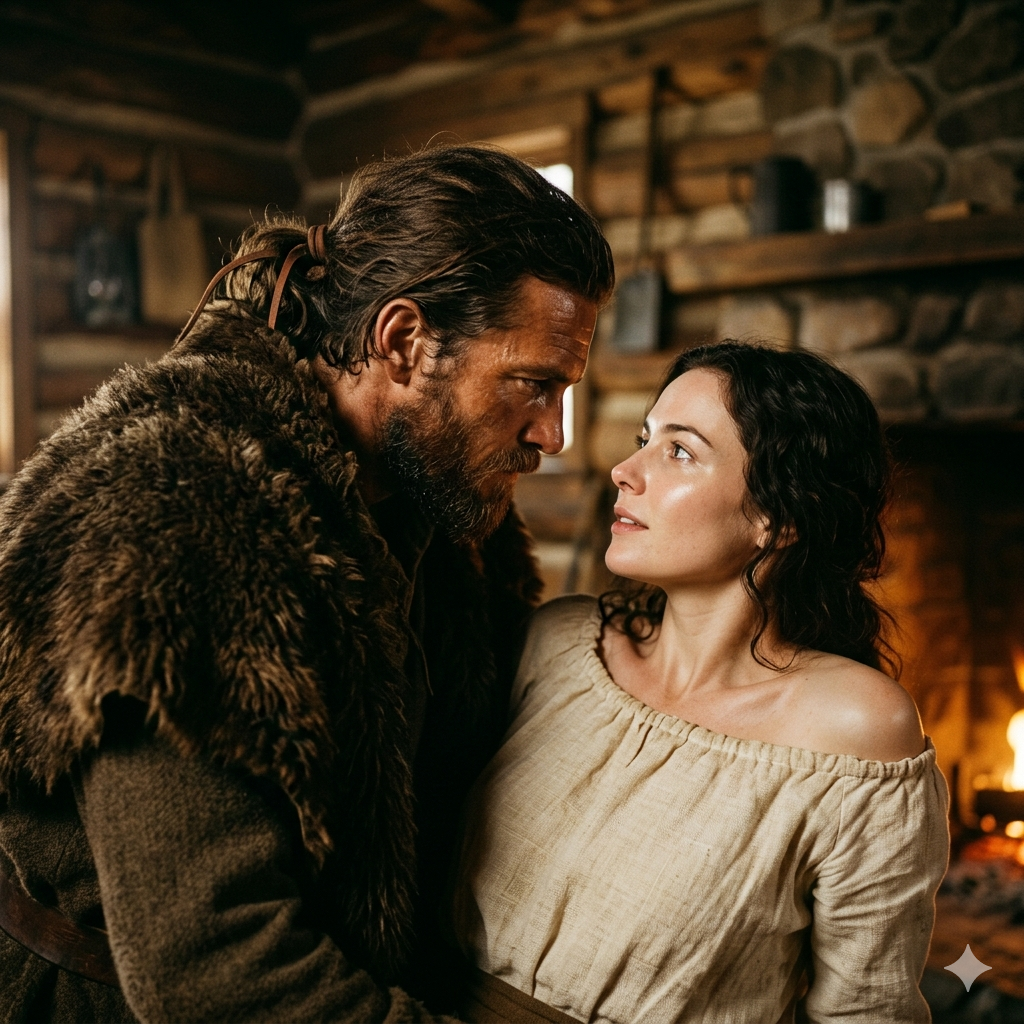
She swallowed.
“Who’s there?” she called, her voice trembling despite her effort to sound strong.
No answer.
Just the wind.
She took a step closer. Another. Her boots creaked against the floorboards. The lantern flickered.
Then a voice came, hoarse and weak.
“Can I stay with you tonight?”
Clara froze.
The voice was deep but fragile, like it had been scraped raw by cold. She hesitated, every warning she’d ever heard ringing in her mind. A woman alone shouldn’t open the door to strangers. Especially not out here.
But then she heard him cough.
It wasn’t a threatening sound. It was a man on the edge of collapse.
She slid the bolt halfway.
“Who are you?” she asked.
“Just… a traveler,” he whispered. “Please.”
Clara opened the door.
The man nearly fell inside.
He was enormous — broad-shouldered, bearded, wrapped in a tattered fur coat stiff with frost. Snow clung to his dark hair, and his boots were worn through at the toes. His face was pale beneath the beard, lips cracked, eyes half-lidded.
He swayed.
Clara dropped the poker and grabbed his arm.
“Sit,” she said quickly, guiding him to the chair near the stove.
He sank into it like a collapsing tree.
The heat from the fire touched him, and he shuddered violently. His hands were raw and red, fingers stiff with cold.
“You’ll lose them if you don’t warm slowly,” Clara murmured, kneeling. She’d seen frostbite before. Her father had taught her. “Don’t rub them.”
He nodded faintly.
She poured warm water into a basin and set it beside him. The man tried to lift his hands but winced.
Without thinking, Clara took them gently.
They were huge compared to hers — rough, scarred, and trembling.
“You walked far,” she said.
“Two days,” he whispered.
Her eyes widened.
“Through this storm?”
“Didn’t know where else to go.”
She wrapped his hands in warm cloth and glanced up. His eyes were watching her — not with suspicion, not with judgment — just quiet exhaustion.
“What’s your name?” she asked.
“Eli,” he said. “Eli Turner.”
“I’m Clara.”
He nodded once, like the effort cost him something.
She ladled stew into a bowl and handed it to him. He hesitated.
“You sure?” he asked.
“It’s just potatoes and carrots,” she said. “I’ve got more.”
He took it carefully, hands still shaking. He ate slowly at first, then with quiet hunger. Clara pretended not to notice.
Outside, the wind grew louder.
Snow slammed against the cabin walls.
“You won’t make it back out tonight,” she said.
“I wasn’t planning to.”
She hesitated, then added, “You can take the bed. I’ll sleep by the stove.”
He looked up sharply.
“No. I can—”
“You can barely stand.”
He studied her face, perhaps expecting mockery. Clara looked away, suddenly self-conscious. She knew what she looked like — round cheeks, heavy shoulders, dress stretched across her middle. Most men avoided her eyes.
But Eli didn’t.
“You’re kind,” he said simply.
The words startled her more than anything.
“I just don’t like seeing people freeze,” she muttered.
The storm howled.
Hours passed. Eli warmed slowly, color returning to his face. Clara set blankets on the bed and turned down the lantern.
“You should sleep,” she said.
He stood carefully. Even weakened, he towered over her. He paused, swaying.
Clara instinctively reached out.
His hand settled lightly on her shoulder — steadying himself, nothing more — but the warmth of it made her heart skip.
“Thank you,” he said quietly.
She nodded, unable to speak.
He lay down, and within minutes, his breathing deepened.
Clara sat by the stove, listening to the storm and the slow rhythm of a stranger’s breathing. She told herself she was only keeping watch.
But she found herself smiling.
Morning came pale and silent.
The storm had buried the world in white.
Clara woke to the smell of coffee.
She blinked.
Eli stood at the stove, moving carefully but steadily. He looked stronger already.
“You didn’t have to—” she began.
“You saved me,” he said. “Least I can do.”
He handed her a tin cup.
Their fingers brushed.
Clara looked down quickly.
“You heading out today?” she asked.
He glanced at the window.
“Not yet. Snow’s too deep. I’d slow you down if you had chores.”
“I always have chores,” she said. Then, after a pause, “You can stay till the trail clears.”
He studied her again.
“You sure?”
She shrugged. “Cabin’s quiet anyway.”
The corner of his mouth lifted.
Days passed.
Eli chopped wood despite Clara’s protests. He repaired the loose hinge on the door. He patched a leak in the roof she’d been ignoring for months. He didn’t talk much, but when he did, his voice was gentle.
Clara found herself laughing more.
On the fourth evening, they sat by the fire.
“You live out here alone?” he asked.
“Since my parents passed,” she said. “Town’s not fond of me.”
“Why?”
She hesitated.
“You know why.”
He shook his head.
“I don’t.”
She met his eyes.
“I’m not… what people expect.”
He looked at her thoughtfully.
“You’re strong,” he said. “You run this place alone. That’s more than most.”
Her throat tightened.
No one had ever said that.
Outside, the wind softened.
“I should head out tomorrow,” he said quietly.
Her chest sank.
“Where will you go?”
“Back to my cabin. Higher up the ridge.”
“You live alone too?”
He nodded.
Silence filled the room.
Clara stared at the fire.
“Will you… come back?” she asked before she could stop herself.
Eli looked at her, surprised.
“If you’d like me to.”
“I would.”
He smiled — a slow, warm thing that reached his eyes.
“I will.”
The next morning, he left.
The cabin felt too quiet after.
Days turned into weeks.
Then one afternoon, Clara heard footsteps again.
Her heart leapt.
She opened the door before he knocked.
Eli stood there, holding a bundle of fresh-cut pine.
“Told you I’d come back,” he said.
She smiled so wide it hurt.
And for the first time in years, Clara didn’t feel alone in the mountains.