
Banished in October, She Found a Warm Cave — And Survived Without Burning a Log
By the time they told Eleanor Whitmore to leave, the first frost had already silvered the fences.
October in northern Montana had a way of warning people before it punished them. The mornings came sharper. The creek edges turned to glass. Elk moved lower through the timber. Smoke rose from every chimney in Bitter Creek as if the whole valley were preparing for judgment.
Eleanor stood in the middle of the town square with one leather satchel in her hand, her old shepherd dog Boone pressed against her leg, and twenty-seven people pretending not to look her in the eye.
The accusation had spread faster than wildfire.
Witch.
Healer.
Dangerous.
Different.
In small towns, those words often meant the same thing.
She was thirty-two, unmarried, and smarter than most of the men who sat on Bitter Creek’s council. She knew which moss stopped bleeding, which roots reduced fever, which mushrooms would kill a man before sunset. For years they had come to her cabin at the edge of the woods—quietly, usually after dark—bringing sick children, infected wounds, winter coughs.
And she had never once turned them away.
Until the mayor’s youngest son died.
Pneumonia.
Nothing Eleanor gave him could save him. Nothing any doctor from Helena could have done either.
But grief needed a target.
So on the fourth day of October, they gave her one hour to leave.
No trial.
No appeal.
No wagon.
No firewood.
Just exile.
Mayor Thomas Reed wouldn’t even meet her eyes.
“You can take what you can carry.”
Eleanor looked at him, then at the men standing behind him.
Hunters.
Farmers.
Men whose wives she had saved in childbirth.
Men whose children she had treated.
She nodded once.
“Then I hope none of you get sick this winter.”
And with that, she turned her back on Bitter Creek.
Snow began before sundown.
Boone stayed close as they climbed into the timber.
Eleanor’s boots sank into wet pine needles. Her breath rose in white clouds. Behind her, the valley lights slowly disappeared between trees.
She had no rifle.
No horse.
No tent.
No axe.
Only a canvas satchel filled with dried herbs, a knife, a flint striker, and three loaves of hard bread.
By every rule of Montana wilderness, she should have been dead before November.
By December, frozen solid.
By January, forgotten.
But Eleanor Whitmore had never cared much for rules.
The first two nights nearly killed her.
She slept beneath fallen spruce branches, wrapped in an old wool blanket, Boone curled against her stomach for warmth.
The temperature dropped below twenty.
Wind screamed through the trees.
She woke every hour, shaking.
By the third day, snow reached her calves.
By the fifth, her bread was gone.
She trapped rabbits with wire snares.
Gathered rose hips.
Dug cattail roots from frozen marshes.
And still she kept climbing.
Higher.
Farther.
Away from the valley.
She didn’t know exactly what she was looking for.
Only that if Bitter Creek wanted her dead…
They’d have to wait.
On the seventh day, Boone found it.
He barked once.
Then vanished behind a ridge of granite.
Eleanor followed.
And stopped breathing.
There, half-hidden behind hanging cedar roots and thick curtains of moss, was an opening in the mountainside.
Not a crack.
Not a crevice.
A doorway.
Ten feet high.
Wide enough for two wagons.
Dark inside.
But from its mouth…
Steam.
Warm, white steam.
Eleanor stepped closer.
Snow melted instantly beneath her boots.
Her frozen fingers trembled as she reached toward the opening.
Warm air.
Not just warm.
Hot.
She looked down.
Water trickled from stone in tiny silver streams.
Mineral-rich.
Geothermal.
She smiled for the first time in a week.
“Well,” she whispered.
Boone wagged his tail.
“Looks like we’re home.”
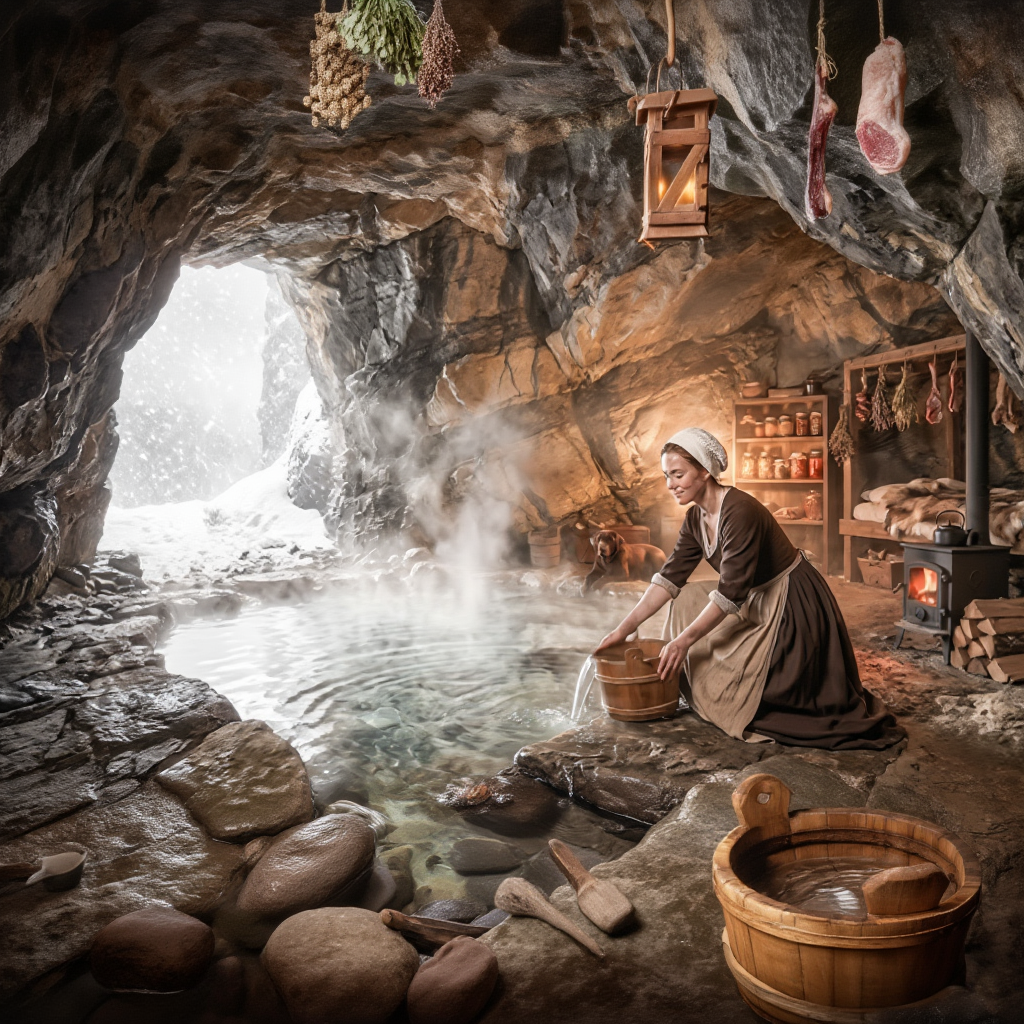
The cave went deeper than she expected.
Fifty feet.
A hundred.
Then farther still.
Its ceiling rose like a cathedral of stone.
Ancient formations twisted overhead.
Stalactites gleamed in lantern-like shapes.
Natural shelves lined the walls.
And near the center…
A pool.
Crystal clear.
Steaming.
Fed from somewhere deep within the earth.
Eleanor knelt beside it.
Dipped trembling fingers into the water.
Hot.
Not boiling.
Perfect.
She laughed.
Actually laughed.
Boone barked as though he understood.
By nightfall, Eleanor had moved in.
The cave became her kingdom.
She never burned a single log.
Never chopped a tree.
Never built a chimney.
She didn’t need to.
The mountain itself kept her alive.
Hot mineral water warmed the cave year-round.
Steam rose constantly, creating a blanket of moist heat that trapped warmth even when blizzards raged outside.
She learned quickly.
She dried venison strips from deer Boone helped track.
Hung rabbit meat from ceiling hooks she carved from antlers.
Bundled sage, mint, pine needles, and juniper to dry above the warm currents.
Collected mushrooms from shaded slopes.
Stored roots in cool stone alcoves.
Built shelves.
Clay bowls.
Bone needles.
Leather sacks.
By November…
She wasn’t surviving.
She was thriving.
Her favorite hour became dawn.
She would kneel beside the steaming pool, white scarf tied over her hair, apron damp with mineral mist, and pour fresh water from wooden buckets into the basin.
Boone would stretch near the cast-iron stove she’d found abandoned in an old trapper’s camp miles away.
Not for heat.
Only for cooking.
Outside, snow buried the world.
Inside…
Steam danced through shafts of pale winter light.
Meat hung from the ceiling.
Herbs swayed gently overhead.
Lanterns glowed against stone walls.
And Eleanor—banished, betrayed, forgotten—
felt richer than she ever had in town.
By December, Bitter Creek began to suffer.
First came the sickness.
Flu.
Then infected cuts.
Then frostbite.
Then pneumonia.
The town doctor left before Christmas.
Said the roads were too dangerous.
Said supplies wouldn’t come until spring.
And suddenly…
People remembered Eleanor Whitmore.
But pride is warmer than guilt.
At first.
Christmas came with the worst storm in thirty years.
Snow buried fences.
Collapsed roofs.
Killed livestock.
Blocked every road for fifty miles.
By New Year’s, Bitter Creek was starving.
By mid-January…
They were desperate.
Eleanor heard them before she saw them.
Voices.
Weak.
Calling through the storm.
Boone barked.
She stepped to the cave mouth.
And there, stumbling through waist-deep snow…
Mayor Thomas Reed.
His daughter.
And two children.
Barely standing.
Faces blue with cold.
Eleanor said nothing.
Just watched.
Reed dropped to his knees.
Snow covered his shoulders.
His voice cracked.
“Please.”
One word.
Nothing more.
Eleanor looked at him for a long moment.
Then stepped aside.
“Bring them in.”
The children cried when they felt the warmth.
Steam wrapped around them like a living blanket.
Reed’s daughter nearly collapsed beside the pool.
Boone licked the youngest boy’s frozen hands until he smiled.
Eleanor fed them venison broth.
Juniper tea.
Roasted roots.
Honey she’d traded from mountain beekeepers months earlier.
No questions.
No accusations.
No revenge.
Just care.
Because that was who she was.
Even when they didn’t deserve it.
Three days later, Reed finally asked.
“How…”
He looked around the glowing cave.
At the hanging herbs.
The dry meat.
The warm stones.
The steam.
The peaceful dog.
At Eleanor.
“How are you alive?”
She smiled faintly.
“Because the mountain was kinder than people.”
Reed lowered his eyes.
And for the first time in his life…
He had no answer.
Word spread.
By February, others came.
Mothers.
Children.
Hunters.
Widows.
Farmers.
Not all at once.
One by one.
Ashamed.
Hungry.
Cold.
Eleanor took them in.
Taught them.
How to preserve food.
How to find hot springs.
How to use moss insulation.
How to heal frostbite.
How to live with the land instead of against it.
And something strange happened.
The cave stopped being exile.
It became sanctuary.
By spring, people stopped calling her witch.
Stopped calling her healer.
Stopped whispering.
They started calling her something else.
The Keeper of Warm Stone.
And Eleanor Whitmore…
The woman they had banished in October…
The woman they expected to freeze before snowfall…
The woman who survived an entire Montana winter without burning a single log…
Never moved back to town.
Not ever.
Instead…
The town moved closer to her.
Cabins appeared near the mountain base.
Then gardens.
Then smokehouses.
Then schools.
And over time…
Bitter Creek became known across Montana not for gold…
Not for timber…
Not for cattle…
But for one impossible truth.
That in the coldest winter anyone could remember…
A woman everyone abandoned found warmth where nobody else thought to look.
Deep beneath stone.
Inside the mountain.
Inside herself.
And when the world came begging at her door…
She opened it.
Anyway.