
At 19, She Was Forced to Marry an Apache — But His Wedding Gift Silenced the Whole Town
The town of Red Creek sat in a dusty valley between low desert hills in the Arizona Territory. It was the kind of place where everyone knew everyone—and everyone knew everyone’s business.
So when people began whispering that Mary Whitaker was going to marry an Apache warrior, the rumors spread faster than a prairie fire.
Mary was nineteen.
She had grown up above her father’s general store, where the smell of flour sacks and leather boots filled the air from dawn to dusk. Her mother had died when she was a little girl, and since then Mary had become the quiet helper who kept the shop running.
People in Red Creek described her the same way: kind, polite… and stubborn.
But even stubborn girls sometimes had no choice.
The Debt
The trouble had started with Mary’s father.
Thomas Whitaker had once been a respected shopkeeper, but over the years he developed a weakness for gambling. At first it was harmless poker games behind the saloon.
Then came bigger bets.
By the time Mary turned nineteen, the store was drowning in debt.
One evening, as the sun dipped behind the hills, Mary heard shouting downstairs.
She stepped carefully down the wooden staircase.
Three men stood inside the shop.
One of them was Sheriff Dalton.
The second was a banker from Prescott.
The third man stood apart near the door.
He was tall, broad-shouldered, and dressed in buckskin and beadwork. His long black hair was tied behind his back, and his dark eyes moved quietly around the room.
Mary had never seen him before.
Her father’s face was pale.
“Mary,” he said, forcing a smile that didn’t reach his eyes. “Come here.”
She stepped closer.
“What’s wrong?”
No one answered immediately.
Finally the banker cleared his throat.
“Your father owes a considerable amount of money.”
Mary looked at her father.
He avoided her eyes.
“How much?” she asked.
“More than the store is worth,” the banker said bluntly.
The room felt suddenly smaller.
Mary turned toward the tall Apache man.
“Why is he here?”
The sheriff shifted uncomfortably.
“His name is Takoda.”
Takoda nodded once.
“He paid the debt,” the sheriff said.
Mary blinked.
“He… bought the store?”
The sheriff shook his head slowly.
“No.”
Silence filled the room.
Then Mary’s father spoke in a hoarse voice.
“He paid the debt in exchange for… a marriage agreement.”
Mary felt the air leave her lungs.
“A marriage…?”
The words barely came out.
Her father finally looked at her.
“I didn’t have another choice.”
The town gossip had always been cruel.
But this?
This would feed them for years.
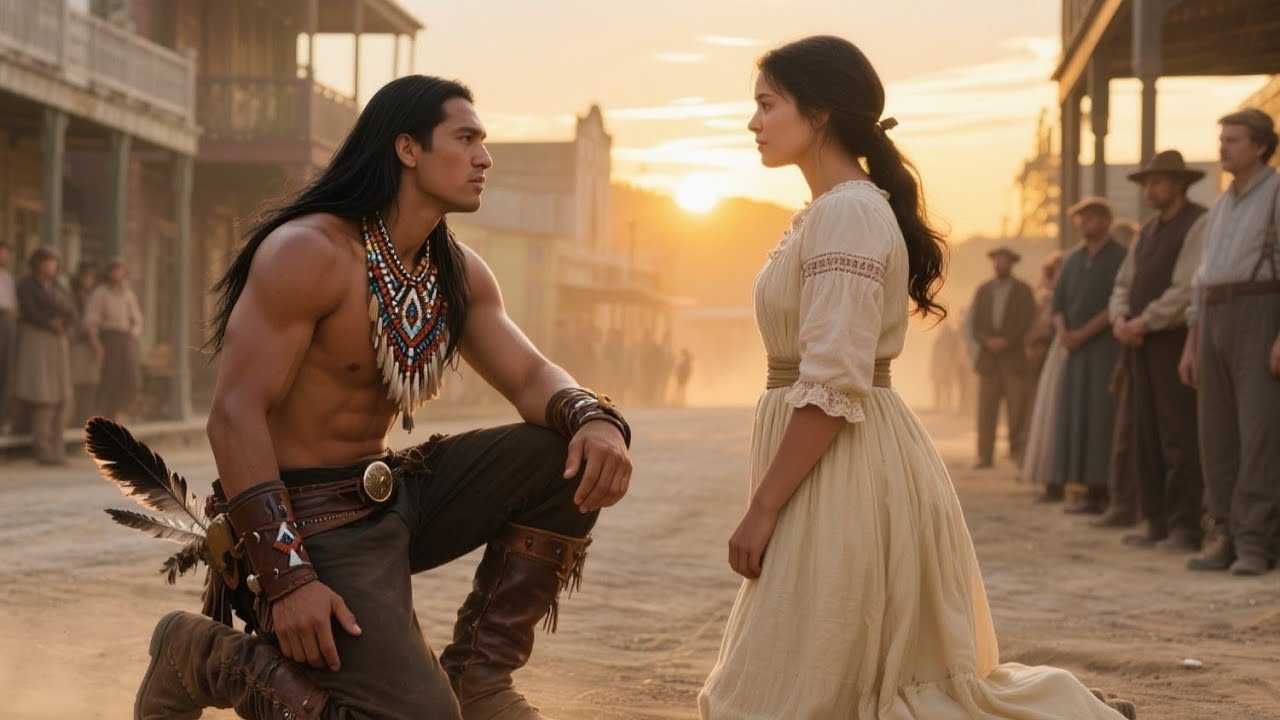
The Town’s Reaction
By morning, the entire town of Red Creek knew.
Whispers followed Mary everywhere she went.
“Did you hear?”
“She’s marrying an Apache.”
“Her father sold her!”
At the water well, two women stopped talking the moment Mary approached.
At the bakery, the owner refused to meet her eyes.
Some people pitied her.
Others judged her.
Most simply watched.
But Takoda said nothing.
He came to town only once a week, trading quietly at the edge of the market.
He never argued.
Never explained.
Never defended himself.
That silence only made people talk more.
The Wedding Day
The wedding was scheduled for a Sunday afternoon in front of the small wooden church.
Nearly the entire town gathered to watch.
Not because they supported the marriage.
Because they were curious.
Mary stood inside the church, staring at her reflection in the small mirror.
Her white dress was simple but clean.
Her hands trembled slightly.
Her father stood near the door.
“You’ll be safe,” he said weakly.
Mary turned toward him slowly.
“Safe isn’t the same as happy.”
He had no answer.
Outside, the crowd murmured as Takoda approached.
He wore traditional Apache clothing—buckskin leggings, a woven sash, and a silver necklace that caught the sunlight.
Some townspeople whispered insults under their breath.
Others simply stared.
The preacher cleared his throat nervously.
“Well… shall we begin?”
Mary stepped forward.
Takoda stood across from her, calm and silent.
His expression revealed nothing.
The vows were short.
Simple.
When the preacher finished, he looked uncertain.
“Is there… anything else?”
Takoda nodded once.
“I have a wedding gift.”
Laughter rippled through the crowd.
“Did he say a gift?”
“Maybe a bow and arrow!”
But Takoda didn’t react.
He turned toward the hills outside town and raised his hand.
For a moment nothing happened.
Then dust appeared on the horizon.
Dozens of riders emerged from the desert.
The crowd gasped.
Apache warriors rode toward town in a long line.
Some townspeople stepped back nervously.
Sheriff Dalton’s hand moved toward his gun.
But the riders stopped just outside the church yard.
One by one, they dismounted.
And then something unexpected happened.
They began unloading wagons.
Crates.
Boxes.
Bundles wrapped in blankets.
The townspeople watched in stunned silence as the items were carried forward.
Takoda turned toward Mary.
“This is my gift to my wife.”
The first crate opened.
Inside were sacks of flour.
The second contained dried meat.
The third held medicine bottles and bandages.
Another revealed tools—hammers, saws, nails.
Then blankets.
Dozens of thick winter blankets.
The preacher blinked in confusion.
“What is all this?”
Takoda finally spoke loudly enough for everyone to hear.
“Red Creek will not survive the winter.”
Murmurs spread through the crowd.
Takoda pointed toward the hills.
“The drought killed the game. The crops are failing.”
Everyone knew it was true.
But hearing it said aloud made people uneasy.
“My people prepared for hard times,” Takoda continued calmly.
“These supplies will feed the town.”
Silence fell.
The sheriff stared at the growing pile of goods.
“You’re… giving this away?”
Takoda shook his head.
“It belongs to my wife.”
He looked at Mary.
“She decides how it will be used.”
Mary stood frozen.
Hundreds of eyes turned toward her.
The girl they had pitied.
The girl they had mocked.
Now she controlled enough food to save the entire town.
The banker looked stunned.
The gossiping women looked ashamed.
Even Sheriff Dalton removed his hat slowly.
Takoda stepped closer to Mary.
“Your town will need help,” he said quietly.
Mary looked out at the people who had whispered about her.
The same people who had watched her humiliation like entertainment.
But she also saw frightened children.
Worried mothers.
Old men who knew winter could kill.
She took a deep breath.
Then she spoke clearly.
“We’ll share it.”
Relief washed across the crowd.
Takoda nodded.
Exactly as if he had expected that answer all along.
The Truth
Later that evening, as the sun set over the desert hills, Mary and Takoda stood outside the now-empty church yard.
The supplies had already begun to be distributed.
People who had mocked the marriage now offered quiet thanks.
Mary turned toward him.
“You knew I would share it.”
“Yes.”
“How?”
Takoda smiled slightly.
“I watched you before the wedding.”
“When?”
“In the market. You gave bread to a hungry boy when your father thought no one was looking.”
Mary blinked in surprise.
“You noticed that?”
Takoda nodded.
“My people believe character matters more than words.”
She looked out across the valley.
“You didn’t buy me to settle a debt, did you?”
He shook his head slowly.
“I paid the debt so you would be free from it.”
Mary studied him carefully.
“And the marriage?”
Takoda hesitated.
Then he answered honestly.
“I hoped you might choose to stay.”
The wind moved softly through the desert grass.
For the first time since this strange arrangement began, Mary smiled.
“Maybe,” she said quietly, “this town isn’t the only place that needs a new beginning.”
Takoda looked at her, surprised.
The young woman who had once been forced into marriage now stood beside him by choice.
Behind them, the lights of Red Creek flickered to life.
And for the first time in months, the town felt hopeful.
Not because of gossip.
Not because of fear.
But because two people had chosen something different.
And sometimes… that was enough to change everything.