
A Widow Sells Her Last Cow, But a Cowboy Buys It and Returns It With a Life-Changing Offer
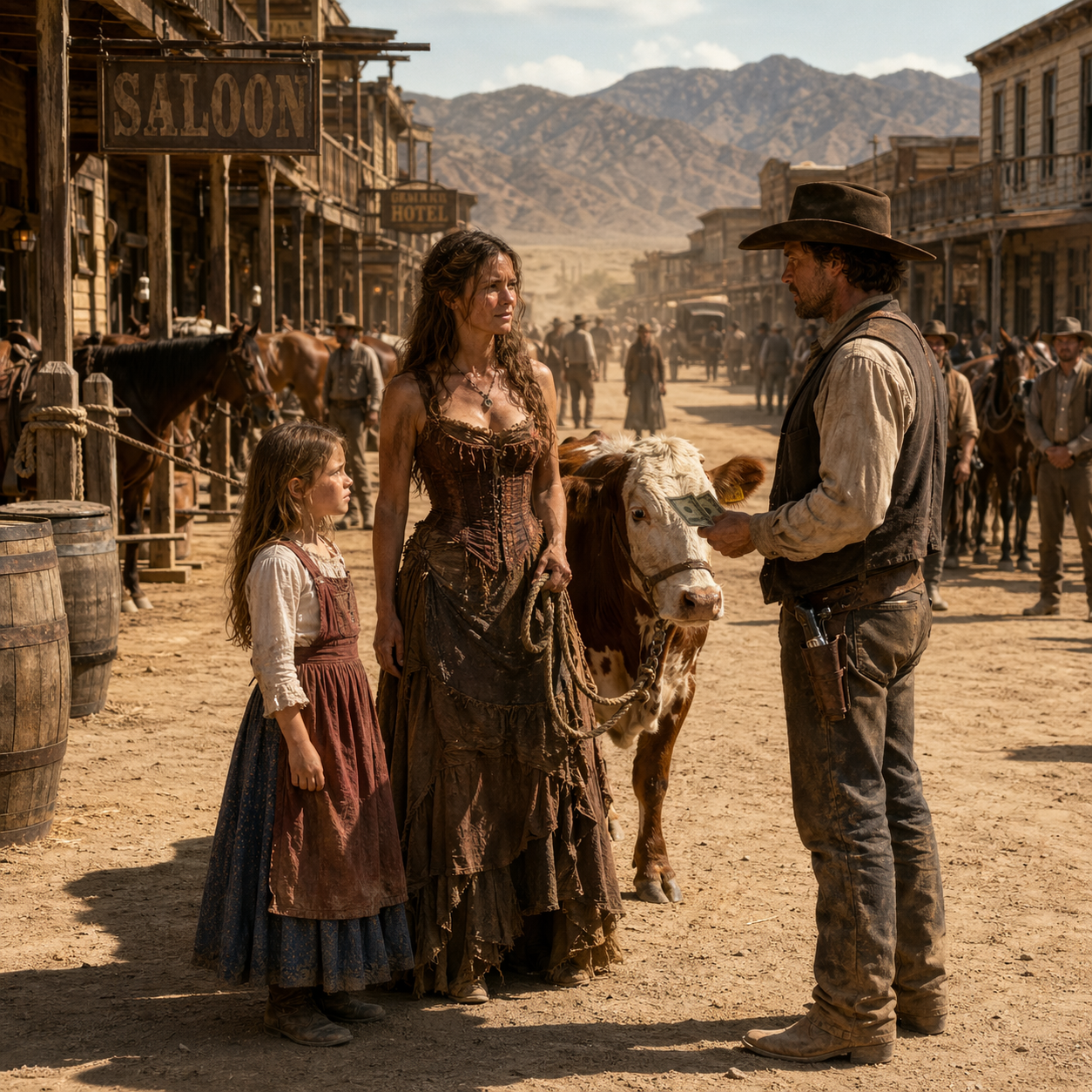
Dust floated in thin golden ribbons across the main street of Dry Creek, a frontier town that clung stubbornly to life at the edge of the mountains. The sun hung low, casting long shadows from the wooden balconies and hitching posts. Horses stamped lazily, leather creaked, and somewhere a piano inside the saloon struggled through a cheerful tune that sounded slightly out of place in the dry, tired air.
Mary Caldwell stood in the middle of the street, gripping a rope tightly in her hand.
At the end of the rope stood her last cow.
The animal was brown and white, ribs faintly visible beneath its hide, but its eyes were calm and trusting. Mary’s fingers tightened as if she feared the cow might disappear if she loosened her grip.
Beside her, her daughter Emily shifted nervously. The girl’s light brown hair was pulled back loosely, and she wore a white shirt under a faded red apron and a blue skirt that had been patched twice at the hem.
“Ma…” Emily whispered. “Do we have to?”
Mary swallowed. “Yes, sweetheart.”
It had come to this.
Three years earlier, her husband Daniel had died in a logging accident up north. A falling pine had crushed his chest before anyone could pull him free. Mary remembered the smell of sawdust, the silence afterward, the way Emily had clutched her dress without understanding.
Since then, Mary had survived by sewing, cleaning, and taking odd jobs. But work had grown scarce. The drought had ruined crops, and families tightened their spending. One by one, she sold what little they owned—the spare chairs, Daniel’s tools, even her wedding silver.
The cow had been the last thing left.
Bessie had given milk every morning, sometimes enough to trade for flour or sugar. Selling her meant giving up the only steady food they had.
But the landlord had come the night before.
“Three days,” he’d said. “Or you’re out.”
So Mary had walked to town, rope in hand, heart heavy.
Men glanced as she passed. Some whispered. Others simply shook their heads. Everyone knew what selling your last cow meant.
It meant desperation.
Emily leaned close. “Will we buy another someday?”
Mary forced a smile. “Someday.”
A voice spoke from behind them.
“How much for the cow?”
Mary turned.
A tall man stood a few steps away, dust clinging to his boots. He wore a dark brown cowboy hat pulled low, a beige shirt rolled at the sleeves, and a dark vest faded from years of sun. A holstered revolver rested at his hip. His expression was calm, but his eyes studied her carefully.
“Forty dollars,” Mary said quietly.
The man looked at the cow, then at Emily, then back to Mary.
“She milk steady?”
“Yes.”
“She gentle?”
“Never kicked once.”
He nodded slowly.
From inside the saloon, laughter burst out. A couple of gamblers leaned over the balcony railing, watching.
“Someone’s buying heartbreak,” one muttered.
The cowboy reached into his vest and pulled out folded green bills. He counted them slowly, deliberately. The sound of paper snapping in the dry air felt louder than it should.
Emily watched, wide-eyed.
Mary’s throat tightened.
The cowboy held out the money. “Forty.”
Mary hesitated.
Her fingers trembled as she reached for it. The rope slipped slightly in her other hand.
“Take care of her,” Emily whispered.
The cowboy crouched down, meeting the girl’s eyes. “What’s her name?”
“Bessie,” Emily said.
He nodded. “I’ll treat her right.”
Mary passed him the rope.
It felt like letting go of a piece of her life.
The cowboy tipped his hat. “Much obliged, ma’am.”
He turned and led the cow down the street. Dust rose around his boots as he disappeared past the hitching posts.
Emily stared after him.
Mary folded the bills carefully, tucking them into her dress pocket. Relief mixed with grief in equal measure.
“Come on,” she said softly. “We need to pay Mr. Collins.”
They walked toward the boarding house.
Behind them, the town resumed its rhythm. The piano played again. Horses snorted. Someone hammered boards across a storefront.
Mary handed the money to the landlord that afternoon. He counted it twice, nodded, and walked away without another word.
That night, Emily stared at the empty barn.
“It’s too quiet,” she whispered.
Mary sat beside her. “I know.”
They went to bed hungry, saving the last bit of bread for morning.
Before dawn, a knock sounded at the door.
Mary woke instantly. Her heart jumped. No one visited this early.
She wrapped a shawl around her shoulders and opened the door.
The cowboy stood outside.
Behind him—Bessie.
Emily gasped from inside.
“Bessie!” she cried, running forward.
The cow mooed softly as the girl hugged her neck.
Mary stared, confused. “I… I don’t understand.”
The cowboy handed her the rope. “She’s yours.”
Mary blinked. “But… you bought her.”
“Still did.”
“Then why—?”
He shifted his weight slightly. “I needed to talk.”
Mary stepped aside. “Come in.”
He entered slowly, ducking beneath the doorframe. The cabin smelled faintly of cold wood and empty shelves.
Emily clung to Bessie outside, whispering happily.
“I’m Jack Turner,” the cowboy said.
“Mary Caldwell.”
He nodded. “I figured.”
She frowned. “You did?”
“Town’s small. Folks talk.”
Mary folded her hands. “You didn’t have to bring her back.”
Jack glanced around the cabin—the worn table, patched curtains, nearly bare pantry.
“Yes,” he said quietly. “I did.”
Mary waited.
“I’ve got a ranch west of here,” he continued. “About fifteen miles. Good land. Water year-round. But…” He hesitated.
“But what?”
“I’ve got more work than one man can handle. Cattle, fencing, cooking, repairs.” He exhaled slowly. “And it’s… quiet.”
Mary said nothing.
Jack looked toward the door, watching Emily laughing with the cow. “You sold your last cow. That tells me things are bad.”
Mary stiffened slightly. “We manage.”
“Not for long,” he replied gently.
Silence stretched.
“I’m not offering charity,” Jack continued. “I’m offering a deal.”
Mary’s heart pounded.
“You come live at the ranch,” he said. “You and your daughter. Help run the place. Milk cows, keep house, whatever you can manage. In return, you get half the milk sales. And a roof. And food.”
Mary stared at him.
“That’s… a lot.”
“There’s more,” he said quietly.
She waited.
Jack removed his hat, twisting it in his hands. “If, in time… we get along… I’d like the chance to court you proper.”
Mary’s breath caught.
He added quickly, “No pressure. No expectations. Just… a chance.”
Outside, Emily laughed again.
Mary looked at the bare shelves. Then at the worn floorboards. Then back at Jack.
“You’d trust a stranger?” she asked.
He shook his head. “You’re not a stranger. You’re a woman who sold her last cow instead of begging. That tells me enough.”
Mary felt tears sting her eyes.
“I can’t promise anything,” she said.
“I’m not asking for promises.”
She looked out the window at Emily hugging Bessie.
“Would Emily be welcome?”
Jack smiled faintly. “Ranch could use some laughter.”
Mary exhaled slowly.
“When would we leave?”
Jack’s eyes softened. “Whenever you’re ready.”
She nodded. “Give me till morning.”
He tipped his hat. “I’ll be here.”
The next day, Mary and Emily loaded their few belongings onto Jack’s wagon. The townsfolk watched quietly. Some whispered. Others nodded approvingly.
Harold from the general store handed Emily a wrapped loaf of bread.
“For the road,” he said.
Emily grinned. “Thank you!”
Jack helped Mary into the wagon.
As they left Dry Creek, dust rose behind them.
The ranch sat in a wide valley surrounded by rolling hills. A wooden house stood near a stream, with a red barn beside it. Cattle grazed peacefully across open land.
Emily gasped. “It’s beautiful!”
Mary felt something inside her loosen.
Life settled into a rhythm.
Mary milked cows each morning. Emily gathered eggs. Jack repaired fences and rode the herd. They shared meals at the same table, conversation slow at first, then easier.
Weeks passed.
The milk sales grew. Mary’s hands became steady again. Emily laughed often.
One evening, Jack placed a small wooden box on the table.
“What’s this?” Mary asked.
“Your share,” he said.
Inside lay folded bills.
Mary’s eyes widened. “This is too much.”
“You earned it.”
She shook her head. “We’re partners.”
He smiled. “Exactly.”
Winter approached. Jack added another room to the house—for Emily. Mary stitched curtains. The place began to feel like home.
One night, under a sky bright with stars, Jack spoke quietly.
“I meant what I said in town.”
Mary looked at him.
“I’d still like to court you… if you’ll let me.”
She studied his face—steady, patient, kind.
“Yes,” she said softly.
Months later, the ranch thrived.
Emily ran across the yard, chasing chickens. Mary stood beside Jack, watching the sunset.
“You changed everything,” she said.
He shook his head. “You did. I just bought a cow.”
Mary smiled. “And gave it back.”
He looked at her gently. “Best decision I ever made.”
The widow who sold her last cow had gained a future—and the cowboy who returned it had found a family.