
A Widow Planted Trees Around Her House — Months Later, They Became Her Only Protection
The wind never stopped on the prairie. It only changed its voice.
Some days it whispered through the dry grass, bending the yellow stalks in long waves. Other days it roared like distant thunder, carrying dust and leaves across miles of open land. Margaret Hale had lived on that prairie long enough to recognize the difference—and to know which winds brought trouble.
She stood beside the first hole she had dug, gripping the wooden handle of her shovel. The earth was stubborn and dry, cracking under each strike. Her gray hair slipped loose beneath her shawl, strands whipping across her face. She didn’t brush them away. Her focus stayed on the ground.
Behind her sat the farmhouse.
It was plain, two stories, weathered boards faded by sun and seasons. The porch sagged slightly at one corner. Smoke no longer rose from the chimney the way it had when Daniel was alive. Since his death the winter before, the house felt too large, too quiet.
Margaret pressed the shovel deeper, prying loose a chunk of soil.
The first sapling leaned against a wooden stake nearby. Its thin branches rattled in the wind. She lifted it carefully, lowering its roots into the hole.
Across the field, a small group had gathered.
Men in hats. A woman holding her shawl tight. Two horses shifting impatiently. They watched from a distance, whispering among themselves.
“She’s too old for this.”
“Trees won’t grow out here.”
“Waste of effort.”
Margaret heard them, but she didn’t stop.
She filled the hole, packing dirt around the roots with steady hands. Then she stepped back and tied the young tree to the stake. The wind tugged at it, but the support held.
One tree.
She moved three steps down the line and started digging again.
The leaves skittered across the prairie, dry and brittle, blowing from left to right. Autumn had settled in fully. The sky hung pale and cloudy, stretching endlessly above her.
By sunset, she had planted five.
Her back ached. Her hands trembled slightly. But she looked at the straight row forming along the western side of her house and felt something close to satisfaction.
That night, she sat by the fire, rubbing her wrists. The wind howled outside, rattling the windows. She imagined it sweeping across the open land, unhindered, striking her house directly.
Not forever, she thought.
The next morning, she planted three more.
Neighbors came closer this time. One man approached, boots crunching through the dry grass.
“What you doing, Margaret?” he asked.
“Planting trees.”
He glanced at the thin saplings. “They won’t survive winter.”
“Some will.”
“You need fences, not trees.”
“I need windbreaks.”
He shook his head. “That’ll take years.”
Margaret wiped dirt from her apron. “I’m planning to stay years.”
He studied her face—lined, determined—and nodded slowly. “Suit yourself.”
He walked back to the others.
She kept digging.
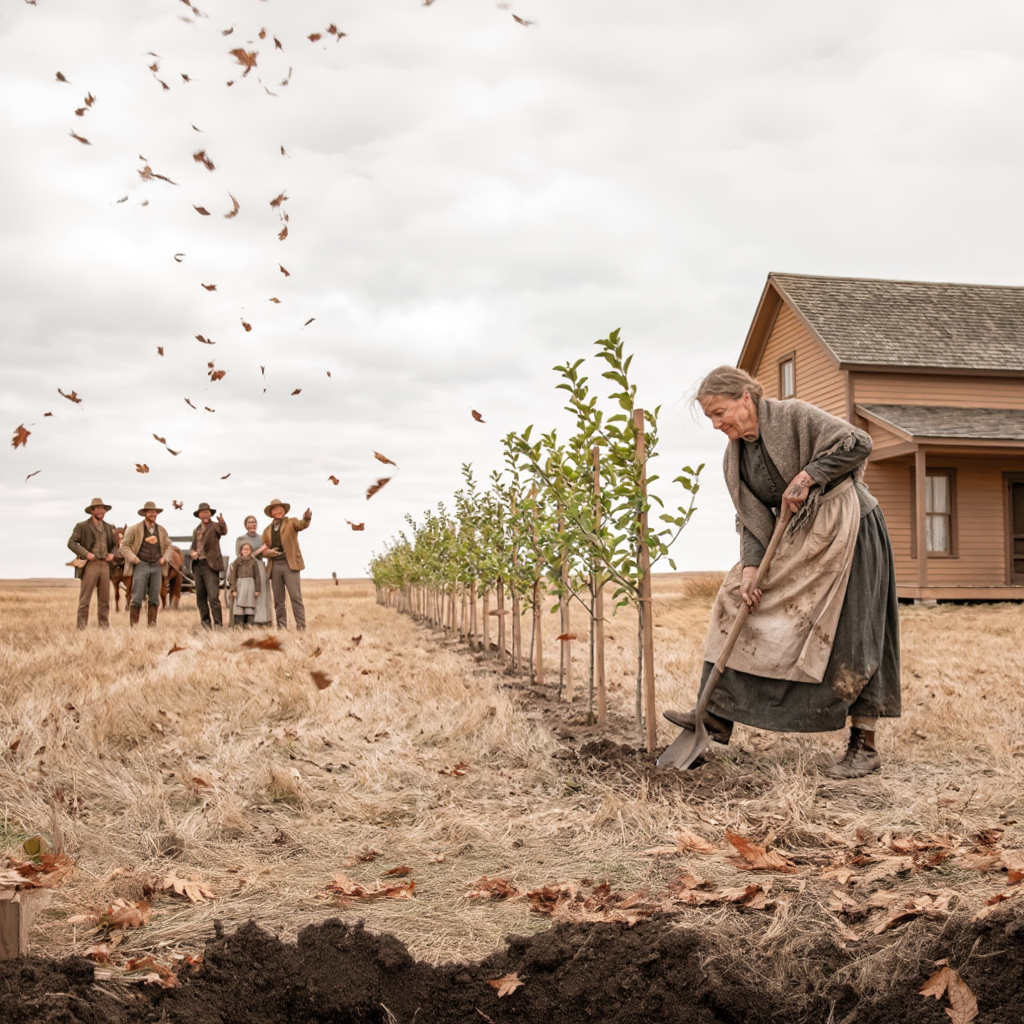
Days passed. The line of saplings grew longer. She planted them in a careful arc around the western and northern edges of the farmhouse. Each one tied to a stake, spaced evenly.
The wind never let up. Leaves flew constantly. Her boots sank into dry grass and loose soil.
She watered them with buckets from the well, one by one.
At night, she wrapped herself in blankets and listened to the wind slam against the house.
Weeks turned into months.
Winter arrived early.
Snow dusted the prairie. The saplings stood bare but upright, thin silhouettes against the pale sky. Margaret checked each stake, tightening ropes.
Neighbors stopped watching. They assumed the trees would die.
But spring came.
Tiny buds appeared.
Margaret noticed them first—small green dots along brittle branches. She touched one gently, almost afraid it would vanish.
“They lived,” she whispered.
Summer followed. The saplings grew taller. Leaves thickened. The row became visible from a distance—a faint green barrier forming across the prairie.
Still, people doubted.
“They’re too thin.”
“Won’t stop anything.”
Margaret kept tending them.
By autumn, the trees had doubled in height. Their leaves turned golden, fluttering in the wind. The arc around the house became more defined.
She planted two more to fill a gap.
That was when the rumors began.
Travelers passed through, speaking of trouble to the west—dust storms, winds stronger than usual. Crops buried. Barns damaged.
Margaret listened quietly.
She walked the line of trees again, tightening ties, reinforcing stakes.
The sky darkened one afternoon in late October. Clouds rolled low and heavy. The wind shifted—deeper, harsher.
Margaret felt it immediately.
This wasn’t ordinary wind.
She stepped onto the porch. Dry leaves whipped across the yard, spinning violently. The horizon blurred with rising dust.
She hurried outside, checking the trees. Their thin trunks bent but held. The stakes creaked.
The storm arrived within minutes.
Wind slammed across the prairie, carrying dirt and debris. The sky turned brown-gray. Margaret struggled to reach the house, her shawl whipping wildly.
She slammed the door shut.
Inside, the farmhouse groaned.
Dust pushed against the windows. The wind roared like a freight train. Margaret pressed her back against the door, heart pounding.
Then she heard something different.
A muted rushing sound—like wind hitting something before reaching the house.
She moved to the window carefully.
Through the swirling dust, she saw the line of trees.
They bent dramatically, leaves ripping free, branches thrashing. But they stood. The wind struck them first, breaking its force. Behind them, the air around the house churned less violently.
The barrier worked.
Hours passed.
The storm intensified. Debris slammed into the trees—twigs, dirt, bits of grass. Some branches snapped. One stake loosened.
But the row held.
By nightfall, the wind finally weakened. Dust settled slowly. Silence returned.
Margaret stepped outside.
The prairie looked battered. Grass flattened. Soil scattered. But her house still stood untouched.
She walked to the trees.
Several leaned heavily, leaves stripped, but roots held firm. They had absorbed the storm’s fury.
Behind her, hoofbeats approached.
Neighbors rode up, faces wide with surprise.
“We thought your house would be gone,” one said.
Margaret touched a bent sapling gently. “They stopped it.”
The man stared at the row. “You planted these months ago.”
She nodded.
“They saved you.”
Margaret looked at the farmhouse, still standing solidly. “They did.”
The wind picked up softly again, but this time it felt different—less threatening, filtered.
The trees rustled quietly.
They had become her only protection.