
A Starving Widow With 9 Children Married a Stranger for Food — Then She Saw What He Truly Owned
The first winter after Thomas Hale died was the longest winter Margaret Hale had ever known.
It wasn’t just the cold.
It was the silence.
The kind that crept into a house once filled with laughter and settled into every corner like dust that refused to be swept away.
Nine children.
That’s what Thomas had left her with.
Nine small, hungry mouths.
And a farm that had already been failing long before grief settled over it.
Margaret stood at the edge of her field one gray morning, her shawl pulled tight around her shoulders. The ground was frozen solid, the crops long gone, the wind cutting through her like it had something personal against her.
Behind her, the house creaked.
Inside, her children waited.
Hungry.
Again.
She closed her eyes for a moment.
Then turned back.
There was no time for breaking.
By the third month of winter, Margaret had sold almost everything she could.
Her husband’s tools.
Her wedding ring.
Even the last of their livestock.
But money didn’t stretch the way she needed it to.
Not for nine children.
Not for a season that refused to end.
The townspeople helped when they could—but everyone was struggling. Food was scarce. Supplies were low.
Sympathy didn’t fill stomachs.
And Margaret had run out of options.
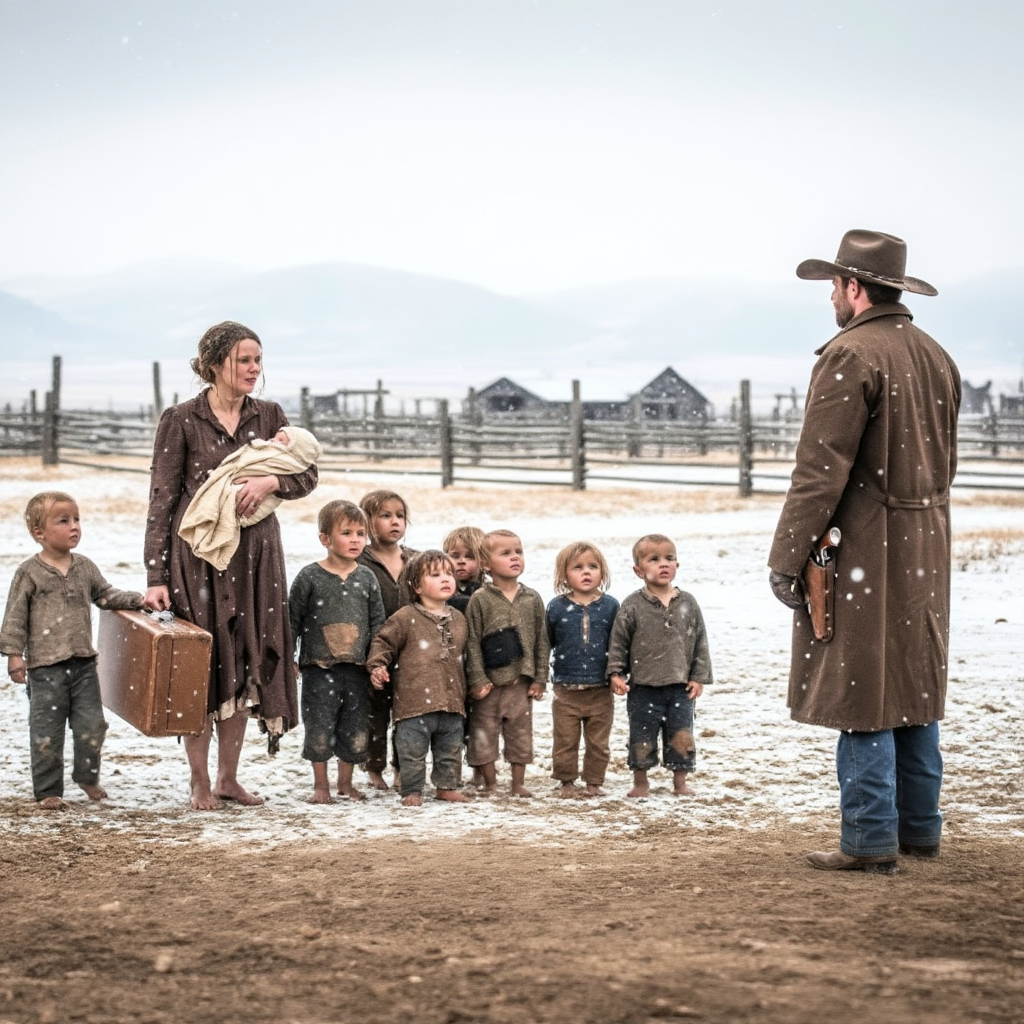
The offer came on a cold afternoon, carried in quietly by Mrs. Davenport, a woman who knew everything about everyone whether she meant to or not.
“There’s a man,” she said, standing awkwardly in the doorway. “Passing through. Not from around here.”
Margaret didn’t look up from the small pot of thin soup she was stirring.
“What kind of man?”
“Quiet,” Mrs. Davenport said. “Keeps to himself. But he’s… well-off, from what I hear.”
Margaret let out a tired breath. “And why are you telling me this?”
The older woman hesitated.
“He’s looking for a wife.”
That made Margaret stop.
Slowly, she turned.
“I’m not in a position to entertain jokes.”
“I’m not joking,” Mrs. Davenport said quickly. “He made it clear. He doesn’t want anything fancy. Just… someone willing to marry him. In exchange, he’ll provide. Food. Shelter. Stability.”
Margaret stared at her.
“That’s not a marriage,” she said quietly.
Mrs. Davenport didn’t disagree.
“No,” she admitted. “But it might keep your children alive.”
That night, Margaret didn’t sleep.
She sat by the dying fire, watching her children curled together under thin blankets.
Nine of them.
Each one carrying a piece of the life she had lost.
Each one depending on her to make impossible choices.
Marriage.
To a stranger.
Not for love.
Not for companionship.
But for survival.
The thought made her chest tighten.
But hunger was louder than pride.
And fear… fear was louder than both.
She met him the next day.
His name was Jonathan Reed.
He wasn’t what she expected.
No fine clothes. No polished boots. No air of wealth.
Just a tall, broad-shouldered man in a worn coat, his face weathered, his eyes steady but hard to read.
“You’re the widow,” he said simply.
Margaret straightened. “Margaret Hale.”
He nodded once.
“I hear you have children.”
“Nine.”
Something flickered in his expression—but it was gone too quickly to name.
“That’s… a lot.”
“They’re my responsibility,” she said firmly.
Jonathan studied her for a long moment.
“I won’t separate you from them,” he said.
Margaret blinked.
“You… wouldn’t?”
“No,” he replied. “If we do this, they come with you.”
A strange weight lifted from her chest.
She hadn’t realized how much she feared that answer.
They didn’t pretend.
There were no romantic words.
No illusions.
“This would be an arrangement,” Margaret said carefully.
Jonathan nodded. “I understand.”
“You provide food. Shelter. Safety.”
“Yes.”
“And in return…”
She couldn’t quite finish the sentence.
Jonathan did it for her.
“You become my wife.”
Silence stretched between them.
Then Margaret nodded once.
“Alright.”
They were married three days later.
A quiet ceremony.
No celebration.
Just signatures, witnesses, and a shared understanding that this wasn’t about happiness.
It was about survival.
The journey to Jonathan’s home took two days.
Margaret and her children rode in a worn wagon, the cold biting at their faces as the landscape changed from familiar fields to something wilder.
Forests grew thicker.
The roads less certain.
By the time they arrived, the sun was setting behind a line of distant hills.
Margaret braced herself.
She expected something modest.
A small house, perhaps.
Enough to survive.
Nothing more.
But what she saw…
Made her stop in her tracks.
It wasn’t a house.
It was land.
Acres of it.
Rolling fields, untouched and vast. A sturdy barn stood to one side, well-built and solid. A large farmhouse sat at the center, its structure strong, its windows glowing faintly with warmth.
Margaret stared.
“You… own all this?”
Jonathan stepped beside her, his expression unreadable.
“Yes.”
She turned to him, disbelief clear in her eyes.
“Why would you need… an arrangement like this?”
Jonathan didn’t answer immediately.
Instead, he looked out over the land.
“I can build things,” he said finally. “I can grow crops. I can survive on my own.”
Margaret waited.
“But I can’t build a family,” he added quietly.
The words settled heavily between them.
Life changed quickly after that.
There was food.
Real food.
Warm meals that filled empty stomachs and brought color back to her children’s faces.
There were beds.
Soft ones.
A roof that didn’t leak.
Clothes that weren’t patched beyond recognition.
For the first time in months, Margaret felt something unfamiliar.
Relief.
But something else began to surface too.
Questions.
Jonathan worked tirelessly, but he kept to himself. He spoke little, moved quietly, and rarely lingered in shared spaces longer than necessary.
He provided everything he promised.
But he remained… distant.
One evening, as Margaret washed dishes by the window, she watched him outside, repairing a section of fence in the fading light.
“He’s kind,” her oldest daughter said softly.
Margaret glanced at her. “He is.”
“But he looks lonely.”
Margaret didn’t respond.
Because she had noticed it too.
The truth came slowly.
In pieces.
Stories shared not by Jonathan—but by the land itself.
The way everything was built with care.
The way tools were maintained meticulously.
The way every corner of the property felt… intentional.
This wasn’t just wealth.
It was work.
Years of it.
And behind it…
Was a man who had done it all alone.
One night, Margaret found him sitting on the porch, staring out into the dark.
“You could’ve told me,” she said, stepping beside him.
“Told you what?”
“That you weren’t just offering survival.”
Jonathan let out a quiet breath.
“I didn’t think it mattered.”
“It does,” she said.
He shook his head slightly. “You didn’t come here for that.”
“No,” Margaret admitted. “I didn’t.”
Silence fell.
Then she added, “But that doesn’t mean it can’t become something more.”
Jonathan looked at her then—really looked at her.
As if seeing her for the first time.
Change didn’t happen all at once.
But it happened.
In small moments.
Shared meals.
Quiet conversations.
Laughter—hesitant at first, then easier.
The children warmed to him quickly. They followed him around the farm, asking questions, eager to learn.
And Jonathan…
Jonathan answered.
Patiently.
Gently.
Like a man discovering something he never thought he’d have.
Months passed.
Spring returned.
And with it, something new took root.
Not just crops in the field.
But something inside the house.
Inside the people living in it.
One afternoon, as Margaret stood in the doorway watching her children play in the yard, Jonathan joined her.
“You ever regret it?” he asked.
She looked at him.
“Marrying a stranger?”
He nodded.
Margaret thought for a moment.
Then smiled faintly.
“I married a stranger for food,” she said. “But I didn’t stay for that.”
Jonathan’s expression softened.
“Then why did you stay?”
Margaret reached out, taking his hand—a simple gesture, but one that meant everything.
“Because I finally saw what you truly owned,” she said.
He frowned slightly. “The land?”
She shook her head.
“No.”
Her eyes met his.
“You built a place where people can belong,” she said quietly. “And that’s worth more than anything else.”
Years later, people would talk about the Hale-Reed farm.
Not as a story of desperation.
But as something else.
A place where a broken beginning turned into something whole.
Where a stranger became a husband.
A father.
A home.
Because sometimes—
The things we think we’re trading for survival…
Turn out to be the very things that teach us how to live.
A Starving Widow With 9 Children Married a Stranger for Food — Part 2
By the time summer settled over the Hale-Reed farm, the land no longer felt like it belonged to one man.
It belonged to a family.
Laughter echoed where silence once lived. The barn doors were rarely closed, the fields always moving with purpose. Margaret’s children—once thin and quiet from hunger—now ran barefoot through the grass, their voices bright, their energy endless.
And Jonathan Reed… was no longer just a stranger.
But peace, Margaret would soon learn, has a way of being tested.
It began with a letter.
Delivered by a rider who didn’t stay long enough for questions.
Jonathan found it tucked between the wooden slats of the front gate one early morning. No name on the outside. No mark to say where it came from.
Just his.
He read it once.
Then again.
His jaw tightened slightly before he folded it and slipped it into his coat.
Margaret noticed.
She didn’t ask right away.
But she didn’t forget.
Three days later, the first sign appeared.
A pair of men on horseback, watching from the far edge of the property.
Not approaching.
Not calling out.
Just watching.
Margaret stood beside Jonathan on the porch, her youngest child in her arms.
“Do you know them?” she asked quietly.
Jonathan didn’t answer immediately.
But his eyes didn’t leave the horizon.
“Yes,” he said finally.
Her grip tightened slightly. “From where?”
“From before.”
That was all he offered.
And somehow, it was enough to make the air feel heavier.
That night, after the children had fallen asleep, Margaret found him in the barn.
He was working later than usual, checking tools that didn’t need checking, tightening ropes that were already secure.
“You’re not telling me something,” she said gently.
Jonathan paused.
Then exhaled slowly.
“I used to be part of something,” he said.
Margaret leaned against the wooden beam, waiting.
“A group of men,” he continued. “We built things. Moved goods. Took jobs wherever they came from.”
“That doesn’t sound like something to hide.”
“It wasn’t always honest work.”
The words landed quietly—but heavily.
Margaret didn’t step back.
She didn’t judge.
She simply listened.
“They want something from you,” she said.
Jonathan nodded once.
“What?”
“The land.”
Margaret’s breath caught. “Why?”
“Because they know what it’s worth,” he replied. “And they think I owe them.”
The truth unfolded slowly.
Jonathan hadn’t just built the farm from hard work.
He had walked away from something dangerous.
A past tied to men who didn’t let go easily.
“I left with nothing,” he said. “Started over. Built this piece by piece.”
“And now they want it back?”
“They want control,” Jonathan corrected. “This land… it’s more than property to them. It’s leverage.”
Margaret looked around the barn—the beams, the tools, the life that had been rebuilt from nothing.
“They can’t have it,” she said firmly.
Jonathan met her eyes.
“I know.”
The men returned the next day.
This time, they didn’t stay at the edge.
They rode up to the house.
Three of them.
Well-dressed, confident, carrying themselves like men who expected to be obeyed.
The one in front dismounted slowly, brushing dust from his coat.
“Jonathan,” he called out, his voice smooth but sharp underneath. “It’s been a long time.”
Jonathan stepped forward, his posture steady.
“Not long enough,” he replied.
The man smiled faintly. “Still the same.”
His gaze shifted briefly to Margaret and the children standing behind the door.
“So this is why you disappeared,” he said. “You built yourself a quiet little life.”
“This isn’t your concern,” Jonathan said.
The man ignored that.
“You owe us,” he said instead. “You don’t just walk away from men like us without settling your debts.”
“I don’t owe you anything,” Jonathan replied.
The smile faded slightly.
“That’s not how we see it.”
The tension was immediate.
Palpable.
Margaret felt it in the way the air seemed to still, in the way her children clung closer to her.
“What do you want?” Jonathan asked.
The man spread his arms slightly.
“Partnership,” he said. “We take a share of the land. Use it the way we see fit. You keep your house, your… family. Everyone wins.”
“And if I refuse?”
The man’s expression hardened.
“Then you lose everything.”
Silence followed.
Heavy.
Unforgiving.
Margaret stepped forward then—before she could second-guess herself.
“This isn’t yours to take,” she said, her voice steady despite the fear in her chest.
The man looked at her, amused.
“And you are?”
“His wife.”
Something flickered in his eyes.
“Ah,” he said. “The arrangement.”
Margaret didn’t flinch.
“This land feeds eleven people,” she said. “Children who have already lost enough. You don’t get to walk in and decide their future.”
The man studied her for a long moment.
Then he chuckled softly.
“You’ve grown bold, Jonathan,” he said. “Or maybe you’ve just grown soft.”
Jonathan didn’t react.
But Margaret felt the shift beside her.
Subtle.
Controlled.
Dangerous.
“You have three days,” the man said finally. “After that, we stop asking.”
He turned, mounted his horse, and rode off with the others.
Dust lingered in the air long after they were gone.
That night, no one slept easily.
Margaret sat at the table, her hands wrapped around a cup she hadn’t touched.
“What are we going to do?” she asked.
Jonathan stood by the window, staring into the dark.
“They won’t stop,” he said. “Not unless I make them.”
“And how do you do that?”
He didn’t answer right away.
Because the answer wasn’t simple.
And it wasn’t easy.
The next morning, something changed.
Not just in Jonathan.
In all of them.
Margaret gathered the children, her voice calm but firm.
“This is our home,” she said. “And we protect it. Together.”
The older ones understood immediately.
The younger ones followed their lead.
And for the first time, this wasn’t just Jonathan’s fight.
It was theirs.
Preparation began.
Not for war—
But for defense.
Jonathan reinforced the barn doors, secured the perimeter, and mapped out every inch of the land like a man preparing for something he hoped wouldn’t come.
Margaret organized supplies, kept the children close, and made sure fear didn’t take root where strength was needed.
“You’re not alone in this,” she told him one evening.
Jonathan looked at her.
“I know,” he said quietly.
And for the first time—
He truly meant it.
On the third day, they returned.
But this time—
They weren’t the only ones ready.
What followed wasn’t a battle in the way stories often tell it.
There was no chaos.
No reckless violence.
Only resolve.
Jonathan stood his ground.
Margaret stood beside him.
And behind them—
Nine children.
A family.
A reason that couldn’t be taken.
In the end, the men left.
Not because they were defeated.
But because they understood something they hadn’t before.
This wasn’t just land anymore.
It was something harder to break.
Weeks passed.
Then months.
And slowly—
The threat faded.
One evening, as the sun dipped low over the fields, Jonathan sat beside Margaret on the porch.
“It could’ve gone differently,” he said.
Margaret nodded. “But it didn’t.”
He looked out at the land—the barn, the house, the children running in the fading light.
“You married me for food,” he said.
Margaret smiled softly.
“I stayed for everything else.”
Jonathan took her hand, his grip steady, certain.
And this time—
There was no hesitation.
Because what he truly owned…
Was never just the land.
It was the life he built.
The family he chose.
And the love that turned an arrangement into something real.
Something lasting.
Something no one could ever take away.